
Emergency Well Pump Repair in Lancaster, TX
Folks in Lancaster know that getting good, reliable water from the ground ain’t always a walk in the park. This part of Dallas County sits right on the edge of some pretty tough geology, meaning well drilling and pump maintenance come with their own set of challenges. We’ve got varying water table depths and hard rock formations that put extra strain on your system, so you can’t just slap any old pump in and expect it to last.
Our groundwater largely comes from the Trinity Group Aquifer, specifically the Paluxy and Glen Rose formations, which run deep under this area. While it’s a generally reliable source, these aquifers can hold water that’s high in minerals or fine silts, especially after heavy rains or prolonged drought when the water levels shift. Understanding these local conditions is key to a pump system that actually works.
That’s why I always tell my customers: a cheap pump in Lancaster is usually a short-lived pump. The stresses from pumping against hard rock, dealing with potential sediment, and the sheer depth required for a consistent water supply will chew up lesser-quality equipment in no time. You end up paying more in the long run for repeated service calls and replacements than you would investing in a robust, commercial-grade pump upfront.
Fast Local Service & Diagnostics
Calls are routed to a licensed local well professional.
Well Pump Repair in
Lancaster
Lancaster & Dallas County Well Stats
In Dallas County, most domestic wells range from 200 to 500 feet deep, though some can reach 800+ feet to hit reliable water-bearing zones in the Trinity Group. The average age of wells we service is around 25-30 years, often with original steel casing. Sediment intrusion is a common issue, along with declining static water levels in some areas, which puts extra strain on submersible pumps.
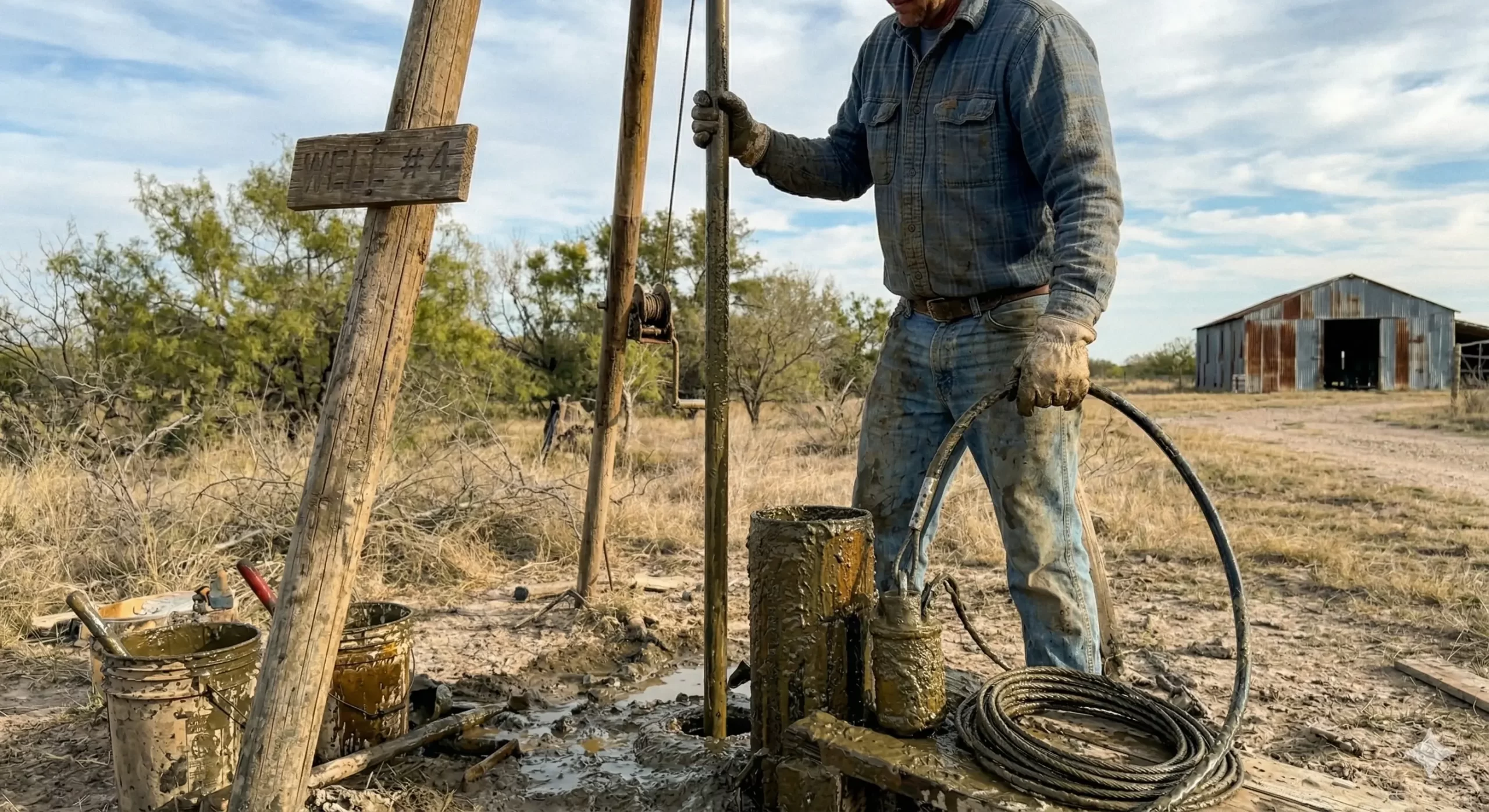
Pulling a well pump here in Lancaster isn’t like pulling one out of soft sand. We’re often dealing with wells drilled through layers of hard Austin Chalk and Eagle Ford Shale. This solid rock means the well casing might be set deep, and if anything’s hung up, it takes significant power and specialized techniques to get that pump out without damaging the well itself. Access can also be tricky on some of these older, more rural properties, requiring careful rig maneuvering.
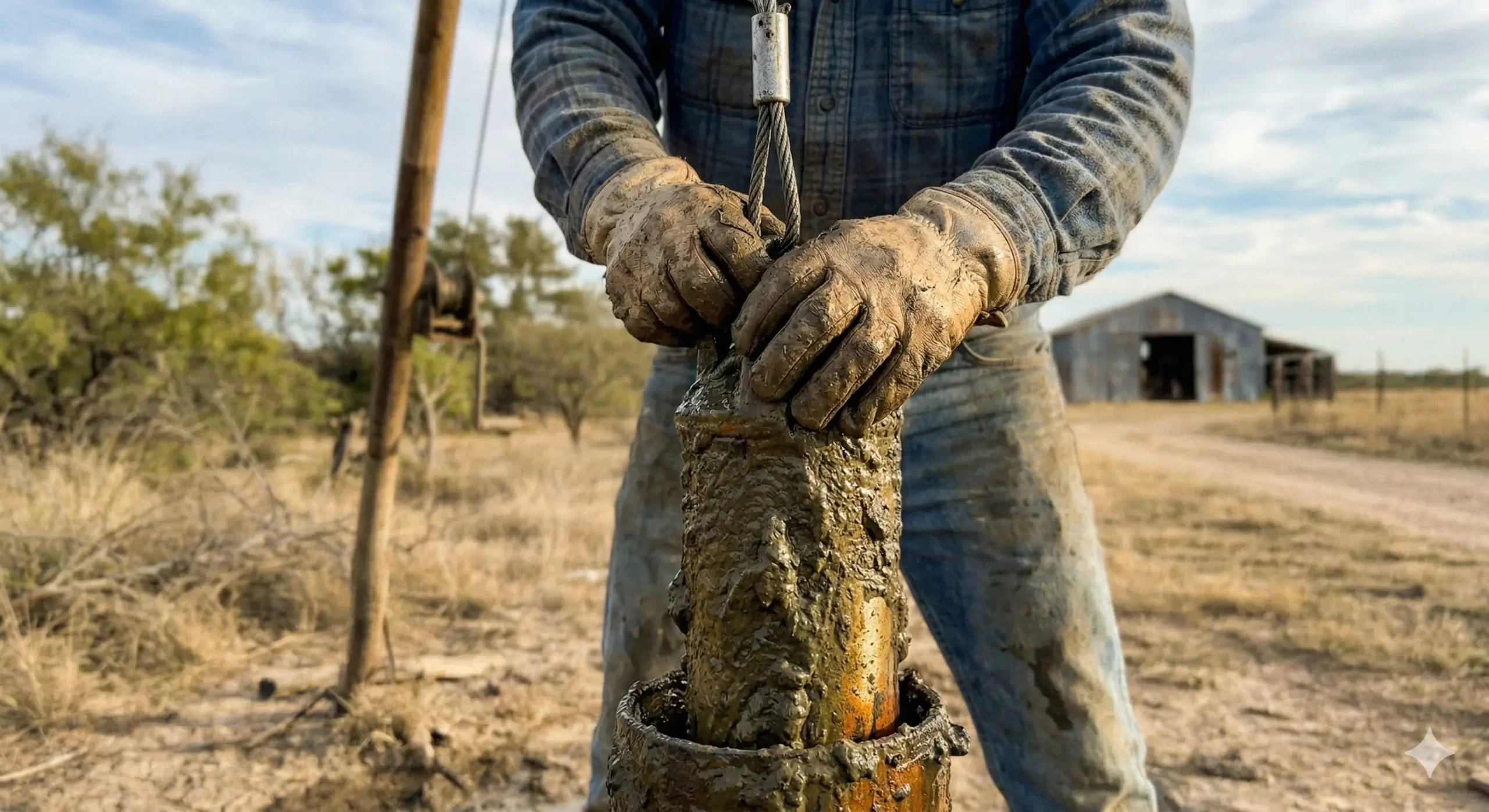
To get a pump out of a typical Lancaster well, we need heavy-duty equipment. That means a dedicated pump hoist rig, not just a pickup truck with a winch. We also carry specialized casing wrenches, safety clamps, and a full suite of diagnostic tools, including downhole cameras, to identify the problem accurately before we even start pulling. All this specialized gear and the expertise to operate it safely contributes to the cost, but it’s what ensures the job is done right.
Spring Well Maintenance in Texas
Heavy spring rains can cause surface runoff to breach well caps. We strongly recommend testing your water for coliform bacteria and inspecting the sanitary seal.
Save $500+ on Replacements
Via the TX Energy Co-op VFD Upgrade Program
73°F in Lancaster
Local Aquifers & Geology
The primary groundwater sources in Lancaster include the The Trinity Group Aquifer is the primary source of groundwater for most domestic wells in the Lancaster area. This aquifer system is composed of several formations, including the Paluxy, Glen Rose, and Travis Peak, consisting mainly of sandstones and shales. It’s known for generally producing good quality water, though mineral content like hardness and occasional iron can be present. Water levels can fluctuate depending on rainfall and regional pumping demands.. Drilling through the local Lancaster and much of Dallas County are characterized by Blackland Prairie soils. This means we’re dealing with deep, fertile clays (specifically Vertisols) that swell when wet and crack when dry. Beneath these clays, you quickly encounter the hard limestone of the Austin Chalk and the shales of the Eagle Ford formation. This hard rock makes drilling tough and can sometimes contribute to sediment in older, unlined portions of wells or if casings are compromised. means that average well depths range from 300 ft – 600 ft.
Due to these geological factors, local homeowners frequently struggle with Sediment & Sand Intrusion. The geology here, especially where wells draw from sandy lenses within the Trinity Group or encounter older, corroded casing, leads to fine sand and silt getting into the well. This acts like sandpaper on pump impellers and motors, significantly shortening their lifespan..
Drilling Depth Comparison
Deeper wells require heavy-duty crane hoists for pump extraction.
Climate & Water Quality
Pump systems in the Lancaster area face severe environmental stressors. The most significant threat is The severe climate swings in Texas are brutal on well equipment. Prolonged droughts lower the water table, forcing pumps to work harder and sometimes suck in air or increased sediment. Conversely, heavy rains can cause shifts in surface soils, potentially stressing well casing or introducing surface contaminants. Then there’s the ever-present threat of lightning during our violent summer storms, which frequently fries pump motors, control boxes, and wiring, necessitating full system replacements.
Additionally, the raw groundwater often presents issues with Hardness (calcium & magnesium) and moderate iron content are the most common water quality issues we see from wells around Lancaster. The calcium buildup can scale up submersible pumps and piping over time, reducing efficiency. Iron can stain fixtures and give water an off-taste. We also occasionally see hydrogen sulfide (rotten egg smell) and, as mentioned, fine sand..
Regional Groundwater Advisory
Known primary contaminant threat to submersible pumps and pipes in this area:
Common Area Systems
VFD Upgrade Savings
Constant Pressure vs StandardReplacing a standard single-speed pump with a Variable Frequency Drive (VFD) eliminates hard starts and drastically reduces energy draw in Texas.
Compliance & Local Permits
Dallas County Level: In Dallas County, there is no active local Groundwater Conservation District (GCD) with specific permitting requirements for domestic well drilling or groundwater withdrawal, unlike many other parts of Texas. Instead, the Texas Department of Licensing & Regulation (TDLR) sets the statewide standards for well drilling, pump installation, and plugging. However, while groundwater withdrawal itself isn’t locally regulated by a GCD, you’ll still need to check with the City of Lancaster or Dallas County Planning & Zoning for any necessary permits related to construction (e.g., electrical permits for pump installation, or if new construction involving a well is planned) and ensure your well location meets local setback requirements from property lines, septic systems, and potential contamination sources.
Top Pump Brands in Texas
Most frequently installed hardware based on local geology (2026 data).
- Verify power supply & electrical connections at control box & pump.
- Check pressure switch operation, cut-in/cut-out pressures, and associated piping.
- Measure pump amp draw & voltage at the control box and wellhead.
- Test pump motor windings for shorts, opens, or grounds.
- Conduct downhole video inspection for casing integrity, sediment levels, and pump condition.
- Check pressure tank air charge, bladder integrity, and overall system pressure.
Premium Well Pump Brands We Service
Our licensed technicians in Lancaster are certified to repair, replace, and install high-quality groundwater equipment from industry-leading manufacturers, including:
- No water at all, or only a trickle.
- Water coming out in spurts, sputtering air.
- Pump runs continuously without shutting off, or cycles on & off frequently.
- Dirty, sandy, or cloudy water suddenly appears.
- Unusual noises coming from the wellhead or pressure tank area.
- Higher than normal electric bills, indicating an inefficient or failing pump.
Lancaster Real Estate Well Regulations
Local Dispatch & Response Times
Live Dispatch: Texas
Updated Just Now⚠️ High demand. Call now to secure the next available technician.
- Typically within 24-48 hours for complete loss of water, often sooner if schedule allows.
- Priority given to homes without alternative water sources, especially during extreme weather.
- On-call technicians available for initial troubleshooting advice over the phone.
- Factors like severe weather (ice, flooding) or widespread power outages can extend response times.
- Always aim to get a diagnostic crew on site as quickly as possible to assess the situation.
⚠️ Dallas County & State Regulatory Warning: Abandoned Wells
Groundwater Threat Level
Current aquifer and mineral impact on pumps in Lancaster.
Dropping water tables cause pumps to suck air and overheat.
Hard water calcifies pump impellers, reducing lifespan.
The Cost of Ignoring Symptoms
Fixing a short-cycling pump early saves thousands in Lancaster.
Data reflects average well contractor estimates in Lancaster.
Pump Lifespan Estimator
Select household size in Lancaster to see strain impact.
Local Lancaster
Well Pros
Fast Local Service & Diagnostics
Calls are routed to a licensed local well professional.
Septic System Services in Lancaster, TX
Do you have a septic tank on your property? Proper maintenance is critical to protecting your well water quality.
Lancaster Homeowner Feedback
“Had ’em out when my old pump died. Real quick, got me water same day. Good folk.”

Local Homeowner
✓ Verified TX
“My well pump was acting up something fierce, constant on and off cycles, driving me nuts and costing a fortune in electricity. Figured it was the pressure tank, but the fella who came out, he really knew his stuff. Turned out my pressure switch was cloged up with some sediment, and the bladder in the tank was shot, but the pump itself was still good. He fixed both, cleaned out the lines, and even adjusted the pressure for better flow. Now my water pressure is strong and steady, and my electric bill should go back down. Was a tricky problem to figger out, but they got it done right.”

Local Homeowner
✓ Verified TX
“Lost all water Christmas Eve! Panic set in. Called these guys, and they had a tech out first thing Christmas morning. Didn’t expect that. He worked tirelessly and got us back up and running. Lifesavers, absolutely amazing service when we needed it most.”

Local Homeowner
✓ Verified TX
Expert Lancaster Well System FAQ
Why do I keep getting sand in my water from my well in Lancaster, even after having the pump replaced?
This is a common and frustrating issue in our area, especially drawing from the Trinity Aquifer. Even a new pump won’t solve a sand problem if the underlying cause isn’t addressed. It could be several things: your well casing might be corroded or damaged in an older well, allowing formation sand to enter. It could also be that your pump is set too deep or too shallow, or it’s simply oversized for the well’s recovery rate, causing it to suck in sand from the bottom or ‘draw down’ the water level too quickly and create turbulence. We often recommend a downhole video inspection to accurately diagnose the source of the sand. Sometimes, simple adjustments like raising the pump or installing a sediment filter or sand separator can help, but in severe cases, the well itself might need rehabilitation or even a new well might be the only long-term solution. Never ignore sand; it will destroy pumps and fixtures.
My submersible pump keeps tripping the breaker. Is it always a bad pump, or could it be something else?
While a tripping breaker often points to a failing pump motor drawing excessive amps, it’s not the only culprit and definitely worth a thorough diagnosis before pulling the pump. In Lancaster, with our intense weather, we frequently see issues with the control box (start capacitor or relay failure), damaged wiring between the control box and the pump (especially if it’s been gnawed by rodents or nicked during installation), or even a short in the submersible wire within the well itself due to insulation breakdown or abrasion against the casing. Sometimes, a faulty pressure switch, a waterlogged pressure tank, or even an issue with your home’s main electrical panel could cause a breaker to trip. We’d start by testing the amperage and resistance at the control box and comparing it to manufacturer specs to pinpoint the exact electrical fault.
How often should I have my well and pump system inspected in the Lancaster area, and what does it cover?
Given the demanding conditions here in Lancaster, I recommend a professional well and pump system inspection at least every 3-5 years, or annually if you’re experiencing any minor issues or have an older system. A comprehensive inspection covers several critical areas: we’ll check your pump’s amperage and voltage, assess the pressure tank’s air charge and bladder integrity, inspect the pressure switch and electrical components, test the water quality (especially for common issues like hardness, iron, and bacteria), verify the wellhead integrity and cap seal, and measure static water levels. We’ll also listen for unusual noises and evaluate the overall efficiency and performance of your system. This proactive approach can catch small problems before they become costly, catastrophic failures, saving you money and preventing unexpected water loss.
What are the common signs of a failing pressure tank, and how is it related to my well pump?
Your pressure tank is like the lungs of your well system, and when it starts to fail, it puts a lot of strain on your pump. The most common signs of a failing pressure tank include your pump cycling on and off very frequently (short-cycling), water pressure fluctuations at your faucets, or hearing water sloshing inside the tank. In Lancaster, where pumps often run deep, a failing tank means your pump is working much harder than it should, leading to premature wear and tear or even burnout. The tank’s primary role is to provide a reserve of pressurized water and to cushion the pump’s starts and stops. If the internal bladder ruptures or the air charge is lost, the tank can’t perform these functions, forcing the pump to run constantly to maintain pressure, drastically shortening its life. We’ll check the air pressure and ensure the bladder is intact during any service call.
Lancaster Groundwater Expert AI
What are the specific groundwater regulations, average well depths, and the local conservation district for Lancaster, Dallas County?
Groundwater Regulations and Well Information for Residential Wells in Lancaster, Dallas County, TX (2026)
As a Senior Hydrogeologist and Local Groundwater Regulatory Expert for Texas, I can provide you with specific information regarding residential water wells in Lancaster, Dallas County, TX, for the current year, 2026.
1. Groundwater Regulatory Framework for Lancaster, Dallas County
It is crucial to understand that Dallas County, including Lancaster, is NOT currently located within any active Groundwater Conservation District (GCD). This significantly impacts the regulatory landscape for private residential water wells.
Without a local GCD, the primary regulatory authority for the drilling, construction, and registration of private residential water wells falls under the state-level jurisdiction of the Texas Department of Licensing and Regulation (TDLR). The Texas Commission on Environmental Quality (TCEQ) oversees water quality standards, especially for public water systems, and plays a role in addressing contamination issues for private wells if they arise.
Here are the key aspects of regulation:
- TDLR Licensing and Construction Standards: All water well drillers and pump installers operating in Texas must be licensed by the TDLR. They are required to adhere to the well construction standards outlined in the Texas Occupations Code Chapter 1902 (Water Well Drillers and Pump Installers Act) and the associated administrative rules, 16 Texas Administrative Code (TAC) Chapter 76. These rules cover aspects like casing, cementing, wellhead completion, and proper sealing to prevent contamination.
- Well Registration: By state law, every new or reconditioned water well must be registered with the TDLR. The licensed driller is responsible for submitting a "Well Report" (also known as a "Drillers Log") to the TDLR and the Texas Water Development Board (TWDB) within 90 days of well completion. This report includes vital information like well depth, casing details, and geological formations encountered.
- Setback Requirements: TDLR rules include specific setback requirements to protect well water quality from potential contamination sources. For instance, 16 TAC §76.100 (Location of Wells) mandates minimum distances from septic systems, property lines, feedlots, and other potential pollutants. For example:
- At least 50 feet from a septic tank or absorption field.
- At least 150 feet from a feedlot, animal waste disposal system, or other concentrated sources of contamination.
- No Local Permitting for Production/Spacing: Since there is no GCD in Dallas County, there are no local permits required for drilling a private residential well regarding groundwater production limits, well spacing, or specific well-use fees beyond the state-mandated well registration process through TDLR. However, it's always prudent to check with the City of Lancaster or Dallas County for any local building or development permits that might be required for the physical construction on your property.
2. Primary Aquifer Beneath Lancaster, Dallas County
The primary aquifer system underlying Lancaster and the broader Dallas County area is the Trinity Group Aquifer. This extensive aquifer system consists of several individual aquifers, including the Paluxy, Glen Rose, Hensell, and Travis Peak formations, which are part of the larger Trinity Aquifer. Water-bearing sands and limestones within these formations provide groundwater resources to the region.
3. Average Well Depths in Lancaster, Dallas County
Based on historical well logs and hydrogeological data for residential wells tapping the Trinity Group Aquifer in the Lancaster/Dallas County area, the average well depth for a reliable residential water supply is approximately 600 feet. Depths can realistically range from about 400 feet to 800 feet, depending on the specific geological conditions, the desired yield, and the target formation within the Trinity Group. Shallower wells might encounter limited water-bearing zones or perched water, which may not offer a consistent, long-term supply.
4. Local Groundwater Conservation District
As previously stated, there is NO Groundwater Conservation District (GCD) operating in Dallas County, including Lancaster. Therefore, there is no local GCD to consult for specific well permits, spacing rules, or production limitations for private residential wells.
5. Water Quality Considerations
While TDLR handles well construction, the quality of groundwater from private residential wells is not routinely monitored by state agencies. It is highly recommended that you have your well water tested regularly (at least annually) by a certified laboratory for common contaminants such as bacteria (coliforms), nitrates, and total dissolved solids (TDS), as well as any specific contaminants of local concern (e.g., arsenic, lead, sulfates) once the well is operational. The TCEQ provides guidelines for drinking water standards, which can be used for reference.
Official Resources and Further Information
- TDLR Water Well Driller and Pump Installer Program: For information on regulations, licensed drillers, and well reports.
https://www.tdlr.texas.gov/wwd/wwd.htm - TDLR Water Well Search Tool: To search for existing well reports in your area.
https://www.tdlr.texas.gov/Search/LicenseSearch (Select 'Water Well Driller/Pump Installer' as the program) - Texas Water Development Board (TWDB) Groundwater Information: For detailed aquifer descriptions and reports.
https://www.twdb.texas.gov/groundwater/index.asp - Texas Occupations Code Chapter 1902: The state law governing water well drillers and pump installers.
https://statutes.capitol.texas.gov/Docs/OC/htm/OC.1902.htm - 16 Texas Administrative Code Chapter 76: TDLR's rules for water well drillers and pump installers.
https://texreg.sos.state.tx.us/public/readtac$ext.ViewTAC?tac_view=4&ti=16&pt=4&ch=76 - TCEQ Drinking Water Standards: For guidance on water quality.
https://www.tceq.texas.gov/drinkingwater/
When considering a residential well, it is highly recommended to engage a TDLR-licensed water well driller who is familiar with the geology and regulatory requirements specific to Dallas County.
Fast Local Service & Diagnostics
Calls are routed to a licensed local well professional.
Blix
provides official
Emergency Well Pump Repair services for the
Lancaster
area.