
Emergency Well Pump Repair in Pharr, TX
Down here in Pharr, the struggle for good, reliable groundwater is a daily reality for many folks, especially outside city limits. We’re in the Lower Rio Grande Valley, and while it’s lush, getting water out of the ground reliably takes a specific kind of know-how. The heat, the soil, and the aquifer itself all present unique challenges to your well system.
Our primary water source comes from the shallow alluvial aquifers and parts of the Evangeline Aquifer. These aren’t your deep, hard-rock formations you see up north. We’re talking sand, gravel, clay, & silt. That means a higher chance of sand production and potential well collapse if not properly cased & developed, leading to a host of pump problems.
Because of these conditions – abrasive sand, high temperatures, and sometimes fluctuating water tables – putting in a cheap, under-spec’d pump here is just asking for trouble. They simply can’t handle the load and wear & tear. You’ll be replacing it in a fraction of the time, costing you more in the long run than investing in quality upfront.
Fast Local Service & Diagnostics
Calls are routed to a licensed local well professional.
Well Pump Repair in
Pharr
Pharr & Hidalgo County Well Stats
In Hidalgo County, there are thousands of private domestic & irrigation wells. Depths commonly range from 100 to 400 feet, though some irrigation wells can be deeper. Water quality varies, with many wells experiencing issues with total dissolved solids (TDS), hardness, and particularly, sand & sediment. Static water levels are generally good but can fluctuate with seasonal irrigation demands & drought conditions. The average flow rate for domestic wells is typically 5-15 GPM, while irrigation wells demand much higher capacities.
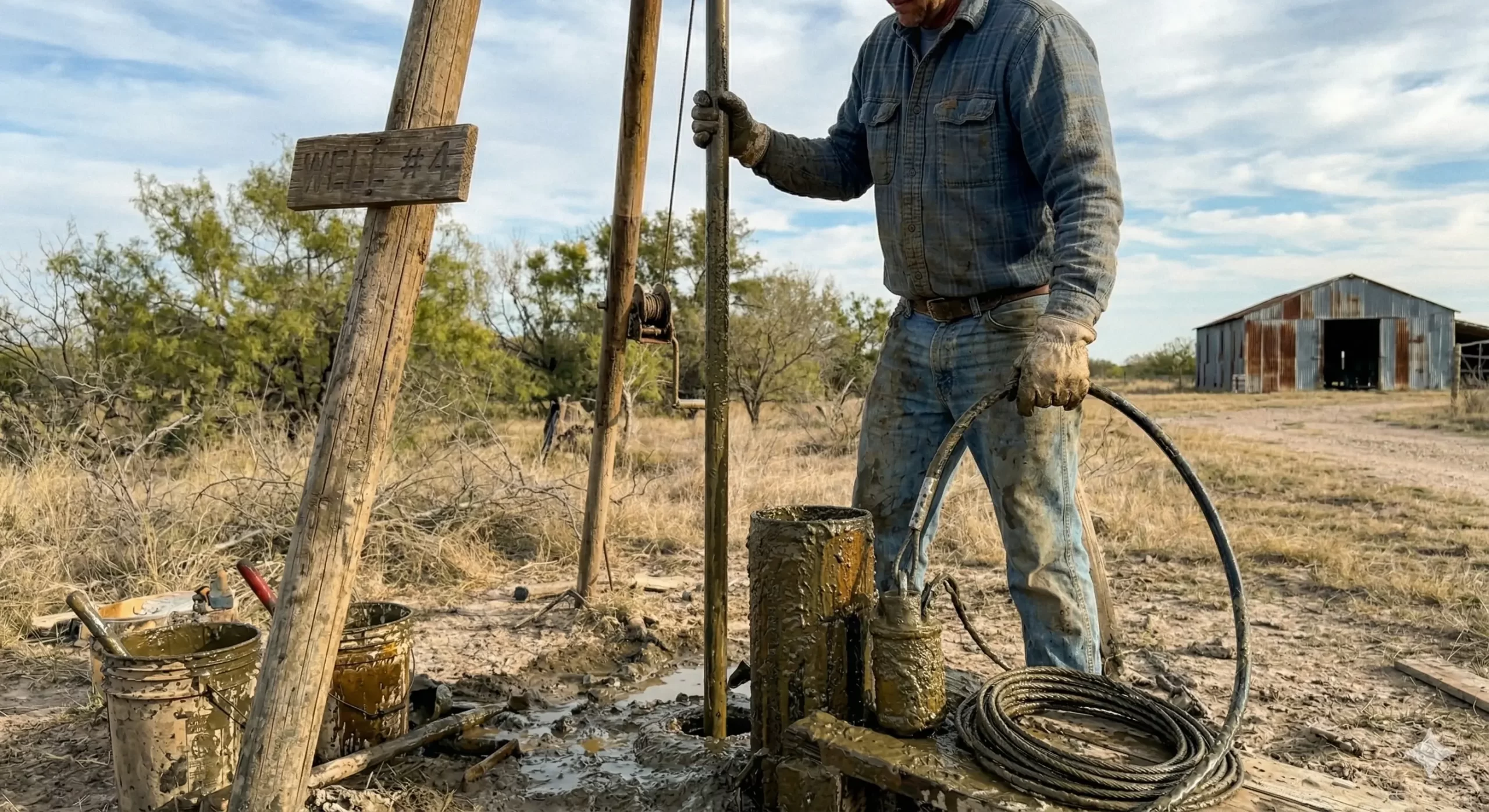
Pulling a pump here in Pharr isn’t usually about drilling through deep rock formations like in the Hill Country. Instead, our challenges come from different angles: dealing with wells that are often older, potentially caved-in from sand production, or having a pump stuck due to sediment buildup. Access can be tight on some rural properties, especially with irrigation systems or agricultural land around, requiring careful maneuvering of our service rig & equipment.
The equipment needed for a typical pump pull & replacement in the Valley includes a heavy-duty service rig, often a crane truck for deeper or larger pumps, specialized well fishing tools if a pump has broken off, and a full complement of safety gear. We also carry a variety of pump sizes, motors, electrical controls, & piping to ensure we can complete the job on the first trip, minimizing your downtime. It’s a significant investment in specialized machinery & skilled labor.
Spring Well Maintenance in Texas
Heavy spring rains can cause surface runoff to breach well caps. We strongly recommend testing your water for coliform bacteria and inspecting the sanitary seal.
Save $500+ on Replacements
Via the TX Energy Co-op VFD Upgrade Program
87°F in Pharr
Local Aquifers & Geology
The primary groundwater sources in Pharr include the The primary water-bearing units in the Pharr area are the alluvial sediments of the Rio Grande & the underlying Evangeline Aquifer. The Evangeline Aquifer here is predominantly composed of interbedded sands, silts, & clays, varying in thickness & permeability. This means the water is held in sand & gravel layers, making it highly susceptible to fine sand production, which acts like sandpaper on pump components. These aquifers are generally unconfined or semi-confined, leading to moderate yields but also vulnerability to surface contamination if wells aren’t properly sealed.. Drilling through the local The soil profile in Pharr & the surrounding Rio Grande Valley is characterized by deep, fertile, & often complex stratigraphy. We mainly deal with vertisols & mollisols, specifically clay loams, silty clay loams, & sandy clay loams. These soils are prone to expansion & contraction with moisture changes, which can impact well casing stability over time. Below the topsoil, you’ll encounter layers of silts, sands, & clays that are characteristic of the Quaternary alluvial deposits from the Rio Grande & the Beaumont Formation, which forms the upper part of our aquifer system. means that average well depths range from 150 ft – 400 ft.
Due to these geological factors, local homeowners frequently struggle with Without a doubt, the #1 mechanical failure reason for well pumps in Pharr is abrasive wear from sand production. Our sandy & silty aquifers mean pumps are constantly working in a corrosive, erosive environment. Impellers, diffusers, & even the pump housing itself get worn down prematurely, leading to a loss of pressure & flow, and eventually, total pump failure. Proper well development & screen selection are critical to mitigating this, but it remains the biggest challenge..
Drilling Depth Comparison
Deeper wells require heavy-duty crane hoists for pump extraction.
Climate & Water Quality
Pump systems in the Pharr area face severe environmental stressors. The most significant threat is The intense heat & high humidity of the Lower Rio Grande Valley are brutal on well equipment. High ambient temperatures stress electrical components – motors, control boxes, & wiring – leading to premature failure. Humidity promotes corrosion on exposed metal parts. While hard freezes are rare, when they do occur, inadequate winterization can lead to burst pipes & pressure tank damage. Furthermore, heavy rains & localized flooding can inundate well heads, potentially contaminating the well or damaging electrical connections if not properly sealed above grade.
Additionally, the raw groundwater often presents issues with Our biggest water quality issues here are hardness & significant sand content. The groundwater often contains high levels of dissolved minerals, leading to scale buildup in pipes, fixtures, & hot water heaters – a constant headache. But the more immediate & damaging issue for well pumps is the prevalence of fine sand & silt. This abrasive material acts like sandpaper on pump impellers & diffusers, drastically reducing their lifespan. Some wells also exhibit elevated iron levels, causing staining, & occasional sulfur, resulting in an unpleasant odor..
Regional Groundwater Advisory
Known primary contaminant threat to submersible pumps and pipes in this area:
Common Area Systems
VFD Upgrade Savings
Constant Pressure vs StandardReplacing a standard single-speed pump with a Variable Frequency Drive (VFD) eliminates hard starts and drastically reduces energy draw in Texas.
Compliance & Local Permits
Hidalgo County Level: While domestic & livestock wells are generally exempt from permitting by the Hidalgo County Groundwater Conservation District (HCGCD), it’s crucial to understand the rules. New irrigation, commercial, or public water supply wells definitely require a permit from the HCGCD. Even for exempt wells, there are strict drilling & completion standards, including proper casing & cementing, to prevent contamination & ensure water quality. It’s always best to check with the HCGCD before any new well drilling or major alteration to ensure compliance & avoid hefty fines. They are located in Edinburg.
Top Pump Brands in Texas
Most frequently installed hardware based on local geology (2026 data).
- Inspect electrical connections, control box components, & check voltage/amperage at the motor.
- Test pressure switch operation & inspect pressure tank for proper air charge & integrity.
- Measure pump motor insulation resistance (Megaohm test) to detect winding failures.
- Conduct a well drawdown test & measure static/pumping water levels to assess well productivity & pump performance.
- Visually inspect pump & pipe for signs of abrasion, corrosion, or mechanical damage upon retrieval.
- Check for sand production in the water line & recommend filtration or well development if excessive.
Premium Well Pump Brands We Service
Our licensed technicians in Pharr are certified to repair, replace, and install high-quality groundwater equipment from industry-leading manufacturers, including:
- No water coming from the tap or significantly reduced flow.
- Pump constantly cycling on & off, even with no water being used.
- Cloudy or sandy water, especially after the pump runs.
- Strange noises coming from the well head or pressure tank area.
- Spiking electricity bills without increased water usage.
- Pressure gauge fluctuating wildly or staying at zero.
Pharr Real Estate Well Regulations
Local Dispatch & Response Times
Live Dispatch: Texas
Updated Just Now⚠️ High demand. Call now to secure the next available technician.
- Rapid dispatch for critical failures like no water or irrigation pump down during peak season.
- Generally within 24 hours for most emergencies, often sooner depending on crew availability & location.
- Our service trucks are stocked with common parts to minimize return trips, especially for electrical issues or pressure tanks.
- We prioritize emergency calls for households with no water, particularly those with vulnerable residents.
- Local knowledge of Pharr & surrounding areas allows for efficient navigation & quick arrival.
⚠️ Hidalgo County & State Regulatory Warning: Abandoned Wells
Pump Lifespan Estimator
Select household size in Pharr to see strain impact.
The Cost of Ignoring Symptoms
Fixing a short-cycling pump early saves thousands in Pharr.
Data reflects average well contractor estimates in Pharr.
Groundwater Threat Level
Current aquifer and mineral impact on pumps in Pharr.
Dropping water tables cause pumps to suck air and overheat.
Hard water calcifies pump impellers, reducing lifespan.
Local Pharr
Well Pros
Fast Local Service & Diagnostics
Calls are routed to a licensed local well professional.
Septic System Services in Pharr, TX
Do you have a septic tank on your property? Proper maintenance is critical to protecting your well water quality.
Pharr Homeowner Feedback
“Had an old pump quit on me last Tuesday. Called these fellas, & they were out here by afternoon. Got me fixed up quick. Good honest work, and didn’t try to sell me what I didn’t need. Thanks again, Bobby.”

Local Homeowner
✓ Verified TX
“Our irrigation well started acting up something fierce – the pump was running, but no water was comin’ out, then it would spit & sputter, and finally just stopped altogether. Thought the well was dry! Called them up, and the technician, a real pro named Miguel, did a thorough diagnostic. Turns out, the old submersible pump had a cracked discharge head from years of sand abrasion, and the motor finally just seized. He explained how the sand literally grinds away at the plastic parts over time. They had a new Grundfos 4-inch pump on the truck. They pulled the old one, put the new one in, & had us back to full pressure in just a few hours. No more sputterring, just a steady stream. My corn crop was saved, thanks to their quick thinking & expertice. Highly recomend!”

Local Homeowner
✓ Verified TX
“Our water pump died on a Sunday morning, and with three kids, that’s an emergency! Called these guys, & they sent someone out within an hour. Professional, got straight to the problem, & had us back with water by lunch. Super grateful for their quick response & getting us out of a bind.”

Local Homeowner
✓ Verified TX
Expert Pharr Well System FAQ
My water well in Pharr is pumping a lot of sand. Is this normal, & what can be done about it?
No, consistently pumping a lot of sand is not normal & is a serious issue for your well system here in Pharr. While a new well might produce some sand during initial development, ongoing sand production means your well screen is either improperly sized, corroded, damaged, or the well has collapsed partially. This sand acts like sandpaper on your pump’s impellers & diffusers, drastically shortening its lifespan. We can perform a video inspection of the well to assess the screen’s condition & identify the source of the sand. Solutions can range from chemical well rehabilitation, installing a sand separator, re-screening the well, or in severe cases, drilling a new well with proper gravel pack & screen design tailored to our local sandy aquifers. Ignoring it will lead to costly pump replacements.
My well pump cycles on & off constantly, even when no water is being used. What causes this in our climate?
Constant cycling, often called ‘short cycling,’ is a common problem & usually indicates an issue with your pressure tank or a leak in your plumbing system. In the hot Pharr climate, this puts immense stress on your pump motor, leading to premature failure & higher electricity bills. The pressure tank’s air bladder might be ruptured, meaning it can no longer store pressurized water, causing the pump to turn on every time there’s a slight pressure drop. Alternatively, a leaky toilet, a dripping faucet, or an underground pipe leak could be slowly letting water out, triggering the pump. We’d start by checking the pressure tank’s air charge & integrity, then systematically check your plumbing for leaks, both above & below ground. Addressing this promptly will save your pump & your wallet.
I’m looking to drill a new domestic well on my rural property near Pharr. Do I need a permit, & what should I consider regarding local water availability?
For domestic & livestock wells on properties less than 10 acres, you typically do not need a drilling permit from the Hidalgo County Groundwater Conservation District (HCGCD). However, you must register the well with the Texas Department of Licensing & Regulation (TDLR) after it’s drilled, & the well must meet all state construction standards for casing & grouting to prevent contamination. When considering local water availability, understand that while our aquifers are generally productive, yields can vary significantly even over short distances due to the interbedded nature of sand & clay layers. It’s crucial to hire a licensed well driller familiar with the Pharr area who can assess the hydrogeology & ensure the well is properly sited & constructed for optimal yield & water quality. They’ll know the typical depths & expected water-bearing zones.
How do the frequent power outages & fluctuations in Pharr impact my submersible well pump, & what can I do to protect it?
Frequent power outages, brownouts, or voltage fluctuations are particularly damaging to submersible well pumps in our area. When power is lost & then restored, or if the voltage drops too low, the pump motor can experience severe stress, leading to overheating, winding damage, or premature failure. This is especially true for older motors or those without adequate protection. To protect your investment, I highly recommend installing a motor protection device like a Franklin Electric SubMonitor or a similar voltage & amperage protector. These devices monitor the electrical supply & will shut down the pump if conditions are unsafe, automatically restarting it when stable power returns. A surge protector for the control box is also a good idea. This small investment can save you thousands in pump replacement costs down the line.
Pharr Groundwater Expert AI
What are the specific groundwater regulations, average well depths, and the local conservation district for Pharr, Hidalgo County?
Groundwater Regulations and Information for Residential Water Wells in Pharr, Hidalgo County, TX (2026)
As a Senior Hydrogeologist and Local Groundwater Regulatory Expert for Texas, I can provide you with the specific information regarding residential water wells in Pharr, Hidalgo County, based on current regulations and historical data.
1. Local Groundwater Conservation District (GCD)
The local groundwater regulatory authority for Pharr, Hidalgo County, is the Hidalgo County Underground Water Conservation District (HCUWCD). Established under the provisions of Chapter 36 of the Texas Water Code, the HCUWCD is responsible for conserving, preserving, protecting, and recharging groundwater within its jurisdiction.
- Official Website: Hidalgo County Underground Water Conservation District
2. Specific Groundwater Regulations
Residential water wells in Pharr are subject to both statewide regulations and specific rules enacted by the HCUWCD:
State Regulations (Texas Department of Licensing and Regulation - TDLR)
- Licensed Drillers Required: All water wells in Texas, including residential wells, must be drilled, cased, and plugged by a driller licensed by the Texas Department of Licensing and Regulation (TDLR).
- Construction Standards: Wells must be constructed in accordance with the minimum state standards outlined in 16 Texas Administrative Code Chapter 76, Water Well Drillers and Pump Installers. These standards cover aspects such as casing materials, cementing, wellhead completion, and prevention of contamination.
- Well Registration: New wells must be registered with the TDLR within 30 days of completion.
- Plugging Requirements: Abandoned wells must be properly plugged by a licensed driller to prevent contamination of the aquifer and eliminate safety hazards, also in accordance with TDLR rules.
- Relevant State Codes:
- Texas Water Code Chapter 36: The foundational law for Groundwater Conservation Districts in Texas. Texas Water Code Chapter 36
- 16 Texas Administrative Code Chapter 76: Details specific regulations for water well drillers and well construction. 16 TAC Chapter 76
- TDLR Water Well Program: Texas Department of Licensing and Regulation - Water Well Program
Local Regulations (Hidalgo County Underground Water Conservation District - HCUWCD)
While often termed "exempt" from certain production restrictions, residential wells (defined by HCUWCD as wells producing 25,000 gallons per day or less for domestic and livestock use) are still regulated by the HCUWCD:
- Application/Registration Required: Even for exempt domestic wells, an application for a new well must be submitted to the HCUWCD prior to drilling. This allows the District to track groundwater use and ensure compliance with other local rules.
- Well Spacing Rules: The HCUWCD enforces minimum well spacing requirements to prevent interference between wells and to protect groundwater quality. These rules specify minimum distances from property lines, other wells, and potential sources of contamination (e.g., septic systems). Refer to the HCUWCD District Rules for precise setback distances.
- Well Construction Standards: The HCUWCD generally adopts or references the TDLR's construction standards, and may implement additional requirements if deemed necessary for local conditions.
- HCUWCD District Rules: HCUWCD District Rules (PDF) (Refer to the latest version available on their site for current regulations, including permitting requirements and spacing rules for exempt wells).
3. Average Well Depths for Pharr
Based on historical state well logs from the Texas Water Development Board (TWDB) and hydrogeological data for the Pharr area within Hidalgo County, residential water wells typically tap into the shallower, more permeable sands of the regional aquifer system.
- Average Depth: An estimated average well depth for residential use in Pharr, Hidalgo County, is approximately 225 feet.
- Depth Range: Depths can vary significantly depending on the specific location, the targeted water-bearing sands, and the desired yield, ranging from as shallow as 150 feet to over 300 feet.
- Resource for Well Data: You can explore existing well data via the Texas Water Development Board - Groundwater Data portal for more detailed local information.
4. Specific Aquifer Beneath Pharr
The primary aquifer system supplying groundwater in Pharr, Hidalgo County, is the Gulf Coast Aquifer System. Specifically, residential wells in this area typically draw from the shallow to intermediate sands and gravels of the Mio-Pliocene age deposits, which are part of the regional coastal plain sediments. These units are sometimes broadly referred to as the Chicot and Evangeline aquifers in the deeper, regional context, though local domestic wells often access undifferentiated water-bearing sands at shallower depths.
Fast Local Service & Diagnostics
Calls are routed to a licensed local well professional.
Blix
provides official
Emergency Well Pump Repair services for the
Pharr
area.