
Emergency Well Pump Repair in Port Arthur, TX
Folks around Port Arthur, we’re right here on the coast, and that brings its own set of challenges for groundwater. You’re dealing with the potential for saltwater intrusion if your well isn’t deep enough or properly cased, and the proximity to industrial areas can always be a concern for overall water quality. Groundwater here often needs a bit of a fight to be truly potable, and the water table can jump around quite a bit with our heavy rains and occasional dry spells.
Our main source of groundwater around here is the Chicot Aquifer, which is part of the bigger Gulf Coast Aquifer system. It’s not a single, clear layer but a complex mix of interbedded sands, silts, and clays. Generally, the deeper you go into those sand layers, the better the quality of water you’ll find, but that means more work and specialized equipment to get to it.
When it comes to pumps, buying cheap just doesn’t cut it in Port Arthur. The corrosive nature of our water, often high in dissolved solids, iron, and sometimes even bacteria, along with the occasional sand content, will chew through a budget pump in no time. They seize up, corrode out, or just plain wear out much faster than a quality pump specifically designed to handle these demanding conditions.
Fast Local Service & Diagnostics
Calls are routed to a licensed local well professional.
Well Pump Repair in
Port Arthur
Port Arthur & Jefferson County Well Stats
Jefferson County wells vary widely. Domestic wells often range from 150-400 feet deep. We see a mix of older wells, some lacking modern casing standards, alongside newer installations. Water levels can be influenced by heavy industrial or municipal pumping in deeper zones. Many wells, especially older ones, are prone to sediment ingress. Water quality is typically high in dissolved solids, iron, and manganese.
Pulling a pump in Port Arthur ain’t like in some other parts of Texas where you’re battling solid rock. Here, it’s mostly unconsolidated sediments. The real challenge often comes down to *access*. We deal with tight lots, overgrown properties, and sometimes even marshy or soft ground around the wellhead. Deeper wells also carry the risk of sand bridging or casing issues that require careful, specialized extraction techniques, increasing labor time and complexity. Plus, operating heavy equipment in potentially unstable ground or near coastal areas demands extra caution and expertise, which factors into the cost.
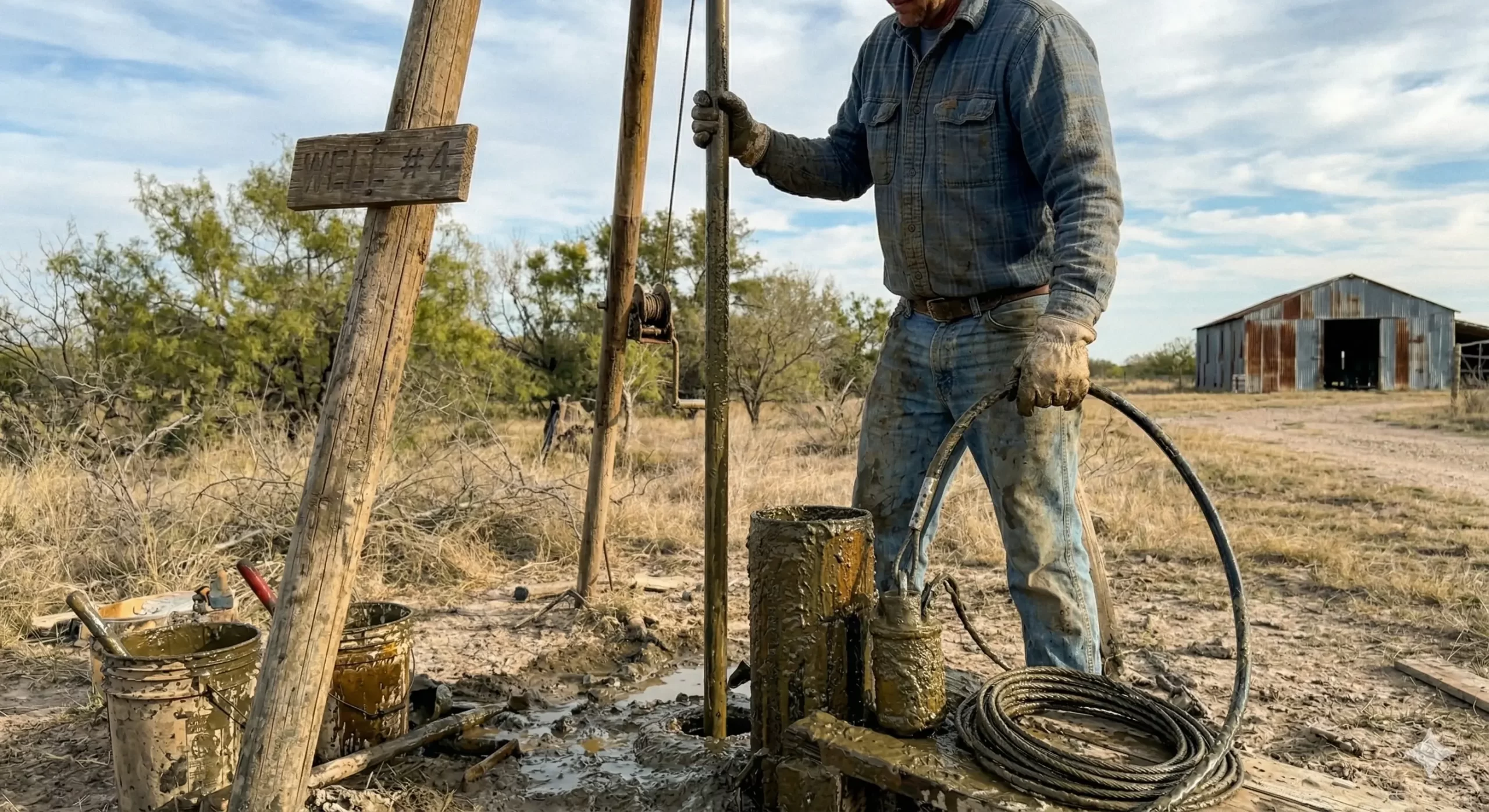
For any major pump repair, especially pulling a submersible, we need a heavy-duty well service rig. These aren’t just pickups with winches; they’re specialized trucks with mast systems capable of lifting thousands of pounds safely. We also carry a full suite of specialized tools: casing wrenches, downhole cameras for diagnostics, well logging equipment, and all the safety gear needed for working with potential confined space issues or gas pockets, even if rare in water wells near industrial zones. This robust equipment, and the trained personnel to operate it, are essential for safe and efficient service.
Spring Well Maintenance in Texas
Heavy spring rains can cause surface runoff to breach well caps. We strongly recommend testing your water for coliform bacteria and inspecting the sanitary seal.
Save $500+ on Replacements
Via the TX Energy Co-op VFD Upgrade Program
75°F in Port Arthur
Local Aquifers & Geology
The primary groundwater sources in Port Arthur include the The Chicot Aquifer, an extensive part of the broader Gulf Coast Aquifer system, is our main source. It’s composed of interbedded layers of fine to coarse sand, gravel, silt, and clay. Water in the Chicot is primarily unconfined to semi-confined, with groundwater generally flowing southeast towards the Gulf. Water quality varies significantly with depth and proximity to the coast; it often requires treatment for elevated iron, manganese, and hardness, and salinity increases deeper and closer to the Gulf.. Drilling through the local Our soil profile is predominantly coastal plain sediments. At the surface, you’ll find fine sandy loams, silty clays, and heavy clays, characteristic of the Beaumont Formation and more recent alluvial deposits. These soils are generally poorly drained and can exhibit high shrink-swell potential. As you go deeper, you encounter the unconsolidated to semi-consolidated interbedded sands and clays that make up the Chicot Aquifer. means that average well depths range from 150 ft – 500 ft.
Due to these geological factors, local homeowners frequently struggle with Corrosion and mineral build-up, frequently worsened by aggressive water chemistry and iron bacteria, leading to seized impellers and premature motor burnout. Sand abrasion is a very close second, especially in older wells..
Drilling Depth Comparison
Deeper wells require heavy-duty crane hoists for pump extraction.
Climate & Water Quality
Pump systems in the Port Arthur area face severe environmental stressors. The most significant threat is Port Arthur’s climate is tough on well equipment. **Hurricanes & Tropical Storms** bring major power outages that can fry unprotected motors on restart, and flooding can submerge and damage above-ground controls and wellheads. Storm surge also carries the risk of saltwater intrusion into shallow wells. Our year-round **High Humidity** significantly accelerates corrosion on all exposed metal components, like pressure tanks, switches, and control boxes. Intense **Summer Heat** also stresses electrical components and motors, leading to premature failure if systems aren’t properly maintained or ventilated.
Additionally, the raw groundwater often presents issues with We regularly contend with high levels of dissolved iron and manganese, causing unsightly staining and fostering iron bacteria growth. Moderate to high water hardness is also typical. Sulfur (hydrogen sulfide gas) often presents itself as a distinct ‘rotten egg’ smell. Furthermore, sand production, particularly from older or less robustly constructed wells, is a chronic problem..
Regional Groundwater Advisory
Known primary contaminant threat to submersible pumps and pipes in this area:
Common Area Systems
VFD Upgrade Savings
Constant Pressure vs StandardReplacing a standard single-speed pump with a Variable Frequency Drive (VFD) eliminates hard starts and drastically reduces energy draw in Texas.
Compliance & Local Permits
Jefferson County Level: For private domestic wells in Jefferson County, the **Texas Department of Licensing and Regulation (TDLR)** governs all well drilling, pump installation, and well plugging standards, ensuring adherence to state construction codes. While there isn’t a specific local groundwater conservation district permit required for individual domestic wells like in some other parts of Texas, local county health departments or city ordinances in Port Arthur may have additional setback requirements from septic systems, property lines, or potential contamination sources. Large-volume commercial or industrial groundwater withdrawals might require permits from regional entities like the Lower Neches Valley Authority (LNVA) or be subject to review by the Texas Commission on Environmental Quality (TCEQ). For most homeowners, the primary local regulation follows TDLR’s strict construction, casing, and grouting mandates.
Top Pump Brands in Texas
Most frequently installed hardware based on local geology (2026 data).
- Verify voltage & amperage at the control box and directly at the pump motor leads.
- Inspect pressure switch calibration, contacts, and connections for signs of pitting or corrosion.
- Check pressure tank pre-charge (air pressure) and visually inspect the bladder for integrity.
- Manually cycle the pump, listening carefully for any unusual noises like grinding, cavitation, or excessive vibration.
- Perform an on-site water quality test for key parameters including iron, pH, turbidity (for sand content), and salinity.
- Conduct a thorough visual inspection of the wellhead for structural integrity, proper seal, and any signs of surface water infiltration.
Premium Well Pump Brands We Service
Our licensed technicians in Port Arthur are certified to repair, replace, and install high-quality groundwater equipment from industry-leading manufacturers, including:
- Complete loss of water or consistently very low water pressure throughout the property.
- The well pump runs continuously without shutting off, or cycles on and off rapidly (short cycling).
- Water coming out of the tap is discolored (orange, brown), sandy, or has a strong metallic or rotten egg odor.
- You hear a humming sound from the well area or control box, but no water is being delivered.
- The circuit breaker dedicated to the well pump frequently trips, especially when the pump attempts to start.
- A noticeable and unexplained increase in your electricity bills without a corresponding increase in water usage.
Port Arthur Real Estate Well Regulations
Local Dispatch & Response Times
Live Dispatch: Texas
Updated Just Now⚠️ High demand. Call now to secure the next available technician.
- We maintain on-call technicians available 24/7 for all no-water emergencies in the Port Arthur area.
- Typical response time for Port Arthur proper is within 2-4 hours, depending on current job load and traffic conditions.
- Critical situations, such as hospitals, nursing homes, or essential infrastructure, receive top priority.
- Severe weather conditions, including hurricanes or widespread flooding, can significantly extend response times, sometimes by days if roads are impassable or dangerous.
- Our immediate goal is same-day diagnosis and, whenever feasible, initiation of temporary repairs or the pump pull process.
⚠️ Jefferson County & State Regulatory Warning: Abandoned Wells
Groundwater Threat Level
Current aquifer and mineral impact on pumps in Port Arthur.
Dropping water tables cause pumps to suck air and overheat.
Hard water calcifies pump impellers, reducing lifespan.
The Cost of Ignoring Symptoms
Fixing a short-cycling pump early saves thousands in Port Arthur.
Data reflects average well contractor estimates in Port Arthur.
Pump Lifespan Estimator
Select household size in Port Arthur to see strain impact.
Local Port Arthur
Well Pros
Fast Local Service & Diagnostics
Calls are routed to a licensed local well professional.
Septic System Services in Port Arthur, TX
Do you have a septic tank on your property? Proper maintenance is critical to protecting your well water quality.
Port Arthur Homeowner Feedback
“My pump went out on a Saturday. Called ’em up, and they were out here by afternoon. Got me water again quick. Good honest work, appreciate it.”

Local Homeowner
✓ Verified TX
“We had this weird issue where the pressure would drop off super fast after the pump shut off. Thought it was the pump goin’ bad. Technician came out, spent a good hour diagnozing. Turned out it was the bladder in our old pressure tank had a leak. He explained how it works, and we got a new one installed right then. Saved us from buying a whole new pump we didn’t need. Very professional and the water pressure is great again. No more short cycling and the well pump ain’t runnin’ as much. Thanks for the good service and not trynna upsell us on stuff we didn’t need. They definately know their stuff.”

Local Homeowner
✓ Verified TX
“Woke up to no water, completely stressed! Called these guys, and they understood it was an emergency. Had a crew at my place faster than I expected, diagnosed a burnt-out motor, and had a new pump in the ground by late afternoon. Absolutely lifesavers!”

Local Homeowner
✓ Verified TX
Expert Port Arthur Well System FAQ
Why does my water from the well in Port Arthur sometimes have a strong rotten egg smell, and is it safe to drink?
That rotten egg smell is almost certainly hydrogen sulfide gas, a common issue with groundwater in our area, especially from the Chicot Aquifer. It’s produced by certain types of bacteria reacting with sulfur compounds naturally present in the aquifer. While the smell is unpleasant, in concentrations typically found in domestic wells, hydrogen sulfide itself isn’t directly harmful to consume. However, its presence often indicates a broader issue with water chemistry or bacterial activity (like iron bacteria) that can affect taste, accelerate corrosion in plumbing, and harbor other less desirable organisms. We always recommend getting a comprehensive water test to identify all contaminants and then discuss suitable treatment options, which could range from aeration and filtration to chlorine injection, depending on the severity and other water quality factors.
I’ve heard about subsidence in our area. How does that affect my well, and can my well contribute to it?
Subsidence, the sinking of the ground surface, is indeed a serious concern along the Texas Gulf Coast, including around Port Arthur. It’s primarily caused by the compaction of underground clay layers due to the excessive withdrawal of groundwater from sandy aquifers, like the Chicot. For your well, subsidence can cause issues like casing collapse or damage, leading to pump failure, reduced well yield, or contamination if the well integrity is compromised. While a single domestic well’s withdrawal is usually too small to significantly *cause* regional subsidence, collective pumping from numerous wells, particularly large municipal or industrial ones, certainly contributes. It’s why proper well construction, especially deep grouting and casing, is so vital here – it protects your well from the effects of ground movement and ensures you’re not inadvertently contributing to pathways for surface contamination.
My well water is constantly staining my fixtures orange/brown. What’s causing this, and what’s the solution?
The orange/brown staining you’re seeing is a classic sign of high iron and/or manganese content in your well water, which is extremely common in the Port Arthur area due to the natural geology of the Chicot Aquifer. When iron and manganese are exposed to oxygen (like when water comes out of the tap), they oxidize and precipitate, forming those noticeable stains on sinks, toilets, and laundry. Beyond aesthetics, high iron can lead to metallic tastes, clog pipes, and encourage the growth of iron bacteria. The solution typically involves a water treatment system. Common approaches include oxidation filters (like greensand filters or air injection systems) designed to remove iron and manganese, or in some cases, a water softener may help if hardness is also a significant factor. A professional water test will determine the exact levels of these minerals and guide us to the most effective and efficient treatment system for your specific well.
With all the storms and potential for flooding here, what should I do to protect my well system?
Preparing your well system for severe weather, especially hurricanes and flooding, is critical here in Port Arthur. First, make sure your wellhead is properly sealed and extends at least 18 inches above anticipated flood levels, as per TDLR regulations. If a storm is approaching, and you’re evacuating or power is expected to go out, consider turning off the circuit breaker to your well pump to prevent damage from power surges or dry running if power fluctuates. After a flood, do *not* drink the water without testing. Floodwaters can introduce bacteria, chemicals, and debris into your well. Have your well system professionally inspected, disinfected (shock chlorination), and then tested for coliform bacteria and nitrates before resuming consumption. We’ll check for physical damage to the well casing, wellhead, pressure tank, and electrical components, ensuring everything is safe and functional before you restart your water supply.
Port Arthur Groundwater Expert AI
What are the specific groundwater regulations, average well depths, and the local conservation district for Port Arthur, Jefferson County?
Residential Water Well Regulations and Information for Port Arthur, Jefferson County, Texas (2026)
As a Senior Hydrogeologist and Local Groundwater Regulatory Expert for Texas, I can provide you with specific, hard data regarding residential water wells in Port Arthur, Jefferson County, for the year 2026.
Groundwater Regulations and Local Regulatory Body
A critical piece of information for Jefferson County is that it is not currently located within the jurisdiction of an active Groundwater Conservation District (GCD) for groundwater management purposes. This means that many of the typical local permitting requirements, well spacing rules, and production limits that are common in other parts of Texas due to GCD oversight do not apply directly to residential wells in Port Arthur.
Without a local GCD, the primary regulatory oversight for private domestic water wells in Port Arthur falls under state agencies:
- Texas Department of Licensing and Regulation (TDLR): The TDLR licenses all water well drillers and pump installers in Texas. They also maintain a statewide well driller database and require the submission of well logs for all newly drilled wells. This ensures adherence to minimum construction standards.
- Texas Commission on Environmental Quality (TCEQ): The TCEQ sets general environmental and public health standards, including regulations for on-site sewage facilities (septic systems) which dictate setback requirements from water wells to prevent contamination.
- Texas Water Development Board (TWDB): The TWDB serves as the state's primary water planning and data collection agency. They maintain the statewide well registry based on logs submitted to TDLR. While not a direct regulatory body for private wells, their data is essential for understanding groundwater resources.
Relevant State Codes and Regulations:
- Texas Water Code Chapter 32 (Water Well Drillers): Establishes the requirement for licensing of water well drillers.
- Texas Water Code Chapter 35, Subchapter B (Water Well Drillers and Pump Installers): Outlines the general requirements and prohibitions for drillers and installers, emphasizing proper construction to prevent contamination.
- 16 Texas Administrative Code (TAC) Chapter 76 (Water Well Drillers and Pump Installers): These rules, enforced by the TDLR, detail the minimum standards for water well drilling, completion, and plugging, including casing, cementing, and sanitary requirements for private domestic wells.
- TCEQ On-Site Sewage Facility (OSSF) Rules (30 TAC Chapter 285): These rules specify minimum separation distances between water wells and septic system components to protect groundwater quality. For instance, a water well must be at least 50 feet from an OSSF drainfield and 100 feet from an OSSF treatment tank or spray area.
Official Resources for Regulations:
- TDLR Water Well Driller Program: https://www.tdlr.texas.gov/wwd/wwd.htm
- TDLR License Search (to verify drillers): https://www.tdlr.texas.gov/LicenseSearch
- TCEQ On-Site Sewage Facilities (OSSF) Rules: https://www.tceq.texas.gov/permitting/ossf/ossf
Average Well Depths for Port Arthur
Based on historical state well logs for residential wells in the Port Arthur area of Jefferson County, most domestic wells target relatively shallow to moderate depths within the regional aquifer system. Considering the local hydrogeology and the need for sufficient yield and water quality, an estimated average well depth for residential use in Port Arthur is around 250 feet. Depths can range significantly, with some shallower wells (e.g., 150-200 feet) for irrigation or older uses, and others extending deeper (e.g., 300-400 feet) to access more robust zones or for improved water quality.
Official Resource for Well Logs:
- TWDB Water Well Registry (searchable database for well logs): https://www.twdb.texas.gov/groundwater/data/gwdbrpt.asp
Specific Aquifer Beneath Port Arthur
The primary groundwater source beneath Port Arthur, Jefferson County, is the Gulf Coast Aquifer System. This extensive aquifer system is comprised of several hydraulically connected sands and clays. In the Port Arthur region, residential wells typically draw water from the uppermost units of this system, primarily the Chicot Aquifer and, to a lesser extent, the upper portions of the Evangeline Aquifer (also known as the Jasper Aquifer in some areas further inland). The Chicot Aquifer is the most heavily utilized for domestic and municipal supply in the coastal plain due to its shallower depth and good water-bearing characteristics.
Fast Local Service & Diagnostics
Calls are routed to a licensed local well professional.
Blix
provides official
Emergency Well Pump Repair services for the
Port Arthur
area.