
Emergency Well Pump Repair in Dripping Springs, TX
Folks out here in Dripping Springs know the harsh reality of living on well water. We’re on the edge of the Edwards Plateau, which means our groundwater resources are precious and often under stress. Droughts hit us hard, and the water table can drop significantly, impacting well yields and the lifespan of your pump. It’s not like municipal water; you’re responsible for your lifeline.
Most of us are drawing from the Trinity Aquifer, a complex system of limestone formations. It’s not an endless river down there; it’s a fractured rock system that recharges slowly. The Edwards Aquifer is to our east, and while it’s a major resource, our primary access is to the Trinity. Understanding your well’s specific characteristics and its interaction with the local geology is key to reliable water.
Trying to save a buck on a cheap pump here in the Texas Hill Country usually backfires, and quickly. The combination of deep wells, hard water with mineral content, and often sediment or sand means a lesser-quality pump just isn’t built to last. They work harder, get worn down faster by abrasives, and succumb to mineral buildup, leading to premature failure and more expensive emergency repairs down the road.
Fast Local Service & Diagnostics
Calls are routed to a licensed local well professional.
Well Pump Repair in
Dripping Springs
Dripping Springs & Hays County Well Stats
Hays County wells, particularly in the Dripping Springs area, typically range from 300 to 800 feet deep, with some reaching over 1000 feet. Yields vary dramatically, from less than 5 gallons per minute (GPM) to over 50 GPM, depending on the specific fractures encountered in the Trinity Aquifer. Water quality is generally hard, with high mineral content (calcium, magnesium) and occasionally elevated iron or manganese. Sediment and fine sand can also be present, especially in newly drilled wells or during high pumping rates.
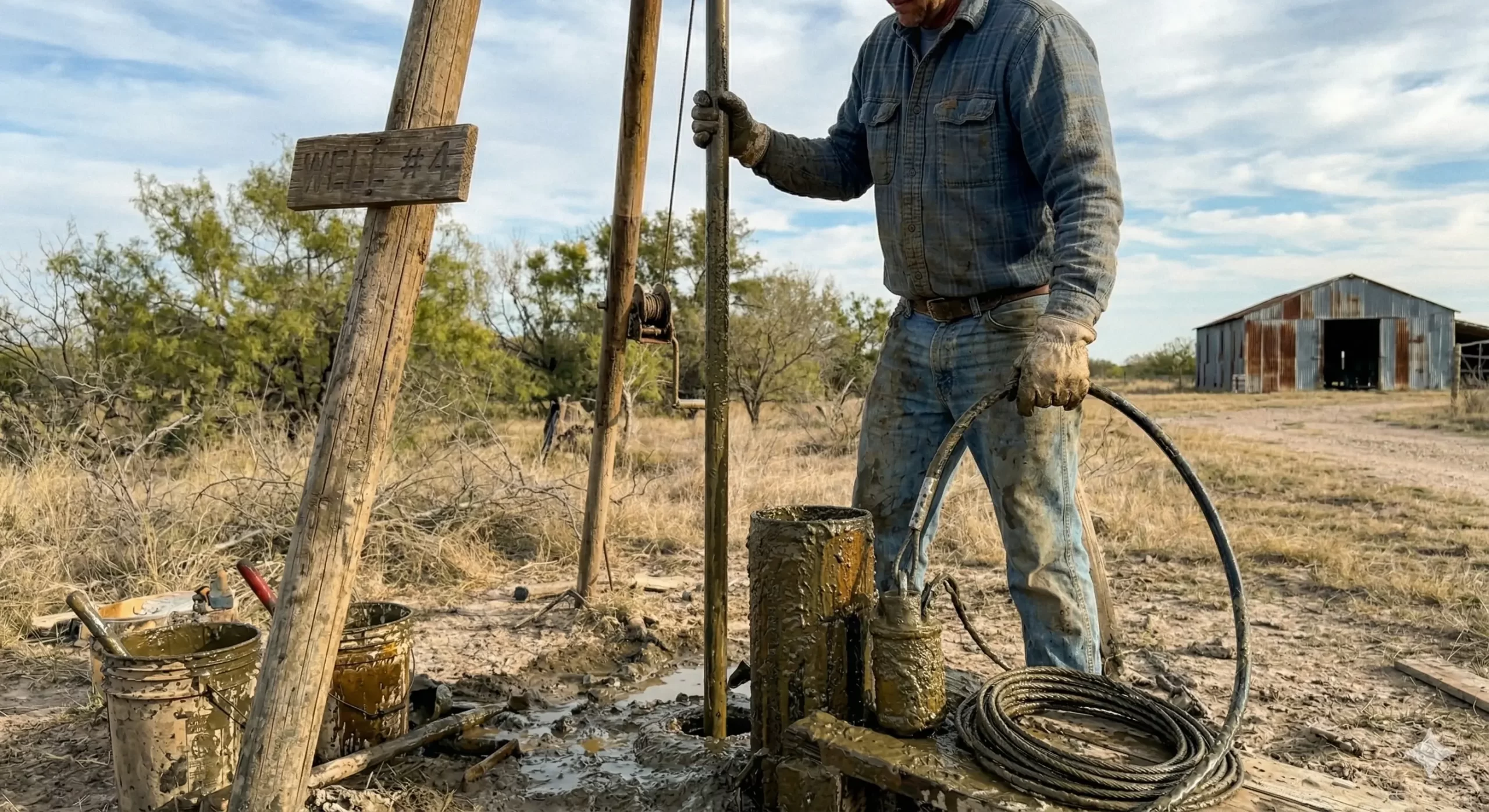
Pulling a well pump in Dripping Springs is a job that demands specialized equipment and expertise. Many wells here are deep, often hundreds of feet into solid limestone bedrock. This isn’t a simple lift; it requires a heavy-duty well rig designed to handle the weight of hundreds of feet of pipe, wire, and a substantial submersible pump. Access to some properties can also be challenging due to rural terrain and tree lines, requiring careful maneuvering.
The equipment needed goes beyond just the pump itself. We’re talking about a truck-mounted well rig capable of pulling thousands of pounds, specialized pipe wrenches, proper safety gear for working at height and with heavy loads, diagnostic tools for electrical and pressure systems, and often welding equipment for repairs. Factor in the cost of quality submersible wire, well-grade piping, and pressure tanks, and it’s a significant investment in specialized gear and skilled labor.
Spring Well Maintenance in Texas
Heavy spring rains can cause surface runoff to breach well caps. We strongly recommend testing your water for coliform bacteria and inspecting the sanitary seal.
Save $500+ on Replacements
Via the TX Energy Co-op VFD Upgrade Program
84°F in Dripping Springs
Local Aquifers & Geology
The primary groundwater sources in Dripping Springs include the Trinity Aquifer. This aquifer is composed primarily of limestone and dolomite, with layers of sandstone, shale, and marl. In the Dripping Springs area, wells commonly tap into the Middle Trinity (Cow Creek, Hammett Shale, Glen Rose Limestone) and Lower Trinity (Hensell Sand, Pearsall Formation, Hosston Sand). It’s a leaky, unconfined to confined aquifer system characterized by fractures and solution channels in the limestone, which influence water movement and well yields. Recharge is primarily through rainfall infiltrating exposed outcrops, making it highly susceptible to drought conditions.. Drilling through the local The local soil profile in Dripping Springs is predominantly characterized by thin, stony clay loams and clays overlying extensive limestone bedrock of the Edwards Plateau. Specific soil series include Tarrant and Crawford series, which are shallow, dark calcareous clays with high shrink-swell potential. The bedrock is often very close to the surface, making excavation and drilling challenging. This rocky geology means less topsoil and slower infiltration rates for surface water into the aquifer. means that average well depths range from 300 ft – 800 ft.
Due to these geological factors, local homeowners frequently struggle with The #1 mechanical failure reason for pumps in Dripping Springs is a combination of abrasive wear from sediment and sand, and mineral scaling from hard water. The limestone geology means our water is naturally high in calcium and magnesium. These minerals precipitate out and build up on pump impellers, motors, and check valves, reducing efficiency and eventually causing seized components. Coupled with occasional fine sand, it’s a harsh environment for any moving part..
Drilling Depth Comparison
Deeper wells require heavy-duty crane hoists for pump extraction.
Climate & Water Quality
Pump systems in the Dripping Springs area face severe environmental stressors. The most significant threat is Our specific local weather directly impacts well equipment. Prolonged droughts are the biggest threat, causing water levels in the Trinity Aquifer to drop significantly. This forces pumps to run hotter, draw in more air or sediment, and in extreme cases, run dry, leading to motor burnout. Extreme summer heat stresses control boxes and electrical components. Conversely, rare but severe winter freezes can cause surface pipes, pressure tanks, and exposed plumbing to burst, leading to costly water loss and equipment damage.
Additionally, the raw groundwater often presents issues with Hardness (high levels of calcium and magnesium), occasional iron/manganese, and sometimes fine sand or silt particles..
Regional Groundwater Advisory
Known primary contaminant threat to submersible pumps and pipes in this area:
Common Area Systems
VFD Upgrade Savings
Constant Pressure vs StandardReplacing a standard single-speed pump with a Variable Frequency Drive (VFD) eliminates hard starts and drastically reduces energy draw in Texas.
Compliance & Local Permits
Hays County Level: The Hays Trinity Groundwater Conservation District (HTGCD) governs groundwater use and drilling within its jurisdiction, which includes Dripping Springs. Any new well construction or significant alteration (deepening, replacing casing) requires a permit from HTGCD before work can begin. They have rules regarding well spacing to prevent interference between wells, casing and cementing requirements for protecting water quality, and reporting requirements for well driller’s logs. Owners are encouraged to register existing wells, and new wells typically require a production permit with annual reporting. It’s crucial to check with HTGCD before starting any well project.
Top Pump Brands in Texas
Most frequently installed hardware based on local geology (2026 data).
- Amperage draw & voltage readings at the control box and pump motor leads (if accessible) to diagnose motor health.
- Megohm testing of the pump motor and wire insulation to detect shorts or grounds.
- Pressure switch calibration & operation check, ensuring proper cut-in/cut-out pressures.
- Pressure tank pre-charge evaluation and waterlogged tank inspection.
- Static and pumping water level measurements (if well access allows) to assess aquifer health and pump placement.
- Visual inspection of all exposed wellhead components, electrical conduit, and plumbing for leaks or damage.
Premium Well Pump Brands We Service
Our licensed technicians in Dripping Springs are certified to repair, replace, and install high-quality groundwater equipment from industry-leading manufacturers, including:
- No water at all, suddenly or gradually, often indicating a complete pump failure or severely dropped water level.
- Low water pressure, particularly noticeable when multiple fixtures are in use, suggesting a failing pump, pressure tank issue, or clogged lines.
- Pump constantly running, or short-cycling (turning on & off frequently), which usually points to a leaky check valve, a bad pressure tank, or a leak in the system.
- Water that tastes, smells, or looks different (e.g., cloudy, sandy, metallic taste, sulfur smell).
- Unexplained high electric bills, as a struggling or inefficient pump draws excessive power.
- Strange noises coming from the wellhead or pressure tank area, such as grinding, clicking, or gurgling.
Dripping Springs Real Estate Well Regulations
Local Dispatch & Response Times
Live Dispatch: Texas
Updated Just Now⚠️ High demand. Call now to secure the next available technician.
- Our team offers 24/7 emergency service for complete water outages, understanding that no water means no life in rural Texas.
- For calls within the Dripping Springs area, we typically aim for a response time of 2-4 hours, depending on current call volume and technician availability.
- Factors like severe weather, road conditions, or the remoteness of a property can occasionally extend response times.
- No-water situations are always prioritized, especially for homes with families, the elderly, or livestock.
- We maintain clear communication, providing estimated arrival times and updates so you’re not left in the dark.
⚠️ Hays County & State Regulatory Warning: Abandoned Wells
Pump Lifespan Estimator
Select household size in Dripping Springs to see strain impact.
The Cost of Ignoring Symptoms
Fixing a short-cycling pump early saves thousands in Dripping Springs.
Data reflects average well contractor estimates in Dripping Springs.
Groundwater Threat Level
Current aquifer and mineral impact on pumps in Dripping Springs.
Dropping water tables cause pumps to suck air and overheat.
Hard water calcifies pump impellers, reducing lifespan.
Local Dripping Springs
Well Pros
Fast Local Service & Diagnostics
Calls are routed to a licensed local well professional.
Septic System Services in Dripping Springs, TX
Do you have a septic tank on your property? Proper maintenance is critical to protecting your well water quality.
Dripping Springs Homeowner Feedback
“Joe fixed my pump quick. Good fella, straight shooter. Water’s back on.”

Local Homeowner
✓ Verified TX
“Had a real head-scratcher with my well. Pressure was all over the place, and the pump sounded like a dying walrus. Called these folks, and old man Johnson came out. He found the pressure tank was completely waterlogged and the pump’s check valve was shot. Replaced ’em both, checked the wiring. Even noticed a small leak at the well head I hadn’t seen. Took him a good chunk of the day but he got it done right. No more intermittant water. Real professional work, and he explained everything. Highley recommend.”

Local Homeowner
✓ Verified TX
“My well quit on a Sunday afternoon. Panic set in. Called these guys and they had a tech out within a few hours. Got us water again before dinner. Lifesavers! Can’t thank ’em enough for the fast service.”

Local Homeowner
✓ Verified TX
Expert Dripping Springs Well System FAQ
My water often looks cloudy or has small particles, especially after heavy rain. Is this normal for Dripping Springs?
While some cloudiness or sediment can occur in the Trinity Aquifer, particularly during heavy pumping or after significant rain events that recharge the system, it’s not ideal for your pump or plumbing. Increased sediment or turbidity after rain could indicate issues with your well’s seal or casing integrity allowing surface water intrusion, or it might just be the nature of your specific aquifer zone. We can perform a well inspection, check your casing, and recommend filtration solutions like a sediment filter or a cyclonic separator to protect your pump and improve water clarity.
With all the growth and droughts, I’m worried about my well running dry. What can I do to protect my pump and ensure water availability?
Your concern is valid, as dropping water tables are a reality here. To protect your pump from running dry and burning out, we can install a low-water cutoff switch or a variable frequency drive (VFD). A VFD allows your pump to match its speed to your water demand, reducing stress and power consumption. It also has built-in low-water protection. Additionally, consider having your well’s static and pumping water levels measured periodically to track aquifer health. If your well is consistently struggling, we can discuss deepening options or the potential for a larger storage tank to supplement your well’s recovery rate.
How long should a well pump last in this area, given our hard water and deep wells?
The lifespan of a well pump in Dripping Springs can vary significantly based on the pump’s quality, the well’s depth, water quality, and your usage habits. For a high-quality submersible pump (like Grundfos or Goulds), we typically see a lifespan of 10 to 15 years, sometimes more, if properly installed and maintained. However, hard water, sediment, and frequent cycling (on/off) can reduce this. Cheaper pumps might only last 3-7 years. Regular maintenance, including periodic water quality tests and pressure tank checks, can help extend your pump’s life.
I’m looking to drill a new well on my property. What are the key steps and regulations I need to be aware of from the Hays Trinity Groundwater Conservation District?
Drilling a new well involves several critical steps and adherence to HTGCD regulations. First, you’ll need to submit a permit application to the HTGCD before any drilling begins. They will review your property’s location, proposed well depth, and proximity to other wells to ensure compliance with well spacing rules. You’ll need to provide accurate property information and a site plan. Once approved, a licensed driller will perform the work, adhering to specific casing and cementing standards. After drilling, the driller must submit a Driller’s Log to both the TDLR and HTGCD. It’s crucial to register your well and understand any production limitations or reporting requirements set by the HTGCD to ensure sustainable groundwater use.
Dripping Springs Groundwater Expert AI
What are the specific groundwater regulations, average well depths, and the local conservation district for Dripping Springs, Hays County?
Groundwater Regulations and Information for Residential Water Wells in Dripping Springs, Hays County (2026)
As a Senior Hydrogeologist and Local Groundwater Regulatory Expert for Texas, I can provide you with precise information regarding residential water wells in Dripping Springs, Hays County, as of 2026. It's crucial to understand that groundwater regulation in Texas is primarily managed at the local level by Groundwater Conservation Districts (GCDs), operating under the authority of the Texas Water Code.
1. Specific Groundwater Regulations and Local Conservation District
The primary regulatory authority for groundwater in Dripping Springs, Hays County, is the Hays Trinity Groundwater Conservation District (HTGCD). The HTGCD is empowered by the Texas Legislature under Texas Water Code Chapter 36 to protect, conserve, and preserve the groundwater resources within its jurisdiction, which includes Dripping Springs.
For residential water wells, the HTGCD typically implements the following regulations:
- Well Registration and Permitting: All new water wells, including residential ones, are required to be registered and permitted by the HTGCD prior to drilling. This process ensures the district maintains an inventory of groundwater usage and can manage potential impacts.
- Well Spacing Requirements: The HTGCD enforces minimum spacing requirements between new wells and existing wells, as well as property lines, to prevent undue interference and protect groundwater rights. These rules are detailed in the District's Management Plan and Rules.
- Well Construction Standards: While the Texas Department of Licensing and Regulation (TDLR) licenses drillers and sets minimum statewide construction standards (Texas Water Well Driller's and Pump Installer's Rules), the HTGCD may have additional construction specifications to ensure proper casing and sealing, especially in areas with known water quality issues or fractured geology.
- Production Limits (less common for individual residential, but can apply): While individual residential wells typically operate under an exempt use for household purposes and watering of livestock, the HTGCD has the authority to implement production limits or curtailment plans, particularly during severe drought conditions or if cumulative residential use in a specific area becomes a concern for aquifer sustainability.
- Conservation Measures: The HTGCD promotes and may require certain conservation practices, especially related to landscape irrigation, to minimize overall groundwater withdrawal.
You can find the most current regulations, permitting forms, and contact information on the official website of the Hays Trinity Groundwater Conservation District:
- Official Website: https://www.hayswater.org/
- Direct link to Well Permitting Information: https://www.hayswater.org/permitting-wells/ (This page will contain application forms and detailed rules).
It is strongly recommended to contact the HTGCD directly before initiating any drilling project to ensure full compliance with all local requirements.
2. Average Well Depths in Dripping Springs
The primary aquifer system underlying Dripping Springs is the Trinity Aquifer, specifically the Middle and Lower Trinity Group (Cow Creek, Hammett Shale, Sligo Formation). Due to the complex geology of the Texas Hill Country, including varying topography, faulting, and the depth to suitable water-bearing zones, well depths can vary significantly even within a relatively small area of Dripping Springs.
Based on historical state well logs for residential wells in the Dripping Springs area of Hays County, you can expect average well depths to range approximately from 450 to 800 feet. Some wells may be shallower if they target higher productive zones or are drilled in specific topographic lows, while others may need to go deeper than 800 feet to secure adequate yield or to penetrate specific formations within the Lower Trinity Aquifer.
For site-specific information, it is advisable to consult existing well logs for properties in your immediate vicinity. The Texas Water Development Board (TWDB) maintains a database of drillers' logs. You can access this and other information through the TDLR's licensed well driller search and well log submittal system:
- TDLR Water Well Driller Search and Well Log Query: https://www.tdlr.texas.gov/LicenseSearch/ (Search for drillers and their submitted well logs in your area for examples).
- TWDB Groundwater Data (including well reports): https://www.twdb.texas.gov/groundwater/data/index.asp
A qualified, licensed well driller familiar with the Hays County geology will be able to provide the most accurate depth estimate after a site evaluation and review of nearby well data.
Fast Local Service & Diagnostics
Calls are routed to a licensed local well professional.
Blix
provides official
Emergency Well Pump Repair services for the
Dripping Springs
area.