
Diagnosis: A 1-flash fault code on a Franklin Electric SubDrive or MonoDrive controller indicates an Underload or Dry Run condition. This is primarily caused by either the well’s water level dropping below the pump intake (insufficient well yield) or a mechanical failure where the pump’s impellers have detached from the motor shaft. A professional diagnosis is required to test the well’s recovery rate and inspect the pump assembly.
In this Guide:
What Causes the Franklin Electric Flashes 1 time (Мигает 1 раз) Issue?
The single-flash fault on a Franklin Electric constant pressure drive is a sophisticated protective function triggered by the physics of motor load. The Variable Frequency Drive (VFD) continuously monitors the amperage drawn by the submersible motor. Pumping water is hard work; it requires the motor to overcome the weight of the water column (total dynamic head) and friction losses. This work translates directly into a stable and predictable electrical current (amperage). When the pump loses its prime and begins pumping air, or when the water level in the well drops below the pump’s intake screen, the motor is no longer doing significant work. The impeller stack spins in air or cavitating water, the load plummets, and the amperage draw drops below a pre-programmed underload threshold. The controller correctly interprets this as a ‘dry run’ condition and shuts the motor off to prevent catastrophic failure.
Permitting a submersible pump to run dry is one of the most damaging things that can happen to a water well system. Water serves two critical functions beyond being the pumped medium: it is the sole lubricant for the pump’s internal shaft bearings (bushings) and the exclusive coolant for the submersible motor. Without water flowing through the pump end, the journal bushings—often made of nitrile rubber or proprietary composites—overheat within seconds from the friction of the spinning stainless steel shaft. They can melt, deform, and seize the pump’s rotating assembly. Simultaneously, the motor itself, which relies on the constant flow of cool groundwater across its steel housing to dissipate heat from its windings, begins to overheat. Even with a low amp draw, this thermal buildup can degrade the winding insulation, leading to a permanent short and motor failure.
An equally probable, though mechanically distinct, cause for the same underload fault is ‘mechanical decoupling.’ In this scenario, the well may have ample water, but there is a failure in the power transmission between the motor and the pump end. This typically occurs at the splined shaft coupling. Over years of torque stress, or due to a manufacturing defect, the splines can shear off. Alternatively, the internal impeller stack may break loose from the pump shaft itself. In either case, the motor receives power from the controller and spins exactly as commanded, but its shaft is disconnected from the impellers. Since the motor is spinning against zero hydraulic load, the amperage draw is extremely low, perfectly mimicking a dry-run condition to the VFD controller. This fault protects the motor from freewheeling at high RPMs but indicates a critical failure within the downhole equipment requiring it to be pulled for repair.
DIY Troubleshooting Steps
- Observe and Document the Fault Cycle: Do not immediately reset the system. Watch it attempt to run. Use a stopwatch to time how long the pump runs before the 1-flash fault occurs. Also, time the ‘off-time’ or rest period before the controller automatically attempts a restart. This run/rest timing is critical diagnostic data for a professional.
- Perform a Full System Power Cycle: Locate the dedicated two-pole circuit breaker for the pump system in your main electrical panel. Turn it completely off and leave it off for at least 10 minutes. This allows all capacitors in the drive to discharge and resets the controller’s fault memory. Turn it back on and observe if the fault returns immediately or after a period of operation.
- Listen at the Wellhead: During a restart attempt, stand safely near the wellhead. You should hear the distinct sound of the motor starting, followed by the sound of water flowing up the drop pipe. If you hear the faint hum of the motor but never hear water, it strongly suggests a dry well or a decoupled pump end.
- Evaluate Environmental and Usage Factors: Consider recent conditions. Have you entered a period of drought? Has your household’s water consumption increased significantly (e.g., new irrigation, filling a pool)? A well that was sufficient for years can become inadequate due to a falling water table, leading to intermittent dry-run faults.
- Check the Pressure Tank Pre-Charge: Turn off the pump breaker and drain all pressure from your plumbing system by opening a faucet. Use a tire pressure gauge to check the air pre-charge in your pressure tank via the Schrader valve. It should be set to approximately 70% of the VFD’s programmed system pressure (e.g., 35 PSI for a 50 PSI system). An incorrect charge, while not a direct cause, can contribute to cycling issues that worsen a low-yield problem.
- Inspect Controller Display for Secondary Data: If your SubDrive model has a detailed LCD screen, watch the real-time data during a run cycle. Note the amperage reading just before it faults. A reading significantly below the motor’s full load amps (FLA) printed on its nameplate confirms the underload condition. Do not change any programmed settings without professional consultation.
When to Call a Professional Well Service
Upon arrival, a qualified technician will bypass any homeowner speculation and proceed directly to quantitative electrical diagnostics at the control panel. Using a true RMS clamp-on ammeter, they will confirm the low amperage reading during operation that is triggering the fault. The next, most crucial step, is to power down and lock out the system, disconnect the motor leads from the SubDrive controller, and connect a megohmmeter (commonly called a ‘Megger’). This specialized instrument applies a high voltage (500V or 1000V DC) to the wiring to test the insulation resistance of the drop cable, splices, and the motor windings themselves. A reading of many megaohms to ground indicates the electrical components are likely sound, shifting the diagnosis towards a hydraulic or mechanical issue downhole. A low or zero reading indicates a failed motor or compromised splice, requiring the pump to be pulled for electrical repair regardless of other factors.
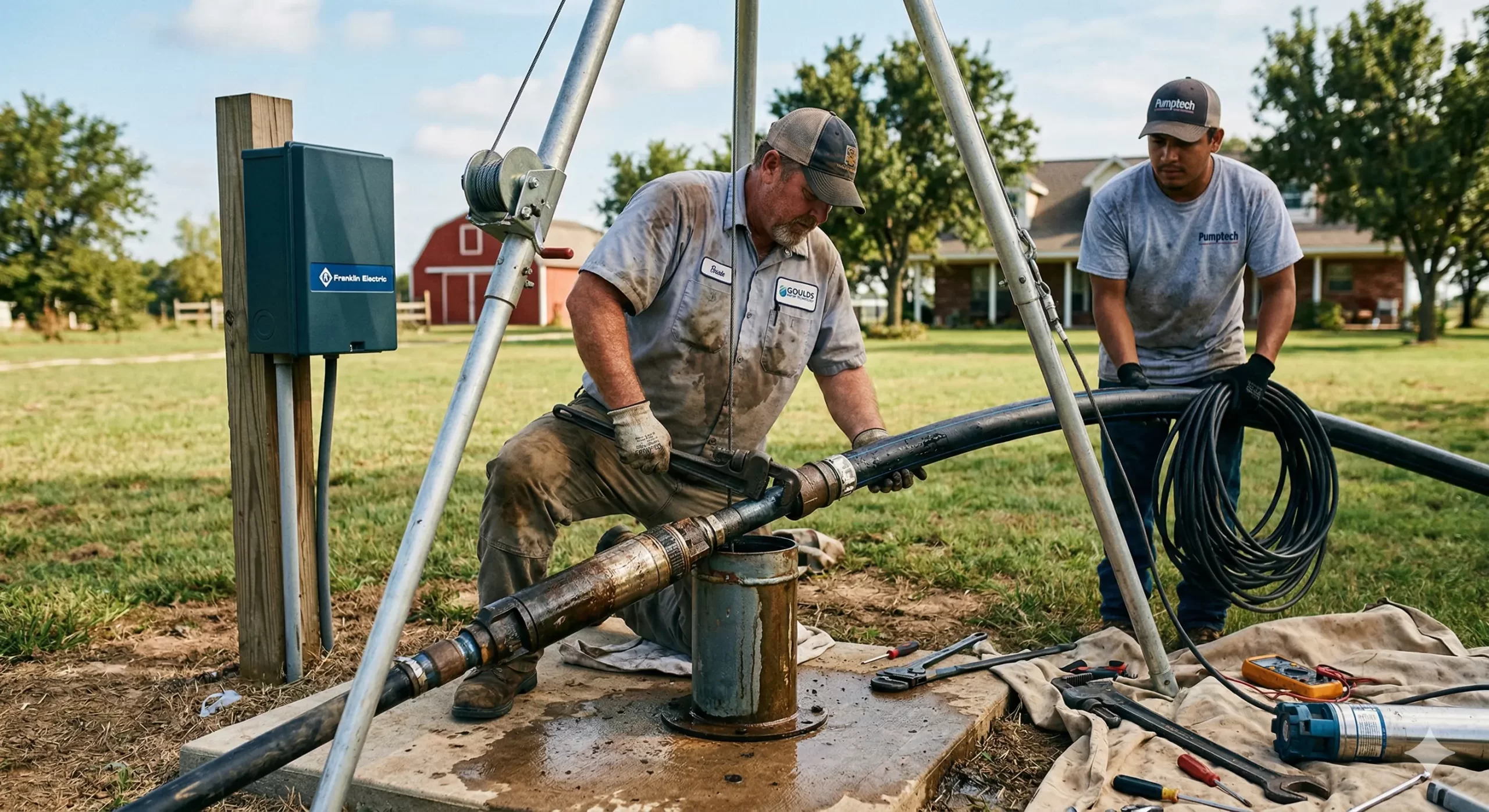
With the electrical system verified, the technician will prepare to pull the pump, a procedure fraught with hazards. This is not a DIY task. A submersible pump, motor, water-filled drop pipe, and cable can weigh upwards of 500 lbs and is located hundreds of feet down a narrow shaft. A professional crew uses a specialized hydraulic pump hoist or a heavy-duty portable pulling rig that securely clamps onto the well casing. They will use a long T-handle pitless key to reach down the casing and disengage the pitless adapter, allowing the entire assembly to be lifted without excavating the yard. As the pipe is raised in sections, it’s carefully handled to avoid damaging the power cable or contaminating the well. Once at the surface, a physical inspection will immediately reveal if the pump intake is clogged or if the shaft is sheared or spins freely, confirming a mechanical decoupling.
The final repair path is dictated by the diagnosis. If the pump is mechanically failed, it is replaced, typically along with the motor as a matched unit. New, waterproof heat-shrink splices are meticulously installed to connect the new motor to the drop cable. If the pump is functional but the well yield is insufficient, a comprehensive well yield test is performed to measure the aquifer’s recovery rate in gallons per minute. Based on this data, the technician will either lower the existing pump deeper into the well bore (if possible) or recommend replacing it with a lower-flow pump that matches the well’s sustainable output. Finally, the controller’s underload and off-time restart delay settings are professionally programmed to match the well’s specific characteristics, providing long-term protection. After reinstallation, the entire well system is shock-chlorinated to ensure potability before being returned to service.
Safety Protocol: Work on a 240V submersible pump system is extremely dangerous. The combination of high voltage, water, heavy equipment, and the risk of dropping tools or the pump down the well, potentially destroying it, necessitates certified professionals. A pump hoist is not optional; it is a required safety tool for controlling the immense weight of the assembly during extraction and installation.
Repair Cost & Time Assessment
The cost to resolve a 1-flash underload error can vary significantly based on the root cause. An initial diagnostic service call from a licensed well contractor typically ranges from $175 to $450. This fee covers the technician’s time, travel, and the use of specialized diagnostic tools like a megohmmeter and clamp meter to determine if the issue is at the surface or downhole.
If the diagnosis requires pulling the pump, costs escalate substantially. The labor for two technicians and the use of a pump hoist rig to pull and reinstall a pump generally runs from $900 to $2,800, with the price heavily dependent on the depth of the well. Deeper wells require more time, more labor, and heavier equipment. This labor cost does not include parts.
If parts are required, a new pump end might cost $600 – $1,800, while a complete pump and motor assembly can range from $1,500 to $4,500+ depending on the horsepower, flow rate, and brand. The customer is paying for the technicians’ certified expertise, liability insurance, investment in a six-figure service vehicle with a crane/hoist, and warrantied, professional-grade components designed for longevity.
Fast Local Service & Diagnostics
Calls are routed to a licensed local well professional.