
Diagnosis: A Franklin SubDrive controller flashing 5 times signifies a critical undervoltage fault, where the incoming line voltage has fallen below the drive’s minimum operating threshold (typically around 195V for a 230V system). This protective shutdown prevents catastrophic motor damage and is commonly caused by utility grid sags, a failing circuit breaker, or undersized supply wiring.
In this Guide:
What Causes the Franklin Electric Flashes 5 times (Мигает 5 раз) Issue?
The five-flash undervoltage fault on a Franklin Electric SubDrive or MonoDrive is a critical protective measure engineered to safeguard the submersible motor from destructive operating conditions. These Variable Frequency Drives (VFDs) continuously monitor the incoming single-phase AC voltage. In a standard 230V system, the drive expects a nominal voltage within a specific range, typically +/- 10%. When the line voltage sags below this engineered threshold (e.g., below 195-200V), the drive’s internal DC bus voltage also drops. To satisfy the power demand of the pump motor (Power = Voltage x Current), the controller would be forced to draw significantly higher current (amperage) from the utility line to compensate for the reduced voltage. The SubDrive’s firmware recognizes this as an unstable and dangerous condition and immediately faults, halting operation to prevent a cascade of electrical and mechanical failures.
From an electrical engineering perspective, forcing a motor to run on low voltage is a death sentence for its windings. The heat generated within the motor’s windings is a function of the square of the current multiplied by the resistance (I²R). A modest 15% drop in voltage can demand a 20-25% increase in current to produce the same shaft horsepower, resulting in nearly 50% more heat. This intense thermal stress rapidly degrades the thin enamel insulation coating on the copper motor windings. The insulation becomes brittle, cracks, and can lead to turn-to-turn shorts within a stator slot. This progresses quickly to a phase-to-ground short circuit, where current arcs directly to the motor’s steel casing, tripping the breaker and rendering the motor permanently inoperable.
The destructive impact of this excess heat extends beyond the electrical windings to the motor’s mechanical systems. Submersible motors rely on internal, fluid-filled chambers to cool the stator and lubricate the thrust and journal bearings. When the motor overheats due to an over-current condition, this fluid’s viscosity breaks down, drastically reducing its lubricating properties. The result is accelerated wear on the bearing surfaces, leading to shaft misalignment, vibration, and eventual seizure. Furthermore, the motor’s primary shaft seals, which are precision-engineered from materials like nitrile or carbon-ceramic to keep well water out, can harden and crack under extreme heat. Once a seal is compromised, water intrudes into the motor, fouling the bearings and causing an immediate and fatal ground fault.
DIY Troubleshooting Steps
- Verify Voltage at the Controller: Using a quality multimeter set to AC Volts, carefully measure the input voltage at the L1 and L2 terminals of the SubDrive controller. For a 230V nominal system, a healthy reading under no load should be between 220V and 245V. A reading below 216V is a significant concern and likely the cause of the fault.
- Inspect the Dedicated Circuit Breaker: Go to your electrical panel and locate the double-pole breaker for the well pump. Firmly switch it all the way off, then all the way back on to ensure a solid internal connection. Visually inspect the breaker and the wire connections for any signs of heat discoloration, melting plastic, or arcing, which indicate a failing breaker or a loose connection.
- Monitor for Voltage Sag Under Load: Note if the fault only occurs when other major appliances (central air conditioning, electric range, clothes dryer) turn on. This indicates a systemic voltage drop problem, potentially due to an undersized electrical service from the utility or a failing transformer on the utility pole.
- Check All Electrical Terminations: After turning off the breaker, verify that all wire connections are secure. Check the screws at the circuit breaker, the pressure switch (if present), and especially the input power terminals on the SubDrive controller. A single loose connection acts as a resistor, generating heat and causing a significant voltage drop precisely at the controller.
- Power Cycle the System: Shut off the main power to the SubDrive controller at the breaker for at least 10 minutes. This allows the internal capacitors and control logic to fully reset. Restore power and observe if the fault immediately returns. If it does, a persistent low-voltage condition is present and requires professional diagnosis.
- Assess Wire Gauge and Distance: Evaluate the size of the wire running from the breaker panel to the controller. Long runs with undersized wire (e.g., 12-gauge wire for a 2HP pump 300 feet away) will cause excessive voltage drop, especially when the motor starts. The installation manual specifies the required wire gauge based on horsepower and distance.
When to Call a Professional Well Service
Upon arrival, a professional technician’s first action is to perform a systematic voltage drop test. Using a True-RMS multimeter, they will confirm the undervoltage fault by measuring voltage at the controller’s input terminals during a startup attempt. If low voltage is confirmed, they will methodically trace the circuit backward, measuring voltage at the disconnect, the circuit breaker, and the meter base. This process definitively isolates the problem’s location: is it within the home’s wiring, a faulty breaker, or an issue with the utility’s service drop? Concurrently, they will use a clamp-on ammeter to measure the current draw. A spike in amperage just before the fault confirms the controller is reacting correctly to the low voltage condition.
If surface voltage is stable and within specification, the technician will suspect a problem with the downhole equipment. The next step is to perform an insulation resistance test using a megohmmeter. After following strict lockout/tagout (LOTO) safety procedures to de-energize the circuit, the motor leads are disconnected from the controller. The megohmmeter applies a high voltage (500V or 1000V DC) to the drop cable and motor windings. This test can reveal subtle insulation weaknesses, moisture intrusion in a heat-shrink splice, or an impending short in the motor windings that a standard ohmmeter cannot detect. A reading of millions of ohms (megohms) indicates a healthy motor and cable; a low reading points to a critical failure requiring the pump to be pulled from the well.
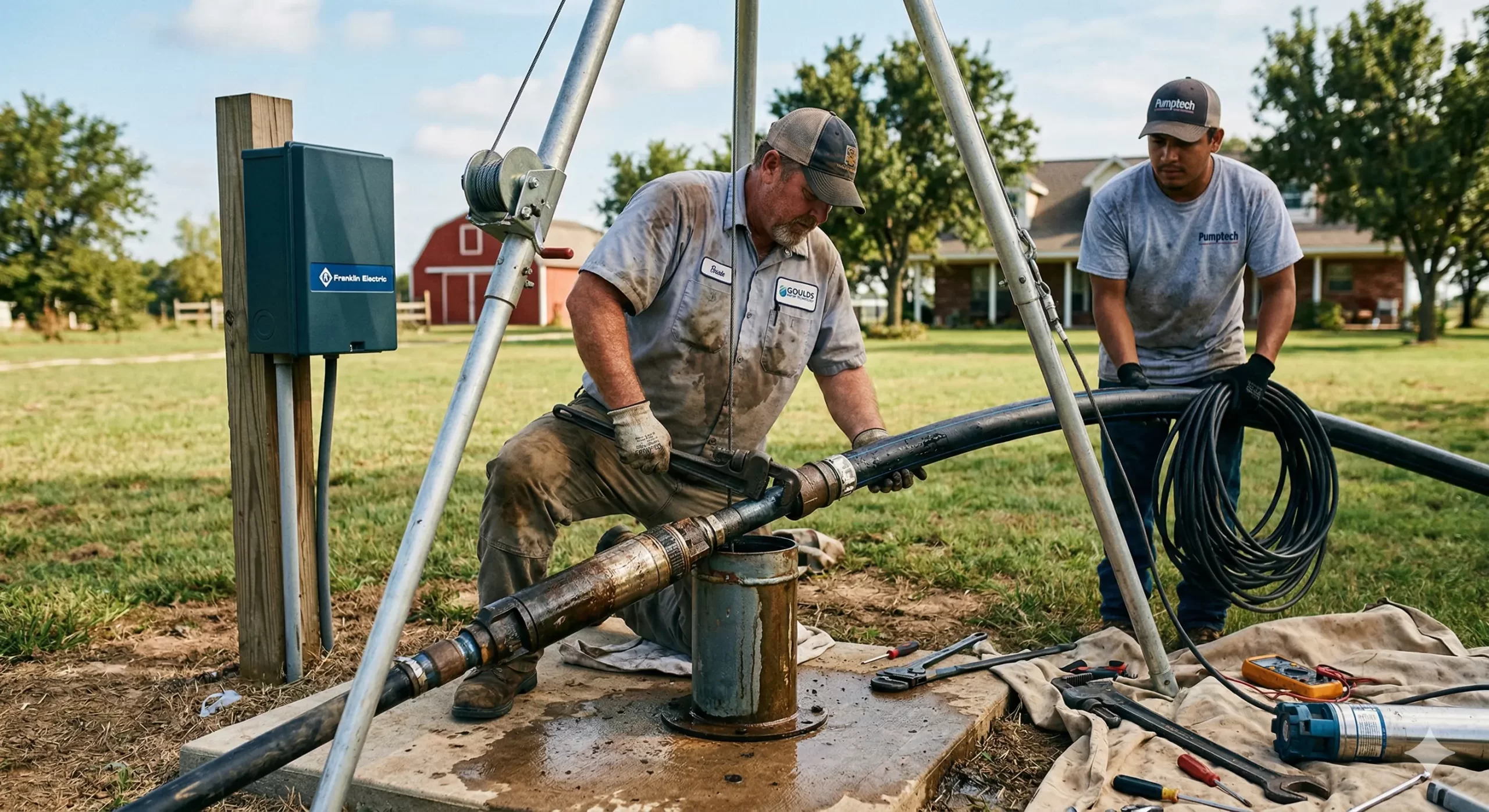
Pulling a submersible pump is a hazardous operation that demands specialized equipment. A pump that is 300 feet deep with water-filled pipe can weigh over 500 lbs. A professional will deploy a hydraulic pump hoist or a heavy-duty pulling rig over the wellhead. Using a T-handle pitless adapter key, they disengage the pump assembly from the underground discharge pipe and carefully hoist it to the surface. Once extracted, a full physical inspection is performed on the pump, motor, wire insulation for any chafing against the well casing, and the integrity of the heat-shrink splices. Any compromised component, from a failed motor to a damaged section of wire, will be replaced before the entire assembly is carefully reinstalled and the system is pressure tested.
Safety Protocol: All work on a 240V well system must begin with a verified lockout/tagout at the breaker panel. The weight and depth of submersible pumps make manual extraction impossible and extremely dangerous. The use of a professional-grade pump pulling rig is mandatory to prevent personal injury and avoid dropping thousands of dollars of equipment down the well casing.
Repair Cost & Time Assessment
The initial diagnostic service call from a licensed well pump contractor typically ranges from $175 to $400 in the US. This fee generally covers the travel time and the first hour of on-site labor for a skilled technician to diagnose the electrical system using professional meters. If the problem is identified as a faulty circuit breaker ($50-$100 part) or a loose connection that can be fixed within that first hour, this may be the total extent of the cost.
If the diagnostic work confirms a downhole failure (motor, wire, or splice), the cost escalates substantially due to the need for heavy equipment and intensive labor. A ‘pull and reset’ service, which involves bringing a pump hoist rig and a two-person crew, typically starts at $700 and can exceed $1,500, depending on the depth of the well and site accessibility. This price is for labor and equipment usage only. The cost of replacement parts is additional. A new SubDrive controller can range from $1,200 to $2,800, while a new submersible motor can cost between $600 and $2,500+. Therefore, a complete job involving pulling the pump and replacing both the motor and controller can easily fall into the $3,000 to $7,500 range. The entire process, from diagnosis to a full replacement, can take between 4 to 8 hours.
Fast Local Service & Diagnostics
Calls are routed to a licensed local well professional.