
Diagnosis: A Grundfos CU 301 Dry Running alarm (Red Indicator #1) signifies the well water level has dropped below the SQE pump’s intake, causing a protective shutdown. This advanced feature prevents motor burnout by detecting the low-amperage condition of pumping air instead of water. The primary solution involves allowing the well to recover, but persistent faults may require professionally lowering the pump.
In this Guide:
What Causes the Grundfos Индикатор №1 (Красный) Issue?
The ‘Dry Running’ fault on a Grundfos CU 301 is a sophisticated protective measure rooted in electrical and physical principles. Your SQE pump relies on the surrounding well water not only as the medium to be pumped but, critically, as its sole coolant and lubricant. When the dynamic water level in the aquifer falls below the pump’s intake screen, the pump begins to draw in air, a condition known as cavitation. The CU 301 controller continuously monitors the motor’s power consumption (power factor, or cos φ). Pumping water requires a specific amount of work, resulting in a predictable amperage draw. Pumping air requires significantly less work, causing a sharp drop in amperage. The CU 301 interprets this specific electrical signature as a dry-run condition and immediately shuts down the motor to prevent catastrophic failure.
Internally, the consequences of dry running are severe and rapid. The submersible motor’s copper windings are designed to dissipate heat into the flow of cool water passing over the motor’s stainless steel housing. Without this convective cooling, winding temperatures can skyrocket in minutes, exceeding the thermal rating of their enamel insulation. This leads to the insulation melting, causing turn-to-turn shorts within the windings or a direct short-to-ground, destroying the motor. Furthermore, the pump’s journal bearings, often constructed from carbon-ceramic or NBR rubber composites, are water-lubricated. Running dry subjects them to intense friction and heat, leading to galling, material transfer, and eventual seizure of the pump shaft, which can stall and burn out the motor.
Beyond the motor and bearings, other critical components are compromised. The mechanical shaft seal, which prevents high-pressure water from entering the oil-filled motor housing, relies on a microscopic film of water between its lapped ceramic and carbon faces for cooling and lubrication. Dry operation causes these faces to overheat and crack, completely compromising the seal and allowing well water to intrude and contaminate the motor. The pump’s impellers, typically made of Noryl or stainless steel and spinning at 3,450 RPM or higher, can also overheat and warp without the cooling and stabilizing effect of water flow. This deformation can cause them to contact the diffuser stack, effectively grinding the pump’s hydraulic end to pieces.
DIY Troubleshooting Steps
- Acknowledge and Reset the Alarm: At the CU 301 controller, press the ‘Reset’ button to clear the fault. Carefully observe if the pump attempts to start. If it runs for a short period (e.g., 30 seconds to a few minutes) and then faults again with the same dry-running indicator, it strongly suggests the well water level has not yet recovered.
- Perform a Well Recovery Test: Shut off the dedicated circuit breaker for the pump and leave it off for at least 2-4 hours. This allows the aquifer time to slowly recharge the well bore without the pump drawing water down. After the waiting period, restore power and see if the pump runs for a significantly longer duration. This test helps confirm a low well yield issue.
- Inspect for System Leaks: A substantial leak in the underground service line running from the well to the house, or a failed seal in the pitless adapter, can cause the pump to run almost continuously. This constant operation can draw down the water level faster than the well can recover. Check for unusually green or marshy areas in your yard between the wellhead and your home.
- Verify Pressure Tank Pre-Charge: A waterlogged pressure tank (one with a failed bladder or incorrect air pre-charge) will cause the pump to short-cycle rapidly. This constant starting and stopping can also excessively deplete the water in a slow-recovering well. Turn off the pump, drain the tank, and check the air pressure with a tire gauge. It should be set to 2 PSI below the pump’s cut-in pressure setting.
- Review CU 301 Restart Settings: The CU 301 has a programmable ‘Auto-Restart’ function after a dry-run event. Check the manual for your unit and ensure this is enabled and set to a reasonable time interval (e.g., 30 minutes or more) to give your well adequate time to recover before the pump attempts another start cycle.
- Monitor Amperage (Qualified Personnel Only): If you are trained and equipped with a clamp-on ammeter, measure the current on one of the motor leads at the control box. A reading significantly below the motor’s nameplate Full Load Amps (FLA) just before the unit trips is a definitive electrical confirmation of a no-load, dry-run state.
When to Call a Professional Well Service
Upon arrival, a certified well technician will perform a series of non-invasive diagnostic tests to confirm the dry-run diagnosis and rule out other potential failures. The primary tool for this is a megohmmeter, often called a ‘megger.’ This instrument applies a high voltage (500-1000V) at a very low current to test the insulation resistance between the motor windings and ground. A healthy motor and drop cable will show a reading of many megaohms; a low reading indicates a short circuit or insulation breakdown that might mimic a dry-run trip. The technician will also use a water level sounder or ‘well dipper’ to measure the exact static and pumping water levels within the well, providing concrete data on the current state of the aquifer.
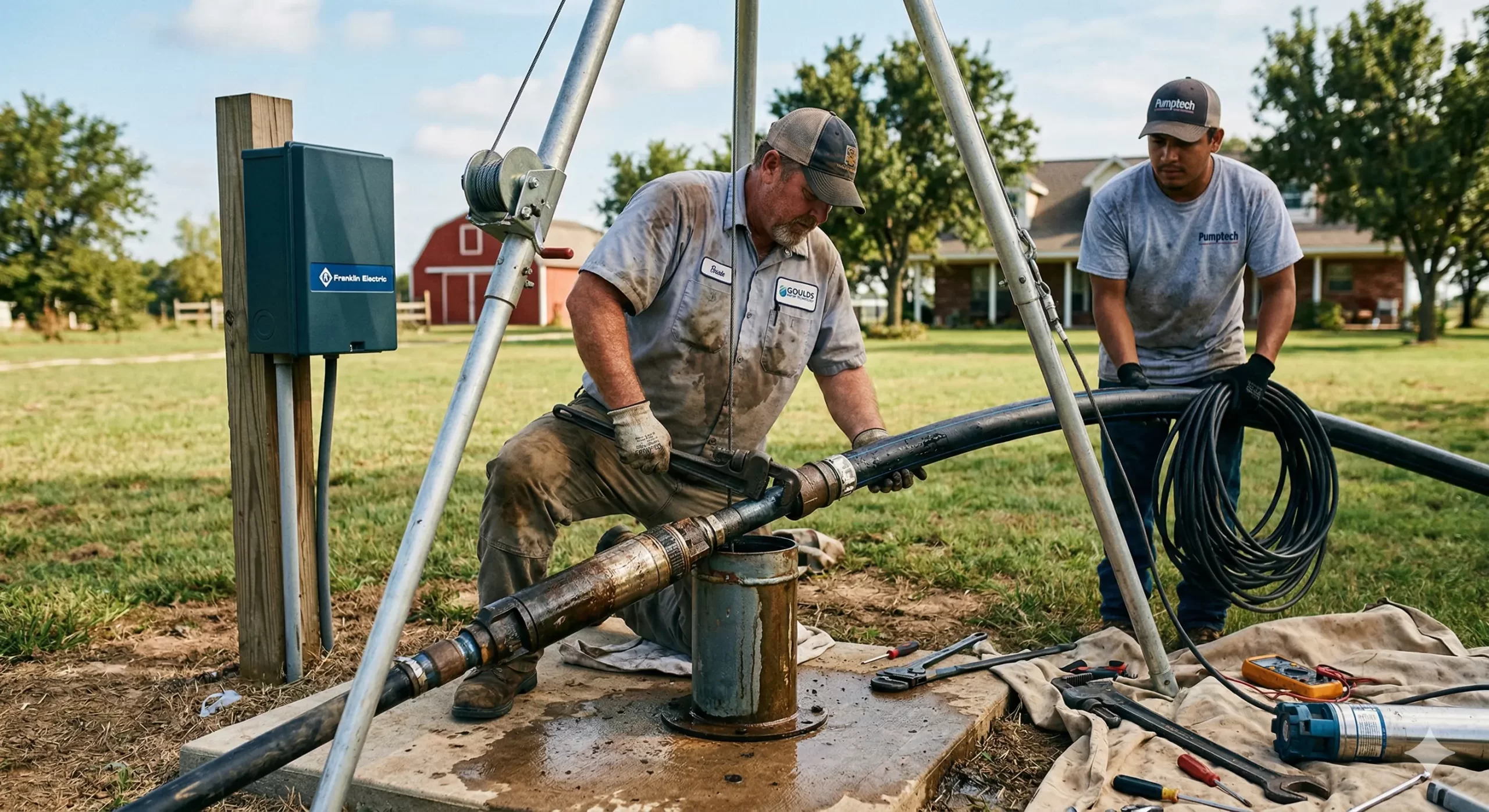
If the diagnosis confirms the pump’s setting is too high for the current water level, a pump extraction is required. This is a hazardous job that demands specialized equipment. A professional crew will use a dedicated pump hoist or pulling rig that anchors securely to the well casing. An SQE pump assembly with hundreds of feet of water-filled drop pipe can exceed 500 pounds of dead weight, making manual pulling unsafe and often impossible. Using a long T-handle pitless adapter key, the technician will reach down into the casing, engage the pitless adapter, and lift it from its slide to disconnect the pump assembly from the home’s water line. The entire assembly—pump, motor, drop pipe, safety rope, and submersible cable—is then carefully hoisted from the well.
With the pump out of the well, the technician will add one or more 20-foot sections of drop pipe to lower the intake. This requires extending the electrical cable using a mission-critical, industry-approved heat-shrink splice kit. This kit creates a multi-layered, completely waterproof seal that is essential for any submerged 240V connection. Once the pump is lowered to its new, deeper setting, the system is re-commissioned. This involves checking for correct motor rotation, measuring the new operational amperage to ensure it’s within spec, and programming the CU 301 controller with updated parameters to optimize performance and protection at the new depth.
Safety Protocol
Working with a deep-well pump system involves significant hazards. The 240V circuit presents a lethal electrocution risk, requiring strict lock-out/tag-out (LOTO) procedures at the breaker panel. The immense weight of the pump and pipe assembly mandates the use of a mechanical pulling rig to prevent back injury or, worse, dropping the entire assembly down the well, which could destroy both the well and the pump. All electrical connections, especially submerged splices, must be performed by a licensed electrician to prevent future electrical failures and ensure code compliance.
Repair Cost & Time Assessment
For a professional service call involving a Grundfos dry-running issue, a homeowner in the United States should budget between $750 and $2,800. The final cost is highly dependent on the well depth and the required solution. An initial diagnostic visit, including electrical testing with a megohmmeter and measuring the water level, will typically cost $250 to $500.
If the pump needs to be pulled and lowered, costs escalate. The use of a specialized pump pulling rig or small crane truck is often billed as a separate line item, ranging from $400 to $900 for the job. Labor for a qualified two-person crew is generally billed at $125 to $200 per hour, and a standard pump pull and reset can take 4 to 6 hours. Material costs include new sections of drop pipe ($50-$100 each), a high-quality submersible heat-shrink splice kit ($40-$80), and potentially a new stainless steel safety rope and torque arrestors ($100-$200). The total time from diagnosis to a fully operational system is typically one business day, assuming parts are readily available.
Fast Local Service & Diagnostics
Calls are routed to a licensed local well professional.