
Diagnosis: A Grundfos CU 301 ‘Overvoltage’ fault indicates the incoming power supply has exceeded the 280V safety limit, triggering a protective shutdown of the SQE pump. This is most often caused by utility grid issues, such as a failing neutral conductor, or incorrect transformer tapping. Immediate diagnosis is critical to prevent permanent damage to the pump’s sensitive internal electronics and motor windings.
In this Guide:
What Causes the Grundfos Индикатор “Overvoltage” Issue?
The ‘Overvoltage’ indication on a Grundfos CU 301 controller is a critical protective measure, signifying that the single-phase 240V nominal supply has surged beyond the system’s maximum tolerance of 280V. From an electrical engineering perspective, the most common cause in North American power systems is a compromised or ‘open’ neutral conductor originating from the utility’s step-down transformer. In a standard 120/240V split-phase service, a stable neutral provides a return path and balances the two 120V legs. When this neutral connection is lost or has high resistance, the two legs become an unbalanced series circuit. This causes the voltage on the less-loaded leg to surge dramatically—often well past 250V—while the voltage on the more heavily loaded leg collapses. The CU 301’s internal circuitry constantly monitors this line-to-line voltage, and upon detecting a sustained level above 280V, it immediately de-energizes the output to the SQE pump to prevent catastrophic failure.
The internal components of the Grundfos SQE pump, particularly its integrated variable frequency drive (VFD) and permanent magnet motor, are highly susceptible to damage from overvoltage. The VFD utilizes a rectifier to convert AC to DC, and then an inverter to create a clean, variable AC waveform for the motor. The capacitors, diodes, and transistors within these circuits have precise voltage ratings. Exceeding these ratings, even for a short period, can cause dielectric breakdown of insulating materials, leading to short circuits and permanent failure of the control board. For the motor windings, excessive voltage saturates the stator’s iron core, causing a massive increase in current draw. This generates extreme heat that can rapidly degrade the thin enamel insulation on the copper windings, leading to an internal short circuit and a complete motor burnout. The CU 301’s shutdown is a last line of defense against this non-repairable electrical damage.
While the primary damage is electrical, sustained or repeated overvoltage events inflict significant mechanical stress. The surge in voltage and current can cause the motor to momentarily over-speed and produce excessive torque before the protective circuit trips. This places an abnormal load on the pump’s thrust bearings, accelerating wear and potentially leading to premature failure. Furthermore, the intense heat generated within the motor windings during an overvoltage event is conducted through the motor housing directly to the pump’s mechanical shaft seals. This heat can cause the seal’s elastomer components to harden, crack, and lose their sealing capability. A compromised seal allows well water to ingress into the hermetically sealed motor housing, which contaminates the motor’s coolant, shorts the windings, and results in total pump failure.
DIY Troubleshooting Steps
- Safely Verify Voltage at the Controller: Using a True RMS multimeter rated for at least CAT III 300V, carefully measure the voltage across the L1 and L2 input terminals of the CU 301 controller. **Warning: This is a live 240V circuit. If you are not a qualified electrician, do not perform this step.** A stable reading significantly above 250V confirms a power supply problem. Monitor for several minutes to observe any fluctuations.
- Perform a Full Power-Down Inspection: Turn off the dedicated pump circuit breaker and apply a lockout/tagout device. Open the CU 301 enclosure, the wellhead junction box (if accessible), and the cover of the breaker panel. With a screwdriver, physically check and tighten every electrical terminal associated with the pump circuit. Look for any signs of heat damage, such as discoloration, melted plastic, or arcing.
- Correlate Faults with High-Load Appliances: Note if the ‘Overvoltage’ fault appears when other heavy equipment on the property (e.g., large air conditioners, shop welders, kiln) starts or stops. This can indicate an unstable utility supply or an undersized service transformer struggling to regulate voltage under changing loads.
- Log Fault Times and Durations: Instead of repeatedly resetting the system, keep a precise log of when the fault occurs. Overvoltage events are often more common late at night or on weekends when overall community electrical demand is low, causing the utility grid voltage to rise. This data is critical when contacting your power company.
- Measure Voltage at the Main Service Panel: If you are qualified, measure the voltage across the main incoming lugs of your property’s main electrical panel. If the high voltage is present at the point of entry, it provides definitive proof that the issue originates upstream with the utility provider’s equipment and is not an internal wiring problem.
- Review the Controller Fault History: The CU 301 stores a log of the last few faults. Access this log according to the Grundfos manual to see if ‘Overvoltage’ is a recurring, consistent problem or if it is mixed with other faults like ‘Undervoltage’ or ‘Overload’, which could point to a more complex power quality issue.
When to Call a Professional Well Service
Upon arrival, a professional technician’s first action is a comprehensive diagnostic sequence, starting with power quality analysis. Using a data-logging power quality meter connected to the controller’s input, they will record voltage, frequency, and potential transients over a period of time to definitively characterize the overvoltage events. The next critical step is to isolate the pump system from the equation using a megohmmeter. By disconnecting the drop cable at the wellhead, the technician will perform an insulation resistance test on the pump motor and the submersible cable running down the well. This test applies a high DC voltage (typically 500V or 1000V) to check for any insulation breakdown between conductors or to ground. A reading of many hundreds of megaohms confirms the downhole equipment is electrically sound, focusing the problem squarely on the power supply.
If diagnostics confirm a stable, high line voltage from the utility, the technician’s role becomes twofold: consulting and remediation. They will provide the homeowner with the recorded data as evidence for the power company, who may need to adjust the tap on their pole-mounted transformer or investigate other local grid issues. As a permanent solution on the property owner’s side, the technician will specify and install a buck-boost transformer or an automatic voltage regulator (AVR). A buck-boost transformer is wired in a ‘bucking’ configuration to provide a fixed percentage voltage drop, reliably bringing a high 275V supply down to a safe ~245V. This is a robust, industrial-grade solution far more effective than a standard surge protector for handling sustained overvoltage.
In cases where the power supply is verified as stable but the fault persists, or if the megohmmeter test fails, the pump itself must be pulled from the well for physical inspection. This is a hazardous operation that demands specialized equipment and expertise.
Safety Protocol
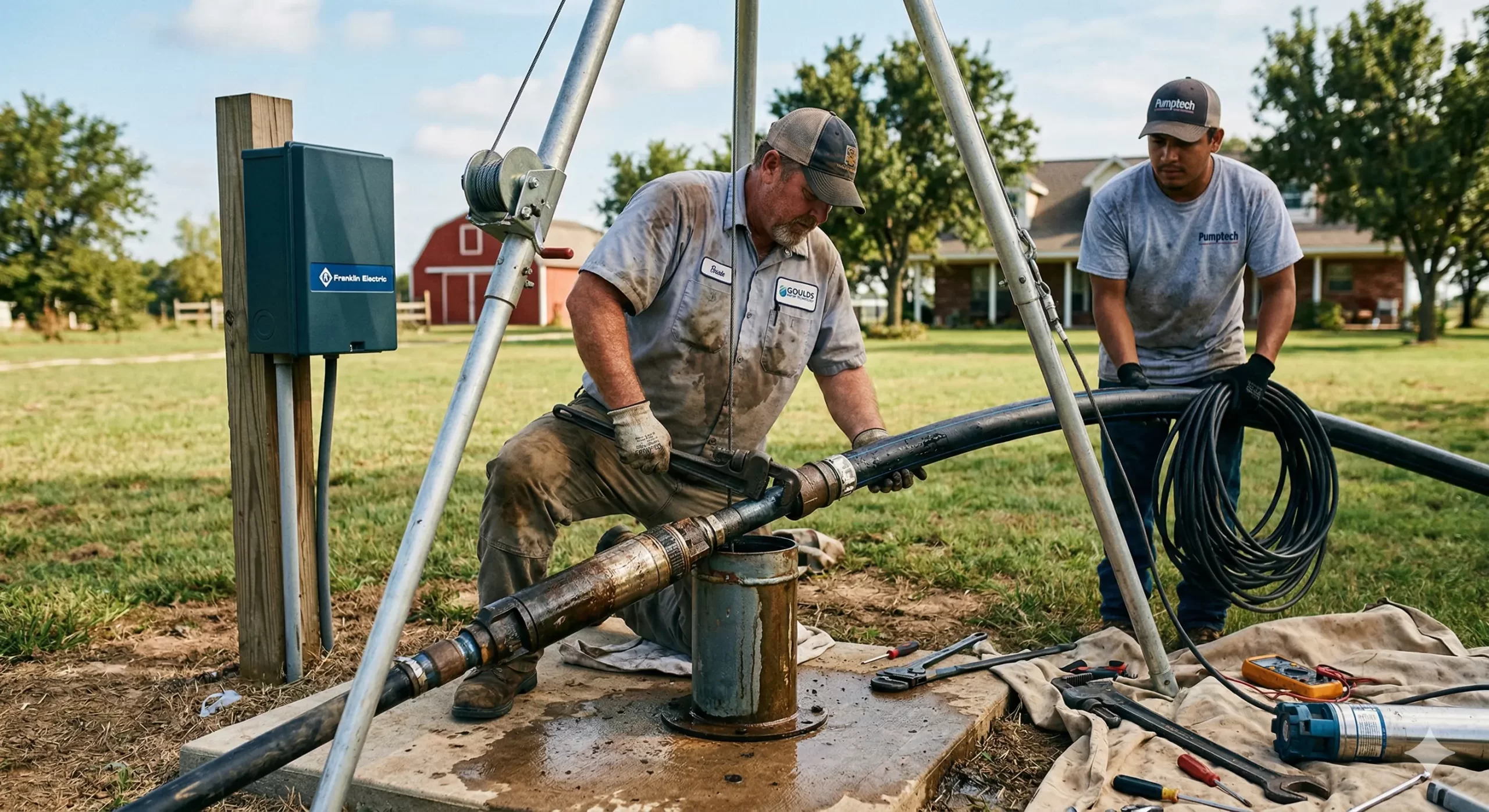
A submersible pump and its column of water-filled pipe can weigh over 500 lbs and is energized by a 240V circuit. The technician will use a dedicated pump hoist or a crane rig securely positioned over the wellhead. A safety clamp is attached to the drop pipe below the coupling being worked on to prevent the entire assembly from dropping down the well. A special pitless adapter key is used to disengage the pump assembly from the well casing far below ground. Once surfaced, the technician will inspect the heat-shrink cable splices for water intrusion and bench-test the motor to isolate the fault, determining if a full pump replacement is the only viable path forward.
Repair Cost & Time Assessment
The financial outlay for resolving a CU 301 overvoltage issue varies widely based on the root cause. An initial diagnostic service call by a certified pump technician or master electrician typically costs between $300 and $600. This fee covers 2-4 hours of on-site time for professional-grade voltage logging, megohmmeter testing, and system inspection. If the problem is traced to the utility provider, this may be the only expense incurred by the homeowner.
If a power conditioning solution is deemed necessary, the costs increase. The supply and installation of a correctly sized buck-boost transformer, including all wiring, a new enclosure, and labor, generally falls in the range of $1,200 to $2,500. Should the diagnostics point to a failed pump motor or drop cable, the cost to pull the pump using a dedicated rig, replace the pump/motor unit, perform a new heat-shrink splice, and re-install everything can range from $2,800 to $5,000+. This higher cost reflects the intensive labor (often a two-person job), the use of heavy hoisting equipment, and the price of premium replacement components like a new Grundfos SQE pump.
Fast Local Service & Diagnostics
Calls are routed to a licensed local well professional.