
Diagnosis: The Goulds Aquavar F03 fault code signifies a Locked Motor or critical Overload condition. This is most often caused by a physically seized pump wet end due to sand infiltration, debris, or internal bearing failure. A professional repair involves pulling the pump from the well to either manually free the rotor or, if internal damage is severe, replace the entire pump and motor unit.
In this Guide:
What Causes the Goulds Код F03 Issue?
The F03 fault is the Aquavar drive’s primary defense mechanism against a catastrophic mechanical failure within the submersible pump. The most common cause is a condition known as a ‘sand lock,’ where fine sand, silt, or clay particulates are drawn into the pump and become wedged between the rotating impellers and the stationary diffuser bowls. The clearance in these multi-stage centrifugal pumps is measured in thousandths of an inch, and this sediment effectively acts as a brake, increasing friction until the rotational force required exceeds the motor’s torque capacity. The rotor becomes physically locked, unable to turn. The drive commands a start, sending current to the motor, but with the rotor stationary, the motor acts as a dead short, causing an immediate, massive overcurrent situation that trips the F03 fault to prevent motor burnout.
A secondary, yet equally critical, cause is progressive mechanical wear leading to bearing failure. Submersible pump motors contain a thrust bearing assembly designed to handle the immense axial downthrust generated by lifting a column of water hundreds of feet. After millions of start cycles and years of operation, this bearing can fail due to fatigue. Its failure allows the entire rotor and attached impeller stack to shift axially, causing the impellers to grind against the diffusers. This metal-on-metal contact creates extreme friction and ultimately seizes the pump assembly. This failure mode is often more severe than a sand lock, as it can cause catastrophic damage to internal seals, allowing well water to penetrate the hermetically sealed motor housing, shorting the windings and compromising the dielectric oil.
From an electrical engineering perspective, the F03 fault is a direct result of the VFD’s sophisticated monitoring. When the drive initiates a start sequence, it expects to see a specific current ramp-up profile as the motor overcomes inertia and spins up to speed. In a locked rotor scenario, the motor’s impedance is near zero. As the drive’s IGBTs (Insulated-Gate Bipolar Transistors) begin to pulse voltage to the motor windings, the current spikes almost instantaneously to several hundred percent of the motor’s Full Load Amp (FLA) rating. The drive’s internal current transducer detects this dangerous condition within milliseconds and triggers the F03 protection protocol, immediately cutting power to the motor. This swift action is crucial for protecting not only the motor windings from overheating and insulation failure but also the drive’s own power electronics from being destroyed by the excessive current draw.
DIY Troubleshooting Steps
- Perform a Hard Power Cycle and Observe: Turn off the dedicated circuit breaker for the pump system for at least 5 minutes to allow all controller capacitors to fully discharge. Turn it back on and listen intently at the well head or pressure tank. A distinct ‘hum’ from the motor for 1-2 seconds, followed by a ‘thud’ or ‘click’ from the controller as it faults, is a classic acoustic signature of a locked rotor.
- Verify Correct and Stable Input Voltage: Using a multimeter set to AC Volts, carefully measure the voltage across the L1 and L2 input terminals of the Aquavar controller. You should read a stable 230-240 VAC. Low voltage conditions can reduce the motor’s starting torque, making it more susceptible to an overload fault, though it’s rarely the root cause for a true F03 lock.
- Monitor Live Amperage on the Drive Display: If the drive allows a brief run time before faulting, navigate the display to monitor the motor’s current (Amps). On startup, observe if the amperage reading spikes dramatically—often to a value 300-600% higher than the motor’s nameplate FLA rating—just before the F03 code appears. This confirms the overcurrent condition.
- Check for Tripped External Overloads: Inspect the main control panel. While the Aquavar has its own internal protection, some installations may include an external magnetic motor starter or thermal overload relay. Ensure it has not been physically tripped and that any manual reset buttons are engaged.
- Isolate the Drive from the Motor: A more advanced step. After a full LOTO power-down, disconnect the motor leads (U, V, W) from the Aquavar’s output terminals. Power the drive back on. If the drive powers up to a ready state without displaying F03, it confirms the controller itself is functional and the fault lies downstream in the wiring or the pump/motor assembly.
- Review System Pressure and History: Consider the system’s recent behavior. Was the water recently cloudy or full of sediment? Did the pump cycle more frequently than usual? These are indicators of a deteriorating well or a failing pump that often precede a final F03 seizure.
When to Call a Professional Well Service
Upon arrival, a certified technician will bypass preliminary checks and proceed directly to definitive electrical diagnostics at the well head. The primary tool for this is a Megohmmeter, often referred to by the brand name ‘Megger.’ By disconnecting the motor leads from the controller, the technician will apply a high voltage (typically 500V or 1000V) to test the insulation resistance between each motor leg (U, V, W) and the ground wire. A healthy motor will show readings of hundreds or thousands of megohms. A reading below 2 megohms suggests a serious insulation breach, likely caused by water ingress from a seal failure associated with the seizure. Following the insulation test, a standard multimeter is used to check the winding resistance phase-to-phase (U to V, V to W, W to U). The readings should be identical and low (typically 1-5 ohms). Any significant deviation or an open circuit indicates a burnt or failed motor winding.
If the electrical tests pass, confirming the motor windings are intact, the diagnosis is confirmed as a mechanical lock-up. Pump extraction is now non-negotiable.
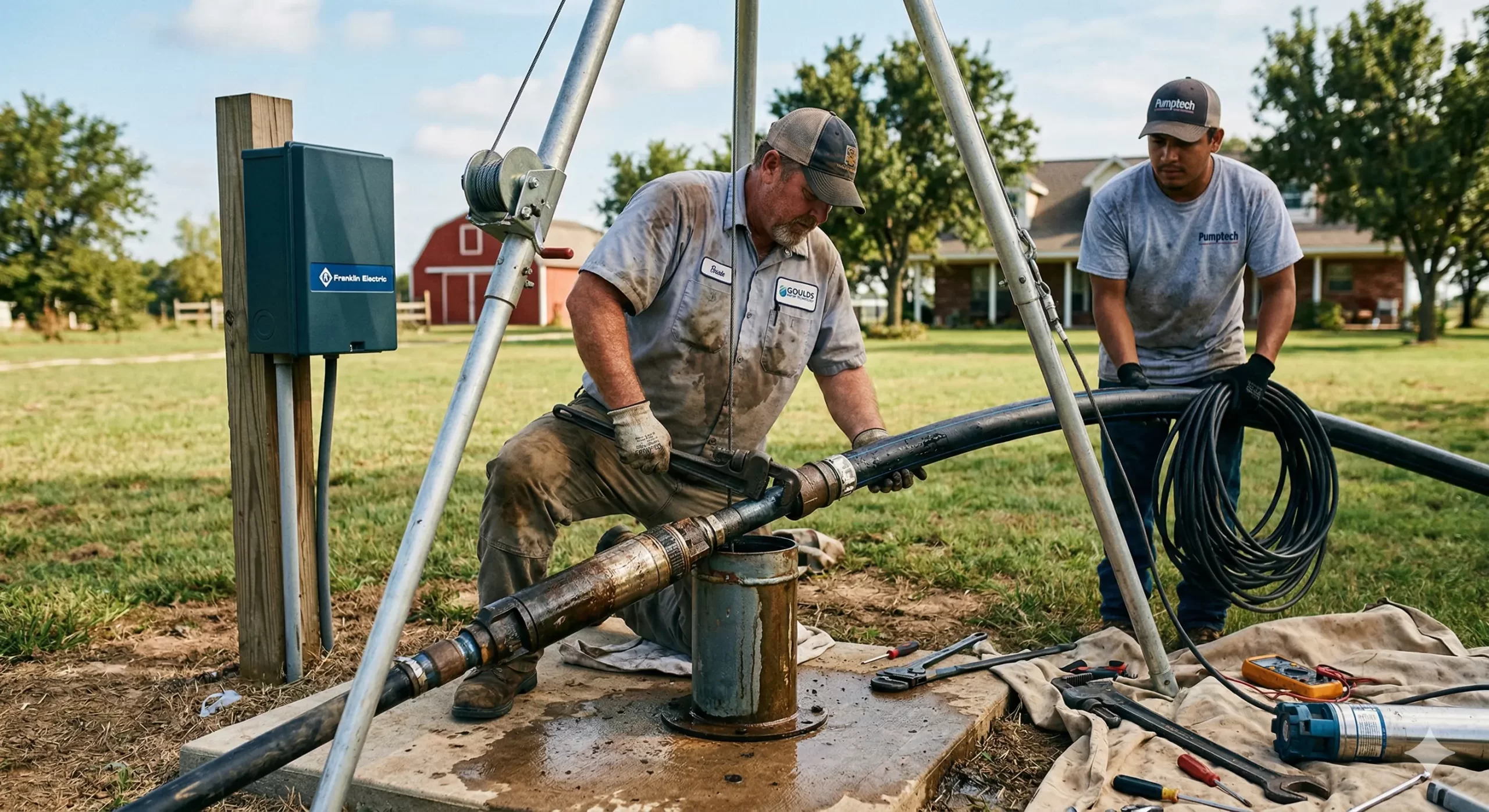
Safety Protocol: All work on a 240V submersible system is initiated with a strict Lockout/Tagout (LOTO) procedure on the main circuit breaker to ensure the system cannot be energized. A submersible pump, motor, water-filled drop pipe, and heavy-gauge power cable can weigh between 300 and 800 pounds, making manual lifting impossible and extremely dangerous. A professional crew will deploy a specialized hydraulic pump hoist or a tripod pulling rig positioned over the well casing. This equipment provides the mechanical advantage needed to safely and controllably lift the entire assembly. A long T-handle pitless adapter key is lowered into the casing to engage and unlock the pitless adapter, allowing the pump assembly to be disconnected from the main water line and pulled to the surface.
Once at the surface, the pump’s hydraulic end (wet end) is separated from the motor. The technician will then affix a large pipe wrench or a specialized shaft-turning tool to the pump shaft and attempt to force it to rotate in the reverse direction. If the cause was a simple sand lock, this action can often break it free. The wet end is then aggressively back-flushed with water to purge all sediment. If the shaft turns freely and smoothly afterward, the pump may be reinstalled. However, if the shaft remains seized, feels gritty, or exhibits excessive play, it indicates severe internal damage to the impellers, diffusers, or bearings. At this point, the pump is declared non-repairable, and a full replacement of the pump and motor is the only professional, reliable solution. The old wire splice is cut, and a new, waterproof heat-shrink splice is meticulously prepared for the new motor installation.
Repair Cost & Time Assessment
The total cost for professionally resolving a Goulds F03 fault in the United States typically ranges from $700 to $3,000. The final invoice is determined by whether the pump can be salvaged or must be replaced. A service call involving pulling the pump, successfully clearing a sand lock, and reinstalling the existing unit generally falls in the $700 – $1,400 range. This price reflects a standard service call fee, 3-5 hours of labor for a two-person crew, and the mobilization cost of the pump pulling rig, which is essential for safety and efficiency.
If the pump is found to be internally damaged beyond repair, the cost will escalate to the $1,500 – $3,000+ range. This higher cost includes all the labor and equipment usage from the lower-end scenario, plus the cost of new equipment. The key variables are the pump’s horsepower and stage count (deeper wells require more powerful, expensive pumps), the current market price for the pump/motor unit, and any necessary ancillary parts like a new heat-shrink splice kit, torque arrestors, or sections of drop pipe. Most repairs, from diagnosis to completion, can be performed within a single 4-6 hour service visit, assuming the correct replacement pump is available on the service vehicle.
Fast Local Service & Diagnostics
Calls are routed to a licensed local well professional.