
Diagnosis: A Pentair Intellidrive E-05 Over Voltage fault indicates the drive’s internal DC bus voltage has exceeded safe limits, typically due to a power surge from the utility grid. A simple power cycle may resolve the error, but if the main board is damaged or the motor windings are shorted, a professional diagnosis with a megohmmeter and the installation of a surge arrestor is required.
In this Guide:
What Causes the Pentair Код E-05 Issue?
The E-05 Over Voltage fault on a Pentair Intellidrive Variable Frequency Drive (VFD) is a protective shutdown mechanism. Internally, the VFD converts incoming AC power to a high-voltage DC bus before inverting it back to a variable frequency AC output for the motor. The E-05 code is triggered when the voltage on this DC bus exceeds its maximum design threshold, which for a standard 240V system is around 400 VDC. The most common cause is a transient over-voltage event on the incoming utility line, often stemming from nearby lightning strikes, power grid switching, or the shutdown of large inductive loads in the vicinity. While Pentair drives incorporate Metal Oxide Varistors (MOVs) for basic surge protection, a significant power surge can easily overwhelm these components, allowing the damaging voltage spike to reach the sensitive insulated-gate bipolar transistors (IGBTs) and control logic, forcing the immediate shutdown to prevent catastrophic failure.
From an engineering perspective, the damage caused by such a surge is twofold: electronic and electro-mechanical. Electronically, the high voltage potential can punch through the delicate semiconductor gates within the VFD’s primary logic board and power components, creating microscopic carbon tracks that lead to a permanent short circuit. For the submersible motor itself, the surge travels down the well wiring and can arc across the thin enamel insulation on the copper motor windings. This creates a short-to-ground or a phase-to-phase short, which is an unrepairable condition that fundamentally destroys the motor. The motor will either fail to start, or it will draw excessively high amperage, causing the VFD to trip on an overcurrent fault immediately after the over-voltage event is cleared.
Mechanically, the consequences are secondary but still significant. The immense and instantaneous electromagnetic torque generated by a voltage spike can cause a violent jolt to the motor’s rotor, placing extreme stress on the entire rotating assembly, including the thrust bearings. Over time, repeated electrical events can also induce bearing failure through a phenomenon known as Electrical Discharge Machining (EDM), where current arcs through the bearings, pitting the raceways and causing premature wear. While a single event is unlikely to compromise the pump’s primary shaft seals, the abrupt stop-start cycling associated with fault conditions places undue mechanical stress on the entire pump stack, potentially accelerating wear on impellers and diffusers.
DIY Troubleshooting Steps
- Execute a Full Power Cycle Reset: Before any other step, de-energize the system completely by shutting off the dedicated double-pole circuit breaker for the pump. Leave the power off for a minimum of 15 minutes. This allows the internal capacitors in the VFD to fully and safely discharge. Then, restore power. This simple ‘reboot’ can often clear a nuisance fault caused by a minor transient.
- Measure Incoming Line Voltage: Using a True-RMS multimeter, carefully measure the AC voltage across the L1 and L2 terminals where power enters the Intellidrive. For a nominal 240V system, a stable reading between 230V and 250V is normal. Document any readings that are consistently high (e.g., >255V) as this indicates a serious utility supply issue that must be addressed.
- Conduct a Visual and Olfactory Inspection: With the power locked out at the breaker (Lockout/Tagout), open the VFD’s cover. Look closely at the main circuit board for any scorch marks, discoloration (especially around resistors and MOVs), or bulging capacitors. A distinct, acrid smell of burnt electronics is a definitive sign that the drive’s internal components have been permanently damaged.
- Verify Grounding and Bonding: Inspect the grounding conductor running from the drive’s chassis back to the main electrical panel’s ground bar. Ensure the connection is tight, free of corrosion, and properly sized according to the National Electrical Code (NEC). A compromised ground can significantly worsen the effects of a power surge.
- Review the Drive’s Fault History: If the drive successfully powers back on after a reset, access the user menu to view the fault log. Determine if the E-05 fault is a singular event or if it has occurred multiple times. A history of recurring over-voltage faults strongly suggests an unstable power source, making a surge protection device essential.
- Check Motor Amperage on Startup: If the pump restarts, use a clamp-on ammeter to measure the current draw on one of the motor leads (T1, T2, or T3) leaving the drive. Compare this reading to the motor’s nameplate Full Load Amps (FLA). An amperage draw that is significantly higher than the FLA indicates a potential short in the motor windings.
When to Call a Professional Well Service
When a professional technician arrives, their diagnosis begins where the DIY checks end, employing specialized equipment to ascertain the true health of the system. The first and most crucial test is an insulation resistance test using a megohmmeter, often called a ‘Megger’. This instrument sends a high-voltage (typically 500V or 1000V), low-current DC signal down the drop cable to the submerged motor. It measures the resistance between the motor windings and ground. A healthy motor will show readings in the hundreds or thousands of megohms; a reading below 2 megohms indicates compromised insulation, and a reading under 1 megohm confirms a shorted, failed motor that must be replaced.
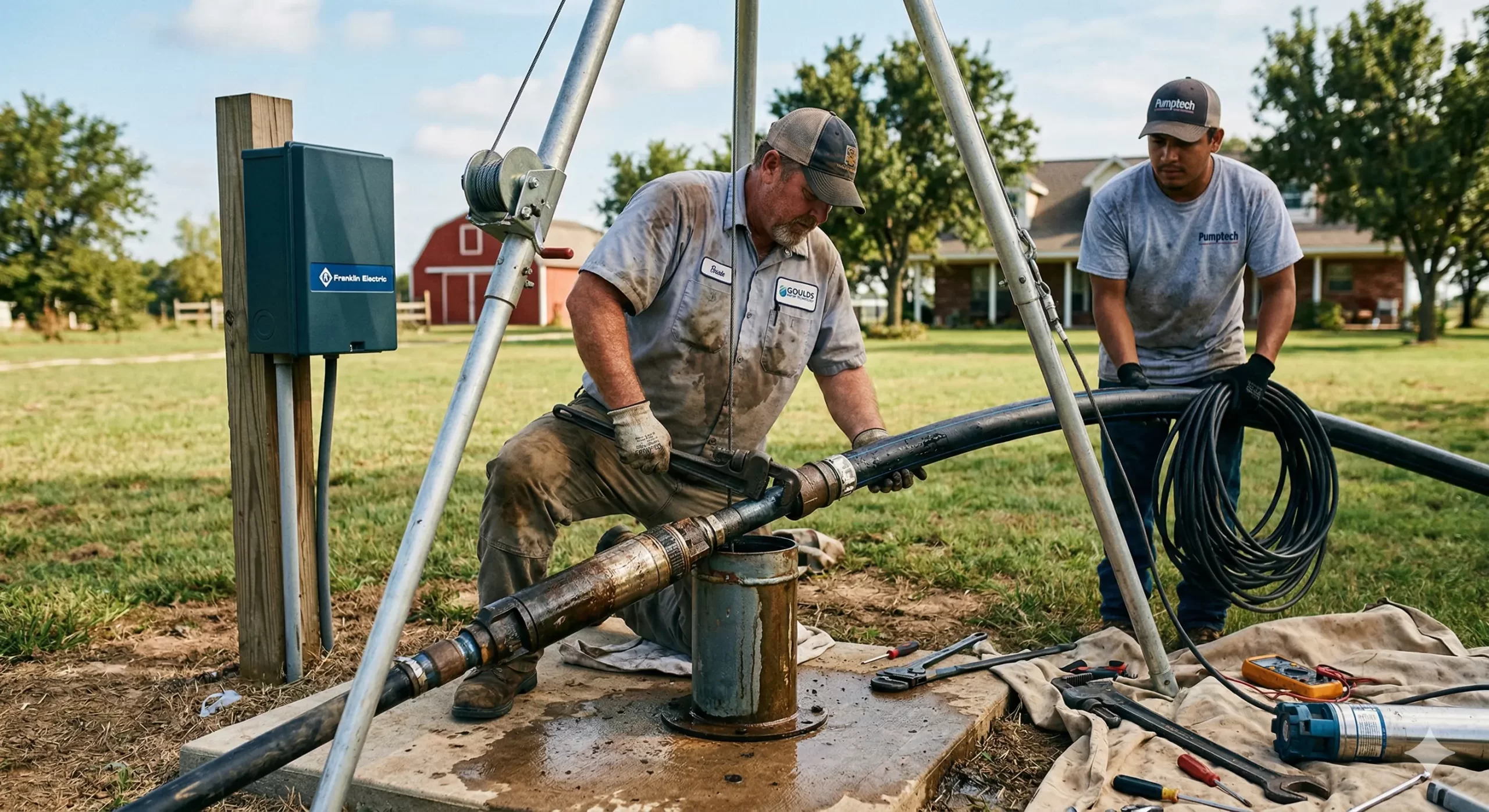
If the megohmmeter test condemns the motor, the entire pump and motor assembly must be pulled from the well. This is a hazardous operation that requires heavy-duty, purpose-built equipment. A hydraulic **Pump Hoist** or truck-mounted pulling rig is used to manage the immense weight of the pump, motor, water-filled drop pipe, and electrical cable, which can easily exceed 500 lbs. The technician will use a **Pitless Key**, a long T-handle tool, to securely latch onto and disengage the pitless adapter from its receiver inside the well casing. This allows the entire assembly to be hoisted vertically out of the well without excavating the yard. Attempting this without a proper rig risks dropping the entire assembly down the well, damaging the well casing, or causing severe personal injury.
Safety Protocol
All professional work on a 240V VFD system begins with a strict Lockout/Tagout (LOTO) procedure at the breaker panel to ensure the circuit cannot be accidentally re-energized. During the pump pulling process, a safe work zone is established, and personnel maintain clearance from the suspended pipe column. Once the new motor is installed, the technician makes the critical downhole electrical connections using premium **heat-shrink splice kits**. These kits create a mechanically robust and completely waterproof seal around the connections, which is essential for decades of reliable service. The final, and most critical, step is the installation of a proper Type 1 or Type 2 Surge Protection Device (SPD) at the pressure switch or disconnect, providing a robust defense against the very power surges that caused the initial failure.
Repair Cost & Time Assessment
The financial outlay to resolve an E-05 fault depends entirely on the extent of the damage. For a scenario where the surge was minor and the drive is not damaged, a professional service call for diagnosis, a system reset, and the proactive installation of a high-quality surge arrestor will typically cost between **$450 and $900**. This fee covers the initial diagnostic charge, 2-3 hours of a licensed electrician’s or pump technician’s labor, and the cost of the surge protection device itself.
However, if the diagnostic tests (specifically the megohmmeter test) confirm the motor windings were shorted by the surge, the project escalates to a full pump replacement. In this case, the cost will range from **$2,800 to $6,500+**. This comprehensive figure accounts for the mobilization of a pump hoist rig, the labor for two technicians for 4-8 hours to pull the old unit and install the new one, the cost of a new submersible pump and motor assembly, new drop wire if required, and premium materials like waterproof heat-shrink splice kits. The final price is influenced by the well depth, pump horsepower, site accessibility, and regional labor rates.
Fast Local Service & Diagnostics
Calls are routed to a licensed local well professional.