
Diagnosis: A Yaskawa iQpump oL1 fault code indicates a critical motor overload, most often caused by a mechanically seized submersible pump. This condition, typically from sand-locking or bearing failure, forces the motor to draw excessive current, prompting the VFD to trip to prevent catastrophic winding damage. Professional diagnosis and pump extraction are usually required.
In this Guide:
What Causes the Yaskawa Code oL1 Issue?
The Yaskawa iQpump’s ‘oL1’ (Motor Overload) fault is a sophisticated protective function, not a failure of the drive itself. It signifies that the Variable Frequency Drive (VFD) has detected motor current exceeding the programmed Full Load Amp (FLA) rating for a duration specified by the overload curve. In physical terms, something is preventing the pump shaft from spinning freely, forcing the motor to demand enormous amounts of current to overcome the resistance. The most common cause is a ‘sand-bound’ or ‘sand-locked’ condition, where fine sand, silt, or mineral scale has migrated into the tight tolerances between the pump’s impellers and diffusers, effectively seizing the entire rotating assembly. This mechanical braking action places an immediate and severe load on the motor, which the iQpump intelligently interprets as a dangerous overload, shutting down power to prevent an immediate motor burnout.
This extreme mechanical stress initiates a cascade of internal failures. The submersible motor’s thrust bearing assembly, designed to handle thousands of pounds of axial downthrust during normal operation, is subjected to immense radial and torsional forces during a locked-rotor event. The polished surfaces of the carbon-graphite or Kingsbury-type bearings can gall and shatter, sending abrasive debris throughout the motor. Simultaneously, the massive inrush of current generates intense heat (I²R losses) within the motor’s copper windings. This heat rapidly degrades the thin enamel insulation coating on the windings. Even a brief overload event can cook this insulation, causing it to become brittle and crack, creating a high probability of a turn-to-turn short circuit or a winding-to-ground fault.
Furthermore, the vibration and excessive heat generated by the struggling motor place extreme stress on the mechanical shaft seals. These seals, often made of silicon carbide or ceramic, are precision components that separate the motor’s internal dielectric oil from the surrounding well water. If these seals are compromised, well water can intrude into the motor housing. This contamination immediately destroys the insulating properties of the oil, leading to a direct and permanent short to ground. This is why a pump that initially trips on ‘oL1’ due to a mechanical bind may, after a few reset attempts, begin tripping on a ‘GF’ (Ground Fault) code, indicating the motor has suffered irreversible electrical failure.
DIY Troubleshooting Steps
- Safety First – Complete Power Down: Before any inspection, locate the circuit breaker supplying the Yaskawa drive and shut it off completely. Apply a lockout/tagout device to the breaker to ensure no one can accidentally re-energize the system while you are working. High voltage (240V or 480V) is lethal.
- Verify VFD Motor Parameters: Power the drive back on and navigate to the motor data parameters (e.g., E2-01 for Motor Rated Current, E2-02 for Motor Rated Voltage). Meticulously compare these programmed values with the data on the submersible motor’s original nameplate or the well contractor’s installation report. An incorrect FLA setting can cause nuisance overload trips.
- Conduct a Visual and Olfactory Inspection: With the power off, open the VFD and control panel enclosure. Look carefully at the output terminals (T1, T2, T3) and any associated contactors or terminal blocks. Look for signs of overheating, such as discolored wire insulation, melted plastic, or soot. Note any strong acrid smells resembling burnt electronics, which indicates severe overheating.
- Perform a Qualified Amperage Test: If you are qualified and equipped with a True-RMS clamp-on ammeter, briefly energize the system. Clamp one of the motor leads (e.g., T1 at the VFD output). Call for water and observe the amperage reading on the VFD display and your meter. A mechanically bound pump will cause the current to spike instantaneously to several hundred percent of FLA before the drive trips on oL1. A healthy pump will show a smooth, controlled ramp-up of current.
- Monitor System Pressure and Cycling: Check the system’s pressure gauge. Is the pump short-cycling (turning on and off every few seconds)? This is often caused by a waterlogged or failed pressure tank. While this typically causes thermal overload over time, it can exacerbate conditions that lead to a more severe mechanical failure and an oL1 fault.
- Review the Fault History: Yaskawa drives store a log of past faults. Navigate the keypad to the fault history menu. Look for a sequence of events. Are there other faults preceding the oL1, such as undervoltage (Uv1) or ground faults (GF)? This can provide clues to a larger systemic problem.
When to Call a Professional Well Service
Upon arrival, a professional technician’s first step is to perform definitive electrical diagnostics from the surface to avoid needlessly pulling a healthy pump. Using a calibrated multimeter, they will check for balanced winding resistance across the three motor leads (U-V, V-W, U-W) at the control panel. Any significant deviation points to a failed winding. The crucial next step is using a high-voltage insulation resistance tester, commonly called a Megohmmeter or ‘Megger’. By injecting 500-1000V DC into the system, this instrument measures the integrity of the insulation between the motor windings and ground. A reading of many megaohms indicates a healthy motor and downhole cable; a low reading confirms a breach in the insulation and a fatal ground fault, meaning the motor is unrecoverable.
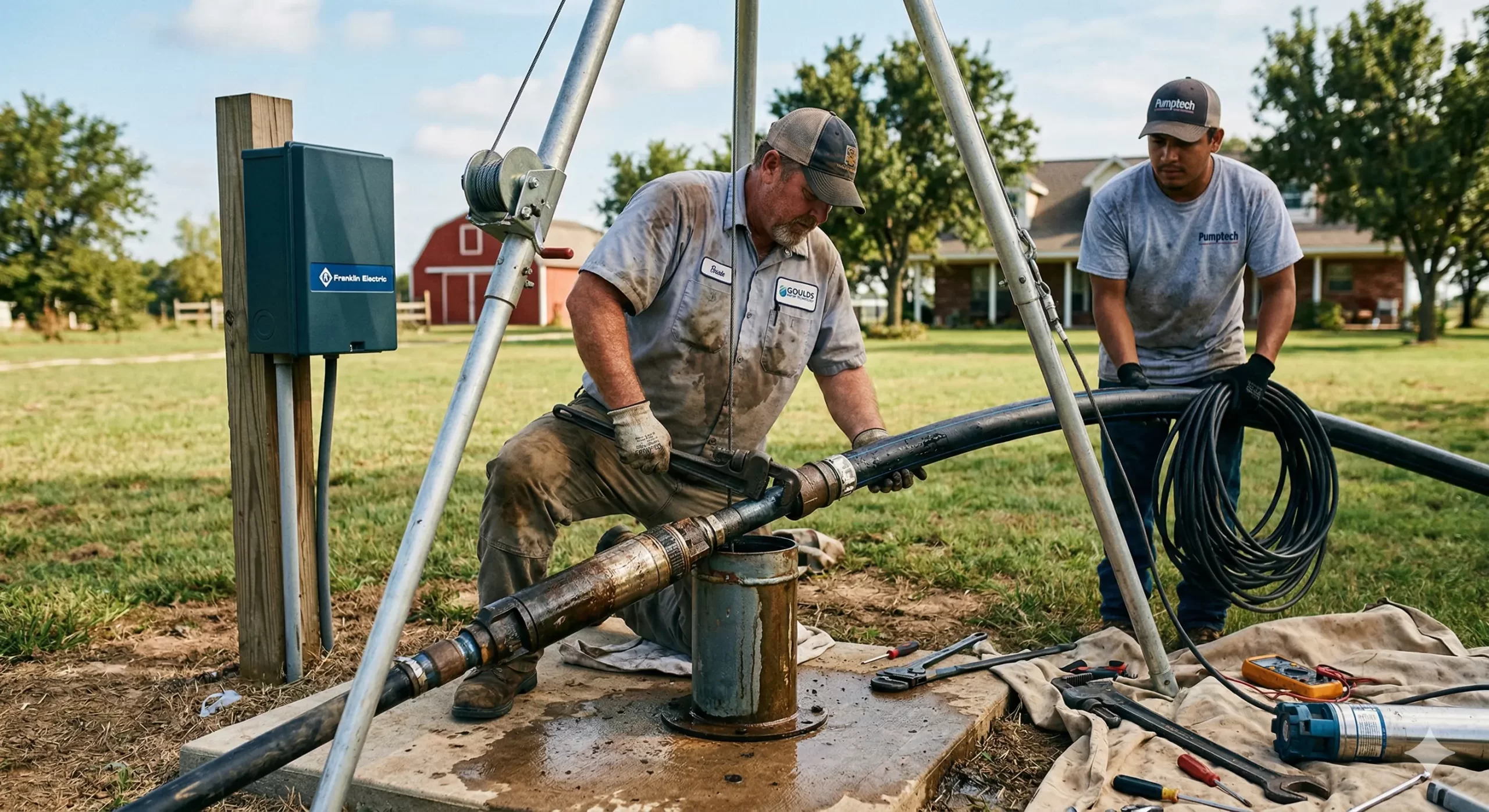
If the electrical tests suggest a recoverable mechanical lock, the pump must be pulled. A submersible pump assembly can weigh 300-800 lbs or more and is often set hundreds of feet deep. For this, a specialized hydraulic Pump Hoist or pulling rig is mandatory. This equipment provides the controlled, powerful vertical lift necessary to safely manage the immense weight. The technician will first use a T-handle Pitless Adapter Key to slide the pump assembly upwards and disengage it from the plumbing connection inside the well casing. The hoist then carefully lifts the pump, drop pipe, and power cable section by section. This process is methodical and prevents catastrophic damage to the well, pitless adapter, or the pump assembly itself.
Safety Protocol
This is not a DIY task. The combination of high voltage (240V/480V), extreme weight suspended over a deep hole, and powerful hydraulic equipment creates a highly hazardous environment. All work must be preceded by strict lockout/tagout (LOTO) procedures at the breaker panel. The pump hoist must be positioned on stable ground, and a minimum two-person team is required for safe operation—one to operate the rig and another to guide the pipe and cable. Attempting to lift a pump manually or with inadequate equipment can result in a dropped pump (a total loss), severe personal injury, or electrocution.
Once the pump is on the surface, the technician will separate the motor from the pump’s hydraulic section (the ‘wet end’). The wet end is then disassembled on a workbench. If sand is the culprit, each impeller and diffuser is meticulously cleaned and inspected for erosive wear. If the shaft is scored or the bearings have failed, the entire wet end is typically replaced. The motor’s integrity is confirmed one last time. If it is salvageable, it’s coupled to the rebuilt or new wet end. A new, waterproof heat-shrink splice is expertly installed to connect the motor leads to the downhole cable, ensuring a service life of decades.
Repair Cost & Time Assessment
The cost for a professional repair of an oL1 fault involving a pump pull can range from $1,800 to $5,500+ in the United States. The final invoice is a composite of several key factors. Labor typically involves a two-person crew for 4 to 8 hours, billed at a rate of $150-$225 per hour. A significant charge, often between $400 and $800, is the equipment fee for mobilizing and using the specialized pump pulling rig. This fee is non-negotiable for any pump that cannot be safely lifted by hand.
The largest variable is the cost of parts. If the pump is simply sand-locked and can be cleaned and reassembled, the cost will be at the lower end of the spectrum. However, if the motor is shorted or the wet end is destroyed, replacement is necessary. A new 4-inch submersible pump and motor assembly can range from $900 for a small residential unit to over $3,000 for a higher horsepower stainless steel model. Additional parts like new heat-shrink splice kits, check valves, torque arrestors, and drop cable will also be itemized. The well’s depth is the primary driver of labor time; a 500-foot setting will take significantly longer than a 100-foot setting, directly impacting the final cost.
Fast Local Service & Diagnostics
Calls are routed to a licensed local well professional.