
Diagnosis: A Uv1 fault on a Yaskawa iQpump drive signifies a DC Bus Undervoltage, most often triggered by a sag in the incoming utility power or inadequately sized wiring. This condition starves the drive of energy, forcing the motor to draw excess current, which can lead to overheating and damage to windings and bearings. Troubleshooting involves verifying supply voltage and connection integrity before proceeding to professional solutions like installing a buck-boost transformer.
In this Guide:
What Causes the Yaskawa Code Uv1 Issue?
The Yaskawa iQpump drive’s ‘Uv1’ fault code specifically indicates a DC Bus Undervoltage condition. In engineering terms, the drive’s first job is to convert the incoming alternating current (AC) from your utility into a stable, high-voltage direct current (DC). This DC power is stored in a bank of capacitors, forming what is known as the ‘DC Bus’. The drive’s inverter then precisely chops up this DC power to create a variable frequency AC output for the motor. A Uv1 fault is triggered when the voltage on this DC bus drops below a minimum operational threshold. The root cause is almost always an external power quality issue—a significant, transient sag in the utility voltage feeding the drive. This happens when other large loads turn on, or when the electrical service from the utility transformer is weak or over-extended. The drive faults as a protective measure to prevent erratic operation and damage to its own power components.
Chronic undervoltage has a devastating cumulative effect on the submersible motor. According to the fundamental power equation (Watts = Volts x Amps), if voltage decreases, the motor must draw proportionally more amperage (current) to maintain the required horsepower and torque to pump water. This dramatic increase in current generates excessive heat within the motor’s stator windings. The enamel insulation coating these windings is rated for a specific temperature; exceeding this rating causes the insulation to become brittle, crack, and eventually fail. This leads to turn-to-turn shorts within a winding or a catastrophic phase-to-ground fault, which will destroy the motor completely.
The damage extends beyond the electrical components. The excessive heat generated in the windings is conducted through the motor’s steel housing and stainless steel shaft directly to the mechanical components. The primary victim is the thrust bearing assembly, which can experience lubricant breakdown and premature failure due to thermal stress. Furthermore, the abrupt shutdown caused by the Uv1 fault induces significant mechanical shock, or water hammer, throughout the system. This shockwave travels up the drop pipe and can stress the pump’s internal seals, couplings, and check valves. Instead of the smooth, controlled ramp-down the iQpump is designed for, the system experiences a violent stop, accelerating wear and tear on every part of the pump and motor assembly.
DIY Troubleshooting Steps
- Log Fault Occurrences: Keep a detailed log of when the Uv1 fault appears on the drive’s keypad. Note the time of day and any other heavy appliances that may have started simultaneously, such as an HVAC unit, electric range, or clothes dryer. This helps correlate the fault with a specific load causing the voltage sag on your service.
- Perform a Full Power Cycle Reset: Turn the main circuit breaker for the pump system off. Wait at least five full minutes to allow the drive’s internal capacitors to completely discharge and its logic to reset. Turn the breaker back on. If the fault clears and stays clear, it may have been a one-time utility anomaly.
- Inspect All Power Terminals for Tightness: After performing a full lockout/tagout procedure to ensure no power is present, open the covers on the pump control panel, the main disconnect, and the VFD itself. Using an insulated screwdriver, systematically check and tighten every power-carrying screw terminal, including the line-in (L1, L2, L3) and load-out (T1, T2, T3) terminals. A loose connection acts as a resistor, causing a significant voltage drop under load.
- Check External Thermal Overload Reset: If your system has an external motor overload relay in addition to the VFD’s internal protection, inspect it to see if it has been tripped. A tripped overload is a clear sign the motor has been drawing excessive amperage, a primary symptom of an undervoltage condition.
- Measure Static Incoming Voltage: If you are fully qualified and equipped with a true-RMS multimeter, safely measure the line-to-line voltage at the main disconnect feeding the system (e.g., L1 to L2). A static reading significantly below your nominal voltage (e.g., 215V on a 240V service) indicates a persistent supply problem that exists even when the pump is not running.
- Verify Correct Drive Parameters: Access the Yaskawa drive’s parameter menu and confirm that the settings for motor voltage (E2-01), motor amps (E2-02), and base frequency (E1-06) exactly match the data on the submersible motor’s nameplate. Incorrect programming can cause the drive to misinterpret the motor’s power requirements.
When to Call a Professional Well Service
A qualified pump technician or master electrician will begin with a dynamic load analysis using specialized diagnostic equipment. A power quality analyzer is connected to the line side of the VFD to record voltage, amperage, and power factor throughout several pump cycles. This instrument provides empirical data, graphing the exact depth and duration of the voltage sag as the pump starts and runs, definitively confirming the root cause. Simultaneously, a megohmmeter (often called a ‘Megger’) will be used. This tool applies a high DC voltage (500V or 1000V) to the motor leads to measure the insulation resistance between the motor windings and ground. This test can preemptively identify compromised motor windings or a failing heat-shrink splice on the submersible drop cable, either of which could cause excessive current draw and contribute to the voltage problem.
Once utility sag is confirmed as the culprit, the technician will evaluate the entire power delivery system. This involves inspecting the wire gauge and length of the run from the main service panel to the well equipment to calculate the voltage drop percentage. If the drop is excessive due to undersized wire or an exceptionally long distance, a primary professional solution is the installation of a buck-boost transformer. This device is strategically installed before the VFD and configured to provide a constant voltage increase (e.g., 10%), creating a stable 240V supply for the drive even when the utility feed droops to 215-220V. This isolates the sensitive pump electronics from poor power quality and permanently resolves the Uv1 fault.
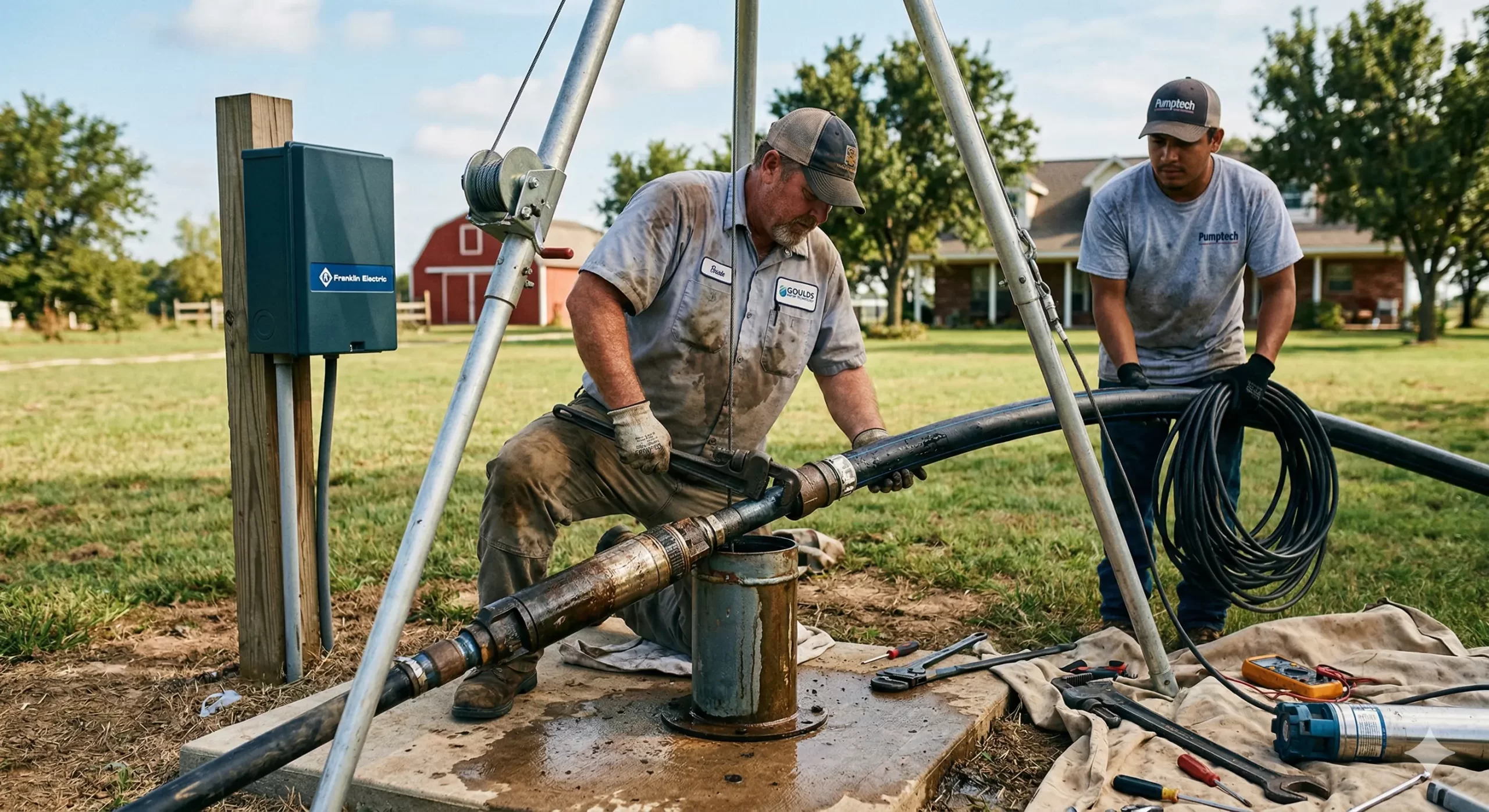
Safety Protocol: All work on a 240V, three-phase pump system is inherently dangerous and must not be performed by unqualified individuals. The technician will implement a strict Lockout/Tagout (LOTO) procedure at the main breaker before any panels are opened. If the pump and motor assembly must be pulled from the well for inspection, a purpose-built pump hoist or small crane is mandatory. A typical 4-inch submersible pump assembly can weigh between 150 and 500 lbs, and attempting to pull it by hand is a recipe for catastrophic failure, potentially dropping the entire assembly to the bottom of the well. The technician will use a heavy-duty pitless adapter key, a long ‘T-handle’ tool, to safely latch onto and disengage the pump from the well’s underground discharge pipe without requiring excavation.
Repair Cost & Time Assessment
The initial diagnostic service call from a licensed professional typically costs between $300 and $600. This fee covers 2-4 hours of on-site labor, travel time, and the use of sophisticated diagnostic tools like a power quality analyzer and megohmmeter. This initial phase will definitively identify the problem, whether it’s a simple loose connection, a failing motor, or a confirmed utility power issue.
If the resolution is the installation of a buck-boost transformer, the total cost for the project will likely fall between $1,200 and $2,500. This price includes the cost of a high-quality transformer ($500-$1,200 depending on the kVA size), a weatherproof NEMA 3R enclosure, conduit, premium copper wire, and the 4-6 hours of a master electrician’s labor required for proper, code-compliant installation and testing. If the diagnostics determine the motor itself has failed, the cost will be significantly higher, often ranging from $3,500 to $8,000+. This larger figure accounts for the use of a pump hoist rig for several hours, the cost of a new submersible pump and motor, a new heat-shrink splice kit, and the extensive labor involved in pulling and reinstalling the equipment, which can be a full-day job depending on well depth.
Fast Local Service & Diagnostics
Calls are routed to a licensed local well professional.