
Diagnosis: An Err 3 code on a CentriPro Aquavar VFD indicates a ‘Dry Run’ or ‘Underload’ fault, meaning the pump is running without sufficient water. This intelligent protection shutdown prevents catastrophic damage from overheating. The primary cause is typically a drop in the well’s static water level, requiring a professional well camera inspection to diagnose and resolve.
In this Guide:
What Causes the CentriPro Code Err 3 Issue?
The ‘Err 3’ fault on a CentriPro Aquavar drive is a critical protective shutdown triggered by an underload condition, which is symptomatic of a pump running dry. The Variable Frequency Drive (VFD) continuously monitors the amperage drawn by the submersible motor. The physics are straightforward: moving a dense fluid like water requires a specific amount of electrical power (work), which translates to a predictable amperage load. When the well’s water level drops below the pump’s intake, the pump begins to move air instead of water. Air is approximately 800 times less dense than water, causing the motor’s workload to plummet. The VFD’s logic instantly detects this sharp drop in amperage, interprets it as a ‘dry run’ scenario, and trips the Err 3 fault to halt the motor. This is a deliberate, intelligent safeguard engineered to prevent the immediate and severe thermal damage that occurs when a submersible pump is operated without its primary cooling and lubricating medium.
When a pump runs dry, the damage cascade begins within seconds. Submersible pumps rely entirely on the flow of ambient well water across the motor housing for cooling and through the pump stages for lubrication. Without this constant heat exchange, the motor windings rapidly overheat, which can cause the winding insulation varnish to melt, leading to turn-to-turn shorts or a direct short-to-ground fault. Internally, the pump’s precision components suffer immensely. The journal bearings, which are designed to ride on a hydrodynamic film of water, will experience direct metal-on-shaft contact, leading to galling and seizure. The mechanical seal, typically composed of carbon-ceramic or silicon carbide faces, will overheat and crack, destroying the watertight integrity of the motor housing and allowing water to intrude, guaranteeing catastrophic motor failure.
The most common root cause for this fault, as indicated by the initial diagnosis of a significant water level drop, is a declining aquifer or a well that is being over-pumped relative to its recharge rate (well yield). The pump, which was once set at a safe depth, is now exposed to air during heavy usage cycles. Other, less common causes can include a major leak in the drop pipe, a completely clogged well screen that severely restricts inflow, or a detached pump motor (a ‘de-coupled’ pump end) which would also result in the motor spinning freely with no load. The VFD’s underload protection is therefore not just a notification; it is the final line of defense against turning a repairable situation into a full replacement of the pump, motor, and potentially the electrical drop cable.
DIY Troubleshooting Steps
- Perform a Full System Power Cycle: Turn off the dedicated double-pole circuit breaker for the pump system in your main electrical panel. Wait a full five minutes to allow the VFD’s internal capacitors to completely discharge. Power the system back on. This will clear the fault code and allow the system to attempt a restart. Observe if the error returns immediately.
- Verify Pressure Tank Pre-Charge: With the system powered off and the water pressure drained to zero, use a quality tire pressure gauge to check the air pre-charge in your pressure tank via the Schrader valve. It should be set to 2 PSI below the pump’s cut-in pressure (e.g., 38 PSI for a 40/60 switch setting). An incorrect charge can cause rapid cycling, which may exacerbate low-water conditions.
- Inspect VFD Display for Live Data: During a run cycle (if you can get it to run briefly after a reset), carefully watch the real-time data on the Aquavar display. Pay close attention to the amperage (Amps). A healthy pump under load will show a steady amp draw. An extremely low reading that quickly triggers the fault confirms the underload condition.
- Manually Check the Motor Starter Overload: If your installation includes a separate magnetic motor starter in addition to the VFD, locate its thermal overload block. There is typically a small, colored (often red or blue) reset button. Press it firmly to ensure it has not been tripped.
- Review Underload Fault Parameters: For advanced users, consult the CentriPro manual to check the ‘Underload Protection’ settings (often found in parameters like P32-P34 or similar). Verify that the underload trip point and delay have not been inadvertently set to be overly sensitive for your specific pump model.
- Listen for Abnormal Sounds: During a startup attempt, listen carefully at the wellhead. You should hear the smooth, quiet operation of the pump and water moving up the drop pipe. Sounds of gurgling, air sputtering, or excessive motor noise before the fault occurs can indicate the pump is struggling to prime due to a low water level.
When to Call a Professional Well Service
Upon arrival, a certified technician will initiate a multi-step diagnostic process that goes far beyond a simple visual check. The first step is electrical verification at the control panel. Using a clamp-on ammeter, the technician will confirm the VFD’s underload readings during an attempted startup. The next critical test involves using a megohmmeter, or ‘Megger’. This specialized instrument applies a high voltage (500V-1000V) to the motor leads to measure the insulation resistance between the motor windings and ground. A reading below 1-2 megohms indicates compromised winding insulation, likely due to overheating from previous dry-run events. Concurrently, an electronic water level sounder or ‘e-tape’ is lowered into the well to get a precise measurement of the current static water level and compare it against the original well log report. This data confirms whether the water has indeed dropped below the pump’s setting depth.
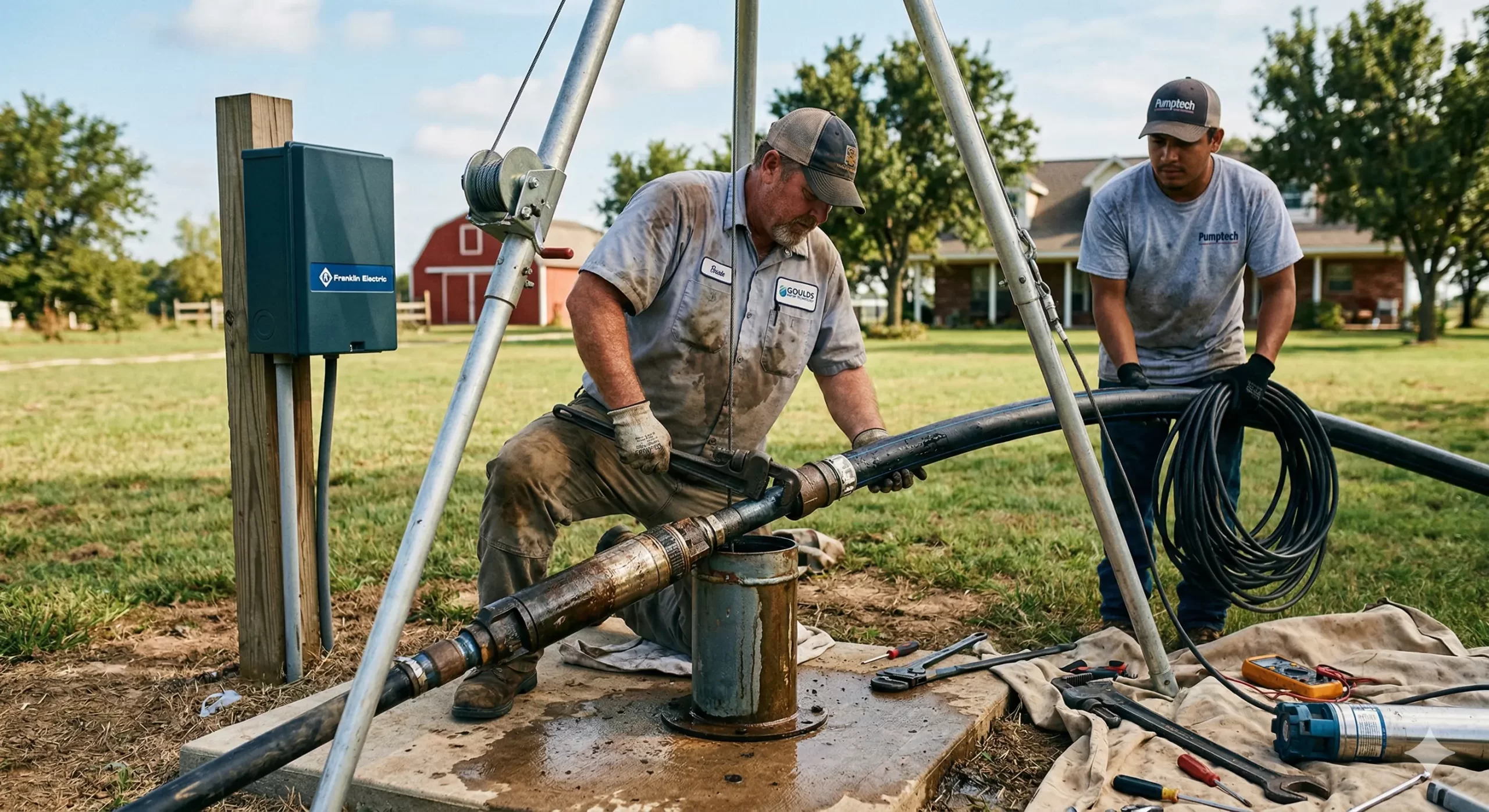
If the diagnostics point to a low water level, pulling the pump is non-negotiable. This procedure is hazardous and requires specialized equipment. A heavy-duty pump hoist, a tripod rig, or a dedicated boom truck is positioned over the wellhead. The technician will secure the drop pipe, wiring, and safety rope to the rig. A large, specialized T-handle wrench known as a ‘pitless key’ is lowered down the casing to engage the pitless adapter, which is the fitting that connects the internal drop pipe to the horizontal discharge pipe buried below the frost line. By lifting with the rig, the technician disengages the adapter, allowing the entire assembly—pump, motor, drop pipe, and wire—to be pulled vertically from the well. The combined weight can easily exceed 500 pounds, making manual pulling unsafe and impractical.
With the pump out of the well, a downhole well camera inspection is performed. This is the definitive step to assess the situation. The camera reveals the true static water level, shows the rate of water recovery after drawdown, and provides a clear visual of the well screen’s condition to check for blockage from sediment or mineral encrustation. Based on these findings, the technician will recommend the correct course of action: lowering the existing pump to a deeper setting (if the well depth allows), replacing the pump with a lower-volume model to match the well’s reduced yield, or advising on more significant well rehabilitation services like hydrofracturing.
Safety Protocol: All work is performed only after the corresponding 240V circuit breaker is shut off, locked out, and tagged out (LOTO procedure). Technicians must also wait several minutes after power-down before accessing VFD terminals, as the internal DC bus capacitors can store a lethal electrical charge long after the main power is disconnected.
Repair Cost & Time Assessment
The cost for diagnosing and addressing an ‘Err 3’ fault involves several components and typically ranges from $1,200 to $2,800 USD for the service call and repair, excluding the cost of a new pump if required. The initial service call fee, which includes travel and initial diagnostics with meters, is generally $150 to $250. The labor-intensive process of pulling a submersible pump requires two technicians for safety and efficiency, billed at a combined rate of $200-$300 per hour for an average of 3-5 hours. The use of specialized equipment, such as the pump pulling rig, incurs a flat fee often ranging from $250 to $500.
The most significant diagnostic cost is the downhole well camera inspection, which is critical for an accurate assessment and typically costs between $450 and $750. This fee covers the specialized equipment and the expert analysis of the footage. Therefore, a customer is paying for 6-10 man-hours of highly skilled labor, the deployment of thousands of dollars in specialized hoisting and diagnostic equipment, and the liability associated with working on high-voltage systems and heavy suspended loads. If the pump and/or motor are found to be damaged from the dry running, a replacement pump/motor assembly can add an additional $900 to $2,000 to the final invoice, depending on the horsepower and brand.
Fast Local Service & Diagnostics
Calls are routed to a licensed local well professional.