
Diagnosis: CentriPro Aquavar’s ‘Err 4’ code indicates a total loss of the pressure signal from the transducer, often caused by physical damage from freezing, wire breaks, or internal electronic failure. This guide explains the engineering causes, provides homeowner diagnostic steps, and outlines the professional repair process, including typical costs and safety protocols.
In this Guide:
What Causes the CentriPro Code Err 4 Issue?
The ‘Err 4’ fault on a CentriPro Aquavar drive is an explicit and non-negotiable error: the drive’s microprocessor has completely lost the analog signal from the pressure transducer. This is not an out-of-range reading; it is the equivalent of a cut wire, indicating an open circuit or a dead short. The transducer itself is a sophisticated solid-state device, typically using a piezoresistive strain gauge bonded to a diaphragm. System pressure flexes this diaphragm, changing the resistance and modulating a 4-20mA or 0-5VDC signal back to the drive. The most common cause of failure, as noted, is freeze damage. When water in the transducer’s sensing port or connecting pipe freezes, it expands with immense force, physically cracking the housing or rupturing the internal diaphragm. This immediately breaks the delicate internal connections, causing a total signal loss. Other causes include vibration-induced wire fatigue at the connection terminals, corrosion from moisture intrusion into the conduit, or a direct electrical failure of the transducer’s internal signal conditioning circuit.
A lost pressure signal forces the Variable Frequency Drive (VFD) into a critical failure mode, and its subsequent actions can cause a cascade of mechanical damage if not immediately addressed. Lacking a pressure reference, the VFD’s control logic is compromised. Depending on its firmware, it may default to a full-speed ‘run’ command, assuming zero pressure. This forces the pump to ‘dead-head’ against a full pressure tank or closed valve, creating extreme hydraulic pressure and massive axial thrust. This downthrust can rapidly destroy the motor’s thrust bearings, which are engineered for specific loads. Simultaneously, the motor is forced into an over-amperage condition, drawing current near its locked-rotor-amp (LRA) rating, which generates tremendous heat in the stator windings.
This extreme electrical and thermal stress directly threatens the motor and pump seals. The excessive heat generated by over-amperage can degrade the PVC or thermoplastic insulation on the motor windings, leading to turn-to-turn shorts and eventual catastrophic motor failure. While the VFD’s internal thermal overload protection should trip, repeated fault cycles can cumulatively weaken the insulation. Furthermore, the combination of high heat and excessive pressure spikes from dead-heading can compromise the pump’s mechanical seals. These seals, often made of carbon-ceramic or silicon carbide, are precision components that separate the pump end from the oil-filled motor. Heat and pressure can cause them to warp or crack, allowing water to intrude into the motor housing, shorting out the windings and contaminating the bearings. The ‘Err 4’ shutdown is ultimately a protective measure designed to prevent this very sequence of expensive mechanical and electrical failures.
DIY Troubleshooting Steps
- Safely De-energize the Entire System: Before any inspection, locate the double-pole circuit breaker labeled ‘Well Pump’ or similar in your main electrical panel and switch it firmly to the ‘OFF’ position. For added safety, apply a strip of electrical tape over the breaker to prevent accidental reactivation. This is a 240V system and is extremely dangerous.
- Visually Inspect the Transducer and Wires: Locate the pressure transducer. It is a small, typically stainless steel cylindrical device threaded into your plumbing near the pressure tank. Carefully examine its body for any cracks or bulging, which are clear signs of freeze damage. Trace its signal wire back to the Aquavar controller, looking for any chafing, cuts, or signs of rodent damage.
- Verify VFD Terminal Connections: Open the cover of the Aquavar controller. Check that the small transducer wires are securely clamped into the correct analog input terminals (e.g., AI1, GND). Gently tug on each wire to ensure it is not loose. Corrosion or discoloration on the terminals indicates a moisture problem that needs to be addressed.
- Inspect the Transducer’s Sensing Port: Check the small pipe nipple or tube that the transducer is mounted on. In areas with high mineral content, this port can become clogged with sediment or scale, effectively isolating the transducer from system pressure. A clogged port can sometimes mimic a failed sensor.
- Re-energize and Check Live Data (Use Caution): If you are comfortable working around a live panel, restore power. Navigate the VFD’s display menu to the parameter that shows the live analog input reading (often displayed in mA or PSI). If the reading is fixed at 0.0 or shows dashes, it confirms the drive is receiving no signal. If the reading fluctuates erratically, it may indicate a failing sensor or a poor connection.
- Assess for Ambient Moisture: Examine the environment around the VFD and pressure tank. High humidity, condensation, or leaks can lead to corrosion on the VFD’s control board terminals. Ensure the area is dry and that the VFD’s enclosure gasket is intact to prevent moisture ingress.
When to Call a Professional Well Service
A certified technician’s approach to an ‘Err 4’ fault is systematic and relies on specialized diagnostic tools. After confirming the basic visual checks, the first step is to isolate and test the signal loop. Using a professional multimeter with a milliamp (mA) function, the technician will disconnect the transducer wires at the drive and test the transducer directly. They can also use a loop calibrator to inject a known 4-20mA signal into the drive, definitively proving whether the fault lies with the drive’s analog input board or the transducer itself. If the transducer is confirmed dead (no signal output despite receiving excitation voltage from the drive), a replacement is necessary. Concurrently, the technician will use a Megohmmeter, often called a ‘Megger,’ to perform an insulation resistance test on the submersible motor windings and drop cable. This crucial step ensures that the erratic operation preceding the fault did not cause underlying electrical damage that would compromise a new transducer or the VFD itself.
The repair workflow begins with complete system de-pressurization and electrical lockout. The failed transducer is unthreaded from the plumbing, and the pipe threads are cleaned and prepped. A new, OEM-specified transducer is installed using both high-quality Teflon tape and pipe thread sealant to ensure a leak-proof seal. The new signal wires are then routed and meticulously connected to the proper terminals on the VFD control board, respecting polarity. Once the hardware is installed, the system is slowly re-pressurized to check for leaks. The technician then powers up the drive and enters the programming menu to perform a system calibration. This involves setting the low and high pressure setpoints and verifying that the VFD is reading the new transducer’s signal accurately across the pump’s entire operational curve. As a final preventative measure, the technician will insulate the transducer and its associated piping with foam pipe insulation and heat tape if it is located in an area susceptible to freezing.
Safety Protocol & Heavy Equipment
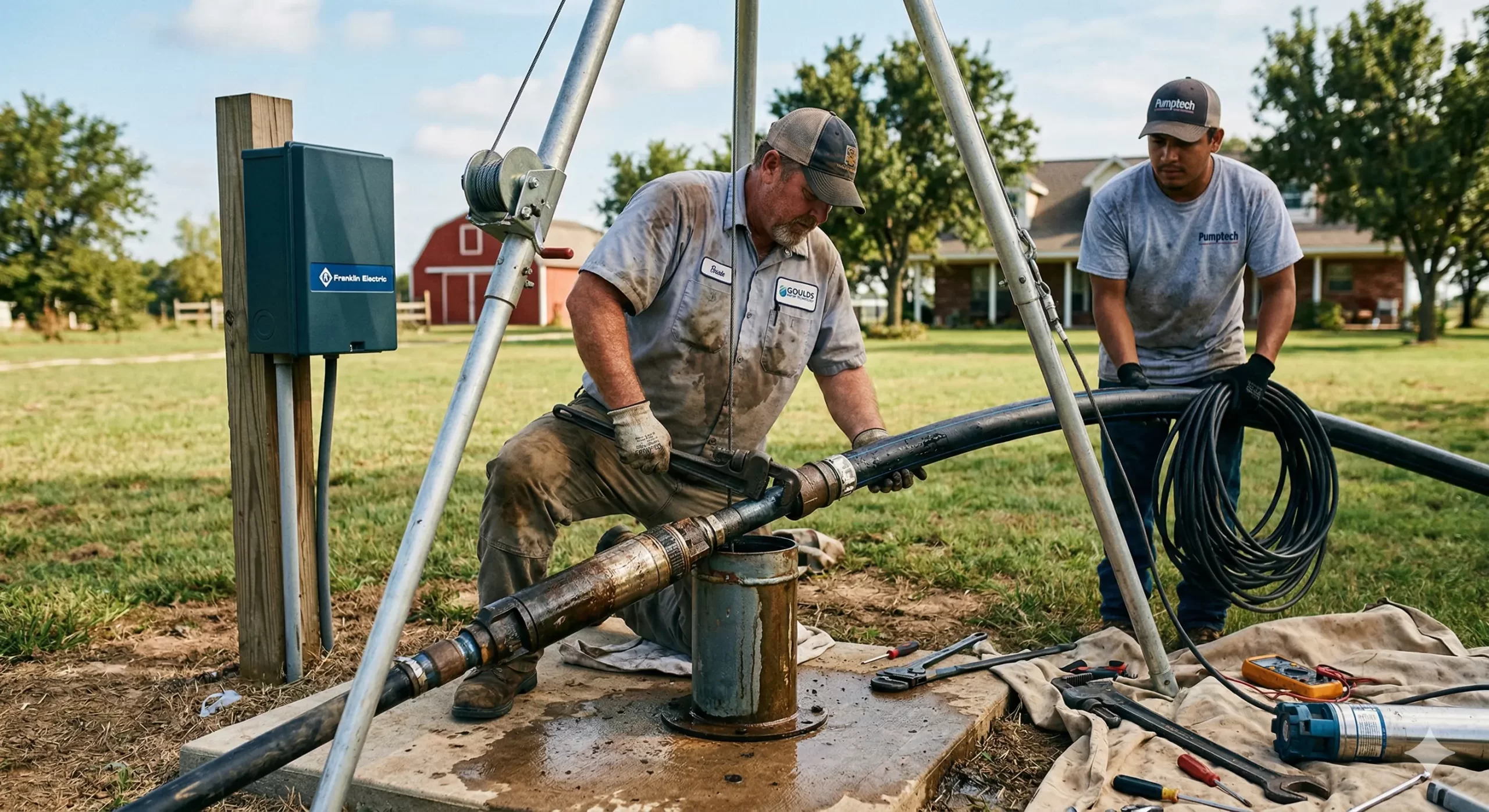
Handling any component of a 240V deep well pump system demands strict adherence to safety protocols. A professional will always perform a full Lockout/Tagout (LOTO) procedure on the circuit breaker to guarantee the system cannot be energized during service. If diagnostics suggest the pump itself needs to be inspected, specialized heavy equipment is mandatory. A submersible pump, along with hundreds of feet of water-filled pipe, can easily exceed 500 lbs. Attempting to pull this by hand is unsafe and risks injury or dropping the entire assembly down the well. A dedicated pump hoist or crane rig is used to safely lift the assembly. To disconnect the pump from the plumbing within the well casing, a technician uses a ‘Pitless Key,’ a specialized T-handle tool that securely latches onto the pitless adapter, allowing it to be pulled and disengaged without risk.
Repair Cost & Time Assessment
For a standard ‘Err 4’ service call involving a pressure transducer replacement, a homeowner in the United States can expect the total cost to be between $400 and $850. This price includes several components: a one-time service call or truck fee ($125-$200), skilled labor billed at 1.5 to 3 hours ($150-$225 per hour), and the cost of the replacement pressure transducer part itself, which can range from $125 for a standard model to over $400 for a high-end, stainless steel OEM component from Goulds or CentriPro.
The final cost and time are influenced by the accessibility of the equipment. A transducer located right next to a pressure tank in an open basement is a straightforward, 90-minute job. If the unit is in a cramped well pit or requires minor re-plumbing, the labor time will increase. The price will escalate significantly if the Megohmmeter test reveals damage to the downhole motor or cable, necessitating pulling the pump. A pump-pulling job is a much more involved process, often requiring two technicians and a pump hoist rig, turning a two-hour service call into a four-to-six-hour job and adding $800-$2,000+ in labor and equipment fees to the final invoice.
Fast Local Service & Diagnostics
Calls are routed to a licensed local well professional.