
Diagnosis: Danfoss VLT Alarm 60 indicates a trip from an external safety device connected to a digital input. This typically means a normally closed protective circuit, such as a float switch in a storage tank or a low-pressure cutout, has opened, signaling an unsafe operating condition like low water level. The drive halts the pump motor to prevent catastrophic damage from running dry.
In this Guide:
What Causes the Danfoss Alarm 60 Issue?
From an engineering perspective, Alarm 60 signifies an intentional and protective shutdown initiated by an open circuit on one of the VFD’s programmable digital inputs. Most booster pump and well systems are designed with a ‘daisy-chained’ normally closed (NC) safety circuit. This circuit can include multiple devices in series: low-level float switches in a storage tank, low-suction-pressure switches, high-discharge-pressure switches, or even flow sensors. When all conditions are normal, this circuit is complete, allowing a low-voltage DC signal (typically 24VDC) to flow back to the VFD’s input terminal (e.g., Terminal 27). If any device in this chain detects an anomaly—for example, a float switch drops due to a low water level in the storage tank—it opens the circuit. The VFD instantly detects the loss of the 24VDC signal and trips on Alarm 60, bringing the pump to a controlled stop to prevent mechanical self-destruction.
Ignoring or bypassing this critical safety interlock is a direct path to catastrophic equipment failure. When a centrifugal pump runs without water, a condition known as running dry, the consequences are severe and rapid. The pumped fluid is not just the product; it’s the primary lubricant and coolant for the pump’s internal components. Without water, the pump’s bearings, whether they are bronze, carbon, or ceramic, will overheat within minutes, leading to galling and seizure. The mechanical seal, which relies on a micro-thin film of water between its lapped faces, will overheat, causing the carbon and ceramic faces to crack and the elastomeric bellows to melt, resulting in a major leak once fluid is reintroduced.
Furthermore, the motor itself is at significant risk. While the VFD provides excellent electrical protection, running dry causes the motor to operate in a near no-load condition. This can cause the motor to over-speed beyond its design limits, putting extreme stress on the motor bearings. More critically, for submersible motors, the surrounding fluid is essential for dissipating heat from the motor windings. Without this cooling medium, the windings’ insulation can rapidly degrade and overheat, leading to a short circuit between phases or to the motor casing (ground fault). An Alarm 60 isn’t a nuisance; it is the VFD’s last line of defense against a cascade of failures triggered by an external system problem.
DIY Troubleshooting Steps
- Safely De-energize the Equipment: Before any inspection, perform a full Lockout/Tagout (LOTO) procedure. Turn off the main disconnect breaker feeding the Danfoss VLT drive. Use a calibrated multimeter to verify zero voltage at the drive’s main input terminals (L1, L2, L3). This is a non-negotiable first step for safety.
- Inspect VFD Control Terminals: Carefully open the VFD cover and locate the digital input terminals. The external interlock is commonly wired to Terminal 27, but consult the specific wiring diagram for your installation. Check for tight, secure connections. A single loose wire or a corroded terminal screw is a frequent cause of intermittent interlock faults.
- Physically Inspect the Interlock Device: Locate the external switch that is triggering the alarm. If it’s a float switch in a storage tank, visually inspect it. Is the water level actually low? Is the float tangled in piping or with other floats? Is the float’s tether properly adjusted? If it’s a pressure switch, check the associated pressure gauge to see if the pressure is truly below the setpoint.
- Verify Switch Continuity: With the power off, disconnect the two control wires for the interlock switch at the VFD terminals. Set your multimeter to the continuity or resistance (Ohms) setting. If the system condition is normal (e.g., tank is full, pressure is adequate), the switch should be closed. You should measure near-zero Ohms (or hear the continuity beep) across the two wires. If it reads open circuit (O.L.), the fault lies in the switch or the wiring back to it.
- Check VFD Parameter Settings: Power the drive back on (do not start the motor). Navigate the VFD’s menu to the parameters governing the digital input used for the interlock (e.g., Parameter Group 5-1*, Digital Inputs). Confirm the input is programmed correctly, typically as ‘External Interlock’ [8], and that the logic is correct (e.g., ‘Normally Closed’ or ‘NC’).
- Inspect Control Wiring Path: Visually trace the control wire from the VFD to the switch. Look for any signs of physical damage, such as crushed conduit, chafed insulation from vibration, or signs of water intrusion in junction boxes, which can cause corrosion and intermittent open circuits.
- Reset and Monitor: Once you have identified and corrected the cause (e.g., refilled the tank, untangled the float), securely reconnect all wiring. Power up the system, reset the fault on the VFD keypad, and start the pump. Carefully monitor the system to ensure the alarm does not return.
When to Call a Professional Well Service
When a qualified technician arrives, their first step is to systematically validate the entire interlock circuit. They will use a multimeter to confirm the presence and stability of the 24VDC control power supplied by the VFD. They will then proceed to the interlock switch itself, bypassing it with a temporary jumper at the switch location to isolate the wiring from the device. If the VFD alarm clears, the switch is confirmed as the faulty component. If the alarm persists, they will test the continuity of the control wire run itself, looking for a break or high resistance. If the entire control circuit—power, wiring, and switch—is verified to be operating correctly, the conclusion is that the interlock is functioning properly and tripping for a valid reason: the pump is failing to maintain water level or pressure.
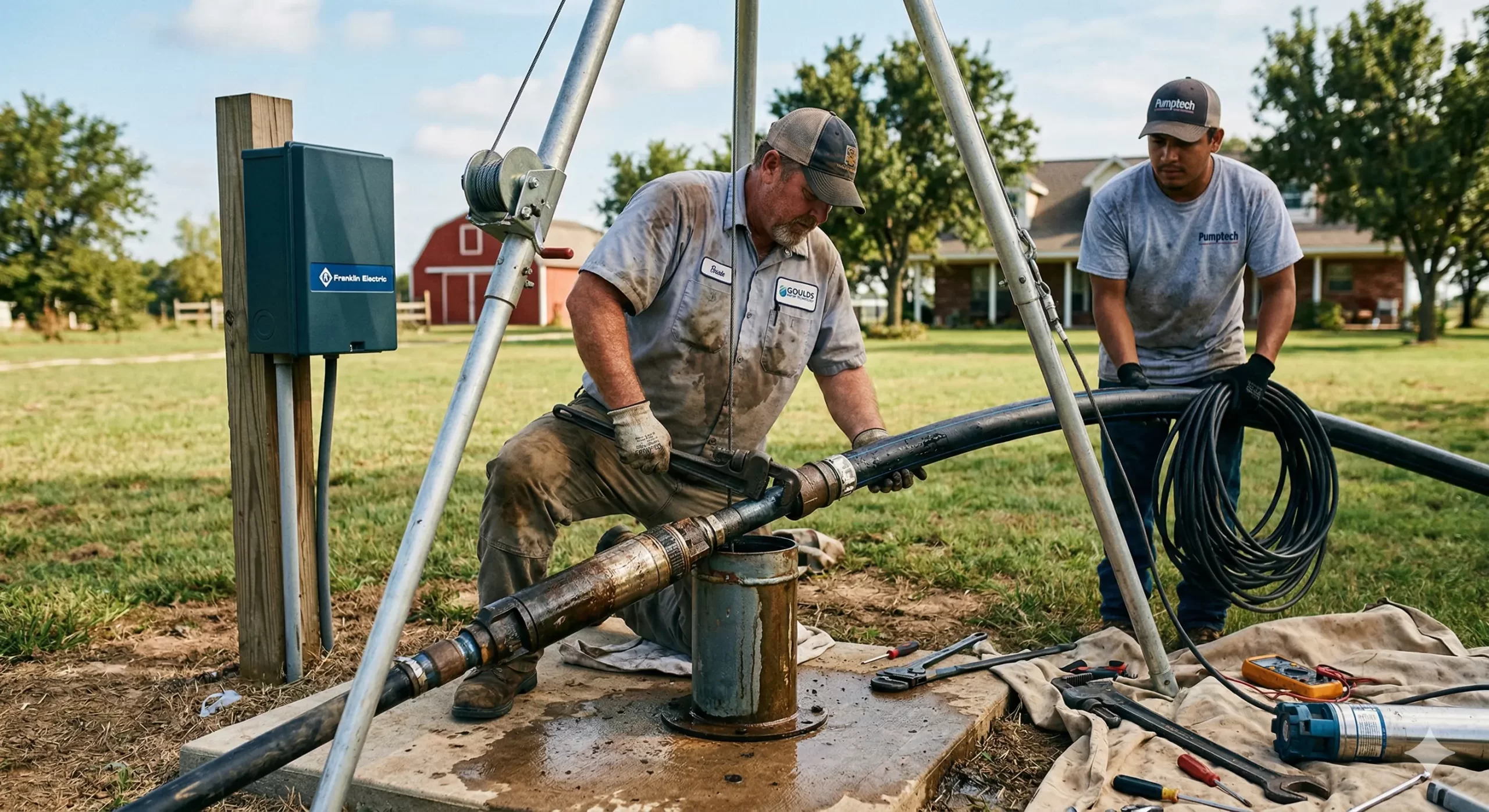
This is where the job escalates from control wiring to heavy mechanical work. For submersible pumps in wells or deep sumps, a specialized pump hoist or pulling rig is mandatory. A 6-inch, 10 HP submersible pump assembly can easily weigh over 500 lbs, and attempting to lift this manually with rope is incredibly dangerous and risks dropping the entire assembly down the well, damaging the pump, drop pipe, and power cable. A professional rig provides a controlled, mechanical advantage to safely retrieve the pump.
Safety Protocol: The work area will be secured, and the high-voltage circuit (240V or 480V 3-phase) will be locked and tagged out. The technician will use a pitless adapter key (for well applications) to safely disconnect the drop pipe from the service line without excavating the well head. The entire procedure requires a minimum of two trained personnel for safe handling of the heavy, awkward equipment.
Once the pump is at the surface, advanced diagnostics begin. The technician will use a megohmmeter (often called a ‘Megger’) to perform an insulation resistance test on the motor windings. This test applies a high voltage (500V or 1000V) to detect microscopic breaks or moisture intrusion in the winding insulation that a standard multimeter cannot find. A reading below 1-2 megohms to ground indicates a failing motor. Concurrently, the pump’s wet end is inspected for clogged impellers, bearing seizure (by attempting to turn the shaft by hand), or a cracked housing. Based on these findings, the technician will either service the pump’s wet end or recommend a full replacement of the pump and motor assembly, ensuring the new unit is correctly sized for the application’s required flow and head pressure.
Repair Cost & Time Assessment
The cost and duration of resolving an Alarm 60 vary dramatically based on the root cause. For a simple control circuit issue—such as a failed float switch, a loose wire on a terminal block, or a required parameter adjustment—the repair is straightforward. A customer can expect to pay for a standard service call, typically ranging from $250 to $550. This generally covers 1.5 to 3 hours of a certified technician’s time, including travel and the cost of minor components like a new float switch or terminal lug.
However, if the interlock is tripping because the pump itself has failed and must be pulled, the cost escalates significantly. This becomes a major repair project. A customer should budget between $1,800 and $5,000+. This comprehensive cost includes: a service call fee for a two-person crew (required for safety), a dedicated charge for the pump hoist truck (typically $400-$800 per job), several hours of skilled labor for pulling, diagnosing, and reinstalling the pump, and the cost of premium replacement parts. A new submersible pump and motor assembly can range from $800 to over $3,000 alone, depending on brand, horsepower, and materials. The entire job can take anywhere from 4 to 8 hours, assuming parts are readily available. Emergency after-hours or weekend service will incur additional premium labor charges.
Fast Local Service & Diagnostics
Calls are routed to a licensed local well professional.