
Diagnosis: A leaking Square D Pumptrol switch indicates a ruptured internal diaphragm, allowing water to flood electrical contacts. This failure, often caused by material fatigue or water chemistry, can lead to rapid pump cycling and catastrophic motor damage. Immediate power disconnection and professional assessment are critical to prevent further system failure.
In this Guide:
What Causes the Square D Течет вода из коробочки Issue?
The core of a Pumptrol pressure switch is an EPDM or nitrile rubber diaphragm separating the pressurized water system from the 240-volt electrical snap-action contacts. This diaphragm is engineered to flex with each pump cycle, absorbing the pressure wave and actuating the switch. However, it is a point of mechanical fatigue. Over millions of cycles, compounded by factors like high iron content, sediment abrasion, or chemical degradation from chlorine or hydrogen sulfide, the rubber becomes brittle. Micro-fractures develop, and eventually, the system’s operating pressure (typically 40-60 PSI) forces water through a pinhole, which rapidly tears into a full rupture. At this point, pressurized water jets directly onto the live electrical terminals, creating an immediate and dangerous short-circuit path.
This water intrusion initiates a cascade of electrical failures. The short-circuiting across the terminals causes the switch to ‘chatter’—opening and closing contacts in rapid succession. This forces the pump motor into a brutal series of high-amperage startups, each demanding an inrush current 5 to 7 times its normal running load. This generates immense heat within the motor windings, far exceeding the thermal limits of their enamel insulation. The insulation breaks down, leading to shorts between windings or a direct short-to-ground, which will either trip the breaker or completely burn out the motor. For single-phase motors, the centrifugal start switch and start capacitor, designed for only a brief startup duty, are quickly destroyed by this relentless cycling.
The mechanical damage is just as severe. The pump’s thrust bearings, designed to handle the immense downthrust of the impeller stack during startup, are subjected to repeated, violent impacts during rapid cycling. This leads to spalling and premature failure of the bearing race, which can allow the impeller assembly to drop and grind against the diffuser stages, destroying the hydraulic efficiency of the pump’s wet end. Simultaneously, a switch that fails in the ‘on’ position will cause the motor to run continuously, even against a closed valve (running ‘dead-headed’). This not only generates extreme heat but can boil the water within the pump housing, cooking the motor’s shaft seals. Once these seals fail, well water floods the motor housing, contaminating the bearings and guaranteeing catastrophic failure.
DIY Troubleshooting Steps
- Immediate Power Disconnection: Before any inspection, locate the dedicated double-pole circuit breaker for the well pump in your main electrical panel and switch it to the full OFF position. Use a non-contact voltage tester at the pressure switch to confirm all power is off. This is the most critical safety step.
- Visual Inspection of Switch Internals: With power verified off, carefully remove the gray cover of the Square D Pumptrol switch. Look for undeniable evidence of moisture: water droplets, white or green mineral deposits (efflorescence or corrosion) on the contacts, springs, or wiring terminals. A ruptured diaphragm will leave a clear trail of water damage.
- Check Pressure Tank Air Charge: Locate the Schrader valve on your pressure tank (it looks like a tire valve). Use an accurate tire pressure gauge to check the air pre-charge. The tank should be empty of water for this check. The pressure should be 2 PSI below the pump’s cut-in pressure (e.g., for a 40/60 PSI switch, the tank pre-charge should be 38 PSI). An improperly charged or waterlogged tank causes short-cycling, which puts excessive stress on the switch diaphragm.
- Observe Fused Contacts or Overload Trip: Look closely at the electrical contact points inside the old switch. Are they blackened, pitted, or physically melted together? Water-induced arcing can weld the contacts closed, causing the pump to run continuously. If your system has an external control box, check if the manual thermal overload reset button has been tripped.
- Monitor Pump Cycle Time (Post-Repair): After a professional installs a new switch, use a stopwatch to time the pump’s run cycle from when it cuts in to when it cuts out. A healthy system should run for a minimum of 60 seconds. A very short cycle time (e.g., under 20 seconds) indicates an underlying problem like a failed pressure tank that will quickly destroy the new switch.
- Amperage Draw Measurement (Advanced Users Only): If you are qualified and possess a clamp-on ammeter, measure the current on both hot legs (L1 and L2) of the pump circuit while it is running. The reading should be balanced and at or below the Full Load Amps (FLA) listed on the motor’s nameplate. An amperage reading that is high or climbing indicates the motor was likely damaged during the failure event and is straining towards a complete burnout.
When to Call a Professional Well Service
A qualified technician’s approach extends far beyond simply replacing the failed part. The first action is a strict lockout/tagout procedure at the breaker panel. The core diagnostic tool is not a wrench, but a Megohmmeter. By applying 500-1000V DC, this instrument tests the insulation resistance of the motor windings and the entire length of the submersible drop cable. A reading in the gigaohms or high megaohms indicates a healthy system; a reading below one megaohm to ground signals compromised insulation. This test is critical because it determines if the short-cycling event has already destroyed the motor. Replacing the switch without performing a ‘Megger’ test is malpractice, as a damaged motor will cause the new switch to fail almost immediately.
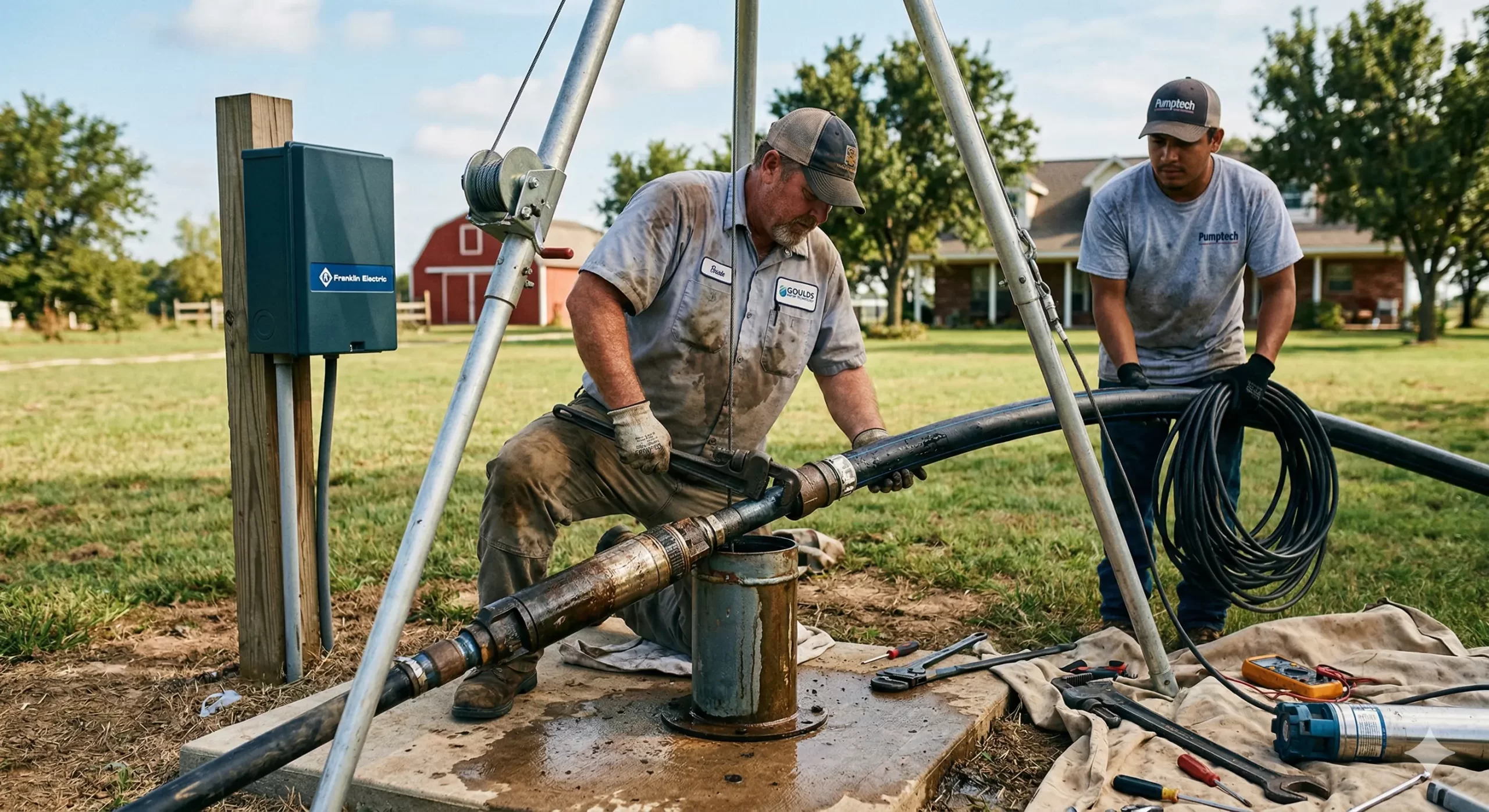
If the Megohmmeter test fails or a deeper inspection is required, the technician will deploy a specialized Pump Hoist or pulling rig. This hydraulic or electric crane is positioned directly over the wellhead and is essential for safety. A 4-inch submersible pump assembly, including hundreds of feet of water-filled pipe and heavy gauge wire, can easily weigh 400-600 lbs—far too much to be pulled safely by hand. The technician will use a large T-handle Pitless Key to reach down into the well casing and disengage the pitless adapter. This clever device allows the entire pump assembly to be lifted out of the well for service without excavating the buried water line, saving immense time and landscape damage. The pump, motor, and wire are then thoroughly inspected on the surface for abrasions, signs of overheating, or bearing wear.
The final repair phase is executed with precision. After replacing the faulty component—be it just the switch or the entire pump and motor—all electrical connections are meticulously cleaned of any oxidation. If a new pump is installed, waterproof heat-shrink splices are used to connect the motor leads to the drop cable, ensuring a permanent, watertight seal. Once the pump is re-installed and the pitless adapter is locked in place, the system is subjected to a pressure test to ensure all fittings are secure. The technician will then calibrate the new pressure switch, verify proper pump cycle times, and measure the running amperage to confirm it matches the motor’s specifications. As a final step in professional service, the well is shock chlorinated to sanitize the system from any surface bacteria introduced during the repair, protecting the homeowner’s water quality.
Repair Cost & Time Assessment
Scenario 1: Simple Pressure Switch Replacement. If a professional diagnosis confirms the motor and wiring are undamaged, the repair is straightforward. A service call to replace the Square D Pumptrol switch, clean terminals, and verify system operation typically costs between $275 and $500. This price includes 1-2 hours of a licensed technician’s labor, the cost of a high-quality, American-made pressure switch, and service vehicle overhead. The higher end of this range reflects emergency after-hours or weekend service calls.
Scenario 2: Full Pump and Motor Replacement. If the investigation reveals the initial switch failure caused a terminal motor burnout, the scope and cost increase substantially. A full pump pull and replacement is a complex job requiring a two-person crew, a dedicated pump hoist rig, and several hours of intensive labor. The total cost for this service typically ranges from $2,000 to $5,000+. This comprehensive figure includes the labor for pulling and reinstalling the pump (4-7 hours), the cost of the new submersible pump and motor assembly, new heat-shrink splice kits, and potentially a new length of submersible wire or a check valve. The final price is primarily dictated by the depth of the well (more pipe and wire) and the horsepower and brand of the replacement pump.
Fast Local Service & Diagnostics
Calls are routed to a licensed local well professional.