
Diagnosis: A Franklin Cerus X-Drive Fault 16 indicates a dangerous ground fault, where high-voltage current is leaking to ground. This is typically caused by a failed underwater cable splice or water intrusion into the submersible motor, requiring immediate system shutdown and professional service to pull the pump and repair the failed component.
In this Guide:
What Causes the Franklin Electric Fault 16 Issue?
A ground fault (Fault 16) on a Cerus X-Drive is a critical safety trip, indicating that electrical current is escaping its intended path within the motor windings or drop cable and leaking directly to ground. The technical cause is a catastrophic failure of the system’s electrical insulation. This occurs when the insulation resistance between a phase conductor (U, V, or W) and the earth ground drops below the VFD’s safety threshold, typically into the low kilohm or ohm range. The Variable Frequency Drive (VFD) is constantly monitoring for current imbalances, and when it detects that a significant portion of the current sent down to the motor is not returning, it immediately trips to prevent electrocution hazards, further equipment damage, and potential damage to the well casing itself.
The most common root cause is water intrusion directly into the submersible motor housing. Over years of service, the motor’s shaft seals can degrade due to abrasion from sand or mineral deposits. Once these seals are compromised, well water displaces the dielectric oil filling the motor. Because water is conductive (especially mineral-rich well water), it creates a direct short circuit path from the high-voltage motor windings to the motor’s steel case, which is grounded to the earth via the well casing. This breach causes immense, localized heat, which can flash-vaporize the water and remaining oil, creating a pressure spike that ruptures internal components and permanently destroys the winding’s enamel insulation. This event can also severely damage the thrust bearings and radial support bearings due to the violent electrical arcing and subsequent mechanical shock.
A second, equally common failure point is the submersible heat-shrink splice connecting the motor’s short factory lead to the main drop cable. This splice is the system’s weakest link if not performed perfectly. An improper installation—due to contamination, insufficient heating, or using the wrong materials—will inevitably allow water to wick into the connection over time. Water molecules will penetrate the adhesive lining of the heat-shrink tubing and create a conductive path between the copper conductor and the surrounding water. The VFD’s high-frequency, pulsed voltage output can accelerate this degradation process, leading to a carbon track forming through the insulation, which eventually develops into a low-resistance path to ground, triggering the fault.
DIY Troubleshooting Steps
- IMMEDIATE SHUTDOWN AND LOCKOUT: This is not a nuisance fault. A ground fault represents an active, high-voltage electrical hazard. Immediately turn off the circuit breaker feeding the VFD. For safety, apply a lockout/tagout device to the breaker to prevent accidental re-energization while you inspect the system.
- Visual Inspection of Topside Equipment: Carefully inspect all wiring at the wellhead and at the control panel. Look for burnt wires, signs of moisture intrusion in the conduit, or damage from insects or rodents. Check that the grounding connections at the VFD and wellhead are tight and free of corrosion.
- Isolate the Motor from the Drive: With the breaker OFF and locked out, disconnect the three motor leads (terminals U, V, W) from the load side of the Cerus X-Drive. This completely isolates the controller from the downstream wiring and motor.
- Perform an Insulation Resistance Test to Ground: This is the definitive DIY test. Using a multimeter set to the highest resistance (Ohms) setting, measure between each disconnected motor lead and the ground terminal. Place one probe on U and the other on the Ground lug. Repeat for V-to-Ground and W-to-Ground. A healthy system will read infinite resistance (often displayed as ‘O.L.’ or ‘Open Line’). If you get any numerical resistance reading, even in the mega-ohm range, you have confirmed a ground fault in the cable or motor.
- Check VFD Functionality (After Isolation): With the motor leads still disconnected, you can safely turn the breaker back on. Attempt to start the VFD. If the Fault 16 code does NOT reappear, it confirms the VFD is likely functioning correctly and the fault lies in the wiring or motor. If the fault immediately reappears with nothing connected to the output, the VFD itself may have a faulty internal ground current sensor, which requires professional service.
- Review System Run History: Check your system’s pressure tank and controls. A waterlogged pressure tank causes the pump to short-cycle (turn on and off rapidly). This excessive starting and stopping causes severe thermal stress on the motor windings and cable splices, accelerating insulation breakdown and leading to faults like this one.
When to Call a Professional Well Service
Upon arrival, a certified technician’s first action is to verify the fault and confirm the diagnosis using specialized equipment. They will use a high-voltage insulation resistance tester, commonly known as a Megohmmeter or ‘Megger’. This instrument applies a DC voltage of 500V or 1000V to the wiring, which is far more effective at detecting subtle insulation weaknesses than a standard multimeter. The test is performed first at the control panel and then at the wellhead to isolate whether the fault is in the drop cable or the motor itself. Any reading below 5 megohms is cause for concern, and a reading under 1 megohm confirms a critical failure requiring the pump to be pulled.
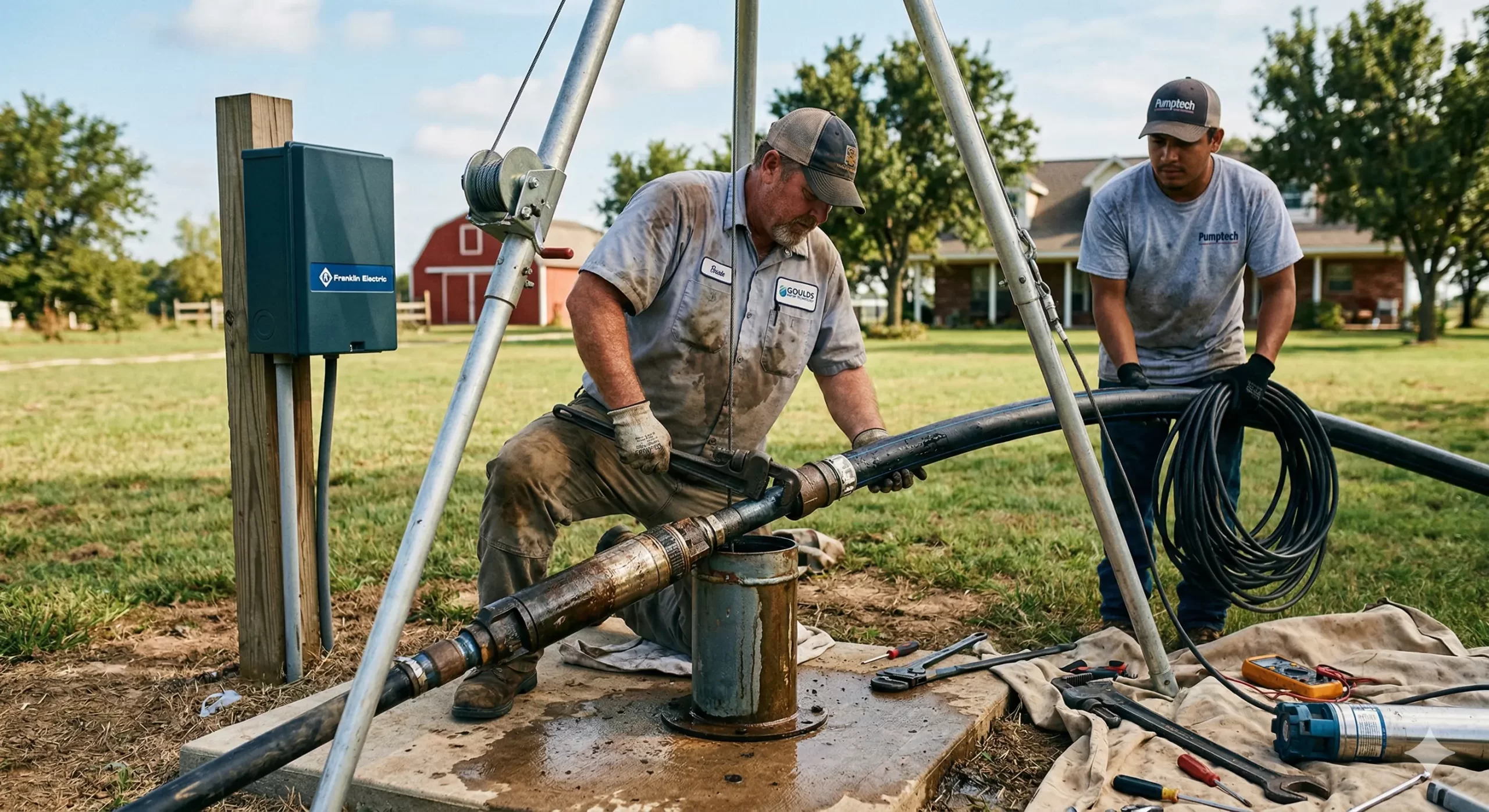
Pulling a submersible pump is a heavy and dangerous operation that demands a specialized pump hoist or pulling rig. A typical 4-inch submersible pump and motor assembly, along with hundreds of feet of water-filled pipe and heavy-gauge cable, can weigh between 300 and 800 pounds or more. The technician will first attach the rig to the drop pipe at the wellhead. They will then use a ‘Pitless Key,’ a long T-handle tool, to reach down into the casing and unlatch the pitless adapter, which creates the watertight seal against the well casing. Once disengaged, the entire assembly is free to be lifted vertically out of the well by the rig’s winch. Attempting this manually is extremely dangerous and risks dropping the entire assembly down the well, causing catastrophic damage.
Safety Protocol
All professional work is conducted under strict Lockout-Tagout (LOTO) protocols at the main disconnect. The high voltage (240V or 480V) present in these systems, combined with a wet environment and a confirmed path to ground, creates a life-threatening electrocution risk. Once the pump is on the surface, the technician performs a conclusive inspection to identify the point of failure—often a visibly burnt section of cable, a failed heat-shrink splice, or a motor that shows signs of internal arcing. The failed component is replaced, a new waterproof splice is meticulously constructed, and the entire assembly is Megger-tested again on the ground to ensure insulation integrity before it is carefully lowered back into the well.
Repair Cost & Time Assessment
The cost for a professional repair of a Fault 16 ground fault typically ranges from $1,800 to $5,000 USD. The final price is highly dependent on the pump’s depth, the horsepower of the motor, and the extent of the damage. A service call for a shallow well (under 150 feet) that only requires a new section of cable and a splice will be on the lower end of that range. Conversely, a deep-set (300+ feet) high-horsepower pump that requires a complete motor and drop cable replacement will be at the upper end.
The customer’s investment covers several critical aspects: the mobilization of a service truck equipped with a hydraulic pump hoist (a significant equipment expense), the labor for two certified technicians for a period of 4 to 8 hours, and the cost of premium replacement parts. A new Franklin Electric submersible motor alone can cost between $600 and $2,500 depending on its size and phase. The heavy-duty submersible drop cable is also a major cost factor. Opting for a professional service ensures the job is done safely with the correct equipment, preventing further damage to the well and ensuring the long-term reliability of the water system.
Fast Local Service & Diagnostics
Calls are routed to a licensed local well professional.