
Diagnosis: A Yaskawa V1000 ‘oC’ (Overcurrent) fault indicates the drive detected excessively high current draw, typically caused by a seized or burned-out submersible motor. This severe mechanical binding, often from debris lodging in the pump’s hydraulic end, prevents rotation and results in a near-direct short, forcing a professional repair involving pulling the pump for replacement.
In this Guide:
What Causes the Yaskawa oC Issue?
An ‘oC’ fault code on a Yaskawa V1000 VFD represents a critical failure mode: Overcurrent. This is not a transient nuisance trip; it signifies that the drive’s output current has exceeded its programmed or hardware limit, a protective measure to prevent catastrophic damage to both the drive and the motor. The root cause, as translated from field diagnostics, is a motor that is mechanically locked or electrically shorted. When a submersible pump motor is blocked by a foreign object—such as sand, gravel, or well casing debris—its impellers cannot rotate. Electrically, a motor at zero RPM (a locked-rotor condition) presents an extremely low impedance path to the VFD. According to Ohm’s Law (I = V/R), this near-zero resistance demands an almost infinite amount of current. The VFD attempts to supply this current to overcome the stall, instantly hitting its overcurrent threshold and tripping to protect its insulated-gate bipolar transistors (IGBTs).
The physics of this failure cascades rapidly from mechanical to electrical. The initial mechanical seizure of the pump’s hydraulic (wet) end places immense axial and radial stress on the motor’s bearing assembly. Thrust bearings, designed to handle thousands of pounds of downthrust during normal operation, are now subjected to violent torsional forces. This can lead to bearing race damage, galling, and complete seizure of the motor shaft itself. Simultaneously, the massive inrush current generates extreme heat within the motor windings due to Joule heating (P = I²R). This intense thermal stress quickly exceeds the temperature rating of the winding’s enamel insulation, causing it to melt and fail. The result is a turn-to-turn or phase-to-ground short circuit, permanently damaging the motor. At this point, even if the mechanical obstruction were cleared, the motor is electrically compromised and will continue to cause an overcurrent fault.
Furthermore, the secondary effects of a seized motor can compromise the entire downhole assembly. The violent torque of a locked-rotor startup attempt can stress the pump-to-motor NEMA spline coupling, potentially shearing it. Internal seals, designed to operate within specific pressure and temperature ranges, can fail under the extreme heat, allowing water intrusion into the motor stator cavity—a fatal condition for an oil-filled motor. This combination of mechanical seizure, bearing failure, and subsequent electrical winding burnout creates a scenario where a simple reset is futile. The fault is not in the drive’s programming but deep within the well, necessitating a complete physical extraction and component replacement.
DIY Troubleshooting Steps
- Power Down and Visually Inspect: Before any action, perform a complete lockout/tagout (LOTO) of the main breaker feeding the VFD. Open the drive panel and check for any visible signs of overheating, such as discolored wiring, melted terminal blocks, or a distinct acrid smell, which could indicate a VFD component failure in addition to the motor issue.
- Verify VFD Fault Log: Power the system back on briefly without attempting to start the pump. Navigate to the Yaskawa V1000’s fault log (monitor U1-13) and confirm that ‘oC’ (Overcurrent) is the most recent and persistent fault. Document any other preceding faults that might provide context.
- Check VFD Motor Parameters: Review the VFD’s basic motor parameters (E2-01 through E2-04) to ensure they correctly match the motor nameplate data for Full Load Amps (FLA), voltage, and frequency. Incorrect parameters can cause nuisance overcurrent trips, although a locked rotor will trip even with perfect settings.
- Measure Input Voltage: With the system energized but idle, use a true-RMS multimeter to verify the incoming L1, L2, and L3 voltage at the VFD’s input terminals. Ensure the voltage is balanced across all phases and within the drive’s specified operating range. Unbalanced voltage can contribute to excess current draw.
- Perform a Static Amperage Check (Advanced): If you are qualified and equipped with a true-RMS clamp-on ammeter, briefly command the pump to run while monitoring the current on one of the output legs (U, V, or W). An instantaneous spike far exceeding the motor’s FLA rating, immediately followed by the ‘oC’ trip, confirms a dead short or locked rotor condition downhole. Do NOT attempt this repeatedly, as it stresses the VFD’s output transistors.
- Isolate the Motor: As a final definitive test, a qualified technician can disconnect the motor leads from the VFD’s output terminals (U, V, W) and attempt to run the drive in an open-loop or test mode at a very low frequency (e.g., 5 Hz). If the drive runs without faulting, the problem is confirmed to be in the wiring or the motor itself. If it still faults, the VFD may have a hardware issue.
When to Call a Professional Well Service
Upon confirming a downhole failure, the professional repair process is initiated, centered on safely pulling the pump. This is a high-risk operation involving high voltage and heavy equipment, demanding strict adherence to safety protocols. The first step is always electrical isolation. The technician will perform a verified LOTO at the main disconnect, then use a multimeter to confirm zero energy at the VFD input and output terminals. Next, a megohmmeter (or ‘Megger’) is used. By disconnecting the motor leads at the wellhead and applying a high voltage (typically 500V or 1000V), the technician measures the insulation resistance between the motor windings and ground. A reading below 1 megohm, and often in the low kilohms or even zero, definitively condemns the motor as electrically shorted and justifies the significant cost and effort of pulling it.
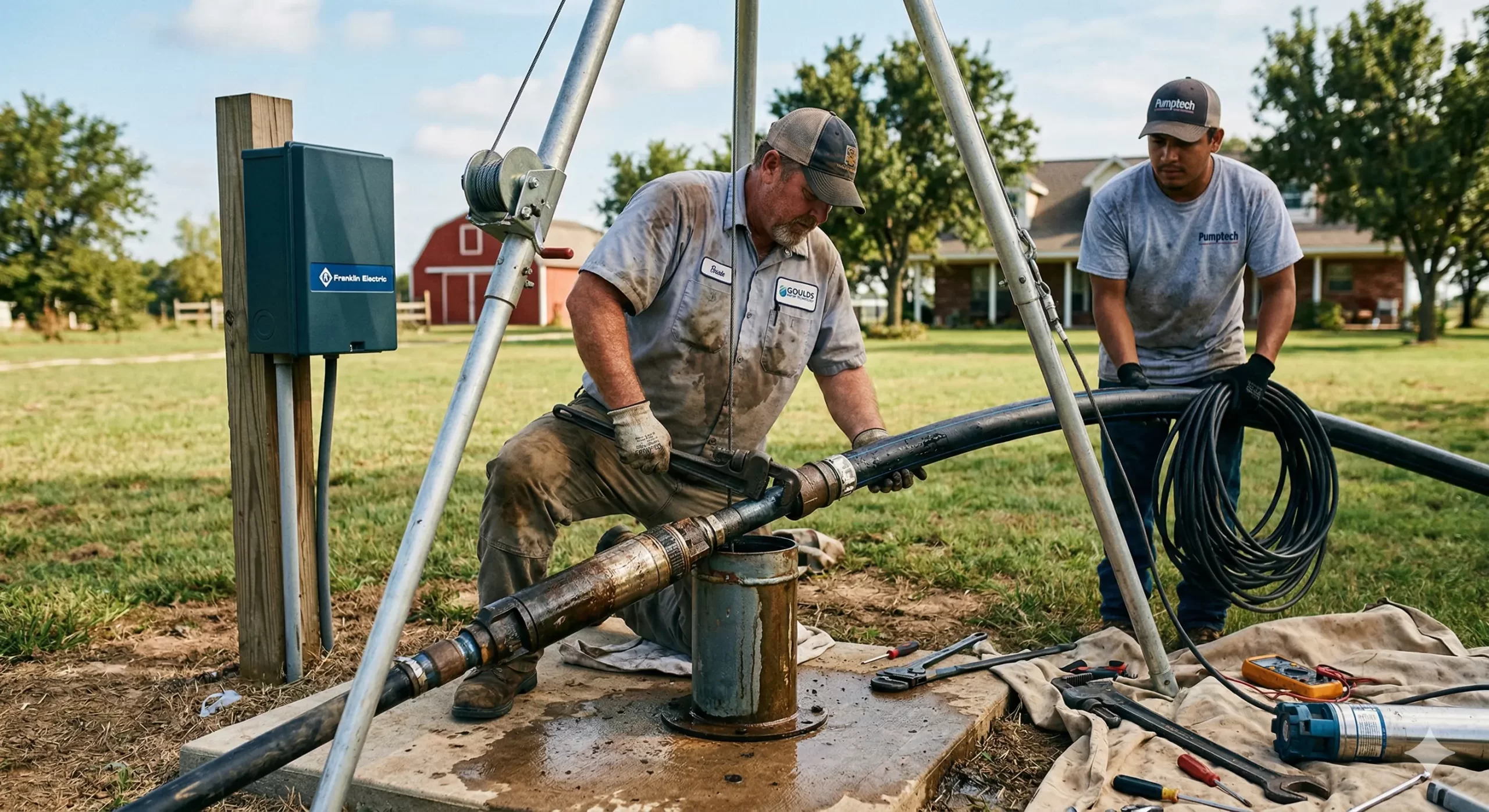
With the motor condemned, a specialized pump hoist or pulling rig is positioned over the wellhead. This equipment is non-negotiable for safety and efficiency, as a deep-set 4-inch or 6-inch pump assembly with water-filled pipe can weigh well over 500 pounds. The technician will remove the well cap, and using a pitless adapter T-handle key, will slide down the casing to engage and unlock the pitless unit, allowing the entire drop pipe, pump, and motor assembly to be lifted vertically out of the well. The technician and an assistant will carefully guide the pipe, uncoupling sections every 10 or 20 feet and stacking them, while also managing the submersible power cable to prevent kinking or damage. This is a methodical, labor-intensive process that requires experience to prevent dropping the assembly back down the well.
Safety Protocol
Handling a 240V/480V system connected to a heavy, suspended load is inherently dangerous. All personnel must wear appropriate Personal Protective Equipment (PPE), including steel-toed boots, gloves, and safety glasses. The pump hoist must be rated for the calculated load and positioned on stable, level ground. A secondary safety clamp or ‘dog’ must be used on the drop pipe below the joint being worked on to prevent the entire string from falling if a hoist mechanism fails. Electrical work must only be performed after a zero-energy state has been verified by a qualified electrician.
Once on the surface, a full diagnosis is performed. The pump intake screen is inspected for the source of the blockage. The technician will attempt to manually turn the pump shaft; if it is seized solid, it confirms the mechanical failure. The decision is then made to either replace the entire pump/motor assembly or, if the motor is salvageable (rare in this scenario), just the hydraulic ‘wet’ end. The new unit is assembled, and a new waterproof heat-shrink splice is meticulously created to connect the motor leads to the main submersible cable—a common point of failure if done incorrectly. The entire assembly is then carefully lowered back into the well, the pitless adapter is re-seated, and the system is prepared for restart and testing.
Repair Cost & Time Assessment
The cost for a professional pump pulling and replacement due to a locked rotor condition is substantial, typically ranging from $1,800 to $4,500 USD. This price is highly dependent on the pump’s depth, horsepower, and local labor rates. The customer is paying for a comprehensive service that includes a diagnostic service call, the mobilization of a two-person crew (a safety requirement for this work), and the use of a specialized pump hoist rig, which can be an hourly or flat-rate charge. Labor accounts for a significant portion, as a deep-set pump can take 4-8 hours to pull and reinstall.
The largest variable in the final invoice is the cost of replacement parts. A new submersible motor and hydraulic end from a premium brand like Franklin Electric or Grundfos can cost anywhere from $800 for a small residential unit to over $3,000 for a high-horsepower agricultural pump. Additional materials like new drop pipe sections, a new submersible cable, or a new check valve will also be itemized. The final cost reflects the complexity, physical risk, specialized equipment, and high-value components required to restore a critical water system to operation.
Fast Local Service & Diagnostics
Calls are routed to a licensed local well professional.