
Diagnosis: An instantly tripping breaker on a 240V Myers submersible pump signifies a catastrophic failure, typically a dead short to ground within the motor windings or the underwater drop cable. This condition requires immediate professional intervention, as the definitive diagnosis involves a megohmmeter insulation test and the repair mandates pulling the pump from the well for complete replacement.
In this Guide:
What Causes the Myers Breaker Keeps Tripping Issue?
The primary cause of an instantaneous breaker trip is a dead short, which is a low-resistance path between a current-carrying conductor and a ground potential. Inside your Myers Predator motor, thousands of feet of copper wire are wound into coils to form the stator. Each copper strand is coated with a thin, yet critical, layer of enamel insulation. Over years of service, thermal cycling from the motor starting and stopping causes this enamel to become brittle. A significant voltage surge, such as from a nearby lightning strike or utility grid fluctuation, can easily puncture this weakened insulation. The moment this happens, 240 volts arc directly to the motor’s steel housing, which is bonded to ground. Per Ohm’s Law (I=V/R), with resistance approaching zero, the current skyrockets to hundreds of amps, forcing the circuit breaker to trip in milliseconds to prevent a fire.
Mechanical failures are often the precursor to electrical catastrophe. The motor is protected by a set of shaft seals that contain its dielectric oil and keep well water out. If these seals fail due to age or abrasive sediment, water will ingress into the motor housing. Water, especially mineral-rich well water, is conductive and will immediately compromise the stator’s insulation, creating multiple paths to ground and causing a dead short. Concurrently, a failure of the upper or lower motor bearings can cause the rotor to seize or wobble, making contact with the stator. This mechanical seizure stalls the motor, but the control box keeps sending power. The windings, unable to turn, rapidly overheat past their thermal limits, melting the enamel insulation and causing the windings to short against each other (phase-to-phase) or against the motor case (phase-to-ground).
The fault is not always inside the pump motor itself. The submersible drop cable, which runs hundreds of feet down the well casing, is a frequent point of failure. During pump cycles, the motor’s torque can cause the cable to twist and rub against the rough steel or PVC well casing. Over thousands of cycles, this abrasion can wear through the cable’s tough outer jacket and the individual conductor insulation. Once a bare copper conductor touches the wet casing, a direct ground fault occurs, which is electrically identical to an internal motor short. Similarly, the heat-shrink splice connecting the drop cable to the short motor lead is a critical point. If not installed perfectly, water can slowly migrate into the splice over time, leading to corrosion and an eventual short circuit between conductors or to ground.
DIY Troubleshooting Steps
- SAFETY WARNING: This fault involves a 240V system in a potentially wet environment. Proceed with extreme caution. Turn off the breaker and verify power is off with a multimeter before touching any wiring. If you are not 100% confident, stop and call a professional.
- Visual Control Box Inspection: With the power locked out, open the pump control box. Look for obvious signs of failure such as bulging/leaking capacitors, burnt or melted wires, black scorch marks on the terminals, or the distinct smell of burnt electronics. These signs point to a severe overcurrent event.
- Static Insulation Test (at Control Box): Disconnect the three wires leading from the control box down to the well pump (typically labeled Y, R, B or L1, L2, G). Set your multimeter to the highest Ohms (Ω) setting. Test the resistance between each power leg (Y, R) and the ground wire (G). Then test between the two power legs (Y to R). A healthy pump and cable will show infinite resistance (OL or open line). Any reading, especially one under a few thousand ohms, confirms a short circuit downhole.
- Inspect Above-Ground Wiring: Carefully inspect all visible conduit and wiring between the breaker panel, any disconnects, the pressure switch, and the well head cap. Look for any physical damage from landscaping equipment, rodents, or sun exposure that could have compromised the insulation.
- Check Pressure Switch Contacts: With the power off, inspect the contacts inside the pressure switch. In rare cases, they can weld themselves shut from arcing, causing the pump to run continuously until it overheats and the motor windings fail.
- Breaker Verification: Ensure the breaker itself is not faulty. A weak breaker can trip under normal load. However, if the breaker trips instantly with a loud ‘snap’ the moment it is engaged, it is almost certainly reacting correctly to a dead short downhole.
- Capacitor Check: For systems with start/run capacitors, a shorted capacitor can sometimes trip a breaker, although it often presents differently. A visual inspection for bulging or leaking is the safest DIY check. Testing with a multimeter’s capacitance function is possible but requires knowledge of how to safely discharge them first.
When to Call a Professional Well Service
Upon arrival, a licensed technician’s first action is to ensure absolute safety through a Lockout-Tagout (LOTO) procedure at the breaker panel. They will then proceed to the well head and disconnect the submersible drop cable leads from the surface wiring. The definitive diagnostic tool used here is not a standard multimeter, but a Megohmmeter, often called a ‘Megger’. This instrument applies a high DC voltage, typically 500V or 1000V, to the motor and cable wiring to stress-test the insulation’s integrity. The Megger measures the resistance in millions of ohms (megohms). Industry standards require a reading of several megohms for a healthy motor; a reading of less than 1.0 megohm, and especially a reading near zero, provides undeniable confirmation of a dead short to ground and mandates that the pump be pulled.
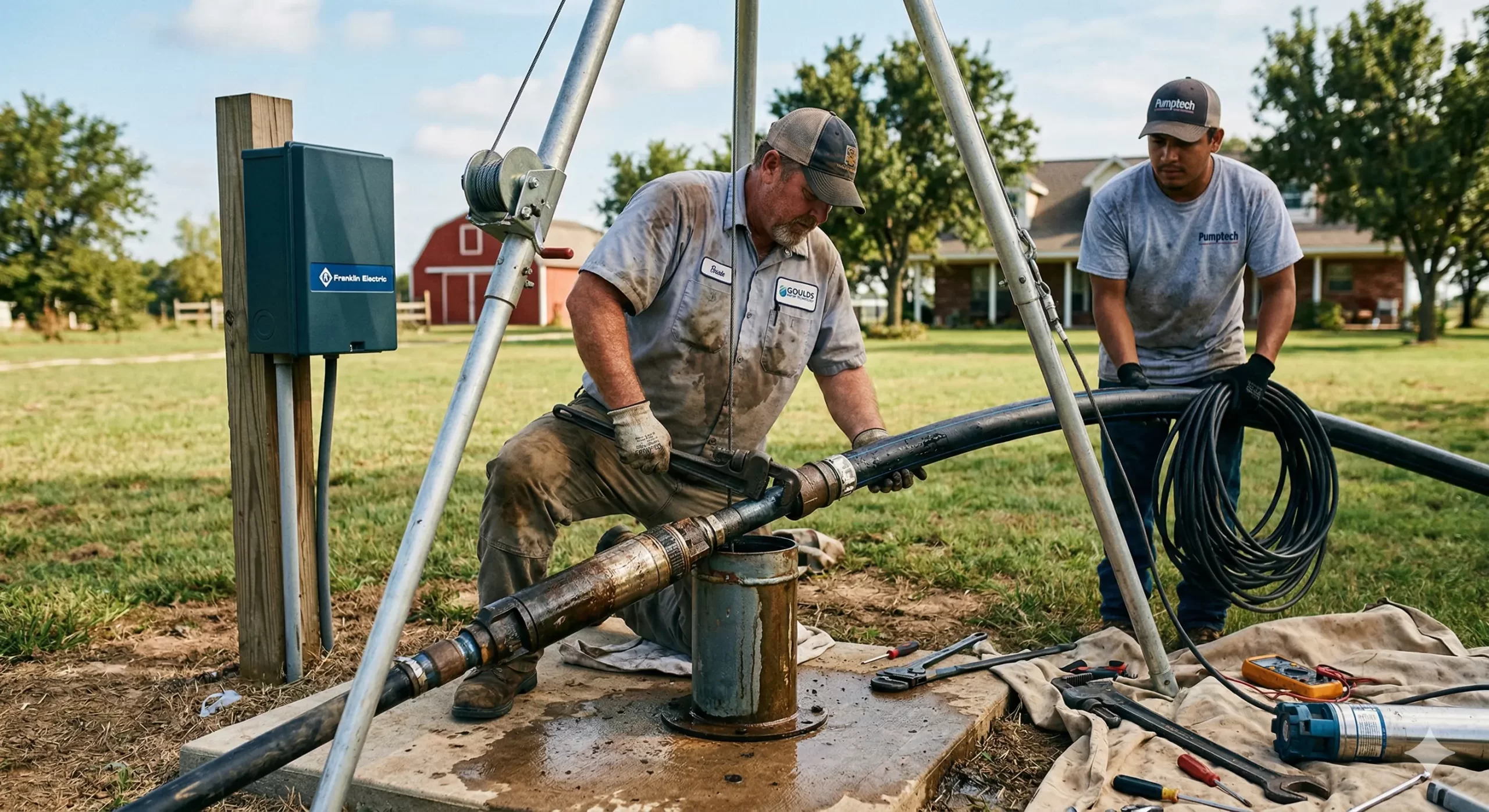
With the failure confirmed, the heavy work begins. Submersible pumps are extremely heavy, often weighing 300-800 lbs when including the pump, motor, pipe, and water-filled column. Pulling this by hand is not only dangerous but risks dropping the entire assembly, potentially destroying the well. The technician will set up a specialized pump hoist or a small crane over the well head. They will remove the well cap, secure the drop pipe with safety clamps, and then use a large pitless adapter T-handle key. This key is lowered down the casing to engage the pitless adapter, allowing the technician to disengage the internal plumbing connection and lift the entire pump assembly straight out of the well. This process requires skill to avoid damaging the well casing, pitless adapter, or the drop cable itself.
Safety Protocol: All work is performed under strict safety guidelines. The LOTO procedure ensures no accidental energization of the 240V circuit. The pump hoist is rated for the specific load, and all rigging is inspected prior to the lift. Personnel maintain a clear zone during the pulling operation. Once the pump is at the surface, the technician will perform a separate Megger test on just the drop cable to ensure it wasn’t the point of failure. Assuming the cable is good, the old motor is removed, and a new, correctly sized Myers pump and motor assembly is prepared. The connection between the motor lead and drop cable is made using professional-grade, waterproof heat-shrink splice kits, a critical step for long-term reliability. The new pump is carefully lowered, the pitless adapter is re-seated, and the system is chlorinated and tested before being returned to service.
Repair Cost & Time Assessment
The cost for a complete submersible pump replacement due to a motor short is significant and typically ranges from $1,800 to $4,500 in the United States. The final price is determined by several factors. The largest portion of the cost is the equipment itself; a new high-quality Myers Predator 1.5 HP stainless steel pump and motor assembly can cost between $900 and $1,500. Labor is another major component, usually involving a two-person crew for 4-6 hours at a rate of $125-$200 per hour, per technician. Specialized equipment usage, such as the pump pulling rig or crane, often incurs a flat fee of $300-$600. Other necessary materials include a new check valve, torque arrestors, and a waterproof heat-shrink splice kit, adding another $100-$150 to the total.
The timeline for a standard replacement is typically 4 to 6 hours from arrival to completion. However, several variables can increase both the time and cost. Well depth is the primary factor; a 500-foot well requires significantly more labor and potentially new wire compared to a 100-foot well. If the technician’s diagnostic tests show the submersible drop cable has also failed, replacing it can add $2-$5 per foot to the final bill. Complications like a corroded pitless adapter that won’t disengage, a pump that has become silted-in at the bottom of the well, or a broken drop pipe can turn a half-day job into a multi-day project requiring specialized ‘fishing’ tools and substantially increasing labor costs.
Fast Local Service & Diagnostics
Calls are routed to a licensed local well professional.