
Diagnosis: Experiencing low water pressure and surging from your Goulds 10GS or 13GS well pump? This is a classic symptom of severe internal impeller erosion caused by pumping sand. The definitive repair requires a professional replacement of the pump’s liquid end and installation of a sand separator to prevent future damage.
In this Guide:
What Causes the Goulds Low Pressure & Surging Issue?
The primary cause of this failure mode is abrasive wear, a direct consequence of pumping water with a high concentration of sand, silt, or sediment. The Goulds GS series impellers, while robust, are subject to the laws of fluid dynamics and material erosion. As sand-laden water is accelerated through the pump stages at high velocity, the abrasive particles act like a sandblaster on the internal components. This process systematically erodes the precision-engineered surfaces of the impellers and diffusers, increasing the internal clearances between them. This widening gap allows a significant portion of the pressurized water to slip backward to a lower pressure stage, a phenomenon known as hydraulic slippage. The direct result is a dramatic loss in the pump’s ability to generate head pressure and deliver its rated flow, leading to the symptoms of low pressure and surging as the system struggles to reach its cut-off setpoint.
This mechanical degradation triggers a cascade of secondary failures. The erosion of the impeller surfaces is rarely uniform, which creates a hydraulic imbalance. This imbalance translates into excessive axial and radial thrust forces on the pump shaft. These forces overwhelm the pump’s bearing assemblies and transmit significant vibration down to the motor’s thrust bearing. Over time, this constant, off-design stress can lead to bearing failure. More critically, the vibration can compromise the integrity of the mechanical shaft seal that separates the pump’s liquid end from the oil-filled motor housing. Once this seal is breached, well water can contaminate the motor, shorting out the stator windings and leading to catastrophic, irreversible motor failure.
Electrically, a pump with a worn liquid end operates far from its Best Efficiency Point (BEP). The motor may struggle to build pressure, causing it to run for extended periods or continuously. This condition often leads to an over-amperage draw as the motor works harder to move water with little resistance (due to the internal slippage), which in turn overheats the motor windings. The motor’s thermal overload protection will trip repeatedly to prevent a fire, but each of these high-heat cycles thermally stresses and degrades the winding’s enamel insulation. Eventually, this insulation breaks down completely, resulting in a direct short to ground and the need to replace the entire pump and motor unit, not just the liquid end.
DIY Troubleshooting Steps
- Measure Amperage Draw: With the system running, use a clamp-on ammeter at the control box to measure the current on both power legs (L1 and L2). Compare this reading to the Full Load Amps (FLA) listed on the motor’s nameplate. An amperage reading significantly higher or lower than the FLA while the pump is producing very low pressure indicates a severe mechanical or hydraulic issue, such as a worn liquid end or a seized pump.
- Verify Operating Voltage: Use a multimeter to check the incoming voltage at the pressure switch or control box while the pump is under load. The voltage should be within +/- 10% of the motor’s rating (e.g., 216-254V for a 230V motor). Sustained low voltage will cause high amperage, overheating, and eventual motor failure.
- Inspect the Control Box Internals: After turning off the breaker, open the pump control box. Visually inspect for signs of overheating, such as melted wire insulation, blackened terminals, or a bulging/leaking start or run capacitor. Manually check if the thermal overload has tripped; if so, you can reset it once, but a repeat trip confirms a serious underlying problem.
- Monitor the Pressure Switch and Tank: Observe a full pump cycle. If the pump runs continuously without reaching the cut-off pressure, it’s a definitive sign of a worn-out liquid end. Also, check for rapid cycling (e.g., on for 10 seconds, off for 10 seconds), which points to a waterlogged or failed pressure tank, a condition that drastically accelerates pump wear.
- Check Pressure Tank Pre-Charge: Turn off the pump breaker and drain all water pressure from the system. Use a tire pressure gauge to check the air pre-charge in your pressure tank via the Schrader valve. It should be set to 2 PSI below the pump’s cut-in pressure setting (e.g., 38 PSI for a 40/60 switch). Incorrect pre-charge causes short cycling.
- Listen to the System: While the pump is operating, listen carefully near the wellhead. Sounds of gravel, rattling, or excessive vibration being transmitted up the drop pipe can indicate that the pump is actively drawing in sand and sediment, confirming the nature of the problem.
When to Call a Professional Well Service
A professional repair begins with a definitive diagnosis, leaving no room for guesswork. Upon arrival, a certified technician will first perform a comprehensive electrical health assessment. This involves using a megohmmeter to test the insulation resistance of the motor windings from the control box. This test sends a high voltage (500-1000V) signal down the wires to detect any microscopic breaks in the winding insulation. A low megohm reading indicates a compromised motor that likely requires replacement along with the liquid end. This step is critical to prevent installing a brand-new liquid end on a failing motor, which would be a waste of the customer’s money and lead to a callback.
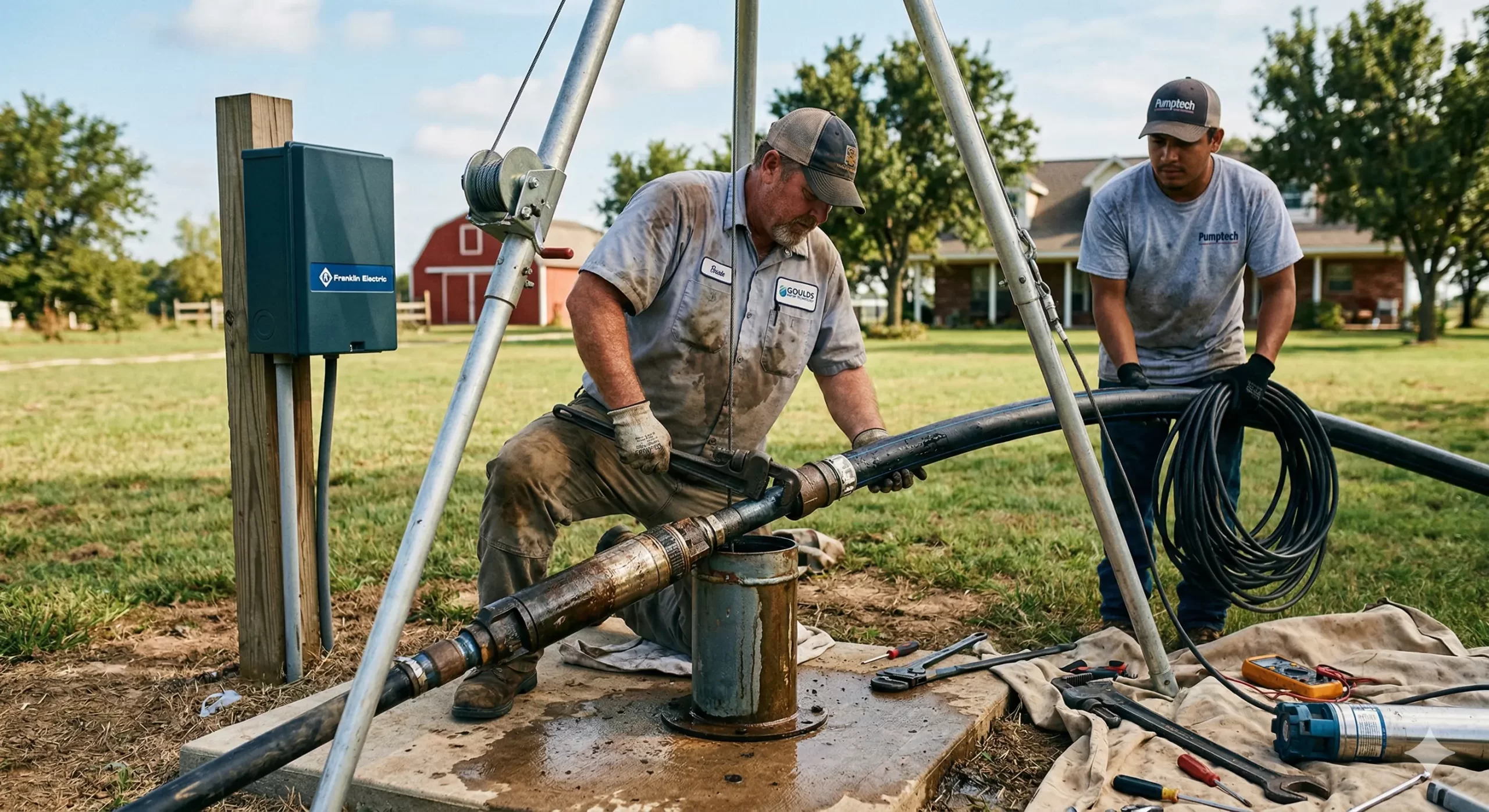
Once the decision is made to pull the pump, safety and specialized equipment become paramount. A submersible pump assembly, including the drop pipe full of water, can weigh upwards of 500 pounds. A dedicated pump hoist truck or portable derrick is non-negotiable for this task. The technician will first use a heavy-duty pitless adapter key, a long T-handle tool, to safely disengage the pump assembly from its connection inside the well casing. The pump hoist is then used to methodically lift the pump, column by column, securing the drop pipe with safety slips at the wellhead to prevent the entire assembly from being lost down the well.
Safety Protocol
All work on a 240V submersible system is extremely hazardous. The technician will execute a strict Lockout/Tagout (LOTO) procedure at the main electrical panel, confirming zero energy with a voltmeter before any wires are touched. The immense weight and potential energy of the suspended pump assembly require a certified pulling rig and experienced personnel; attempting to pull a deep-set pump by hand is a recipe for catastrophic equipment loss, well damage, or life-threatening injury.
With the pump on the surface, the technician will unbolt the failed liquid end from the motor. The motor’s splined shaft is carefully inspected for wear or damage. The new Goulds 10GS or 13GS liquid end is then mounted and torqued to factory specifications. The electrical connection is remade using a high-quality, submersible heat-shrink splice kit, which creates a permanent, waterproof seal essential for long-term reliability. Before reinstalling the pump, the technician will recommend and install a crucial preventative measure: a centrifugal sand separator. This device is plumbed into the service line between the wellhead and the pressure tank. It uses cyclonic action to spin sand and sediment out of the water stream, collecting it in a purge chamber. This protects the new pump from the very issue that destroyed the old one, ensuring a long-term solution rather than a temporary fix. The entire system is then pressure tested for leaks before the pump is carefully lowered back into the well.
Repair Cost & Time Assessment
The cost for a professional liquid end replacement on a Goulds GS series pump, including the installation of a sand separator, typically ranges from $2,800 to $6,000. This price variation is dictated by several factors: the well depth (which determines labor time and materials), the specific pump horsepower, local labor rates, and emergency call-out fees. The cost covers the new Goulds liquid end (a premium part costing $900-$1,800), a high-quality centrifugal sand separator ($350-$700), and miscellaneous materials like new check valves, torque arrestors, and splice kits. The majority of the cost is in the specialized labor and equipment.
Customers are paying for the expertise of licensed technicians and the deployment of a fully-equipped service vehicle with a pump hoist or crane, which carries a significant operational and insurance cost. A standard job on a well of 200-400 feet depth will typically take a two-person crew between 4 and 7 hours to complete. This includes diagnostic time, pulling the pump, performing the replacement, installing the separator, re-installing the pump, and conducting a final system performance test to verify flow rate, pressure, and correct amperage draw. Complications like a pump stuck in the well, damaged wiring, or difficult site access can extend this timeframe and increase the final cost.
Fast Local Service & Diagnostics
Calls are routed to a licensed local well professional.