
Diagnosis: Water hammer in systems with a Cycle Stop Valve (CSV) is most often caused by mineral scale (calcium deposits) physically seizing the valve’s internal piston. This prevents smooth pressure regulation, causing the valve to slam shut abruptly and creating a damaging hydraulic shockwave. Repair involves professionally disassembling and descaling the valve or replacing the entire unit.
In this Guide:
What Causes the Cycle Stop Valve Water Hammer (Banging pipes) Issue?
The Cycle Stop Valve (CSV) is a precision-engineered mechanical device designed to maintain a constant downstream pressure, regardless of flow rate. It functions as a back-pressure regulating valve. As system demand decreases, the CSV’s internal spring-loaded piston assembly moves to close a port, creating back-pressure that forces excess water from the pump back down the well. This allows the pump to run continuously without rapid cycling, significantly extending its service life. The core of the failure mechanism lies in water chemistry. In areas with hard water, dissolved minerals like calcium carbonate and magnesium will precipitate out of solution and form a hard, crystalline scale on the internal moving parts of the valve, specifically the main piston, the seating surface, and the guide shaft. This accumulation is accelerated by the pressure and temperature changes that occur within the valve body during normal operation.
When these calcium deposits become substantial, they effectively increase the static friction between the piston and the valve body. Instead of modulating smoothly in response to pressure changes, the piston begins to stick in a partially open position. As water demand ceases (e.g., a faucet is closed), the system pressure builds rapidly. However, the stuck piston resists this pressure increase until the force becomes great enough to overcome the friction, causing it to break free and slam shut violently. This abrupt stoppage of a moving column of water creates an instantaneous and massive pressure spike, a phenomenon known as hydraulic shock or water hammer. The loud ‘bang’ heard in the pipes is the physical manifestation of this shockwave reverberating through the plumbing system at the speed of sound in water.
The consequences of this recurring hydraulic shock extend far beyond noise. The pressure wave travels in all directions, hammering every component in the system. The most severe impact is often on the submersible pump itself. The violent upward thrust generated by the shockwave repeatedly slams the pump’s impeller stack against the thrust bearing, leading to accelerated wear and eventual catastrophic failure. The motor windings are subjected to severe mechanical stress and the associated current spikes can degrade their insulation over time, leading to a short circuit. Furthermore, the high-pressure spike can compromise the pump’s mechanical shaft seals, allowing water to intrude into the oil-filled motor housing and causing a complete burnout. This single point of failure—a sticking valve—can trigger a cascade of expensive and complex secondary failures throughout the entire well system.
DIY Troubleshooting Steps
- Systematic Listening Test: De-energize non-essential household appliances to create a quiet environment. With the pump powered on, open a large-draw fixture like a bathtub faucet for two minutes. Position yourself near the pressure tank and CSV. Have an assistant shut the faucet off abruptly. A single, loud ‘BANG’ at the exact moment the flow stops is the classic signature of a sticking CSV. A healthy system will shut off with only a quiet click from the pressure switch.
- Pressure Gauge Analysis: Carefully observe the system pressure gauge during a full pump cycle. When flow stops, a functional CSV system will show a smooth, rapid, but controlled pressure rise to the switch’s cut-off point (e.g., from 50 PSI to 60 PSI). If the valve is sticking, you will witness the needle hesitate and then jump violently past the cut-off pressure, often peaking at 100 PSI or more for a split second, coinciding with the water hammer event.
- Amperage Draw Verification: Using a true RMS clamp-on ammeter at the pump control box or disconnect, measure the current on one of the hot legs (L1 or L2) while the pump is running. A healthy pump modulated by a CSV will show a very stable amperage reading. A system suffering from a sticking valve may exhibit erratic or fluctuating amperage as the motor’s load changes unpredictably against the inconsistent back-pressure.
- Inspect Thermal Overload Protection: Power down the system at the circuit breaker. Open the pump control box and visually inspect the thermal overload device. Many have a manual reset button. If this button has been tripped, it’s a strong indicator that the motor is experiencing extreme stress from current spikes, which can be a direct result of the hydraulic shock from a slamming CSV.
- Check for Rapid Cycling Under Low Flow: Open a single small faucet, such as a bathroom sink, just enough to cause the pump to turn on. A properly operating CSV should allow the pump to run continuously for many minutes or even hours to satisfy this low demand. If the pump still turns on and off every 30-60 seconds (short cycling), it indicates the CSV is not modulating correctly and may be completely seized.
- Feel for Valve Vibration: With the pump running, carefully place your hand on the body of the CSV. You will feel a slight hum and the flow of water. When the pump shuts off, a sticking valve will transmit a sharp, violent jolt through the metal casing, which is distinctly different from the normal cessation of flow.
When to Call a Professional Well Service
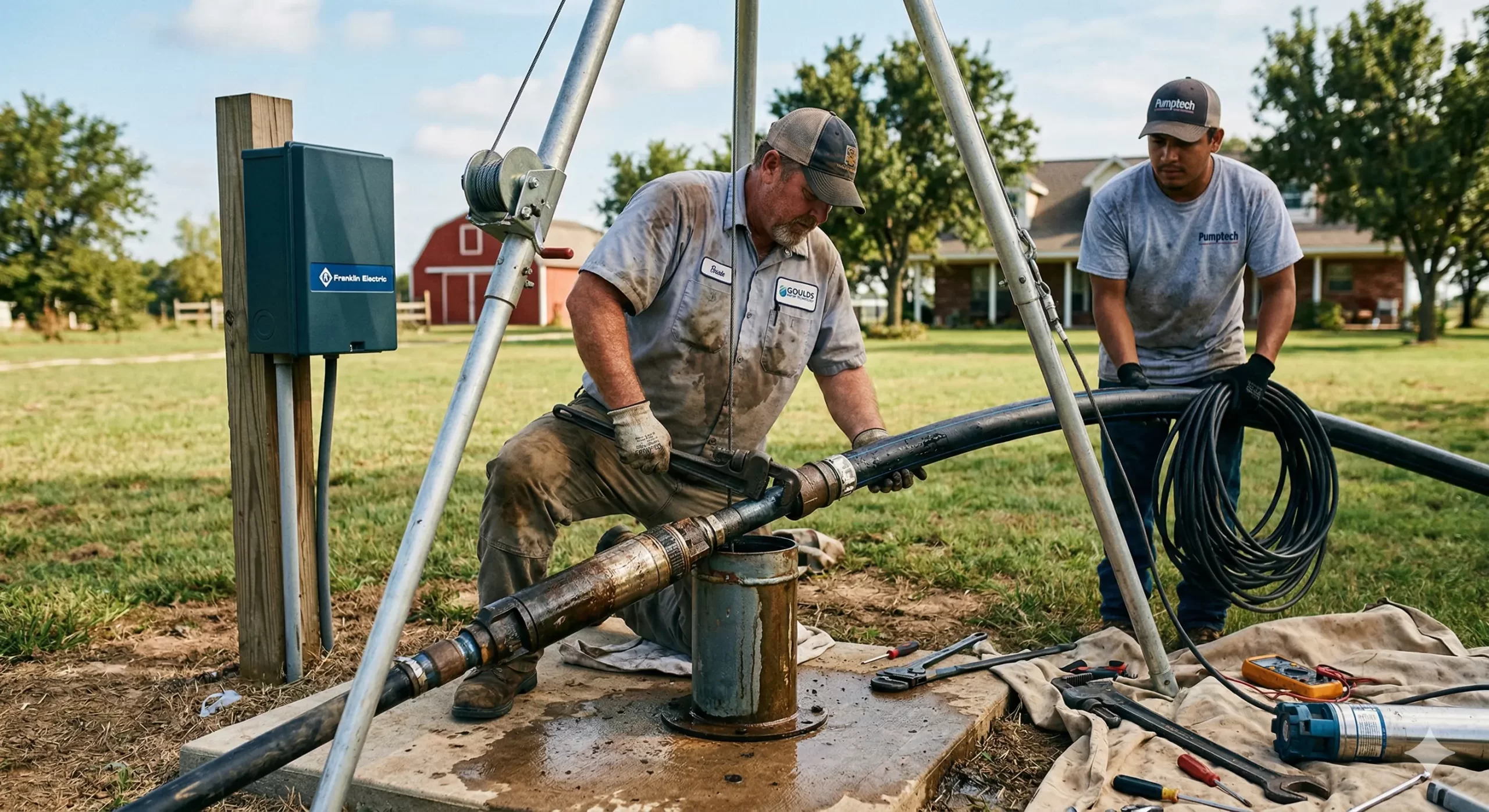
A professional technician’s approach begins with confirming the diagnosis using advanced instrumentation. A high-resolution digital pressure gauge with a data logging function is often connected to the system’s boiler drain. This tool captures the pressure spike in milliseconds, providing indisputable evidence of water hammer and quantifying its severity. The technician arrives prepared with specialized equipment essential for well work, including a portable pump hoist or a truck-mounted pulling rig, a megohmmeter (often called a ‘megger’) to test the integrity of the motor’s electrical windings, and the specific pitless adapter T-handle key required to disengage the pump from the wellhead. This preparation ensures the job can be done safely, efficiently, and without risk of losing equipment down the well bore.
The repair workflow is methodical and safety-focused. The technician first performs a full electrical lockout/tagout at the breaker panel, verifying zero voltage at the control box. The well cap is removed, and the pitless adapter key is used to unlock and lift the entire drop pipe assembly. The pump hoist is then used to carefully pull the pump, pipe, and wire from the well—a load that can easily be several hundred pounds. Once at the surface, the CSV, typically located directly above the pump, is accessible. The technician will systematically disassemble the valve, inspecting the piston, spring, and seat for calcium buildup and scoring. If the scaling is minor and there is no physical damage, a muriatic acid bath followed by a thorough neutralization and rinse may be performed. However, in most cases of severe sticking, the most reliable and long-lasting repair is a complete replacement of the CSV assembly to restore factory-calibrated performance.
Safety Protocol: This repair is classified as high-risk and is not suitable for DIY attempts. The system operates at a lethal 240 volts, posing a severe electrocution hazard. The combined weight of a submersible pump, water-filled drop pipe, and heavy-gauge wiring frequently exceeds 500 lbs. Attempting to lift this dead weight manually is exceptionally dangerous and can lead to catastrophic failure, including dropping the entire pump assembly to the bottom of the well—a mistake that can cost thousands to rectify. A professional pump hoist provides the critical mechanical advantage and braking control needed to manage this heavy, suspended load safely. It prevents damage to the well casing, pitless adapter, and the pump equipment itself, ensuring the repair is conducted to professional standards.
Repair Cost & Time Assessment
The cost for professionally resolving a sticking Cycle Stop Valve is primarily driven by labor and the need for specialized hoisting equipment. A standard service call fee for a licensed well technician typically ranges from $150 to $250, which covers travel and initial diagnostics. Labor rates vary by region but generally fall between $125 and $200 per hour. The replacement CSV1A valve itself is a relatively inexpensive part, costing around $100 to $150 for a high-quality, lead-free brass model.
For a shallow well where the pump can be accessed without a hoist, the total repair cost might be in the **$450 to $700** range, with the job taking 1-2 hours. However, for a typical submersible pump set at a depth of 100 feet or more, a pump pulling rig is mandatory. The use of this equipment often adds a flat fee or higher hourly rate, bringing the total job time to 3-5 hours. In this more common scenario, the customer should expect the final invoice to be between **$800 and $1,500**. This comprehensive cost covers the technician’s expert labor, the use and transport of a multi-thousand-dollar pump hoist, the new valve, and any miscellaneous plumbing fittings required to complete the installation to code.
Fast Local Service & Diagnostics
Calls are routed to a licensed local well professional.