
Diagnosis: A Well-Mate tank that feels solid and heavy is waterlogged due to a failed internal bladder, which eliminates the critical air cushion. This forces the well pump to short-cycle, causing rapid overheating and catastrophic failure of the motor, bearings, and controls. Immediate system shutdown and tank replacement are necessary to prevent costly pump damage.
In this Guide:
What Causes the Well-Mate Tank feels totally solid/heavy Issue?
The primary technical cause of a Well-Mate WM or CH series tank becoming ‘waterlogged’ is a catastrophic failure of the internal butyl rubber air cell, or bladder. This component’s sole function is to separate a captive, pre-charged air cushion from the system’s potable water. Over years of service, factors like chlorine degradation, material fatigue from millions of flex cycles, or an original manufacturing imperfection can cause a perforation. Once breached, the pressurized air cushion is no longer isolated. The air is either forced out into the plumbing or, more commonly, dissolves into the water under pressure, a process governed by Henry’s Law. Without this compressible air pocket to absorb the pump’s output, the tank effectively becomes a solid, non-compliant section of pipe, leading to violent and damaging hydraulic shock and immediate pump short-cycling.
The immediate consequence of a waterlogged tank is severe short-cycling, a condition where the pump turns on and off with extreme frequency. A healthy system might see a pump run for 60-120 seconds to raise pressure from 40 to 60 PSI. In a waterlogged state, this cycle can be less than five seconds. This subjects the pump’s motor to immense thermal and mechanical stress. Submersible pump motors are designed for longer run times which allow the flow of water past the motor housing to act as a coolant. During short-cycling, the heat generated by the massive inrush current required for startup never has a chance to dissipate. The motor’s internal copper windings rapidly overheat, compromising their enamel insulation and leading towards a dead short.
This abusive operating condition precipitates a cascade of component failures. The repeated high-torque startups place extreme stress on the pump’s mechanical components, particularly the thrust bearings and shaft seals. Bearings designed for continuous rotation are hammered by constant start-stop impacts, leading to galling and eventual seizure. The mechanical shaft seal, which relies on a thin film of water for lubrication and cooling, can overheat and crack, allowing water to intrude into the motor’s hermetically sealed stator housing. This intrusion guarantees a ground fault, tripping the breaker and destroying the motor. Concurrently, the control box components, such as the start capacitor and control relay, are not rated for such high-frequency switching and will quickly burn out.
DIY Troubleshooting Steps
- Perform the Percussion Test: With the pump off, firmly tap the side of the fiberglass tank from top to bottom with your knuckle. A functional tank will produce a high-pitched, hollow ring in the upper portion (where the air charge resides) and a dull, solid thud in the lower portion (filled with water). A waterlogged tank will sound solid and dead from top to bottom, indicating no air cushion remains.
- Check the Schrader Valve: Remove the protective cap from the air valve on top of the tank. Using a small tool, briefly and carefully depress the valve stem. If a steady hiss of air is released, a pre-charge is still present (though it may be low). If a jet or dribble of water sprays out, the bladder is definitively ruptured and the tank is condemned. Exercise caution as this water may be under pressure.
- Time the Pump Cycle: With a faucet running slowly inside the house, use a stopwatch to time the pump’s on/off cycle. A healthy system should have a run-time of at least 45-60 seconds. If your pump is turning on, running for 10 seconds or less, and shutting off, it is short-cycling and immediate shutdown is required to prevent further damage.
- Observe the Pressure Gauge: Watch the system pressure gauge as the pump cycles. In a waterlogged system, the needle will swing wildly and almost instantaneously from the cut-in pressure (e.g., 40 PSI) to the cut-out pressure (e.g., 60 PSI). This rapid sweep confirms there is no compressible air volume to buffer the pressure change.
- Measure Amperage Draw: If you are qualified and comfortable working around live electricity, use a clamp-on ammeter on the primary power line feeding the pressure switch or control box. You will observe a very high inrush current every few seconds as the pump kicks on, followed by a rapid drop to zero. This repeated high-amp draw is the primary cause of heat damage to the motor windings.
- Inspect for Tripped Thermal Overload: Check the pump control box or the pump motor itself for a thermal overload reset button. If this button has popped out or the breaker has tripped, it is a definitive sign that the motor has overheated due to severe short-cycling. Do not repeatedly reset it, as this will only cause further irreversible damage.
When to Call a Professional Well Service
Upon arrival, a certified technician will first confirm the waterlogged diagnosis using a calibrated pressure gauge and by performing the checks listed above. The primary focus then shifts to a rigorous safety protocol and a thorough assessment of the consequential damage to the pump and motor. The technician will perform a complete electrical lockout/tagout at the circuit breaker panel, rendering the 240V circuit dead. Voltage will be verified with a multimeter at the pressure switch to ensure the system is completely de-energized before any physical work begins. The system is then fully depressurized and drained via the boiler drain at the tank tee. This is a crucial step, as a water-filled fiberglass tank can be deceptively heavy and unwieldy, posing a significant physical hazard during removal.
With the system safe, the old tank is disconnected. The technician then installs the new Well-Mate tank, ensuring all threaded connections on the new tank tee assembly are meticulously sealed with both Teflon tape and a high-quality pipe joint compound to prevent leaks. The most critical step in the new tank installation is setting the air pre-charge. Using a precision air gauge, the technician will adjust the tank’s air pressure to be exactly 2 PSI below the pump’s pressure switch cut-in setting (e.g., a 40/60 PSI switch requires a 38 PSI pre-charge). This must be done while the tank is empty of water. Failure to set this pre-charge correctly will negate the benefit of the new tank and can lead to its premature failure.
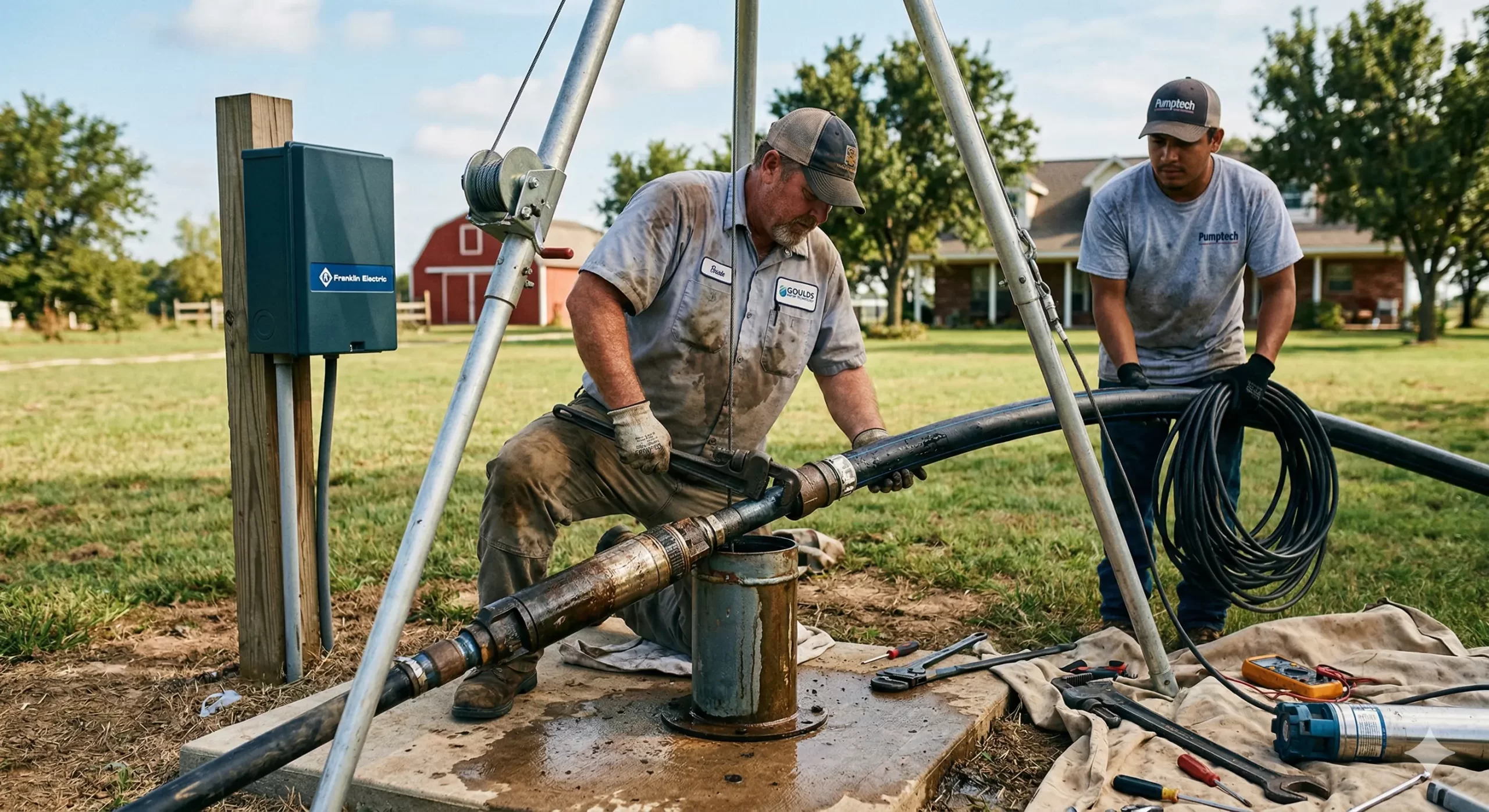
Before re-energizing the system, a comprehensive health check of the submersible pump is mandatory. The technician will use a megohmmeter (often called a ‘Megger’) to perform an insulation resistance test on the motor windings. This test applies a high voltage (500-1000V) to check for leakage current between the motor’s power leads and ground, which reveals the integrity of the winding insulation. A reading below 1-2 megohms indicates compromised insulation due to the previous overheating, and the pump is on borrowed time. If the pump is deemed faulty, it must be pulled from the well. This requires specialized equipment like a heavy-duty pump hoist or crane, as a pump, pipe, and wire assembly can weigh upwards of 500 lbs. A specific ‘pitless key’ is used to latch onto and disengage the pitless adapter deep inside the well casing, a task that is impossible without the correct tool.
Repair Cost & Time Assessment
For a standard replacement of a waterlogged Well-Mate pressure tank where the pump has not been damaged, a homeowner in the US can expect a cost ranging from $900 to $1,900. This price includes a premium fiberglass Well-Mate tank (which can cost $450 – $950 alone, depending on size), a new brass tank tee assembly with pressure gauge and relief valve, and approximately 2-4 hours of labor by a licensed and insured well technician or master plumber. The final cost depends on regional labor rates, accessibility of the installation area, and the condition of existing plumbing.
This cost estimate can escalate dramatically if the short-cycling has destroyed the submersible pump. If a pump replacement is required, the total project cost can jump to $3,000 to $6,000+. This expanded scope includes the initial tank replacement plus the cost of a new submersible pump and motor, new drop pipe, and new submersible wiring with waterproof heat-shrink splices. It also covers the significant increase in labor (4-8 hours) and the use of specialized equipment, such as a dedicated pump pulling rig or crane service, which is essential for safely extracting a pump from depths of several hundred feet.
Fast Local Service & Diagnostics
Calls are routed to a licensed local well professional.