
Diagnosis: Water coming from the air valve on your Amtrol Well-X-Trol tank indicates a critical failure of the internal diaphragm. This catastrophic failure eliminates the system’s pressure buffer, causing the well pump to short-cycle, which quickly leads to motor burnout. The only correct repair is a complete replacement of the pressure tank.
In this Guide:
What Causes the Amtrol Water coming out of air valve Issue?
The primary function of a Well-X-Trol pressure tank is to act as a hydraulic accumulator, storing water under pressure to prevent the well pump from running every time a faucet is opened. This is achieved by separating a captive cushion of pre-charged air from the system water using a heavy-duty butyl diaphragm. In a healthy system, as the pump fills the tank, it pushes against this diaphragm, compressing the air charge. This stored energy provides water pressure to the home. When the diaphragm ruptures due to age, material fatigue, or excessive flexing from an incorrect air pre-charge, this critical separation is lost. Water floods the air side of the tank, completely displacing the air cushion and creating a ‘waterlogged’ state. Without this buffer, the system has zero effective pressure storage capacity.
The immediate and destructive consequence of a waterlogged tank is severe pump short-cycling. Without an air cushion to absorb the pump’s output, the system pressure rises almost instantaneously from the cut-on to the cut-off pressure setting (e.g., 40 to 60 PSI) in a matter of seconds. This causes the pressure switch to constantly cycle the pump on and off. Each startup subjects the pump motor to immense mechanical stress and an electrical inrush current that is 5-7 times its normal running amperage. This repeated, high-amperage draw generates excessive heat within the motor windings, which rapidly degrades their enamel insulation, leading to turn-to-turn shorts and eventual catastrophic motor failure.
The damage extends beyond the motor windings. The violent torque from dozens or even hundreds of startups per day places extreme stress on the pump’s thrust bearings, which are designed for continuous duty cycles, not this kind of punishing stop-start operation. This leads to accelerated wear and eventual seizure. Furthermore, the constant thermal cycling—rapid heating during the short run time followed by rapid cooling—causes expansion and contraction of the motor shaft and housing. This movement can compromise the pump’s internal mechanical seals, leading to leaks and the eventual failure of the entire wet end of the submersible pump. A ruptured diaphragm is not just a failed tank; it is an active threat that will destroy the entire well pump system if not addressed immediately.
DIY Troubleshooting Steps
- Confirm the Failure at the Schrader Valve: After putting on safety glasses, briefly and carefully depress the pin in the center of the air charging valve (Schrader valve) on top of the tank with a small screwdriver. If a forceful stream or even a slight trickle of water ejects instead of air, the diaphragm is ruptured. This is a definitive test; the tank must be replaced.
- Isolate Power to the System: Locate the dedicated two-pole circuit breaker for your well pump in your main electrical panel. Switch it to the ‘OFF’ position. Verify power is off at the pressure switch or control box with a non-contact voltage tester or multimeter. This is a critical safety step before any further inspection.
- Monitor the Pump Cycle Time: If it’s safe to do so before shutting down power, observe the pump’s behavior. Turn on a faucet and watch the pressure gauge near the tank. A system with a failed tank will cause the pump to run for very short periods, often less than 15-20 seconds, before shutting off. The pressure will drop just as quickly when water is used. This is classic short-cycling.
- Inspect the Pressure Switch Contacts: With the power securely off, remove the cover from the pressure switch. Visually inspect the electrical contact points. Look for signs of severe pitting, black carbon buildup, or evidence of melting. The rapid cycling caused by a failed tank forces these contacts to arc excessively, leading to their premature failure.
- Check the Pump Control Box: If you have an external pump control box (common for 3-wire pumps), check if it has a manual thermal overload reset button that has tripped. An overheating pump motor caused by short-cycling will trip this protective device. Frequent tripping is a major red flag.
- Perform a Clamp Amperage Reading (Advanced): For those experienced with electrical diagnostics, use a clamp-on ammeter around one of the pump’s main power leads at the control box or pressure switch. Measure the amperage draw during the brief run cycle. An abnormally high reading that approaches the Locked Rotor Amps (LRA) rating on the motor nameplate indicates extreme stress.
When to Call a Professional Well Service
A professional technician’s first step upon arrival is not to simply replace the part, but to perform a full system diagnosis. After confirming the ruptured diaphragm, they will immediately proceed to an electrical health assessment of the submersible pump motor, which has undoubtedly been subjected to damaging short-cycles. Using a specialized instrument called a Megohmmeter (or ‘Megger’), they will test the insulation resistance between the motor windings and ground. This test sends a high voltage (500-1000V) signal down the well wires to detect microscopic cracks or degradation in the winding insulation. A low megohm reading indicates that the motor’s life has been severely compromised and may be on the verge of failure, allowing the homeowner to make an informed decision about a proactive pump replacement.
The mechanical replacement workflow is systematic and safety-focused. The technician first ensures the 240V circuit is de-energized and locked out. The entire plumbing system is then depressurized and drained. The old waterlogged tank, which can weigh several hundred pounds and be extremely difficult to handle, is carefully disconnected and removed. The technician will then install the new WX-202 (or equivalent) tank, ensuring all plumbing connections are remade with high-quality brass fittings and appropriate thread sealant to prevent leaks. Crucially, they will replace the pressure gauge and pressure switch, as the switch’s contacts are likely damaged from the excessive arcing. The new tank’s air pre-charge is then precisely set with a digital gauge to 2 PSI below the pressure switch’s cut-on setting (e.g., 38 PSI for a 40/60 PSI switch) BEFORE introducing water to the system.
Safety Protocol and Specialized Equipment
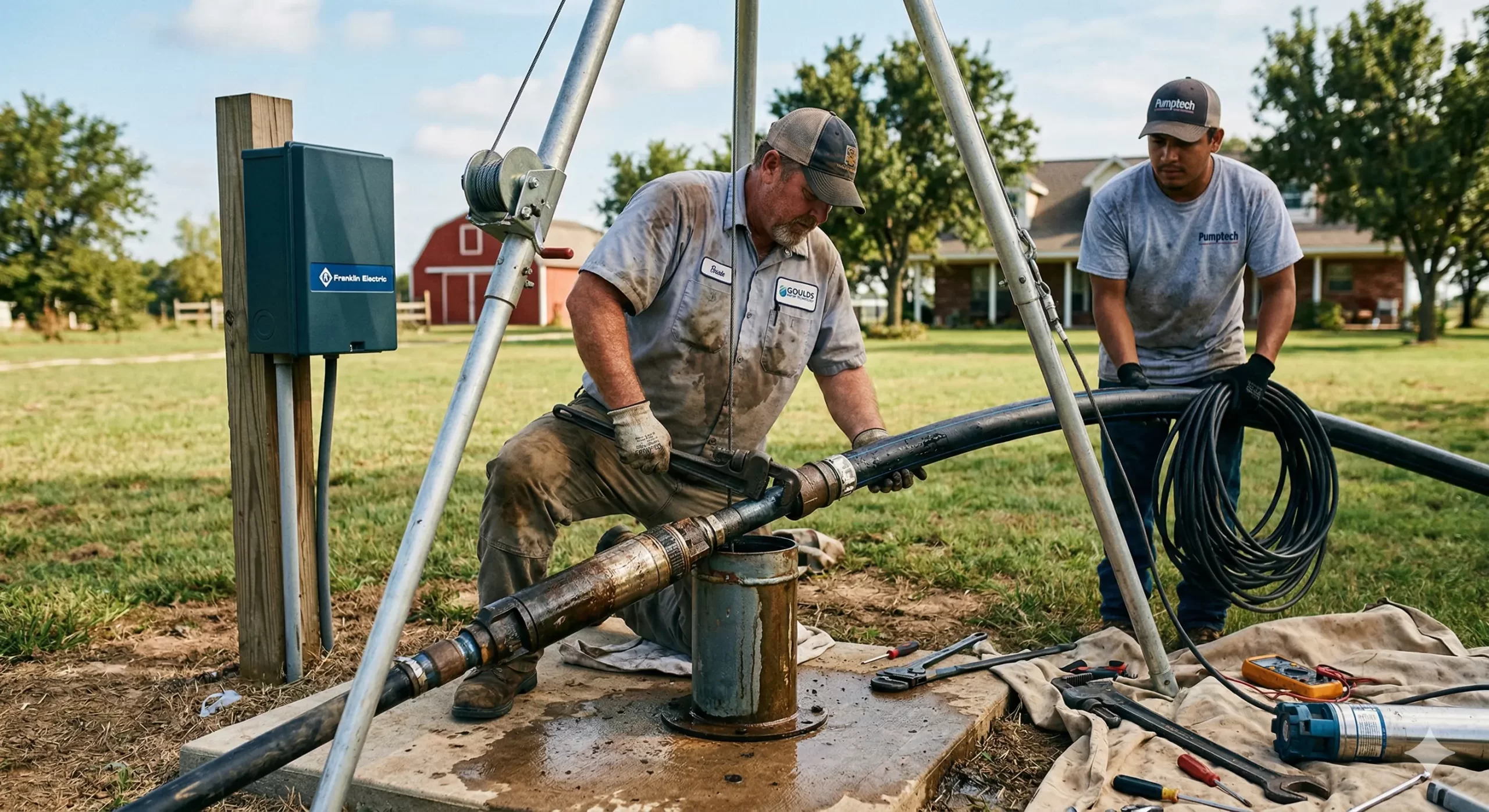
This is not a DIY project. A licensed technician is required due to the inherent dangers of a 240V electrical system and the significant weight of a waterlogged tank. Mishandling the electrical connections can be lethal. It’s important to note that while the tank replacement itself doesn’t require a Pump Hoist or a Pitless Key, these specialized tools are absolutely necessary if the Megohmmeter test reveals a failing pump. Pulling a 500lb pump and pipe assembly from a well hundreds of feet deep is a complex and hazardous operation that requires a dedicated pulling rig and deep industry expertise to perform without damaging the well or the equipment, or causing serious injury.
Repair Cost & Time Assessment
The cost for a professional replacement of an Amtrol Well-X-Trol WX-202 pressure tank in the United States typically ranges from $900 to $1,800. This price includes several components: the cost of the premium Amtrol tank itself (often $400-$600), 2-4 hours of skilled labor from a licensed well technician or plumber ($200-$600), a service call fee, and the cost of miscellaneous parts such as a new pressure switch, pressure gauge, brass tank tee, and thread sealant ($100-$200). It also includes the proper disposal of the old, heavy steel tank.
The final cost can be influenced by the installation location. A tank located in a cramped crawlspace or other hard-to-access area will increase labor time and, consequently, the price. If the diagnostic tests reveal that the short-cycling has damaged other components, such as the pump’s starting capacitor in the control box or the wiring itself, those repair costs will be additional. This estimate is exclusively for the tank replacement and associated components; if the well pump itself is found to be failing from the abuse, a full pump replacement is a much more significant project, often costing between $3,000 and $8,000 or more, depending on well depth and pump specifications.
Fast Local Service & Diagnostics
Calls are routed to a licensed local well professional.