
Diagnosis: If your submersible well pump runs but delivers no water pressure, a common cause is a ruptured drop pipe inside the well casing. This failure prevents water from reaching the surface, causing the pump to run continuously without load, which can lead to severe motor and bearing damage. Professional repair involves pulling the entire pipe column with a specialized hoist to replace the damaged section.
In this Guide:
What Causes the Universal No Water at Faucet Issue?
The fundamental cause of this failure is a physical breach in the drop pipe column connecting the submersible pump to the pitless adapter at the surface. This pipe, often made of PVC or polyethylene, is under constant stress from pump cycling, water hammer, and system pressure. Over time, material fatigue, freezing-induced expansion, or abrasion against the well casing can cause a crack or complete separation. When this occurs, the pump, which is a centrifugal-type machine designed to push against a column of water (head pressure), loses its load. Instead of lifting water to the surface, it expends all its energy circulating water within the well casing, which then cascades back down around the pump. This creates an audible sound of falling water at the wellhead and a complete loss of pressure at the faucet.
This no-load or ‘runout’ condition is catastrophically damaging to the pump and motor assembly. A centrifugal pump operating far to the right on its performance curve (high flow, low head) draws significantly more amperage than its Full Load Amp (FLA) rating. This over-current condition generates excessive heat in the motor windings, which can rapidly degrade the winding’s enamel insulation. If the thermal overload protector fails to trip in time, this can lead to a direct short between windings, burning out the motor. Furthermore, this condition puts extreme axial thrust on the pump’s internal components. Without the expected back-pressure from the water column to hydraulically balance the impeller stack, the impellers can experience severe ‘up-thrust,’ causing them to grind against the diffusers. This mechanical friction destroys the pump’s wet end, leading to seizure.
Internal seals are also compromised during a broken drop pipe event. The motor is typically protected from water intrusion by a set of mechanical seals and a diaphragm system. The violent water circulation, cavitation, and heat generated by a pump running in a runout condition accelerate wear on these seals. Once the primary mechanical seal fails, well water can penetrate the oil-filled motor housing, displacing the dielectric oil and directly contacting the stator windings. This intrusion results in a low insulation resistance (a ‘meg-out’ condition), which will cause an immediate trip at the breaker and render the motor permanently inoperable. What begins as a plumbing failure quickly cascades into a terminal electrical and mechanical failure of the entire submersible unit if not addressed promptly.
DIY Troubleshooting Steps
- Auditory Wellhead Inspection: Turn off all other running water and stand near the wellhead. Have someone turn on a faucet to call for water. Listen carefully. If you hear the pump motor hum but also hear the distinct sound of water falling or cascading back down inside the casing, it is a strong indicator of a pipe breach.
- Pressure Gauge & Switch Analysis: Locate your pressure tank and gauge. Observe the gauge as the pump kicks on. If the pump runs audibly but the pressure needle fails to climb or barely flutters above zero PSI, the system is unable to build pressure. The pressure switch will remain in the closed (on) position, forcing the pump to run continuously.
- Amperage Draw Measurement (Advanced): If you are comfortable and qualified to work with live electrical panels, use a clamp-on ammeter on one of the hot legs going to the pump at the control box. Compare the reading to the motor’s nameplate FLA. In a broken pipe scenario, the amperage may be slightly higher than normal due to the runout condition, but more importantly, it will be sustained as the pump never reaches its shut-off pressure. A reading of zero indicates a power supply or wiring issue, not a broken pipe.
- Monitor the Thermal Overload: Check the pump’s control box for a manual reset button for the thermal overload. If the pump runs for several minutes and then shuts down, and you find this button has tripped, it’s a critical sign that the motor is overheating from being overloaded or running without proper cooling and hydraulic load.
- Cycle Time Observation: A healthy pump system runs for a specific cycle (e.g., 1-2 minutes) to fill the pressure tank and then shuts off. With a broken drop pipe, the pump will never satisfy the pressure switch’s cut-off setting. It will run indefinitely until it either burns out, the thermal overload trips, or it is manually shut off at the breaker.
- System Isolation Test: Close the main ball valve located immediately after your pressure tank, isolating the well system from the house plumbing. If the pump still runs continuously without building pressure on the gauge, you have definitively confirmed the problem lies between the pump itself and this valve, pointing overwhelmingly to a failure within the well casing.
When to Call a Professional Well Service
Upon arrival, a professional technician will first confirm the diagnosis using specialized equipment. This begins with verifying the electrical integrity of the system before any heavy lifting occurs. A megohmmeter (or ‘megger’) is used to perform an insulation resistance test on the motor windings from the surface. This test sends a high-voltage, low-current signal down the wires to measure resistance between the windings and ground. A reading of many megaohms indicates a healthy motor, while a low reading suggests a breach in the motor’s waterproof seals and imminent failure. This diagnostic step is critical, as it determines whether the job is a simple pipe repair or a full pump and motor replacement, saving time and preventing the reinstallation of a compromised unit.
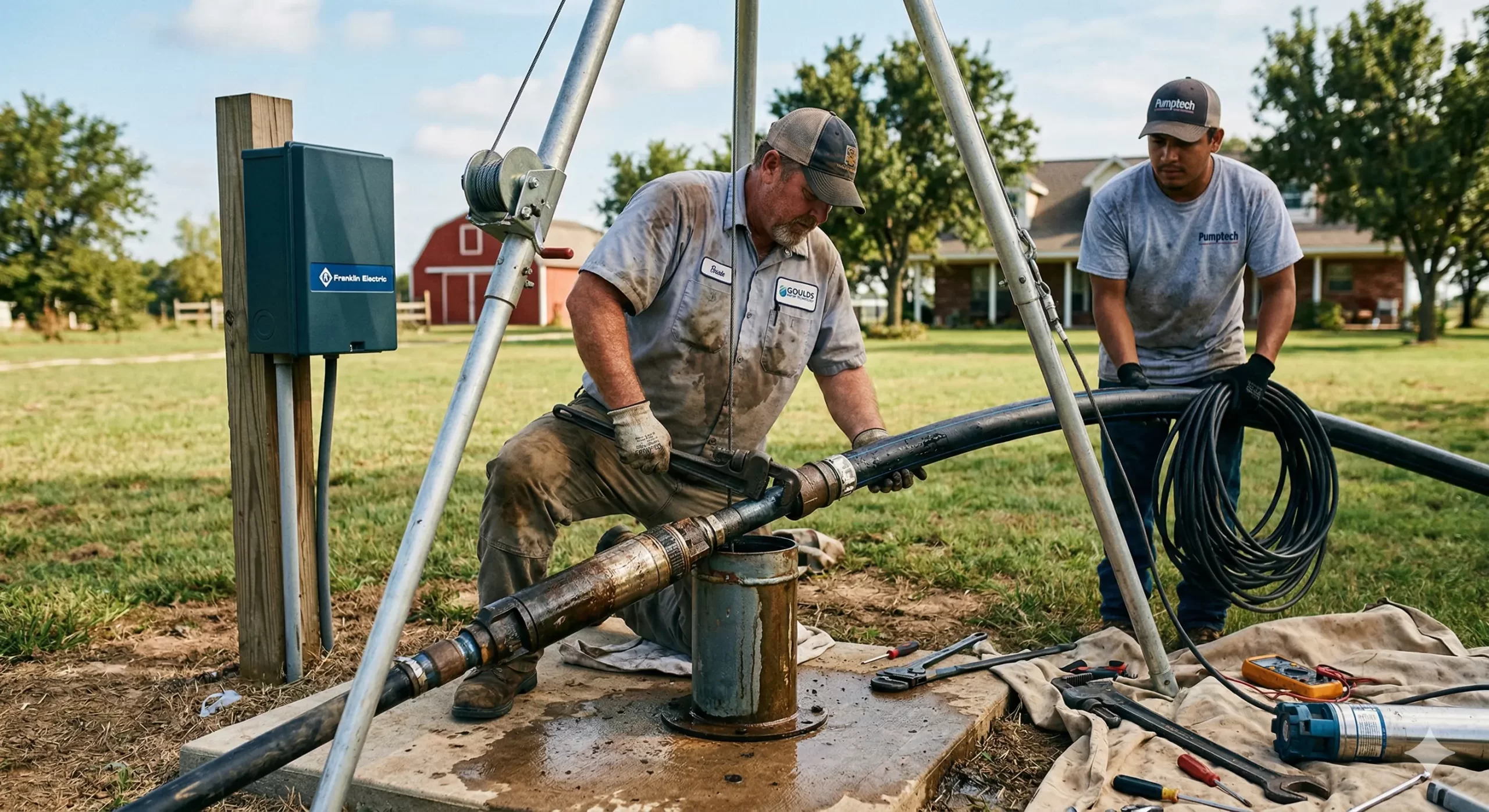
Once the motor’s health is assessed, the physical extraction process begins. This is a high-risk operation requiring a purpose-built pump hoist or pulling rig. These hydraulic or electric rigs are anchored over the wellhead and are designed to safely manage the combined weight of the pump, motor, hundreds of feet of water-filled pipe, and heavy gauge power cable, which can easily exceed 500 pounds. The technician will use a large T-handle ‘pitless key’ to reach down into the casing and unlock the pitless adapter, disengaging the entire drop column from the main water line. The rig then carefully hoists the assembly, with technicians guiding the pipe and securing it at intervals to prevent it from dropping back into the well—an accident that could destroy the well itself.
Safety Protocol: The combination of 240-volt high-amperage electricity, extreme suspended weight, and water creates a highly hazardous work environment. Professionals adhere to strict lockout/tagout (LOTO) procedures at the circuit breaker to ensure the system is de-energized. The pulling rig is equipped with safety clamps and chains as a redundant measure against mechanical failure. Attempting this repair without the proper rig and safety knowledge can lead to electrocution, crushing injuries, or catastrophic damage to the well system. After locating and replacing the failed pipe section—typically upgrading to robust Schedule 80 PVC—and installing a new waterproof heat-shrink splice if necessary, the entire assembly is sanitized with a chlorine solution and carefully lowered and re-engaged. A final pressure test and well yield check ensure the system is operating to specification.
Repair Cost & Time Assessment
The cost for a professional repair of a broken drop pipe can range from $900 to $2,500 for a standard residential well. This price reflects several factors: a significant portion is dedicated to labor, as the job typically requires two qualified technicians for 4 to 8 hours. The use of specialized, expensive equipment like a pump pulling rig is often billed as a flat or hourly equipment fee. The cost of materials includes premium Schedule 80 PVC pipe, stainless steel couplings, new torque arrestors to prevent pipe abrasion, and potentially a new waterproof splice kit. A service or trip charge to get the fully equipped truck and crew to your location is also standard.
The total cost and time are heavily influenced by the depth of the well. A shallow 150-foot well is far less time-consuming than a 500-foot well, which involves more pipe and significantly more weight and risk. If the initial megohmmeter test reveals that the motor has failed as a result of the event, the job escalates to a full pump replacement. In this scenario, the cost can increase substantially to the $2,500 to $5,000+ range, depending on the horsepower of the required pump and the complexity of the installation. Most straightforward pipe repairs can be completed within a single business day, restoring water service by the evening.
Fast Local Service & Diagnostics
Calls are routed to a licensed local well professional.