
Diagnosis: A rapid clicking sound from your Square D Pumptrol FSG2 pressure switch, known as short cycling, is almost always caused by a ruptured internal bladder in the pressure tank. This creates a waterlogged tank with no air cushion, forcing the pump to turn on and off constantly. Immediate power-down is critical to prevent permanent pump motor damage; the required repair is a full pressure tank replacement.
In this Guide:
What Causes the Square D Rapid Clicking Sound Issue?
The root cause of this failure mode lies in the fundamental physics of a hydropneumatic system. A functional pressure tank contains a captive air charge, separated from the system water by a flexible bladder or diaphragm. This air charge acts as a compressible cushion, absorbing the energy of the incoming water from the pump. When you open a faucet, this compressed air pushes water out, maintaining system pressure and delaying the need for the pump to activate. This allows the pump to run for longer, more efficient cycles. When the bladder ruptures—due to age, material fatigue, or improper pre-charging—water infiltrates the air side of the tank. Because water is virtually incompressible, this essential air cushion is eliminated. The tank becomes ‘waterlogged,’ losing its ability to store pressurized water. The slightest draw of water causes a near-instantaneous pressure drop, forcing the Square D FSG2 switch to engage the pump. The pump immediately builds pressure in the rigid, water-filled pipe system, and the switch disengages. This violent on-off sequence is the source of the rapid clicking sound.
This condition of severe short cycling is one of the most destructive scenarios for a submersible or jet pump. Each time the motor starts, it experiences an inrush current that can be 5-7 times its normal running amperage. This massive current surge generates intense heat in the motor windings. In a normal cycle, the motor runs long enough to dissipate this initial heat. During short cycling, the motor turns on and off so frequently that the windings never cool, leading to a thermal breakdown of their lacquer insulation. This degradation can cause internal short circuits between windings, resulting in complete motor burnout. The damage is not limited to the electrical components; the mechanical systems are also under extreme duress.
The repeated, high-torque starts and stops exert tremendous stress on the pump’s mechanical components. The motor’s thrust bearings, designed to handle the load of lifting a column of water, are hammered with each cycle, leading to accelerated wear and eventual seizure. The impeller stack and shaft are subjected to repeated torque shock, which can cause fatigue fractures or shearing of the keyways connecting them. Furthermore, the internal mechanical seals, which rely on stable pressure and rotation to function correctly, are exposed to constant, jarring pressure fluctuations. This can cause the seal faces to wear unevenly or unseat, leading to internal recirculation, loss of efficiency, and ultimately, catastrophic failure of the pump assembly.
DIY Troubleshooting Steps
- IMMEDIATE ACTION – DISCONNECT POWER: Before performing any checks, go to your electrical panel and shut off the double-pole circuit breaker dedicated to the well pump. Apply lockout/tagout (LOTO) if possible to prevent accidental re-energization. This step is non-negotiable and will prevent further damage to the pump motor.
- Perform a Percussion Test: With the power off and the system depressurized (by opening a faucet), gently tap the side of the pressure tank from top to bottom with your knuckles. A healthy tank will produce a higher-pitched, hollow ‘ping’ on the upper half where the air pre-charge is located, and a dull, solid ‘thud’ on the lower half containing water. A waterlogged tank will produce a dull ‘thud’ all the way from bottom to top.
- Check the Schrader Valve: Locate the air valve on top of the pressure tank, which looks identical to a tire valve. Remove the cap and briefly depress the pin with a small screwdriver. If a sustained spray of water comes out, the bladder is definitively ruptured and the tank must be replaced. If only air comes out, the tank may have simply lost its pre-charge, though a ruptured bladder is still the most likely culprit for severe short cycling.
- Inspect Pressure Switch Contacts (Power OFF): Carefully remove the grey cover from the Square D FSG2 switch. Visually inspect the electrical contact points. Look for signs of pitting, carbon buildup, or melting. The intense, repeated arcing caused by short cycling often destroys these contacts.
- Monitor the Cycle Time (Use Extreme Caution): If you are comfortable with electrical systems, you can briefly restore power for a diagnostic test. Open a faucet slightly and use a stopwatch. Time the duration the pump stays ON and the duration it stays OFF. If the cycle time (on + off) is less than 60 seconds, you have confirmed a severe short cycling condition that warrants immediate shutdown and repair.
- Measure Amperage (Advanced DIY): For those with a clamp-on ammeter, clamp one of the pump’s hot legs at the pressure switch or control box. Observe the amperage during a start-up cycle. You will see a very high inrush current spike followed by a brief run period. Repeatedly seeing this spike every few seconds is a definitive electrical confirmation of short cycling.
When to Call a Professional Well Service
Upon arrival, a certified technician will first confirm the diagnosis by verifying system pressures and checking the tank’s Schrader valve. Their primary diagnostic tool beyond basic observation is a Megohmmeter, often called a ‘Megger.’ This instrument applies a high voltage (500-1000V) to the motor’s windings to measure insulation resistance to ground. Short cycling generates immense heat, which can cook the motor’s insulation. A low reading in megohms indicates that the motor is likely compromised and on the verge of failure. This test is critical, as replacing only the tank without addressing a damaged pump will lead to another failure in short order.
The primary repair involves the complete replacement of the waterlogged pressure tank. The technician will electrically isolate the system using LOTO protocol, depressurize and drain the plumbing, and physically disconnect the old tank. A new, appropriately sized tank (e.g., Well-X-Trol, Flexcon) is then installed with new brass or stainless steel fittings, a new pressure gauge, and often a new pressure relief valve. The most crucial step of the installation is setting the pre-charge of the new tank. Using a calibrated air gauge, the technician will charge the tank’s air bladder to exactly 2 PSI below the verified cut-in pressure of the FSG2 switch (e.g., a 40/60 PSI switch requires a 38 PSI pre-charge). This must be done while the tank is empty of water. Incorrect pre-charge pressure is a leading cause of premature tank failure and repeat short cycling.
Safety Protocol and Submersible Pump Work
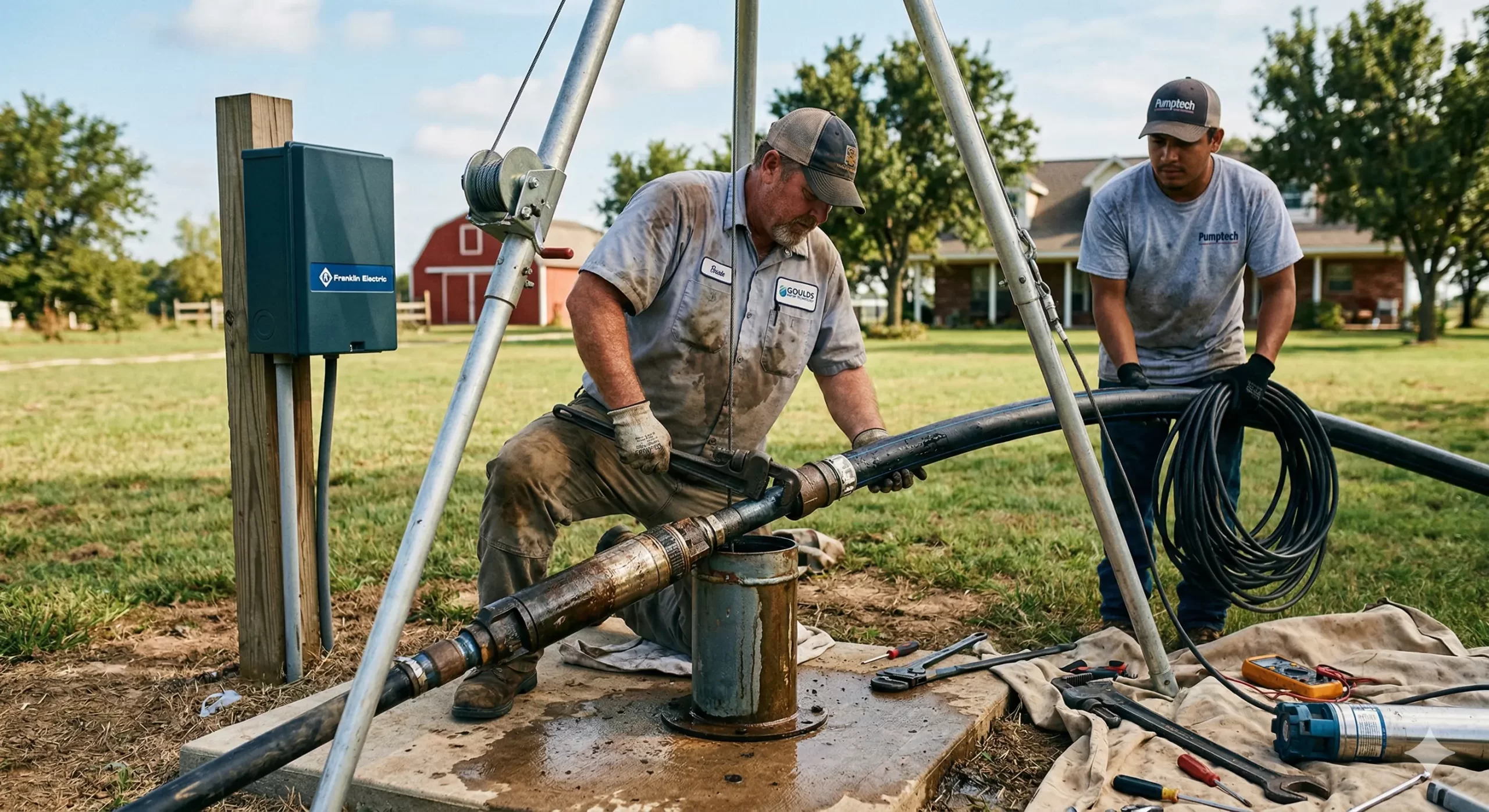
All work on a 240V well pump system is performed under strict safety protocols. Technicians use calibrated voltmeters to confirm a zero-energy state before any physical contact with wiring. If the Megohmmeter test reveals a failed submersible pump, the job escalates significantly. A submersible pump, along with its water-filled drop pipe, can weigh several hundred pounds. A dedicated pump hoist or pulling rig is mandatory for safe extraction. Attempting to pull a pump by hand is reckless and can result in dropping the entire assembly down the well, a catastrophic event that can damage the well casing and require expensive ‘fishing’ operations or even a new well. The technician will use a specialized ‘Pitless Key’ to safely disengage the pitless adapter below ground, allowing the pump and pipe to be pulled without excavating the well head.
Repair Cost & Time Assessment
For a standard pressure tank replacement, a homeowner in the US can expect a cost ranging from $750 to $1,600. This price includes a high-quality, name-brand pressure tank (20-44 gallon range), all necessary brass fittings, a new pressure switch and gauge, and the labor of a licensed and insured technician. The variance in price depends on regional labor rates, accessibility of the equipment, and the complexity of the existing plumbing. A straightforward replacement is typically a 2-4 hour job from diagnosis to final system testing.
If the diagnostics determine that the short cycling has destroyed the submersible pump motor, the scope and cost of the project increase substantially. The cost to pull the pump, replace the pump/motor unit (a significant part cost), install a new waterproof heat-shrink splice, and reinstall the assembly can range from $2,500 to $5,000+. This cost is highly dependent on the well depth (which dictates labor time and equipment needs), the horsepower of the pump required, and whether the existing drop pipe and wiring can be reused. This type of major repair is a full-day job requiring a pump hoist and often two technicians for safe execution.
Fast Local Service & Diagnostics
Calls are routed to a licensed local well professional.