
Diagnosis: If your well pump turns on when no water is running, you likely have a critical system leak or a failed check valve. This failure allows system pressure to bleed off, triggering the pressure switch to cycle the pump repeatedly. This guide explains the engineering causes, DIY diagnostics, and the required professional repair process.
In this Guide:
What Causes the Universal Pump turns on when no water is used Issue?
The core of this issue lies in a breach of a closed hydraulic circuit. A well water system is designed to be a sealed vessel from the check valve, located just above the submersible pump, to every faucet in the house. When the pump runs, it fills the pressure tank and piping until it reaches the pre-set ‘cut-out’ pressure (e.g., 60 PSI), at which point the pressure switch de-energizes the pump. A properly-seated check valve then prevents the entire column of water in the drop pipe from falling back into the well, and intact plumbing prevents it from leaking out elsewhere. When the check valve fails or a leak develops in the underground service line, this seal is broken. The static head pressure of the water column exerts force, pushing water back down the well, or the system pressure forces it out through the leak. This pressure drop is detected by the pressure switch, which then signals a ‘false demand’ and re-energizes the pump, leading to the constant cycling.
This frequent, short cycling is catastrophically damaging to the pump motor and its bearings. A single-phase submersible motor draws an immense inrush current during startup—often 5 to 7 times its rated running amperage—to overcome inertia and generate a rotating magnetic field. This current spike generates significant heat in the motor windings. In normal operation, the motor runs long enough for the flow of cool well water to dissipate this heat. During short cycling, the windings are subjected to repeated, intense thermal shocks without adequate cooling time. This progressively bakes and degrades the thin enamel insulation on the copper windings, leading to turn-to-turn shorts, reduced efficiency, and eventual ground faults that will trip the breaker or destroy the motor.
Beyond the electrical components, the mechanical systems suffer extreme wear. Submersible pumps utilize precision thrust bearings, often of a Kingsbury-type design, to handle the significant downthrust generated during operation. At every startup, the entire rotor and impeller assembly is slammed upwards by hydraulic force before settling onto the bearing. Short cycling multiplies these high-impact events by thousands of cycles per day, causing rapid wear on the bearing pads and rotor face. This leads to increased friction, higher amperage draw, and ultimately, a seized motor. Furthermore, the rapid pressure fluctuations and water hammer associated with constant starts can fatigue and fracture the carbon-ceramic mechanical seals that separate the motor’s dielectric oil from the well water. Once this seal is compromised, water ingress causes immediate and irreparable motor failure.
DIY Troubleshooting Steps
- Isolate the System at the House: Locate the main water shut-off valve immediately after your pressure tank. Close it fully. If the pump continues to cycle, the problem lies between this valve and the pump itself (i.e., the underground service line, drop pipe, or check valve). If the cycling stops, the leak is within your home’s plumbing.
- Perform a Pressure Bleed-Down Test: With all faucets closed, watch the pressure gauge on your system. Note the exact pressure when the pump cuts out. Time how long it takes for the pressure to drop to the cut-in pressure and restart the pump. A bleed-down time of less than 10-15 minutes indicates a significant leak or a completely failed check valve. A very slow drop might indicate a minor issue, but any pressure loss without demand is problematic.
- Listen at the Well Head: On a quiet day or night, place your ear near the well cap (do not remove it). After the pump has shut off, listen carefully. A distinct sound of water falling or trickling inside the well casing is a definitive sign that the check valve has failed or there is a hole in the drop pipe, allowing water to cascade back down.
- Check the Pressure Tank Air Charge: Turn off the pump breaker and drain all pressure from the system by opening a faucet. Use a tire pressure gauge to check the air pre-charge in your pressure tank via the Schrader valve. It should be 2 PSI below your pump’s cut-in pressure setting (e.g., 38 PSI for a 40/60 switch). An improperly charged or waterlogged tank will not cause the pump to cycle without demand, but it will exacerbate the problem by causing extremely short run times.
- Qualified Electrical Inspection: If you are trained and equipped to work safely with 240V circuits, use a clamp-on ammeter to check the current on both legs of the pump circuit at the control box or pressure switch. Observe the high inrush current at startup and the steady-state running current. An amperage that fluctuates wildly or is significantly higher than the motor’s nameplate rating suggests severe mechanical stress or winding damage caused by the short-cycling.
- Inspect the Motor Control Box: For systems with an external control box (common for three-wire pumps), turn off the power and open the box. Look for signs of overheating, such as charred wires, a bulging or leaking start capacitor, or a pitted and blackened start relay. These are clear indicators that the electrical starting components are failing under the strain of excessive cycling.
When to Call a Professional Well Service
A professional technician’s first step is definitive diagnosis to avoid unnecessary work. They will isolate the house plumbing and connect a high-pressure gauge directly to a port at the wellhead or pitless adapter. This allows them to pressure test the drop pipe and pump assembly independently from the service line running to the house. If this isolated section holds pressure, the leak is in the underground service line, requiring excavation. If it fails the pressure test, the problem is in the well. Concurrently, the technician will use a megohmmeter (or ‘megger’) to perform an insulation resistance test on the motor windings. This sends a high-voltage, low-current signal down the wires to detect any current leakage from the windings to ground. A reading below 1-2 megaohms indicates compromised insulation, warning that the motor is on the brink of failure and should be replaced along with the faulty check valve.
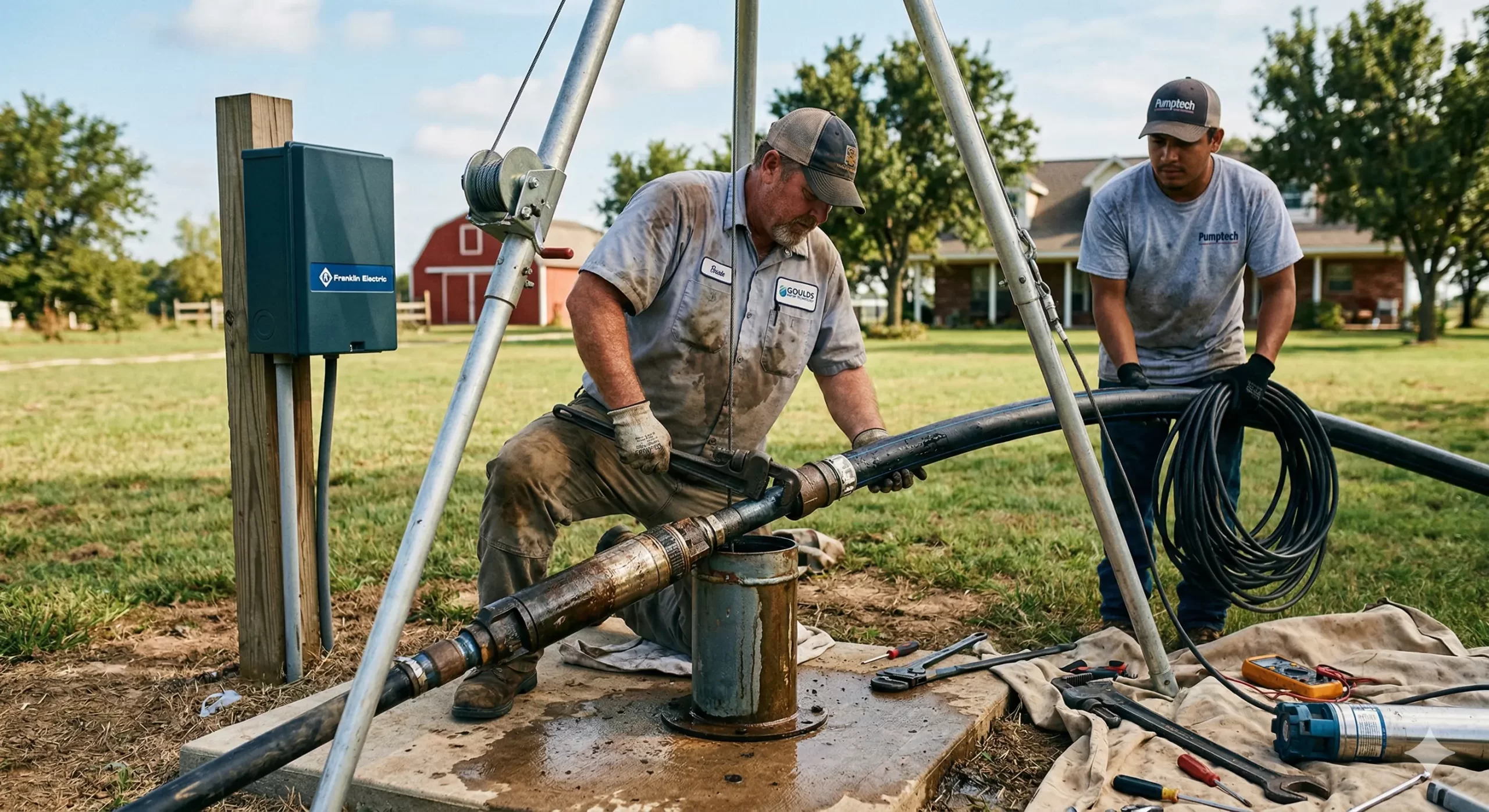
Once the fault is confirmed to be in the well, the pump must be pulled. This is a hazardous operation requiring specialized equipment. A heavy-duty pump hoist or truck-mounted crane is positioned over the well. After implementing a strict lock-out/tag-out (LOTO) procedure on the electrical breaker, the technician removes the well seal or cap. A pitless adapter key, a long T-handle tool, is lowered into the casing to engage the adapter, which is then slid upwards to disengage the pump assembly from its connection to the service line. The entire assembly—pump, motor, drop pipe, cable, and safety rope—is then carefully hoisted from the well. A two-person team is essential to manage the hundreds of feet of pipe and wire, laying it out straight on clean tarps to prevent contamination of the system or damage to the components.
With the pump on the surface, a physical inspection immediately reveals the point of failure. A faulty brass check valve is removed and typically replaced with a superior full-flow stainless steel model. Any abraded sections of the submersible wire are repaired with submersible heat-shrink splice kits. If a hole is discovered in the drop pipe, that section is cut out and replaced. Before reinstallation, the well is often shock chlorinated to ensure sanitation. The entire assembly is then carefully lowered back into the well, the pitless adapter is securely reseated, and the wellhead is sealed. A final pressure test, amperage draw verification, and cycle time monitoring confirm a successful and lasting repair.
Safety Protocol: This work involves lethal 240V+ electricity, loads weighing up to 500 lbs or more, and direct interaction with a potable water source. Professionals must adhere to strict LOTO electrical safety standards, use a lifting rig properly rated and inspected for the load, and follow sanitary procedures to prevent bacterial contamination of the well. Attempting this without the correct equipment and training risks electrocution, severe injury from a dropped pump, or fouling the water supply.
Repair Cost & Time Assessment
The professional repair of a failed check valve or drop pipe typically costs between $900 and $2,500 in the United States. This price range is heavily influenced by the well’s depth, accessibility for the service truck, and regional labor rates. The invoice is a composite of several charges: a non-negotiable service call fee ($150 – $300), labor for two technicians billed at $100 – $200 per hour for each, and a specific equipment charge for the pump hoist rig, which can be $300 – $600 for the job. The cost of premium replacement parts, such as a stainless steel check valve ($75 – $150) or a heat-shrink splice kit ($40), is a relatively small part of the total bill.
The on-site time for this repair usually falls between 4 and 8 hours. Deeper wells naturally take longer, as handling 400 feet of pipe is far more time-consuming than handling 100 feet. Unexpected complications are the primary driver of higher costs. A pitless adapter that has corroded and seized in the well casing can add hours of difficult labor. If the initial megohmmeter test determines the motor has failed due to the cycling, the job scope expands to a full pump and motor replacement, potentially pushing the cost to $3,000 – $5,000 or more. If the diagnostic pressure test reveals the leak is actually in the underground service line to the house, the project then requires excavation, which is a completely different and far more expensive undertaking.
Fast Local Service & Diagnostics
Calls are routed to a licensed local well professional.