
Diagnosis: If your jet pump runs continuously without shutting off, the primary cause is often a clogged ejector nozzle preventing the system from reaching its cut-off pressure. This obstruction, typically sand or sediment, disrupts the Venturi effect, forcing the motor into a state of constant operation which can lead to overheating and component failure.
In this Guide:
What Causes the Universal Motor running constantly Issue?
The core of this failure lies in the physics of the jet pump’s operation, specifically the Venturi principle. The pump’s motor drives an impeller which sends a high-velocity stream of ‘drive water’ down to the ejector assembly. This ejector contains a precisely machined nozzle and a Venturi tube. As the drive water is forced through the narrow nozzle, its velocity increases dramatically, causing a corresponding drop in pressure (Bernoulli’s principle). This low-pressure zone creates a powerful suction effect that draws a much larger volume of water from the well into the Venturi, where it mixes with the drive water and is carried to the surface. When the ejector nozzle becomes obstructed with sand, mineral scale, or debris, the velocity of the drive water is severely diminished. This collapse of the Venturi effect cripples the pump’s ability to lift water and build pressure. The system pressure will stall well below the pressure switch’s cut-off setting (e.g., stalling at 35 PSI when the switch requires 60 PSI to open), leaving the motor’s electrical circuit closed and forcing it to run indefinitely.
A motor running continuously under this condition is on a path to self-destruction. The motor windings, which are insulated copper coils, are rated for a specific duty cycle and amperage draw. In a stalled, low-flow condition, the motor struggles against the hydraulic load, often causing the current draw to exceed its nameplate Full Load Amps (FLA) rating. This over-amperage condition generates excessive heat (I²R losses) that cannot be dissipated effectively. The high temperatures cause the enamel insulation on the windings to break down and degrade, leading to microscopic shorts between coils. This reduces motor efficiency, increases heat generation further, and ultimately results in a complete burnout. While the motor’s internal thermal overload protector is designed to trip and prevent this, repeated tripping cycles weaken the bimetallic strip within the switch until it fails to reset or fuses shut, offering no further protection.
The mechanical components of the pump assembly suffer equally from this abusive duty cycle. The motor’s shaft bearings, whether sealed ball bearings or sleeve-type, are subjected to sustained thermal and rotational stress. The intense heat conducted from the motor housing breaks down the bearing’s grease lubricant, causing it to lose viscosity and seep out. This leads to direct metal-on-metal contact, generating a characteristic high-pitched whine and culminating in bearing seizure. Concurrently, the mechanical shaft seal, which resides between the ‘wet end’ of the pump and the motor, is critically damaged. This seal relies on a thin film of pumped water for both lubrication and cooling. In a clogged-nozzle scenario with minimal flow, the seal can run dry, overheat rapidly, and cause its ceramic and carbon faces to crack. This failure results in a significant water leak directly into the motor’s front-end bell, which quickly destroys the bearings and shorts out the windings, causing catastrophic failure.
DIY Troubleshooting Steps
- Safety-First System De-energization: Before touching any equipment, locate the double-pole circuit breaker dedicated to the pump in your main electrical panel. Switch it to the ‘OFF’ position and secure it with tape and a ‘Do Not Operate’ tag. Use a reliable multimeter or non-contact voltage tester to verify that there is zero voltage (0 VAC) present at the pressure switch terminals and motor connection box.
- Analyze the Pressure Gauge: Observe the pressure gauge on your system’s pressure tank. If the motor was running but the needle was stuck at a low, unmoving value (e.g., 25-40 PSI), this is a strong indicator that the pump is unable to build pressure, pointing directly to a clog or major leak.
- Inspect the Motor Thermal Overload Reset: Carefully examine the pump motor’s housing for a small, typically red, reset button. If this button has popped out, the motor has overheated and the thermal protection has tripped. Allow the motor to cool for at least one hour before attempting a single, firm press to reset it. If it trips again shortly after starting, do not continue to reset it; this indicates a persistent problem that will destroy the motor.
- Perform a Qualified Amperage Draw Test: If you are trained and equipped with a clamp-on ammeter, briefly re-energize the pump. Clamp the meter around one of the two hot wires (never both) leading to the motor. Compare the amperage reading to the Full Load Amps (FLA) value printed on the motor’s nameplate. A reading substantially higher than the FLA value confirms the motor is struggling against a severe hydraulic restriction or has failing windings.
- Listen for Auditory Clues: Pay close attention to the sound of the pump when it runs. A pump struggling with a clog may sound labored or produce a gurgling noise as it cavitates (forms and collapses vapor bubbles). A distinct, high-pitched squealing or grinding noise is a critical sign of imminent bearing failure.
- Isolate the Pump for Diagnosis: Shut off the main valve that supplies water to the house, effectively isolating the pump, pressure tank, and pressure switch. If you restart the pump and it still fails to build pressure and shut off, you have definitively proven the fault lies with the pump, the drop pipe, or the well itself, and not with a leak in the home’s plumbing.
When to Call a Professional Well Service
Upon arrival, a professional technician initiates a systematic diagnostic protocol far beyond visual inspection. The first step is a comprehensive electrical safety and performance analysis. Using a megohmmeter (or ‘megger’), they will test the insulation resistance between the motor windings and the motor’s steel frame (ground). This test, often performed at 500V or 1000V, reveals any degradation in the wire insulation that could lead to a dangerous and inefficient short to ground. Following the megger test, they confirm proper supply voltage (e.g., 240-245V) and perform a running amperage test to quantify the motor’s workload. If these diagnostics confirm a healthy motor struggling against a hydraulic blockage, specialized heavy equipment is prepared for pump extraction.
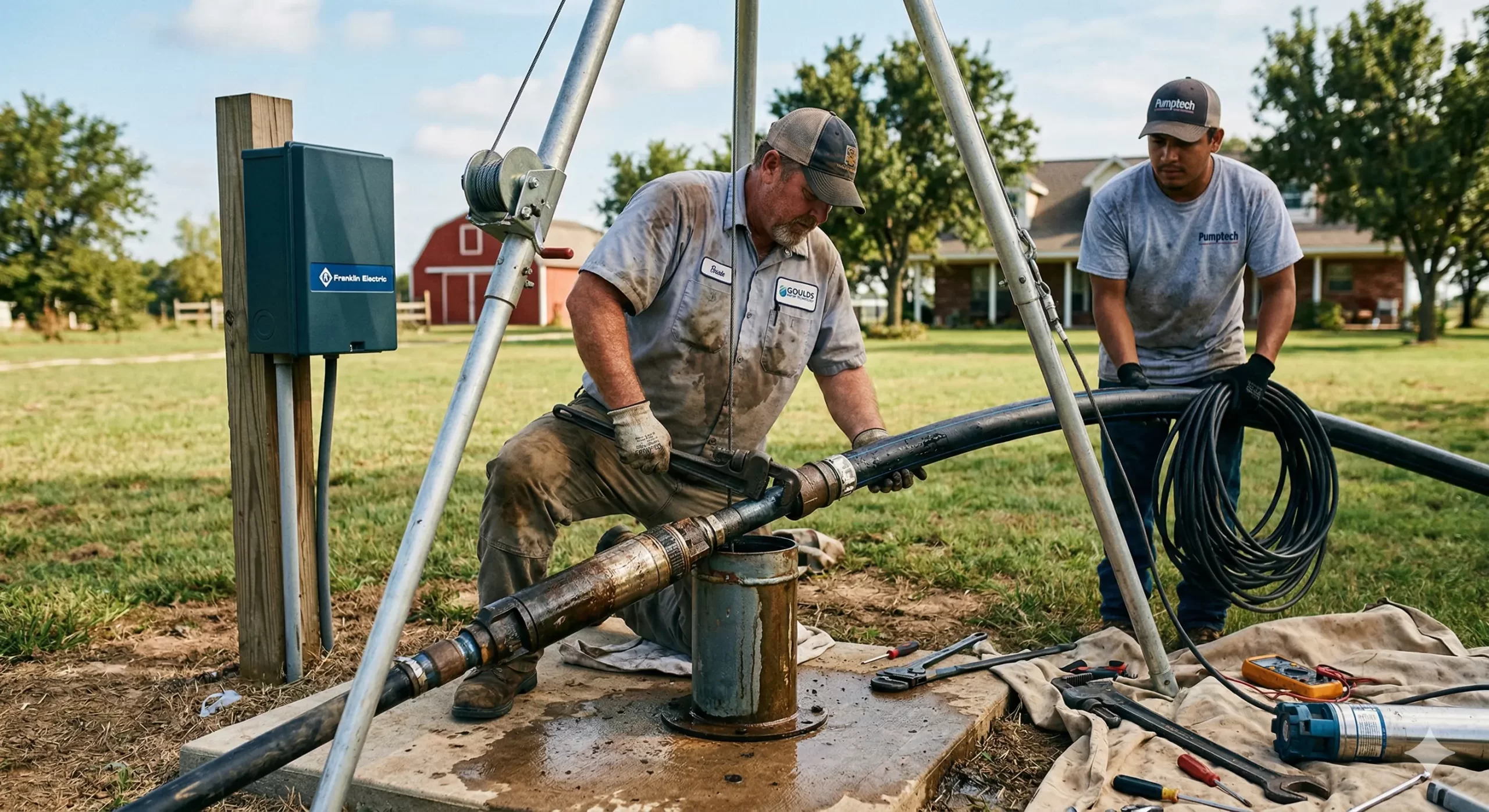
For deep well jet pumps, where the ejector is located far down the well casing, a purpose-built pump hoist or service rig is essential. This equipment provides the mechanical advantage and, more importantly, the controlled braking needed to safely lift hundreds of pounds of pump, pipe, and water-filled cable. The technician will use a specialized pitless adapter key—a long T-handle tool—to engage and unlock the pitless adapter assembly from its receiver inside the casing, allowing the entire drop pipe assembly to be pulled. Once at the surface, the ejector body is methodically disassembled. Using precision picks, wire brushes, and high-pressure air, the technician will meticulously clear all sediment, sand, and mineral deposits from the fine orifices of the Venturi nozzle and diffuser. The foot valve screen is also cleaned and inspected for integrity. Every component is examined for cracks or wear before being reassembled with new, potable-water-rated pipe sealant.
After the ejector is serviced, the pump is re-primed by hand, and the entire assembly is carefully lowered back into the well. The final step is re-engaging the pitless adapter and verifying a leak-free seal before sanitizing the well as needed. The technician will then monitor the pump through several cycles to ensure it builds pressure rapidly, reaches the pressure switch’s cut-off point, and shuts down correctly. They will adjust the pressure switch settings if necessary to optimize performance and ensure the system operates within its design parameters.
Safety Protocol
This is not a DIY task. Working with a 240V circuit presents a lethal electrocution hazard, and strict lockout/tagout (LOTO) procedures are mandatory. The combined weight of a submersible pump, steel drop pipe, and water can easily exceed 500 lbs, posing a severe crush hazard and the risk of irretrievably dropping the entire assembly down the well. A professional pump pulling rig is the only safe method for this operation. Furthermore, any downhole electrical splices must be made with high-quality, heat-shrink splice kits to create a durable, watertight connection capable of lasting for decades underwater.
Repair Cost & Time Assessment
The professional repair cost for a clogged jet pump ejector in the USA typically falls between $450 and $950. The lower end of this estimate is for shallow well pumps where the ejector is mounted directly to the pump at the surface, making for a straightforward disassembly and cleaning that takes 2-3 labor hours. The higher end of the range is representative of a deep well pump service call. This price reflects the inclusion of a service truck equipped with a hydraulic pump hoist, a higher labor charge for a 2-man crew (often required for safety), and the extended time (3-5 hours) needed to pull and reinstall the pump.
This cost structure covers the service call fee ($100-$175), hourly labor for a licensed pump technician ($125-$200/hour), and a specific charge for the use of the pump pulling rig ($200-$350). It’s crucial to understand that this estimate assumes the pump’s motor, bearings, and seals have not sustained permanent damage. If the diagnostics show the motor windings are shorted or the bearings have seized due to prolonged operation, the repair will pivot to a replacement. A new pump and motor assembly can add $600 to $1,500+ to the final invoice, depending on the brand, materials (e.g., stainless steel vs. cast iron), and horsepower rating required for the well’s depth and yield.
Fast Local Service & Diagnostics
Calls are routed to a licensed local well professional.