
Diagnosis: A motor winding reading to ground indicates a critical insulation failure, typically from water intrusion breaching the motor seals, drop cable, or a heat-shrink splice. This creates a severe electrocution hazard and requires immediate shutdown. Professional replacement using a pump hoist is necessary as the motor is non-repairable.
In this Guide:
What Causes the Multimeter Test Reads to Ground Issue?
The root cause of a submersible motor winding reading to ground is the catastrophic failure of its electrical insulation system. Every conductor within the motor and its supply cable is coated with a material possessing a high dielectric strength, designed to contain the electrical potential. However, this insulation can be compromised in several ways. Abrasions or nicks in the submersible drop cable during installation can create a microscopic entry point for water, which, under immense downhole pressure, will inevitably penetrate the jacket. The most common point of failure is often the heat-shrink splice connecting the motor lead to the drop cable; if not executed with surgical precision, it becomes the weakest link, allowing water ingress over time. Once moisture bypasses this primary defense, it begins a cascading failure within the motor itself.
Once water penetrates the motor capsule, it contaminates the specialized dielectric oil that fills the motor housing. This oil serves both to cool the windings and to provide a secondary layer of insulation. As water emulsifies with the oil, the mixture’s dielectric properties plummet, and it becomes conductive. This allows electrical current from the energized copper stator windings to find a path of least resistance to the motor’s steel housing, which is bonded to the equipment ground. This connection is the ‘ground fault.’ The initial effect is a massive current spike that should trip the circuit breaker, but it also causes intense, localized heating at the point of the short, which can melt the winding’s enamel coating and propagate the damage.
The consequential damage from a ground fault is extensive and terminal for the motor. Beyond the initial electrical short, the contaminated and overheated oil loses its lubricating properties. This leads to accelerated wear and eventual seizure of the precision-machined shaft bearings and the critical thrust bearing assembly. Furthermore, the pressure changes and heat can cause the motor’s primary shaft seals to fail, allowing well water to flood the motor completely, ensuring its destruction. At this stage, the motor is not a salvageable component; it is a complete loss requiring full replacement.
DIY Troubleshooting Steps
- Isolate All Power and Verify Zero Energy State: Before any inspection, locate the double-pole circuit breaker dedicated to the well pump. Turn it to the OFF position. Apply a certified electrical lockout/tagout device to prevent accidental re-energization. Use a multimeter to verify there is zero voltage at the pump controller and pressure switch terminals. This is the most critical safety step.
- Perform a Visual Inspection at the Wellhead and Controller: Examine the visible wiring, conduit, and the pump control box. Look for signs of physical damage, corrosion, burnt wires, or evidence of arcing (soot marks). Check if the well cap seal is intact and not allowing surface water to enter the casing.
- Check Pump Controller Components: Open the pump control box (with power confirmed off). Look for signs of overheating, such as discolored terminals or melted plastic. If it has start/run capacitors, inspect them for bulging tops or any signs of fluid leakage, which indicates failure. Ensure all terminal screws are tight.
- Conduct a Surface-Level Insulation Test: Disconnect the motor leads from the pump controller. Set your multimeter to the highest Ohms (resistance) setting. Test by placing one probe on a motor lead (e.g., Yellow) and the other probe on the ground screw or bare ground wire. A healthy motor will read infinite resistance (OL). A reading of anything less, especially a low number, confirms a path to ground and a definitive fault in the submerged equipment. Repeat for all motor leads.
- Evaluate the Circuit Breaker: Note the type of breaker that tripped. Was it a standard overcurrent breaker or a Ground Fault Circuit Interrupter (GFCI)? A standard breaker tripping indicates a massive current draw, while a GFCI trip indicates a much smaller, but still lethal, leakage of current to ground. If the breaker immediately trips upon attempting a reset, it confirms a dead short and you must not attempt to reset it again.
- Review System Behavior Prior to Failure: Recall if the pump was short-cycling (turning on and off rapidly), or if you noticed higher than usual amperage draw with a clamp-on ammeter prior to the event. These symptoms point to a struggling motor or a failing check valve, conditions that drastically increase motor heat and accelerate insulation breakdown.
When to Call a Professional Well Service
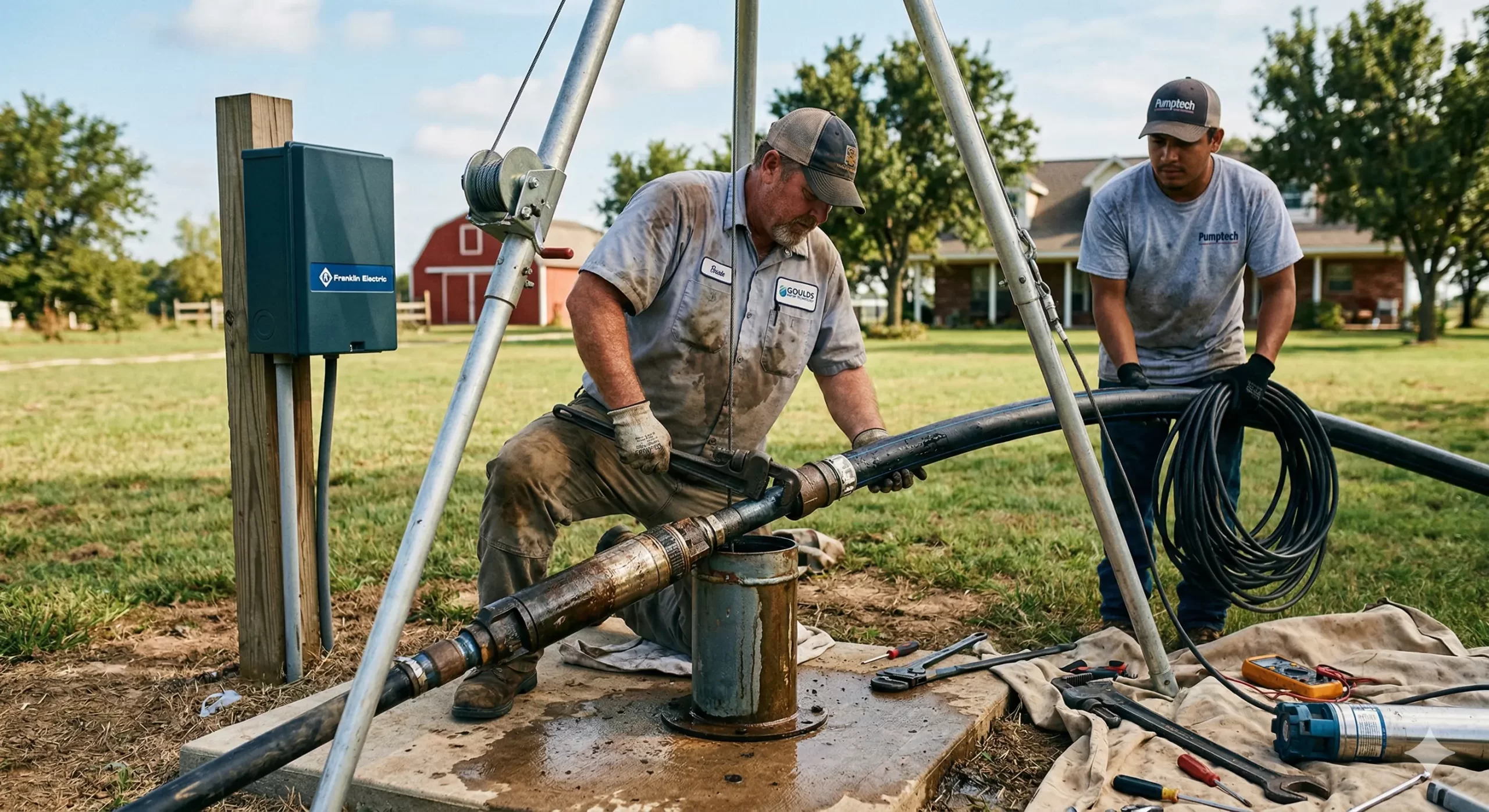
A ground-faulted submersible pump is not a DIY repair. The combination of high voltage (typically 240V), extreme weight (pumps can exceed 500 lbs), and significant depth necessitates a certified well technician with specialized equipment. The process begins with the arrival of a service truck equipped with a hydraulic pump hoist or pulling rig. This machinery is essential for safely and controllably lifting hundreds of feet of pipe, cable, and the pump itself without risk of dropping the assembly down the well, which could destroy the well casing and require a new well to be drilled.
Safety Protocol First
Before any work begins, the technician establishes a safe work zone and performs a verified Lockout/Tagout on the pump’s circuit breaker. They will then use a Megohmmeter, or ‘Megger,’ for definitive diagnosis. Unlike a standard multimeter, a Megger applies a high voltage (500V or 1000V) to the wiring to test the insulation’s integrity under a simulated load. This test will unambiguously confirm a weak or failed insulation jacket, justifying the pump’s extraction. Once confirmed, the technician will use a large T-handle pitless adapter key to disengage the internal water line from the well casing, allowing the entire drop pipe assembly to be pulled.
The extraction is a methodical process. As the hoist raises the assembly, the technician manages the drop pipe in sections, along with the submersible cable and safety rope. Once on the surface, a full failure analysis is conducted on the old pump, cable, and any splices. The replacement involves selecting a new pump and motor correctly sized for the well’s depth and yield. The creation of a new waterproof heat-shrink splice is one of the most critical steps, requiring meticulous cleaning, proper tools, and technique to ensure a multi-decade lifespan. After the new pump is installed and the system is disinfected per health codes, a full commissioning is performed. This includes checking the motor’s amperage draw at various operating points, verifying the water flow and pressure, and fine-tuning the pressure switch to ensure optimal performance and prevent future premature failures.
Repair Cost & Time Assessment
The cost for a professional submersible pump replacement due to a ground fault typically ranges from $2,500 to $7,000+ in the United States. This price is a function of several key variables. The primary costs are the new pump and motor unit, which vary based on horsepower, brand, and materials (e.g., stainless steel construction). Labor constitutes a significant portion, typically involving two technicians for 4 to 8 hours. The customer is also paying for the use of specialized equipment, often billed as an ‘equipment surcharge’ or ‘rig fee’ for the pump hoist, which is essential for the job’s safety and success. Additional parts like new drop wire, pitless adapters, check valves, and safety rope also contribute to the final invoice.
The timeline for a replacement is heavily dependent on the well’s specifics. A straightforward replacement in a 200-foot well with clear access might take 3-5 hours. However, a deeper well (400+ feet), difficult site access for the service rig, or complications like a pump stuck in the casing can easily extend the job to a full day or more. Customers in remote areas may also incur travel charges. The quoted price should be a comprehensive figure covering all aspects of the job, from diagnostics and extraction to installation, system disinfection, and commissioning to ensure the system is fully operational and safe upon completion.
Fast Local Service & Diagnostics
Calls are routed to a licensed local well professional.