
Diagnosis: A zero microfarad (µF) reading on a multimeter confirms a failed pump start capacitor. This failure prevents the motor’s start winding from creating the necessary torque, resulting in a humming sound without rotation and leading to rapid overheating. The correct repair involves safely discharging and replacing the capacitor with a new one of the exact same µF and voltage rating.
In this Guide:
What Causes the Multimeter Test Microfarad (µF) reading is zero Issue?
The primary function of a start capacitor in a single-phase AC motor is to create a phase shift in the current supplied to the motor’s start winding, generating a rotating magnetic field essential for initial torque. When a multimeter reads zero microfarads (µF), it signifies a complete internal failure. The root cause is typically the degradation of the internal dielectric material over thousands of start cycles. This material, often an oil-impregnated paper or plastic film, acts as an insulator between two plates of aluminum foil. Over time, electrical stress and heat cause this dielectric to break down, creating an internal short circuit. Another common failure mode is electrolyte dry-out; the electrolytic fluid inside the capacitor slowly evaporates, especially in high-temperature environments like a sun-baked control box, diminishing its ability to store a charge until capacitance falls to zero.
A catastrophic failure, often caused by a significant voltage surge from a lightning strike or utility switching event, can cause the capacitor to physically rupture. The immense and sudden energy forces the electrolyte to flash-boil, building internal pressure that violently blows out the top seal or bursts the aluminum casing. Regardless of the failure mode, the result is the same: the start winding receives no phase-shifted current. The motor attempts to start solely on its run winding, drawing immense Locked Rotor Amperage (LRA). This excessive current instantly overheats the start windings, which are only designed for intermittent, seconds-long duty. The enamel insulation on the copper windings can melt, leading to a permanent short circuit and complete motor destruction.
The mechanical consequences of a failed start cycle are equally severe. The stationary motor shaft, under intense magnetic stress and drawing LRA, places enormous axial and radial loads on the thrust bearings and sleeve bearings. These components are designed to operate with a hydrodynamic film of lubrication that only forms during rotation. Without rotation, metal-to-metal contact occurs under high load, causing galling and premature failure. Furthermore, the pump motor relies on the flow of water for cooling. In this stalled, high-amperage state, the motor generates extreme heat with no cooling mechanism. This heat can cook internal motor seals, causing them to become brittle and crack. A failed seal allows well water to intrude into the hermetically sealed motor housing, shorting the windings and contaminating the bearings, guaranteeing a complete and irreparable system failure.
DIY Troubleshooting Steps
- Full Power Disconnection and Verification: Before any inspection, shut off the two-pole breaker supplying the pump. At the control box, use a multimeter to verify zero voltage between both hot legs (L1-L2) and between each hot leg and ground. This is a critical, non-negotiable safety step for a 240V system.
- Visual and Olfactory Inspection: Open the pump control box and carefully inspect the start capacitor. Look for any physical deformities such as a bulging or domed top, an oily residue leaking from the seals, or scorch marks on the casing and terminals. A distinct, acrid smell of burnt electronics often accompanies a capacitor failure.
- Audible System Check (with caution): Have an assistant briefly restore power at the breaker while you listen near the control box or well head. If you hear a loud, distinct HUM or BUZZ the instant the pressure switch calls for water, but the pump does not start, it’s a classic sign of a failed start capacitor. Have the power turned off immediately to prevent motor damage.
- Thermal Overload Reset: Locate the thermal overload protector in the control box, which is often a small red or black button. Press it firmly to reset it. If this overload trips again immediately on the next start attempt, it confirms a severe over-current condition, most likely caused by the stalled motor.
- Capacitor Discharge and Test: With power again verified OFF, use a screwdriver with a heavily insulated handle to short across the two terminals of the capacitor. You may see a small spark if it held any residual charge. Disconnect the capacitor’s wires, set your multimeter to the capacitance setting (µF), and measure across the terminals. A reading of zero, ‘OL’ (Over-Limit), or a value significantly below its rating confirms it is defective.
- Amperage Draw Test (Professional/Advanced DIY): For those experienced with live electrical measurements, use a clamp-on ammeter around one of the motor’s power leads. During a failed start attempt, you will see the amperage spike to the motor’s Locked Rotor Amps (LRA) rating, often 50-100 amps or more, for a brief moment before the breaker trips. This confirms the motor is receiving power but cannot rotate.
When to Call a Professional Well Service
Upon arrival, a professional technician’s first step is a comprehensive electrical diagnosis at the surface, which goes beyond a simple capacitance test. Using a megohmmeter (or ‘megger’), they will test the insulation resistance between the motor windings and ground. This test applies a high voltage (typically 500V or 1000V) to detect any weakness or shorts in the motor windings or the submerged drop cable. A reading below one megohm suggests a compromised motor or cable, indicating that simply replacing the capacitor will not solve the underlying problem. This single test prevents a costly callback and protects the new capacitor from failing due to a downstream short circuit.
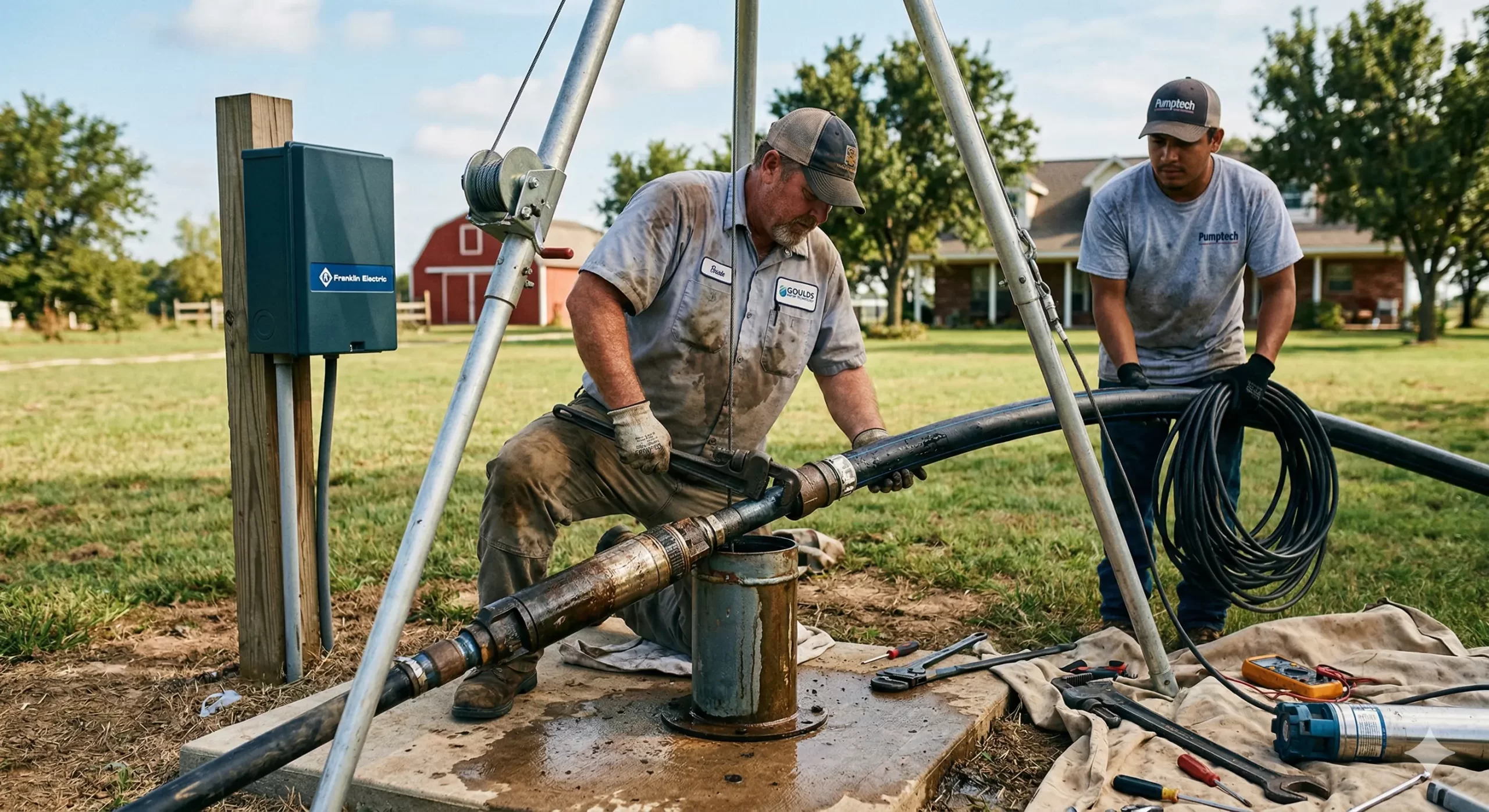
If the megger test indicates a fault downhole, the submersible pump must be pulled. This operation is hazardous and requires specialized equipment. A heavy-duty pump hoist or pulling rig is positioned over the wellhead to safely manage the static and dynamic loads of the pump, motor, water-filled drop pipe, and cable, which can easily total 500-1000 lbs for deep-set pumps. The technician uses a ‘pitless adapter key’—a long T-handle tool—to reach down into the well casing and disengage the pump assembly from the pitless adapter. This allows the entire assembly to be hoisted vertically without disturbing the main water line buried below the frost line. Attempting this manually is a direct path to severe injury or dropping the entire assembly, leading to a much more expensive ‘fishing’ operation.
Once the pump is at the surface, a full forensic analysis is performed. The intake screen is checked for bio-fouling or sediment. The technician will perform another direct megohmmeter test on the motor leads to confirm if the fault is in the motor itself or the drop cable. If the motor is shorted, it is replaced. The drop cable is meticulously inspected for any chafing or cuts that may have occurred against the well casing. When installing the new motor, the technician uses industrial-grade, heat-shrink splice kits to create a permanent, watertight electrical connection. These splices are far superior to simple electrical tape and are essential for the longevity of a 240V motor submerged hundreds of feet underwater. After installation, the system’s amperage draw, cycling time, and pressure switch settings are all re-calibrated for optimal performance.
Safety Protocol: All work on 240V well systems mandates a strict Lockout/Tagout (LOTO) procedure at the circuit breaker. Capacitors must be properly discharged as they can retain a dangerous electrical charge. The mechanical risks associated with pulling a heavy pump necessitate the use of a certified hoist and proper lifting techniques to prevent equipment loss down the well bore or serious personal injury.
Repair Cost & Time Assessment
The cost to resolve a zero microfarad reading varies dramatically based on the true point of failure. For the simplest scenario—where only the start capacitor in an above-ground control box has failed—the repair cost typically ranges from $225 to $450. This price includes the service call fee, one hour of diagnostic and repair labor, and the part itself, which is usually under $50. The majority of the cost is for the technician’s time, expertise, and stocked service vehicle.
However, if diagnostics determine the motor itself is shorted and the pump must be pulled from the well, the cost increases substantially. A full pump and motor replacement project generally falls in the range of $1,800 to $4,500. This comprehensive price reflects several factors: 2-4 hours of labor for two technicians, a dedicated pump hoist/rig usage fee, the cost of the new submersible pump and motor unit (which can be $800-$2000+ alone depending on horsepower and brand), new waterproof heat-shrink splice kits, and potentially a new length of submersible drop cable if the old one is damaged. The final price is dependent on the well depth, pump size, and regional labor rates.
Fast Local Service & Diagnostics
Calls are routed to a licensed local well professional.