
Diagnosis: Bubbling water at the wellhead indicates a failed pitless adapter O-ring, often caused by ground shifts, vibration, or freezing. This leak can introduce contaminants and cause the pump to short-cycle, leading to catastrophic motor failure. Professional repair involves excavation and replacing the seals using a specialized pulling tool.
In this Guide:
What Causes the Visual Check Water bubbling around casing top Issue?
The primary engineering cause for a bubbling wellhead is the mechanical failure of the rubber O-rings in the pitless adapter. This component, typically a heavy-duty two-part brass or stainless steel fitting, creates a sanitary, frost-proof seal through the well casing several feet below ground. Its O-rings are subjected to constant pressure and significant environmental stress. The most common failure vectors are soil movement from frost heave or settling, which exerts immense shear force on the casing and misaligns the adapter’s mating surfaces, pinching or extruding the seals. Additionally, high-frequency vibration transmitted up the drop pipe from the pump motor, especially during startup, can cause long-term chafing and wear on the O-ring material, eventually compromising its integrity.
When this seal fails, a high-pressure water leak is created on the discharge side of the pump. This has immediate and severe consequences for the entire electromechanical system. The leak prevents the system from reaching its shut-off pressure quickly, forcing the pressure switch to cycle the pump far more frequently than designed—a condition known as short-cycling. Each startup cycle draws a massive inrush current (often 5-6 times the running amperage), which generates significant heat in the motor windings. This thermal stress progressively breaks down the winding’s enamel insulation. Eventually, this insulation will fail entirely, causing a short-to-ground fault that destroys the motor and trips the breaker.
Beyond the electrical damage, the hydraulic and mechanical stresses are substantial. The constant short-cycling and pressure fluctuations amplify the effects of water hammer, sending shockwaves through the drop pipe and placing extreme stress on the pump’s thrust bearings and shaft. Furthermore, a failed pitless seal presents a grave sanitary risk. When the pump shuts off, the pressure differential can siphon contaminated surface water, soil bacteria like coliform, and sediment back into the well through the leak path. This not only contaminates the potable water supply but can also introduce abrasive sediment into the pump itself, which will rapidly wear down impellers and diffusers, permanently reducing pump performance and efficiency.
DIY Troubleshooting Steps
- Visual Confirmation & Cycle Timing: First, confirm that water is actively bubbling from the ground around the well casing when the pump runs, not from a loose well cap or electrical conduit. Next, use a stopwatch to time the pump’s run cycle. A healthy system may run for 60 seconds or more to build pressure. If your pump is running for less than 30 seconds before shutting off, and then kicking back on again shortly after, you have a severe short-cycling issue indicative of a major leak.
- Perform a Pressure Hold Test: With the pump running, close the main water valve inside your home. Watch the pressure gauge at your tank. If the pump shuts off and the pressure immediately starts to drop, it confirms a leak exists somewhere between the pump and the valve you closed. Given the bubbling at the wellhead, the pitless adapter is the prime suspect.
- Measure Pump Motor Amperage: If you are proficient with electrical safety, use a clamp-on ammeter on the pump’s power leg at the control box or pressure switch. Measure the current draw while the pump is running and compare it to the Full Load Amps (FLA) rating on the motor’s nameplate. An amperage reading significantly higher than the FLA indicates the motor is under severe strain, likely from continuous operation against a leak.
- Inspect the Control Box & Pressure Switch: After turning off the dedicated two-pole breaker, open the pump control box. Look for signs of overheating, such as discolored wires, melted plastic on the start relay, or a bulging/leaking start capacitor. At the pressure switch, check for burned or pitted contact points, which is physical evidence of excessive arcing caused by short-cycling.
- Check for a Tripped Thermal Overload: Many submersible pump control boxes feature a manual thermal overload reset button. If this has tripped, it’s a definitive sign that the motor has been overheating. You can attempt to reset it once. If it trips again, do not reset it; the motor is in danger of permanent failure and requires immediate professional service.
- Secure the Wellhead: While awaiting professional service, ensure the area is cordoned off, as the saturated ground can become unstable. Ensure no surface runoff is being directed toward the well casing to minimize further contamination.
When to Call a Professional Well Service
A professional repair begins with a comprehensive system diagnosis, not just an immediate excavation. The technician will first use a megohmmeter to perform an insulation resistance test on the motor windings from the wellhead. This critical step determines the health of the submersible motor before committing to the labor-intensive process of pulling it. A reading below 1 megohm indicates compromised insulation, and the technician will advise on a potential pump and motor replacement in addition to the pitless repair. Once the electrical system is assessed, the crew will excavate around the well casing to expose the pitless adapter body and the service line, typically 4 to 6 feet below grade.
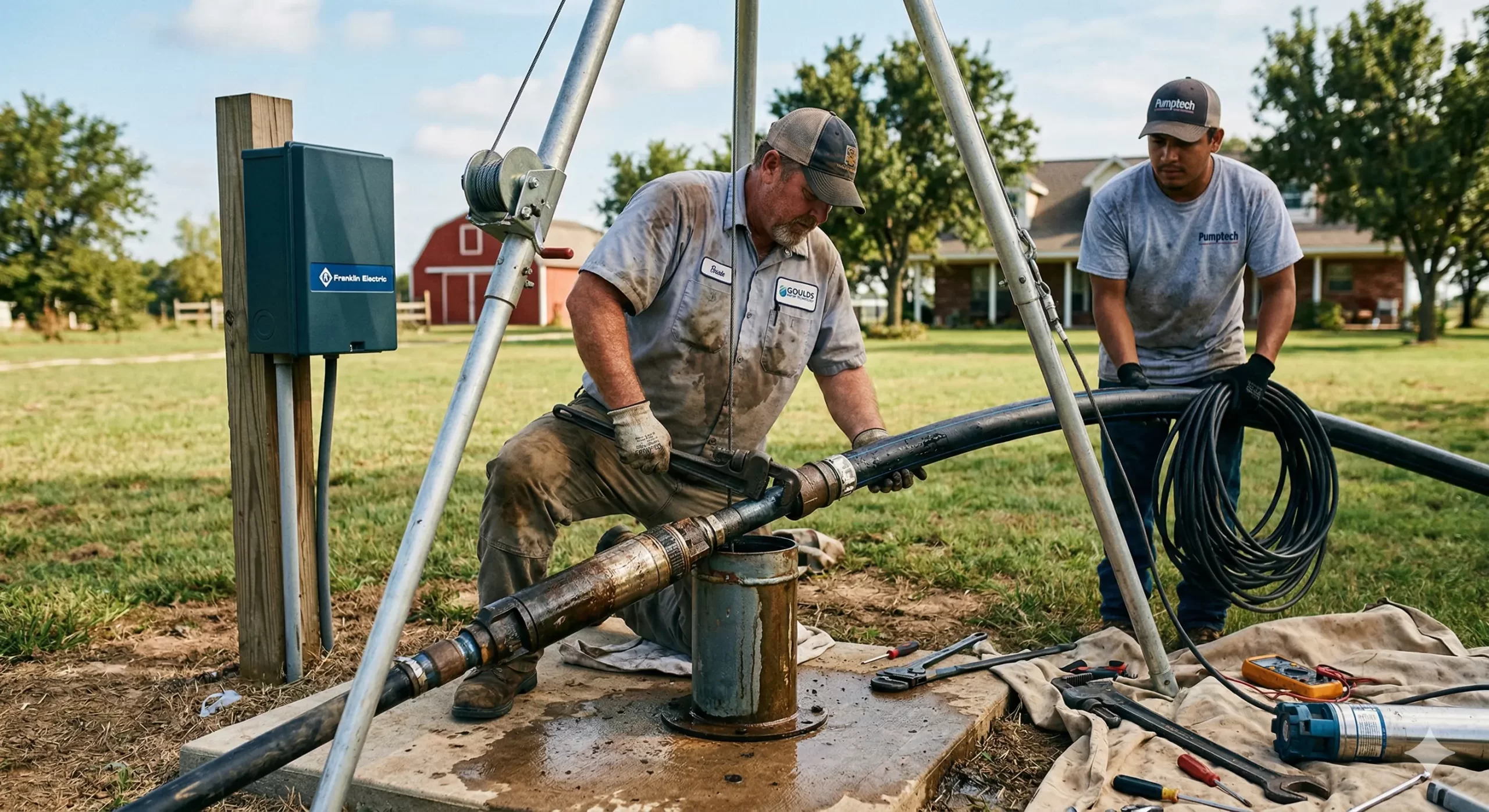
With the adapter exposed, the safe and controlled pulling of the pump assembly is next. This is a non-negotiable, safety-critical procedure that requires specialized equipment. A heavy-duty pump hoist or portable pulling rig is positioned over the well. A threaded T-handle pitless adapter key is screwed into the top of the drop pipe, engaging the pump assembly. The hoist then takes the full weight—which can easily exceed 500 pounds for a deep-set pump—and lifts the column a few inches. This action slides the male, interior half of the adapter vertically out of the female, casing-mounted half, allowing the entire pump, pipe, and wire assembly to be pulled from the well and safely laid out on the ground for service.
Safety Protocol
Handling a 240-volt electrical system submerged in water, coupled with the immense weight of the pump assembly, demands strict safety protocols. The procedure begins with a full Lockout/Tagout (LOTO) at the main electrical panel to de-energize the circuit completely. The excavation site itself is treated as a potential confined space, with shoring used if the trench walls are unstable. Attempting to pull a pump manually is extremely dangerous; it risks dropping the entire assembly down the well (a catastrophic event), damaging the well casing, or causing severe physical injury to the operator.
Once the pump is on the surface, the technician removes the worn O-rings and gasket. The mating surfaces of both halves of the pitless adapter are meticulously cleaned of all corrosion and mineral scale to ensure a perfect seal. New, high-grade nitrile or Viton O-rings, lubricated with an NSF-61 approved, food-grade silicone grease, are installed. The assembly is then carefully lowered back into the well, and the hoist is used to guide the male adapter precisely back into the female housing to establish a firm, watertight connection. Before backfilling, the system is re-energized, and a pressure test is conducted to confirm the repair’s integrity.
Repair Cost & Time Assessment
The total cost for a professional pitless adapter O-ring replacement in the United States typically falls between $850 and $2,200. This price variation is dictated by several key factors. A straightforward job on a shallow well (e.g., 100 feet deep) with easy-to-dig soil and clear access for the service truck will be at the lower end of the range. The cost increases significantly with well depth, difficult excavation conditions such as rocky soil or extensive landscaping, or if the well is located in an area with limited access requiring more portable equipment.
The customer’s investment covers a comprehensive service package designed for safety and longevity. This includes the mobilization of a service truck equipped with a hydraulic pump hoist, which is a critical piece of equipment. The labor costs typically account for a two-person crew (a licensed technician and a helper) for 4 to 6 hours. This covers excavation, diagnostics, pulling and reinstalling the pump, and site restoration. Finally, the cost includes premium replacement parts, which are not just the O-rings themselves but may also include a new pitless adapter gasket, sanitary well cap seals, and any necessary electrical components found to be damaged from the short-cycling.
Fast Local Service & Diagnostics
Calls are routed to a licensed local well professional.