
Diagnosis: A seized well pump from hard water presents as low pressure and white crust on fixtures. Calcium scaling cements the pump’s impellers, causing a locked rotor condition that can burn out the motor. Professional repair involves well acidization or pump replacement and installing a water softener to prevent recurrence.
In this Guide:
What Causes the Water Quality White crust on fixtures / Low pressure Issue?
The fundamental cause of pump seizure in hard water environments is the precipitation of dissolved minerals, primarily calcium carbonate (CaCO3), directly onto the pump’s internal components. As groundwater with a high concentration of these minerals is drawn into the pump, the changes in pressure and velocity across the impeller stages create ideal conditions for these minerals to fall out of solution. This process is analogous to how scale forms in a water heater. The mineral deposits build up layer by layer, especially on the tight-tolerance surfaces between the rotating impellers and the stationary diffusers. Over time, this buildup becomes a rock-hard scale that effectively cements the plastic or stainless steel impellers in place, physically preventing the pump shaft from rotating.
This mechanical seizure triggers a cascade of electrical failures. When the control system calls for water, it sends 240 volts to a motor that is physically unable to turn. The motor immediately attempts to draw what is known as Locked Rotor Amperage (LRA), a current draw that can be five to seven times its normal Full Load Amperage (FLA). This massive inrush of current generates extreme heat within the motor windings. While the motor’s thermal overload protection is designed to trip under these conditions, repeated cycling or a faulty overload can allow the winding insulation’s temperature to exceed its rating. The enamel insulation melts, causing adjacent copper windings to short-circuit. This results in a catastrophic, non-recoverable motor burnout, often requiring a complete pump and motor replacement.
Beyond the primary failure of the impellers and motor windings, the immense torque exerted by the motor against a locked rotor inflicts significant stress on the entire drivetrain. The pump shaft can be twisted or damaged, and the thrust bearing assembly, designed to handle axial downthrust during operation, is subjected to extreme radial and starting torque forces it cannot withstand. Furthermore, the heat generated during locked rotor events and the abrasive nature of the calcium crystals can compromise the pump’s mechanical seals. A failed seal allows water to penetrate the oil-filled motor housing, displacing the cooling and lubricating oil and leading to rapid corrosion and bearing failure, ensuring the motor’s destruction even if it survives the initial electrical overload.
DIY Troubleshooting Steps
- Observe the Circuit Breaker and Control Box: Locate the dedicated two-pole circuit breaker for the well pump in your main electrical panel. If it has tripped, attempt to reset it ONCE. If it trips again immediately, do not reset it again. This indicates a severe overcurrent condition, likely a locked rotor or shorted motor. Also check for any manual reset buttons on an external pump control box.
- Perform a Clamp Ammeter Reading (Qualified Persons Only): If you are comfortable and qualified to work with live 240V circuits, use a clamp-on ammeter on one of the motor leads at the pressure switch or control box. When the pump tries to start, you will observe a very high amperage reading (the LRA) that persists for a second before the breaker or overload trips. A healthy pump’s starting amperage drops to its normal running amperage (FLA) within a second. A sustained high reading confirms a locked rotor.
- Listen for Diagnostic Sounds: When there is a call for water (e.g., a faucet is open), stand near your pressure tank or well head. Instead of the sound of flowing water and a running pump, you will likely hear a single, loud ‘thump’ followed by a distinct electrical ‘hum’ or ‘buzz’ that lasts for a few seconds before cutting out. This is the sound of the motor energizing but failing to turn.
- Inspect the Pressure Switch Contacts: After turning off the power at the breaker, remove the cover of your pressure switch. Look for signs of severe pitting, black carbon scoring, or melted plastic around the electrical contacts. The extremely high amperage of a locked rotor condition can cause significant arcing and damage to the switch as it attempts to make and break the circuit.
- Monitor the Pressure Gauge: The pressure gauge will typically drop to zero (or near it) as you run water. When the pump is supposed to kick on, the gauge needle will not move at all, confirming that the pump is not building any pressure despite receiving power.
- Check for Rapid Cycling History: Before the final seizure, a pump struggling with scale buildup may have been rapid cycling—turning on and off frequently. This is because the partially clogged impellers struggle to build enough pressure to satisfy the pressure switch’s cut-off setting, a key warning sign of impending failure.
When to Call a Professional Well Service
Upon arrival, a professional technician will first confirm the diagnosis using specialized electrical test equipment. The primary tool for this is a megohmmeter, often called a ‘Megger’. This instrument applies a high voltage (typically 500V or 1000V) to the motor’s wiring to test the integrity of the insulation between the motor windings and the motor’s steel casing (ground). A reading of many megohms indicates healthy insulation. A low reading, especially one below one megohm, confirms that the winding insulation has failed and shorted to ground, necessitating a complete pump replacement. If the motor tests electrically sound with the megohmmeter but still draws locked rotor amps, the problem is confirmed as a purely mechanical seizure, and a well rehabilitation might be an option after pulling the pump.
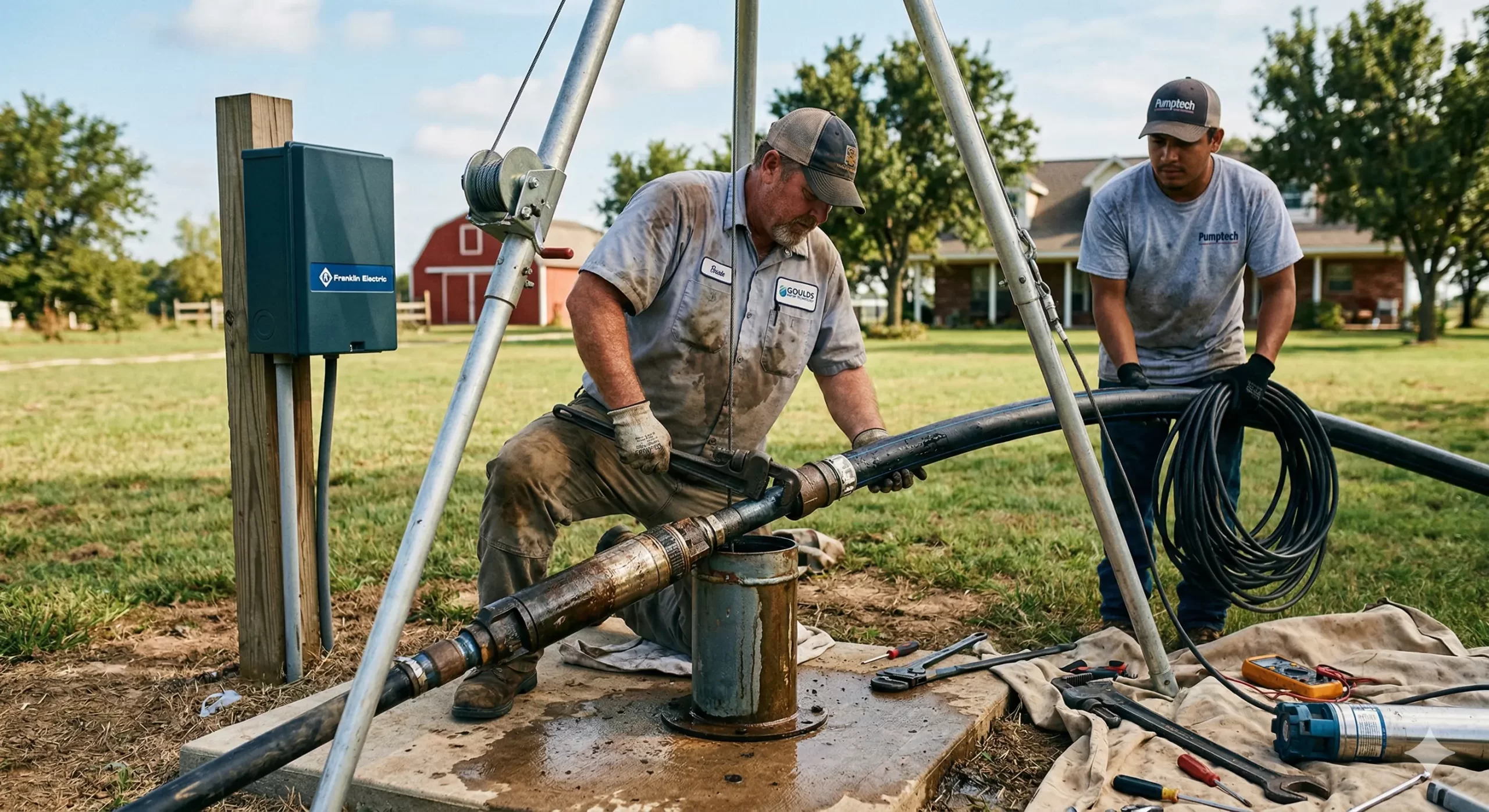
Extracting a submersible pump is a hazardous and equipment-intensive operation that should never be attempted without the proper machinery. Safety Protocol: The procedure begins with a strict lockout/tagout of the 240V circuit breaker. The technician then accesses the wellhead and uses a specialized T-handle pitless adapter key to disconnect the pump assembly from the home’s plumbing inside the well casing. A dedicated hydraulic pump hoist or pulling rig is positioned over the well. This rig is essential for safely managing the combined weight of the pump, motor, hundreds of feet of water-filled drop pipe, and heavy submersible cable, which can easily exceed 500 pounds. Attempting to pull this by hand is not only incredibly difficult but also risks dropping the entire assembly down the well, creating a much more expensive problem.
Once the pump is on the surface, a visual inspection will confirm the extent of the calcium scaling. If the damage is confined to the hydraulic end (the ‘wet end’) and the motor is still viable, the technician may replace only the seized hydraulic stage assembly. However, it is more common to replace the entire pump and motor unit to ensure reliability. The old wire splice is cut, and a new waterproof heat-shrink splice kit is used to connect the new motor to the existing submersible cable. If the well itself is heavily scaled, the technician may perform a well rehabilitation by circulating a specialized acid, like Nu-Well, to dissolve mineral buildup from the well screen and borehole wall. Following the pump replacement, the installation of a high-capacity water softener is strongly recommended as a permanent solution to prevent a recurrence of the scaling issue.
Repair Cost & Time Assessment
The cost for a professional repair of a seized, scale-locked well pump in the United States typically ranges from $1,800 to $4,500, with some complex cases exceeding this. This cost is a composite of several factors. Labor constitutes a significant portion, usually involving two technicians for 4 to 8 hours at professional rates. The use of specialized equipment, such as a fully-equipped service truck and a hydraulic pump pulling rig, is billed as a service or mobilization fee, often several hundred dollars. The bulk of the cost often comes from parts: a new submersible pump and motor assembly can range from $800 to over $2,000 depending on horsepower, brand, and materials (a stainless steel pump is a premium over a thermoplastic model). Additional parts include a new heat-shrink splice kit, new safety rope, and potentially new sections of drop pipe or submersible cable if they are found to be damaged.
What you are paying for is a complete, safe, and warrantied solution. The price reflects the technician’s expertise in diagnosing high-voltage electrical systems and deep-well hydraulics, the high liability and physical risk associated with the work, and the investment in thousands of dollars of specialized tools. This is not a handyman task; it is a specialized trade. The cost ensures the job is done correctly, from the electrical connections and waterproof splicing to the proper setting of the pump, preventing future issues and ensuring the safety and reliability of your home’s water supply.
In most standard scenarios, a complete pump pull and replacement can be accomplished within a single workday, typically lasting between 4 and 8 hours from arrival to final system testing. Factors that can extend this timeline include extreme well depth, difficult access to the wellhead, or the decision to perform a well rehabilitation procedure, which requires time for the chemicals to work effectively before the new pump can be installed and the well can be properly flushed.
Fast Local Service & Diagnostics
Calls are routed to a licensed local well professional.