
A Bradford White 4-blink code indicates a high-temp shutdown. This emergency requires immediate gas shutoff. Fix involves flushing scale or replacing the gas valve.
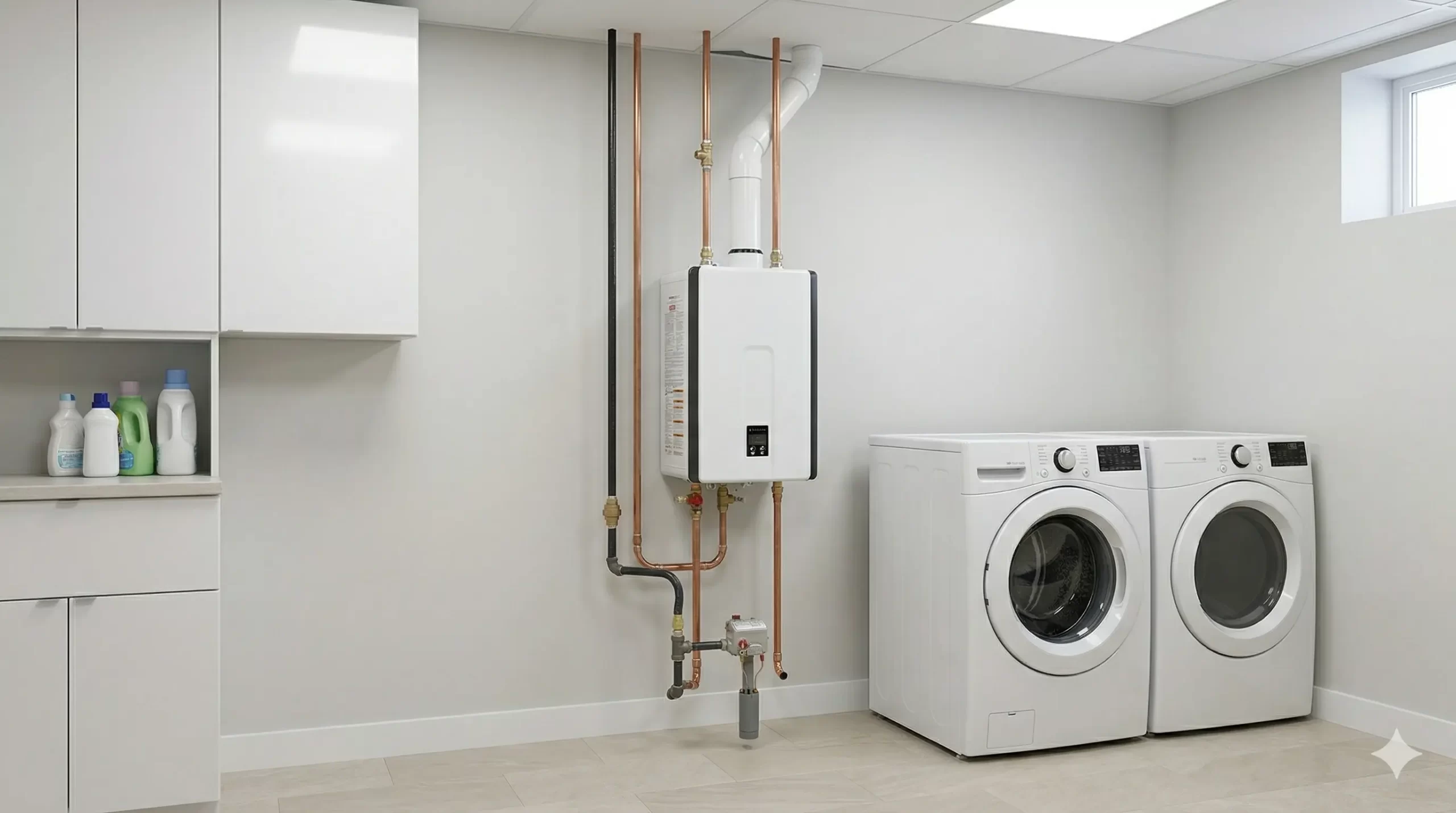
A 4-blink High Temperature Shutdown is not a minor fault; it signifies the primary temperature regulation system has failed. Continuing to operate the unit risks creating superheated water within a pressurized vessel. This condition can lead to a violent steam explosion (flash boiling) at any faucet or, in a worst-case scenario, catastrophic tank failure far exceeding the capacity of the T&P relief valve. Do not attempt a simple reset. The gas supply must be terminated immediately pending a professional diagnosis of the control system and tank integrity.
️ Repair Profile
Required Diagnostics Tools
Pipe Wrench, Channel-Lock Pliers, Pipe Dope, Teflon Tape, Digital Multimeter, Manometer, Garden Hose, Bucket, Screwdriver Set
Financial Breakdown: Parts vs. Licensed Labor
The cost distribution is heavily weighted towards parts because the Bradford White ICON System gas control valve is a complex, integrated electronic assembly, not a simple mechanical thermostat. Labor costs reflect the precision required for gas line fitting, pressure verification with a manometer, and ensuring a leak-free, safe recommissioning of the appliance.
Deep Technical Diagnosis: The Physics of the Failure
A 4-blink status light on a Bradford White water heater equipped with an ICON gas control valve indicates a High Temperature Shutdown event. This is a critical safety lockout triggered when the thermistor within the thermal well detects a water temperature exceeding the safety limit, typically around 180°F (82°C). The control’s microprocessor interprets this over-temperature condition as a severe operational fault, immediately de-energizing the main gas valve solenoid and initiating the lockout code to prevent a hazardous situation. This is not merely a high-limit switch trip; it is a hard lockout requiring diagnostic intervention. The system’s logic board ceases ignition attempts and waits for a manual reset, but simply resetting without addressing the root cause is extremely dangerous.
The underlying fault can stem from several conditions that disrupt the delicate balance of heat transfer and temperature regulation within the pressurized vessel. A primary culprit is the thermal insulation effect caused by mineral deposits. Over time, severe sediment calcification on the bottom flue sheet of the tank creates an insulating barrier. The burner continues its firing cycle, but the heat cannot efficiently transfer to the water. This traps intense heat at the tank bottom, creating localized boiling and superheating the water nearest the thermal well, tricking the sensor into registering a tank-wide over-temperature condition long before the bulk of the water has reached the setpoint. Other possibilities involve the gas supply and control system itself.
- Severe Sediment Buildup: A thick layer of lime, calcium, and magnesium scale on the tank’s lower surface acts as a thermal barrier, causing localized overheating and deluding the thermal sensor.
- Failing Gas Control Valve: The internal thermostat or thermistor component of the ICON control valve may be malfunctioning, providing inaccurate temperature readings to the logic board or physically failing to shut off the gas flow at the correct temperature setpoint.
- Excessive Gas Pressure: Gas pressure delivered to the manifold that exceeds the manufacturer’s specification (typically 3.5″ W.C. for natural gas) will cause the burner to over-fire, inputting more BTUs than the unit is designed to handle and leading to a rapid, uncontrolled temperature rise. This must be verified with a manometer.
- Improper Combustion Stoichiometry: A poorly optimized air/fuel mixture, potentially from a clogged burner orifice or restricted venting, can alter flame characteristics, causing inefficient and excessively hot combustion that overheats the flue and tank bottom.
- Faulty Thermal Well Sensor: While less common, the sensor probe itself can fail, sending erroneous high-temperature data (incorrect resistance or millivolt signals) to the control board, triggering a false shutdown.
US Building Codes & Plumbing Regulations
In the context of a 4-blink high-temperature shutdown, compliance with NFPA 54 (the National Fuel Gas Code) is paramount, specifically concerning appliance operation and servicing. Section 9.1.2 mandates that gas appliances be operated in accordance with their listed instructions, and a high-temperature lockout is a clear deviation from normal operation. A professional diagnosis must verify that the manifold gas pressure aligns with the specifications on the appliance’s rating plate, a requirement stipulated by NFPA 54. An over-pressure condition causing the shutdown is a direct code violation, as it creates an immediate hazard that the appliance’s safety systems are forced to contain.
Furthermore, this error directly involves the ultimate safety device governed by the Uniform Plumbing Code (UPC) and International Plumbing Code (IPC). The Temperature and Pressure (T&P) relief valve, mandated by UPC Section 504.4, is the final line of defense against catastrophic tank failure in an over-temperature event. A 4-blink code indicates the primary electronic control has failed or has been forced to activate due to extreme conditions. It is a code violation to ignore this warning, as the next failure point could be a compromised T&P valve, leading to an explosion. A post-repair inspection must always include verification of the T&P valve’s condition and proper discharge piping.
Professional Master Plumber Repair Sequence
- Immediate Safety Protocol: Confirm the 4-blink code on the ICON control. Do not attempt a reset. Immediately locate the manual gas shutoff valve on the supply line to the water heater and turn it to the ‘Off’ position. The handle should be perpendicular to the pipe.
- Verify T&P Valve Integrity: Carefully inspect the Temperature and Pressure (T&P) relief valve. Check for any signs of weeping, corrosion, or discharge. Do not operate the valve if the system is potentially superheated. This step is for visual inspection only.
- Depressurize and Prepare for Flush: Turn off the cold water supply to the heater. Open a hot water tap somewhere in the building to relieve pressure. Connect a heavy-duty garden hose to the boiler drain at the bottom of the tank and route it to a floor drain or outside.
- Execute Full Tank Flush: Open the boiler drain valve. Allow the tank to drain completely to remove loose sediment. To dislodge baked-on scale, briefly open the cold water supply valve in short bursts to create turbulence inside the tank. Repeat until the draining water runs clear.
- Refill and Purge System: Close the boiler drain valve and disconnect the hose. Fully open the cold water supply valve. Leave the hot water tap open elsewhere in the building until a steady stream of water, free of air, flows out. This ensures the tank is full and all air is purged. Close the hot water tap.
- System Re-Ignition and Observation: Follow the manufacturer’s specific relighting procedure printed on the unit. This typically involves turning the gas control knob to ‘Pilot’, pressing it down, and lighting the pilot. Once the pilot is lit, turn the knob to ‘On’. Set the thermostat to a low setting (e.g., 90°F).
- Monitor Operation: Carefully observe the main burner operation and listen for any unusual sounds like popping or rumbling (kettling), which indicates remaining sediment. Allow the unit to run a full heating cycle at the low temperature.
- Advanced Diagnosis (If Code Returns): If the 4-blink code reappears, the issue is likely the gas control valve or gas pressure. A qualified technician must connect a manometer to the valve’s inlet and outlet ports to verify gas pressure is within the manufacturer’s specified range (e.g., 3.5″ W.C. for NG).
- Gas Control Valve Replacement: If gas pressure is correct, the ICON control valve is the point of failure. The gas and water supply must be shut off, the tank partially drained, and the old valve carefully removed. The new valve must be installed using appropriate pipe dope, and all electrical connections must be securely re-established.
- Final Leak Check and Commissioning: After replacing the valve, turn the gas supply on and meticulously check all new fittings for leaks using an electronic gas detector or soap solution. Once confirmed leak-free, re-light the appliance and verify proper burner operation and flame characteristics.
Expert Verdict: Is It Worth Repairing?
When faced with a 4-blink error on a Bradford White heater, the repair-versus-replace decision hinges directly on the unit’s age and the root cause. If a simple, aggressive tank flush resolves the issue on a unit less than 6 years old, the repair is a highly cost-effective investment in preventative maintenance. However, if the diagnosis confirms a failed ICON System gas control valve, the financial calculus shifts dramatically. The valve itself is a high-cost component, often representing 40-60% of the price of a brand new, comparable water heater.
For a unit approaching or exceeding 8-10 years of service life, investing several hundred dollars to replace the gas valve yields a poor return on investment. The severe scale buildup that likely contributed to the overheating has already inflicted irreversible wear on the tank’s glass lining and anode rod. Replacing the valve on an aged, inefficient, and compromised tank is often a temporary fix before a tank leak or another component failure occurs. In this scenario, replacing the entire water heater is the more prudent financial decision, providing a new warranty, improved energy efficiency, and long-term reliability.
Frequently Asked Questions (FAQ)
Q: Can a 4-blink high-temperature code on my Bradford White fix itself?
A: No. A 4-blink code is a hard lockout initiated by the unit’s safety controls. It will not clear on its own and requires manual intervention. The underlying cause, be it massive sediment buildup or a faulty gas valve, must be professionally diagnosed and rectified before the unit can be safely returned to service.
Q: Is it safe to just reset the water heater after a 4-blink error?
A: Absolutely not. Resetting the unit without addressing the cause of the high-temperature condition is extremely dangerous. You would be overriding a critical safety feature that prevented the water from becoming superheated, which could lead to a steam explosion or scalding injury. The gas supply must be turned off until a proper diagnosis is complete.
Q: How does sediment on the tank bottom cause a high-temperature shutdown?
A: Sediment (scale) acts as an insulator between the burner flame and the water. The burner fires, but the heat gets trapped in the steel tank bottom instead of transferring to the water. This creates an intense hot spot directly where the temperature sensor is located, fooling the control system into thinking the entire tank is dangerously hot and triggering the safety shutdown.
Q: Could my thermostat setting being too high cause the 4-blink error?
A: Unlikely under normal circumstances. The 4-blink code indicates a temperature well above the normal operating range (e.g., >180°F), far exceeding the maximum settable temperature on the dial (typically 150-160°F). The error signifies a runaway heating condition caused by a mechanical or mineral buildup fault, not a user setting.