
Rheem power vent blower won’t shut off? A stuck relay on the control board is the cause. This guide details the pro fix: replacing the control assembly.
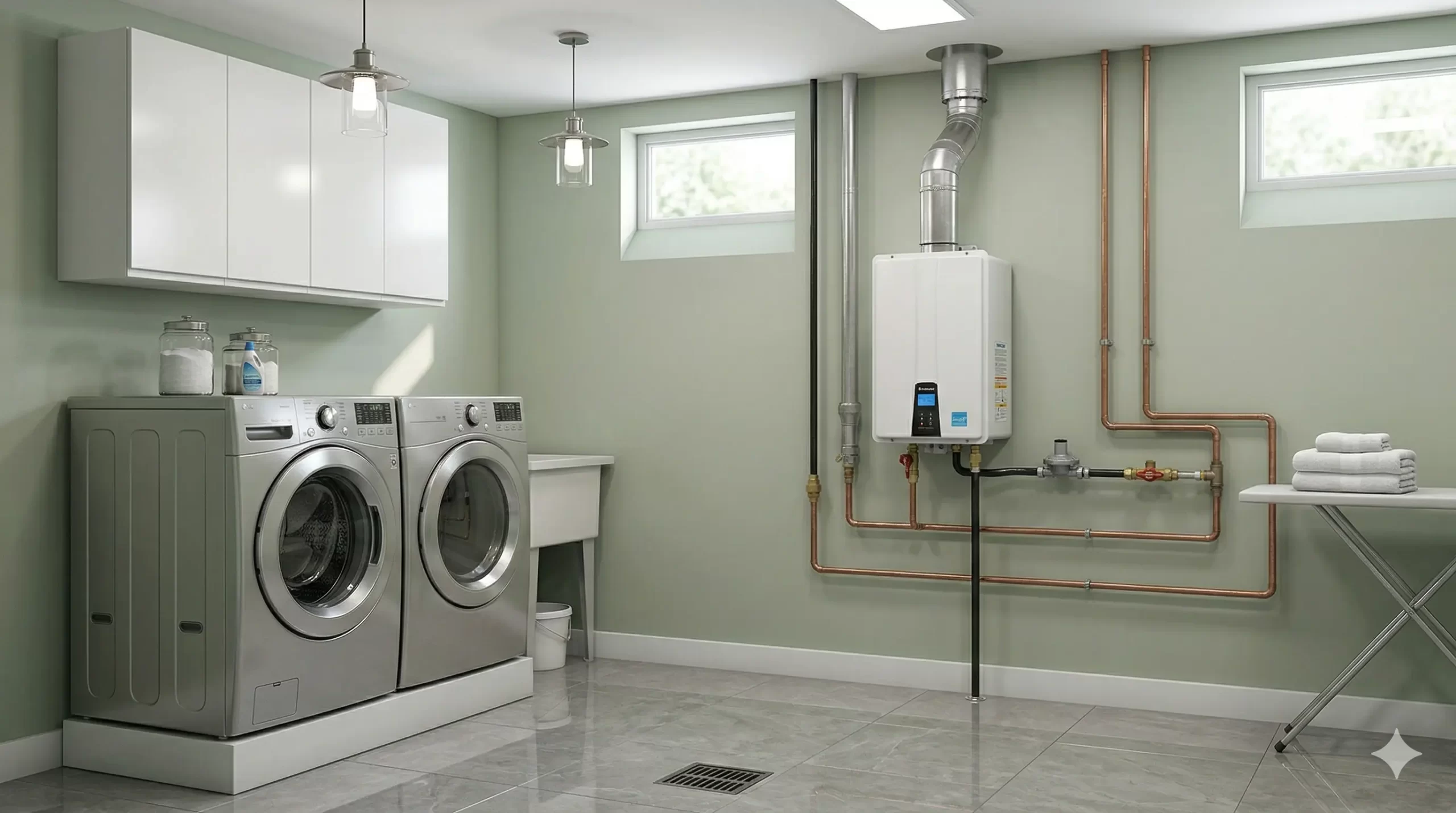
IMMEDIATE ACTION REQUIRED: A continuously operating power vent blower indicates a critical failure of the main control board’s safety logic. This is not a minor annoyance; the blower motor is not rated for continuous duty and will overheat, creating a significant fire hazard. Furthermore, the faulty control board could fail in other unpredictable ways, potentially affecting gas valve operation. De-energize the water heater at the dedicated circuit breaker immediately and do not restore power until the control assembly has been professionally replaced.
️ Repair Profile
Required Diagnostics Tools
Multimeter, 1/4″ Nut Driver, Phillips Head Screwdriver, Adjustable Pipe Wrench, Gas-rated Pipe Thread Sealant, Gas Leak Detection Solution
Financial Breakdown: Parts vs. Licensed Labor
The cost is heavily weighted towards the part because the integrated gas control valve and electronic board assembly is a sophisticated, factory-calibrated component. Labor constitutes a smaller portion as the physical replacement is a focused and relatively quick procedure for a qualified technician.
Deep Technical Diagnosis: The Physics of the Failure
The persistent operation of a Rheem power vent blower, even after the thermostatic demand for heat has been met, is an unambiguous symptom of a failure within the electronic control logic, specifically a stuck relay. In a correctly functioning system, the sequence is precise: the thermostat (a thermistor) detects a water temperature below its setpoint, altering its resistance. The microprocessor on the main control board interprets this change and energizes an electromechanical or solid-state relay, sending 120V AC line voltage to the power vent blower motor. This initiates the pre-purge cycle. A manometer would confirm the blower establishes the required negative pressure (typically -0.1 to -0.5 inches w.c.) in the combustion chamber, which closes the pressure switch’s diaphragm, completing a low-voltage circuit and signaling the board to proceed with ignition. Once the water is heated and the thermostat is satisfied, the microprocessor is programmed to de-energize the relay, cutting the 120V circuit to the blower. The failure occurs when the relay’s internal contacts, responsible for switching the high-voltage load, become physically welded together from arcing or have failed in a closed state. This creates a permanent electrical bridge, supplying continuous power to the blower motor, completely bypassing the microprocessor’s command to shut down. The system’s logic is now irrelevant to the blower’s operation; it will run indefinitely as long as the unit has power.
- Electrical Arcing: Over time, the making and breaking of the 120V connection can cause microscopic pitting and material transfer on the relay contacts, eventually leading to a micro-weld that fuses them closed.
- Power Surge Event: A significant voltage transient from the grid can overwhelm the relay’s specifications, causing an instantaneous weld or destroying the solid-state switching component (e.g., a TRIAC).
- Component Fatigue: Simple end-of-life failure of the relay’s mechanical spring or internal coil, particularly common in units with high cycling frequency.
- Moisture Intrusion: Condensation or a minor leak onto the unsealed control board can cause a short circuit that forces the relay into a permanently closed state.
This is not a failure of the thermopile or flame sensor, as those components are upstream in the ignition logic. The core issue is a hardware failure on the control board itself, preventing it from executing a fundamental command in the operational sequence. The blower motor is not designed for continuous duty and its windings will eventually overheat and fail, leading to a no-start condition and a potential release of un-vented flue gases on the next ignition attempt.
US Building Codes & Plumbing Regulations
According to NFPA 54, the National Fuel Gas Code, all gas appliances must operate in accordance with the manufacturer’s installation and operating instructions, which are predicated on the appliance’s certified design. A power vent blower that fails to cycle off represents a deviation from this certified operation. Section 9.6.1 mandates that venting systems shall be designed and constructed so as to develop a positive flow adequate to convey all flue gases to the outside atmosphere. A continuously running blower might seem to satisfy this, but the underlying control failure means the system’s safety interlocks (like the pre-purge and post-purge cycles) are no longer guaranteed to function as designed, creating a hazardous condition not addressed by the original safety certification.
Furthermore, the Uniform Plumbing Code (UPC) Section 503.2 requires appliances to be ‘Listed and Labeled’ by an approved agency. This listing is contingent on the appliance functioning precisely as tested. A control board with a stuck relay renders the original safety listing void because the appliance is now in a state of uncontrolled failure. An inspector would immediately red-tag the unit, as the failure mode presents an electrical fire risk from the overheating blower motor and compromises the integrity of the entire combustion and venting safety system. Continued operation is a direct violation of the code’s intent to ensure safe and predictable appliance function.
Professional Master Plumber Repair Sequence
- Safety First – Isolate Power: Locate the dedicated circuit breaker for the water heater in your main electrical panel. Switch it to the ‘OFF’ position. Place a piece of tape over it with a note, ‘DO NOT TURN ON – SERVICE IN PROGRESS,’ to prevent accidental re-energization.
- Verify Zero Voltage: Remove the access panel to the gas control valve/control board assembly. Set your multimeter to AC Volts (a setting higher than 120V). Carefully touch the probes to the incoming L1 and Neutral terminals on the control board. The meter must read 0 volts. This is a non-negotiable safety verification step.
- Shut Off Gas Supply: Locate the manual gas shut-off valve on the supply line leading to the water heater. Turn the handle a quarter turn so it is perpendicular to the pipe, cutting off the gas flow.
- Document and Disconnect Wiring: Before unplugging anything, take a clear photo of the control board and all connected wiring harnesses with your smartphone. This provides an infallible reference for reassembly. Carefully disconnect all molex connectors and spade terminals from the old control board.
- Remove the Old Assembly: The control board is typically part of the entire gas control valve assembly. Using a pipe wrench, carefully unscrew the assembly from the water heater tank’s threaded spud. Be prepared for a small amount of residual water to drip out.
- Prepare and Install New Assembly: Apply a moderate amount of gas-rated pipe thread sealant to the male threads of the new gas control valve assembly. Do not use Teflon tape. Thread the new assembly into the tank by hand until snug, then use a pipe wrench for a final quarter-turn to secure and seal it. Do not overtighten.
- Reconnect Gas and Check for Leaks: Reconnect the main gas line to the new control valve. Slowly turn the gas supply back on. Using a gas leak detection solution (or soapy water), apply it to all joints you have disturbed. Look for the formation of bubbles, which indicates a gas leak. If bubbles appear, shut off the gas and tighten the connection.
- Rewire the New Control Board: Using your reference photo, reconnect all wiring harnesses to their corresponding terminals on the new control board. Ensure each connector is fully seated and secure.
- Restore Power and Initiate Test Cycle: Remove your lockout tag from the breaker and switch it back to the ‘ON’ position. The unit should power on. Set the thermostat to a high temperature to initiate a call for heat. Observe the normal sequence: the blower should start, followed by ignition.
- Confirm Correct Shutdown: Once the water heater has completed a full heating cycle and the burner has shut off, continue to observe the unit. The power vent blower should run for a brief post-purge cycle (typically 30-60 seconds) and then shut off completely. This confirms the new relay is functioning correctly. Replace all access panels.
Expert Verdict: Is It Worth Repairing?
When faced with a failed control board on a Rheem power vent water heater, the repair-versus-replace decision hinges almost exclusively on the unit’s age. For a unit under 6 years old, a repair is almost always the superior financial choice. The integrated gas control valve and electronic board is a costly part, but it is significantly less than the price of a new power vent water heater plus full installation. This repair effectively restores the unit’s ‘brain’ to new condition, likely ensuring several more years of reliable service from an otherwise healthy tank and burner assembly. The return on investment is high, as you are maximizing the lifespan of your initial purchase.
However, if the Rheem water heater is approaching or has exceeded 10 years of service, investing several hundred dollars into a new control board presents a poor ROI. At this age, the sacrificial anode rod is likely depleted, and the tank itself is nearing the end of its structural life, facing risks of leaks and failure. Pouring money into a new control system for an aged tank is a losing proposition. In this scenario, the smarter financial move is to apply the repair cost towards a complete replacement, gaining a new unit with a full warranty, modern energy efficiency standards, and peace of mind against imminent tank failure.
Frequently Asked Questions (FAQ)
Q: Can I just replace the specific relay on the board instead of the whole assembly?
A: While technically possible for an electronics expert with soldering skills, it is strongly discouraged and professionally unadvisable. The control board is a certified safety component. Desoldering and replacing a single relay voids its UL listing, introduces potential for a cold solder joint failure, and creates immense liability. The only safe and code-compliant repair is to replace the entire factory-sealed board or assembly.
Q: Will the blower running constantly make my gas bill go up?
A: No, the blower motor itself does not consume gas. It is an electric motor that uses a relatively small amount of electricity. Your gas bill will not be affected, but your electricity bill will see a minor increase. The primary concerns are not utility costs, but the high risk of the motor burning out and creating a fire hazard or a no-vent situation.
Q: Is it safe to just turn the water heater off at the breaker when I don’t need hot water?
A: This is an unsafe and impractical temporary measure. While it stops the blower from running, it leaves you without hot water on demand and does not fix the underlying critical fault. A faulty control board could fail in other ways upon being repeatedly power-cycled. This practice introduces risk and should only be done once to de-energize the unit until a professional repair can be made.
Q: My Rheem unit is still under warranty. Is this type of failure covered?
A: Typically, yes. Most Rheem warranties cover the failure of electronic components like the control board for a period of time (e.g., 1-6 years, check your specific model’s documentation). However, the warranty usually covers the cost of the part itself, but not the labor for the service call and installation. You will need to contact a Rheem-authorized service provider to process the warranty claim.