
Emergency: A huge, rolling flame on your Rheem heater indicates a critical gas pressure or orifice failure. Shut off gas immediately. This guide diagnoses the hazard.
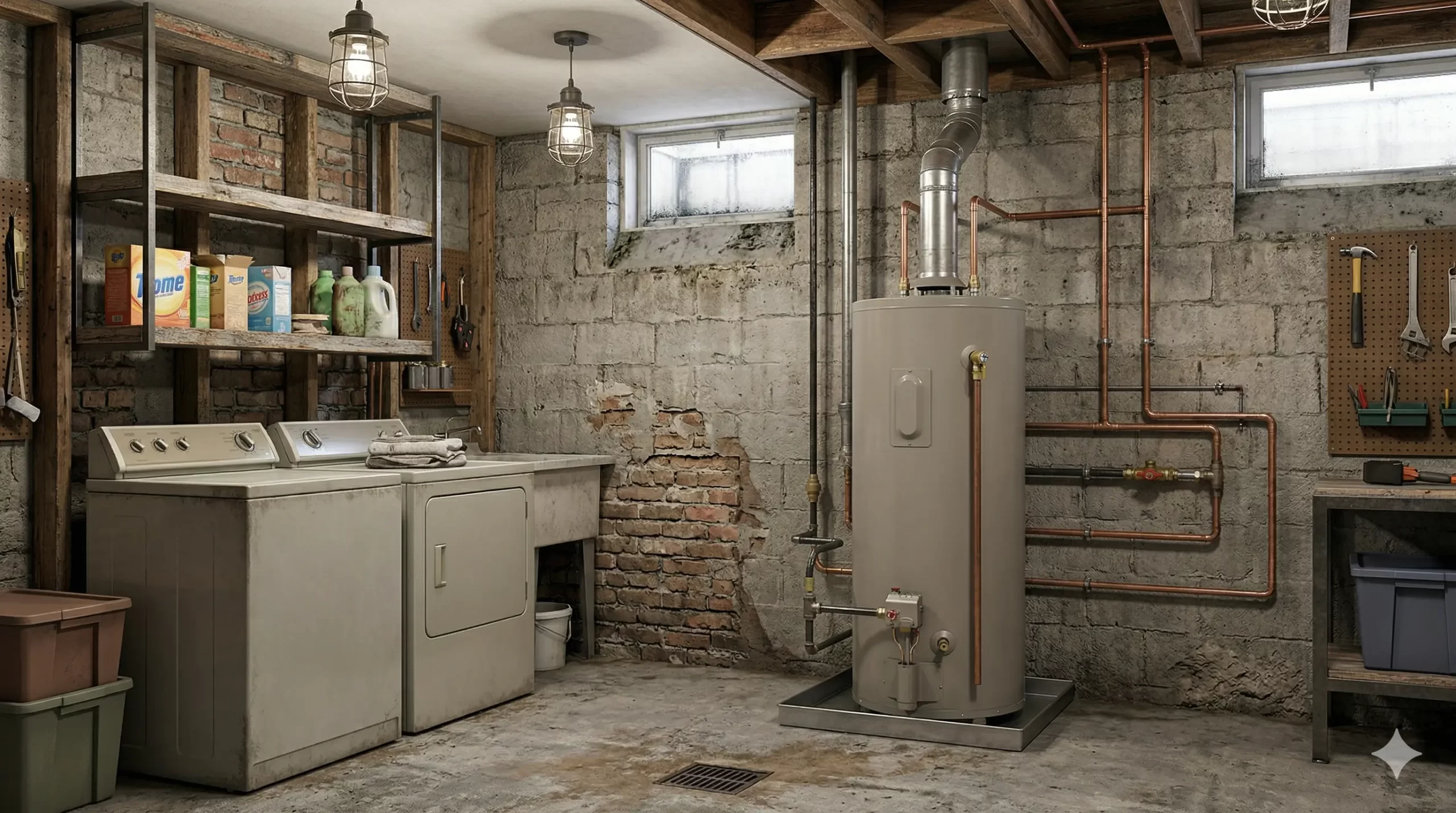
️ Repair Profile
Required Diagnostics Tools
Digital Manometer, Pipe Wrenches, Socket Set, Gas-Rated Pipe Thread Sealant, Gas Leak Detection Solution, Flashlight, Multimeter
Financial Breakdown: Parts vs. Licensed Labor
The financial investment is overwhelmingly for the certified technician’s diagnostic expertise and liability, not the component itself. The actual part, a precision-drilled brass orifice, is inexpensive, but identifying it as the root cause and verifying gas pressures with a manometer requires specialized tools and knowledge.
Deep Technical Diagnosis: The Physics of the Failure
A massive, rolling flame, often described as ‘flame rollout’ or ‘flame lifting,’ is a definitive sign of dangerously incomplete or improperly staged combustion within your Rheem water heater. This is not a minor issue; it indicates a fundamental breakdown in the gas delivery and mixing system. The core of the problem lies in a severely disrupted stoichiometric ratio—the ideal air-to-fuel mixture for clean, efficient combustion. When an excessive volume of fuel gas is introduced into the burner, it cannot mix with a sufficient volume of primary air drawn in through the burner’s throat. This over-rich mixture results in a flame that is literally searching for oxygen, causing it to expand, lift off the burner surface, and escape the confines of the sealed combustion chamber.
The primary culprits are directly related to fuel volume and velocity. The burner orifice is a precisely drilled brass fitting that regulates the amount of gas entering the burner’s Venturi tube. If this orifice is missing entirely or is incorrect for the fuel type (e.g., a larger Natural Gas orifice used with a higher-pressure Propane supply, or vice-versa), the gas flow will be catastrophically wrong. Gas pressure, measured in inches of water column (W.C.), is the other critical variable. A failed appliance regulator within the gas control valve or, more broadly, a failing whole-house gas regulator can deliver pressure far exceeding the typical 3.5″ W.C. for natural gas. This excessive pressure forces a massive volume of fuel through the orifice, overwhelming the system’s ability to induct primary air and resulting in the hazardous flame rollout.
This condition creates several immediate dangers. First, the uncontained flame can directly impinge on the gas control valve, thermocouple, and wiring, potentially melting safety components and leading to an uncontrolled gas release. Second, the incomplete combustion generates extremely high levels of carbon monoxide (CO). Finally, the flame exiting the unit can ignite any nearby combustible materials, creating a severe fire hazard.
- Incorrect Orifice: The most common cause, where an LP (Propane) orifice is installed on a Natural Gas unit, or vice-versa, during a botched fuel conversion or incorrect installation.
- Missing Orifice: During a previous service, the orifice may have been mistakenly omitted, allowing raw, unregulated gas flow into the burner assembly.
- Failed Appliance Regulator: The diaphragm or spring inside the unit’s gas control valve has failed, permitting full line pressure to reach the burner.
- Excessive Supply Pressure: The primary gas regulator at the meter is malfunctioning, delivering dangerously high pressure to the entire building’s gas train.
- Severe Venting Blockage: A completely obstructed flue can cause backpressure, forcing the flame and exhaust gases to exit through the front of the combustion chamber.
US Building Codes & Plumbing Regulations
The presence of a rolling flame is a direct violation of multiple safety mandates within the NFPA 54: National Fuel Gas Code. Specifically, the code requires that all gas appliances be installed and operated according to the manufacturer’s listed instructions and for the specific gas type intended. A flame rollout is prima facie evidence that the appliance’s fuel input rate is dangerously incorrect, directly contravening the principles of certified appliance operation. Any technician investigating this must, per code, verify the gas type and check the gas pressure at the appliance’s inlet, ensuring it falls within the required range specified on the rating plate. Failure to correct this condition constitutes leaving a life-threatening hazard in place.
Furthermore, under codes such as the Uniform Plumbing Code (UPC), the integrity of the entire gas piping system and its components is paramount. The situation implies either a faulty component (regulator, orifice) or improper installation. The code mandates that any modification, such as a fuel type conversion, must be performed using only the manufacturer’s authorized conversion kit and procedure. A flame rollout resulting from a DIY or unauthorized conversion is a severe code infraction. A certified plumber is legally obligated to immediately red-tag the appliance, shut off the gas supply, and ensure the system is not returned to service until the hazardous, non-compliant condition is fully rectified and tested.
Professional Master Plumber Repair Sequence
- Execute Immediate Gas Shutdown: Locate the dedicated gas shutoff valve for the water heater and turn it to the off position. For added safety, proceed to the main gas meter for the building and shut it off as well. This is a non-negotiable first step.
- Ventilate and Assess: Open windows and doors in the utility area to dissipate any potential accumulation of unburned hydrocarbons. Do not operate any electrical switches or create any sparks.
- Connect Manometer for Static Pressure Test: Remove the threaded plug from the inlet pressure tap on the gas control valve. Connect a digital manometer and slowly reopen the main gas meter valve (leave appliance valve off). Measure the static pressure to verify if the supply from the street is within the correct range (e.g., typically 3.5″-7″ W.C. for Natural Gas). An abnormally high reading points to a failed house regulator.
- Isolate and Depressurize: Shut off the main gas meter again. Disconnect the burner feed tube, pilot tube, and thermocouple from the gas control valve. Carefully unbolt and remove the entire burner assembly from the combustion chamber access port.
- Inspect and Identify Burner Orifice: Locate the small, threaded brass fitting at the point where the gas enters the burner’s mixing tube. This is the orifice. Examine it for any stamped numbers or letters indicating its size and fuel type. A complete absence of this fitting is an immediate red flag.
- Verify Orifice Specification: Cross-reference the orifice number (or lack thereof) with the Rheem manufacturer’s technical specifications for your specific water heater model and the fuel type being supplied to the home. This step confirms or denies an orifice mismatch.
- Install Correct OEM Orifice: If the orifice is missing or incorrect, procure the exact OEM-specified part for your model and fuel type. Apply a minimal amount of gas-rated pipe thread sealant to the threads and install it securely.
- Reassemble and Perform Leak Test: Carefully reinstall the burner assembly, ensuring proper alignment. Reconnect all tubes and fittings to the gas control valve, tightening them to specification. Turn the gas supply back on and use an approved bubble-style leak detection solution to coat every joint and fitting you serviced. Watch for any bubble formation, which indicates a leak that must be corrected.
- Commission and Observe Flame Character: Follow the official lighting procedure on the water heater’s label. Once the main burner ignites, carefully observe the flame through the viewport. The flame should now be stable, predominantly blue, and fully contained within the combustion chamber, with no lifting or rollout.
Expert Verdict: Is It Worth Repairing?
When faced with a catastrophic flame rollout on a Rheem gas water heater, the repair-versus-replace decision hinges almost entirely on the age of the unit and the extent of collateral damage. If the root cause is simply an incorrect or missing burner orifice—often due to an installation error on a relatively new unit—a repair is overwhelmingly the most logical choice. The repair itself involves a low-cost part and specialized labor, representing a small fraction of a new unit’s cost and restoring the heater to its intended safe operation. In this scenario, the return on investment (ROI) for the repair is extremely high.
Conversely, if the unit is approaching or has exceeded its 6-10 year warranty period, replacement becomes a more compelling option. The intense heat from the flame rollout may have compromised critical components like the gas control valve, the thermocouple safety sensor, or the glass lining of the tank due to thermal shock. If the cost of replacing multiple damaged components begins to approach 40-50% of a new installation, investing that money into a new, more efficient unit with a full warranty offers better long-term financial security and peace of mind. The risk of future failures on an older, stressed unit outweighs the short-term savings of a complex repair.
Frequently Asked Questions (FAQ)
Q: Can a dirty burner cause a massive flame rollout like this?
A: No. A dirty or clogged burner typically causes a lazy, yellow, sooty, or lifting flame due to poor air mixture, but it will not cause the massive, forceful, and uncontrolled rollout seen in this scenario. This symptom points directly to a severe fuel over-pressurization or volume problem, not a simple cleaning issue.
Q: My heater was just converted from propane to natural gas and now has this problem. What happened?
A: This is a classic symptom of a failed fuel conversion. The technician almost certainly failed to replace the small propane orifice with the correctly-sized, larger natural gas orifice. Propane is delivered at a higher pressure (around 11″ W.C.) and requires a smaller orifice; introducing lower-pressure natural gas (around 3.5-7″ W.C.) through that tiny opening starves the burner, but the reverse—using an NG orifice with LP gas—causes the massive flame you see.
Q: Is it safe to just turn the gas valve down a little to control the flame?
A: Absolutely not. This is extremely dangerous. The appliance’s gas shutoff valve is a quarter-turn ball valve designed to be fully open or fully closed, not for throttling or modulating flow. Attempting to do so can create an unpredictable fuel supply, damage the valve, and does not address the root cause of the hazardous pressure or orifice mismatch.
Q: Could a blocked vent cause the flame to roll out of the front?
A: Yes, a severely blocked flue vent or chimney is another potential cause. If the exhaust gases have no path to escape, the combustion chamber will pressurize, forcing the flame and toxic gases (including carbon monoxide) out of any available opening, which is typically the burner access area. This is an equally critical emergency that requires immediate shutdown.