
Discover why white, powdery flakes appear in your hot water. This guide details the cause—severe scale buildup—and how to flush your gas water heater.
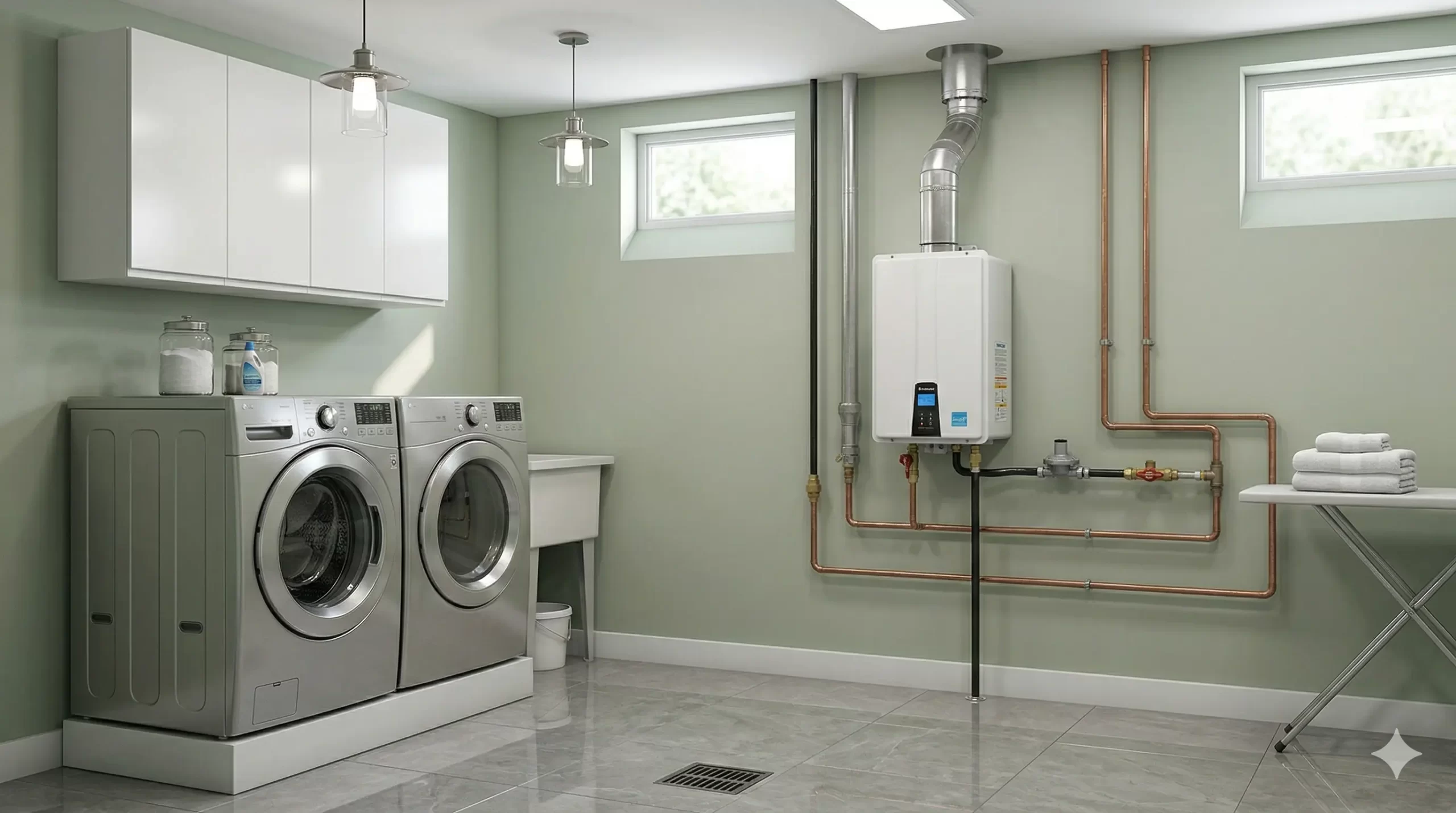
Exercise extreme caution. The discharge of white flakes signifies a heavily scaled tank, which can cause unpredictable behavior. Dislodged scale fragments can potentially obstruct the Temperature and Pressure (T&P) relief valve’s internal mechanism, rendering it inoperable during an over-pressurization event. Furthermore, a sudden release of consolidated sediment can instantly and completely clog downstream fixture aerators and valves, leading to water backup and potential overflow damage at sinks or tubs.
️ Repair Profile
Required Diagnostics Tools
Garden hose, Channel-lock pliers, Bucket, Work gloves, Safety glasses, NPT thread seal tape, Hose-end jet nozzle
Financial Breakdown: Parts vs. Licensed Labor
The cost allocation is heavily weighted towards labor because the procedure is a service-intensive flush, not a parts replacement. The expense is rooted in the technician’s time to safely perform a multi-stage drain, power flush, and system verification.
Deep Technical Diagnosis: The Physics of the Failure
The presence of white, powdery, or crystalline flakes exclusively in the hot water supply is a definitive indicator of advanced mineral precipitation within the gas water heater tank. This phenomenon originates from water containing high concentrations of dissolved minerals, primarily calcium carbonate (CaCO₃) and magnesium carbonate (MgCO₃), a condition known as water hardness. Inside the heater, the combustion process transfers thermal energy to the water, which acts as a catalyst dramatically reducing the solubility of these bicarbonate ions. This forces a chemical reaction—a change in the water’s stoichiometry—where the dissolved minerals precipitate out of solution and adhere to the internal surfaces as scale.
Over time, this scale forms a thick, insulating layer, particularly at the bottom of the tank directly above the burner assembly. This insulation severely impedes heat transfer, forcing the burner to run for extended cycles to satisfy the aquastat’s temperature setpoint. A technician might measure a perfect gas pressure with a manometer at the inlet, yet the unit’s efficiency plummets due to this internal thermal barrier. In some cases, this insulation can even disrupt the heat reaching the thermopile, reducing its millivolt output and causing nuisance pilot outages. The flakes you observe are the result of thermal stratification and the mechanical stresses of expansion and contraction, which cause layers of this brittle scale to delaminate from the tank walls and the flue, becoming entrained in the water flow and discharged through the hot water outlet.
- High Regional Water Hardness: The primary root cause is a high grain per gallon (GPG) rating of the municipal or well water supply.
- Excessive Temperature Setpoint: Operating the thermostat above 125°F (52°C) significantly accelerates the rate of mineral precipitation.
- Depleted Sacrificial Anode: A consumed sacrificial anode can alter the electrochemical balance within the tank, potentially increasing the rate of scale formation on tank surfaces.
- Lack of Routine Maintenance: Failure to perform annual draining and flushing allows sediment to accumulate and solidify into intractable layers.
- System Agitation: Sudden changes in water pressure or nearby vibrations can cause large, already-formed scale deposits to break free.
US Building Codes & Plumbing Regulations
While no code explicitly mentions ‘white flakes,’ the condition implicates violations of foundational principles within the Uniform Plumbing Code (UPC). UPC Section 508.4 mandates that water heaters be maintained in accordance with manufacturer instructions to ensure safe and sanitary operation. A tank so inundated with scale that it continuously discharges particulate matter into the potable water distribution system fails this standard. This sediment obstructs fixture aerators, shower heads, and valve cartridges, which can be interpreted as impeding the proper and intended function of the plumbing system as a whole, a core tenet of the code.
Furthermore, from a fuel gas perspective, NFPA 54 (National Fuel Gas Code) requires appliances to be installed and maintained to operate safely and efficiently. The severe scale buildup creating these flakes acts as a significant thermal insulator between the burner flame and the water. This forces abnormally long firing cycles, leading to wasted energy and potential overheating of the tank’s bottom plate. This condition of sustained, inefficient combustion and localized metal stress is contrary to the code’s objective of ensuring the long-term, safe operational parameters of a gas-fired appliance.
Professional Master Plumber Repair Sequence
- Isolate the Appliance: Turn the gas control knob on the water heater to the ‘OFF’ position. Then, locate the cold water inlet pipe at the top of the heater and turn the shutoff valve clockwise until it is fully closed.
- Prepare for Draining: Connect a heavy-duty garden hose to the drain valve located near the bottom of the tank. Route the other end of the hose to a floor drain or an outdoor area away from vegetation, ensuring it is downhill.
- Break the Vacuum: Open a hot water faucet, such as a bathtub faucet, in the highest level of the building. This allows air to enter the system as water drains, preventing a vacuum lock.
- Initiate the Drain: Using channel-lock pliers or a handle, carefully open the water heater drain valve by turning it counter-clockwise. Water, likely discolored and filled with sediment, will begin to flow. Allow the tank to drain completely.
- Agitate Sediment: Once the tank is empty, with the drain valve still open, briefly open and close the cold water supply valve in short, powerful bursts. This ‘shock’ of incoming water will help stir up and flush out heavy sediment that has settled at the bottom.
- Power Flushing (Optional but Recommended): For heavy scale, close the cold water supply, remove the drain valve entirely, and use a hose-end jet nozzle to spray high-pressure water inside the tank opening, physically breaking up stubborn deposits.
- Reassemble and Close: Reinstall the drain valve using NPT thread seal tape for a proper seal. Ensure it is fully closed. Disconnect the garden hose. Go to the faucet you opened in Step 3 and close it.
- Refill the Tank: Slowly reopen the cold water supply valve. You will hear the tank begin to fill. Stay near the heater and check for any leaks from the drain valve.
- Purge Air from Lines: Go back to the highest faucet and open the hot water side. Let it run until all air has been purged and you have a steady, non-sputtering stream of water. Then close it. Check other faucets for air as well.
- Restore Operation: Only once the tank is completely full of water, follow the manufacturer’s specific instructions printed on the appliance to relight the pilot light and turn the gas control knob back to its operational setting.
Expert Verdict: Is It Worth Repairing?
The repair-versus-replace decision for an issue causing white flakes hinges directly on the water heater’s age and the presumed severity of the internal scaling. A repair, consisting of a professional power flush, offers a high return on investment (ROI) for units under 6 years old. The relatively low cost of the service can restore lost energy efficiency and extend the unit’s service life, making it a financially sound choice. However, the white flakes are a symptom of a long-term problem; the flush may not remove all the scale, especially if it has solidified into rock-like formations.
Conversely, replacing the unit presents the superior long-term ROI if the water heater is approaching or has exceeded 8-10 years of service. At this age, the internal damage from scale is likely irreversible, the anode rod is probably depleted, and the unit’s efficiency is permanently compromised. Investing in a new, high-efficiency unit, especially when paired with a new whole-home water softener to prevent recurrence, provides a definitive solution. This strategy not only resolves the immediate issue but also protects all water-using appliances and plumbing fixtures from future scale damage, maximizing the value of the investment.
Frequently Asked Questions (FAQ)
Q: Are the white flakes in my hot water harmful to drink?
A: While aesthetically unappealing, the flakes are primarily calcium and magnesium, minerals already present in hard water. They are generally not harmful to ingest but can damage plumbing fixtures and indicate a severe problem with your water heater’s health and efficiency.
Q: Why do I only see the white flakes in the hot water and not the cold?
A: The minerals that form these flakes are held in a dissolved state in cold water. The high temperature inside your water heater acts as a catalyst, causing them to precipitate out of solution and solidify into scale, which then breaks off and flows only into the hot water supply lines.
Q: Will flushing my water heater get rid of all the white flakes immediately?
A: A thorough flush will remove the vast majority of loose sediment from the tank bottom. However, some residual flakes may remain lodged in your home’s plumbing pipes and will continue to appear for a few days until they are fully cleared out through normal water usage.
Q: Can a depleted anode rod cause more white flakes?
A: Yes, indirectly. A failing sacrificial anode rod can alter the water’s electrochemical properties inside the tank. This change can accelerate the rate at which calcium and magnesium precipitate and form scale deposits on the tank walls, leading to a greater volume of flakes over time.