
Hot air spilling from your water heater’s draft hood indicates dangerous backdrafting. This is an emergency caused by negative pressure, fixable with a makeup air vent.
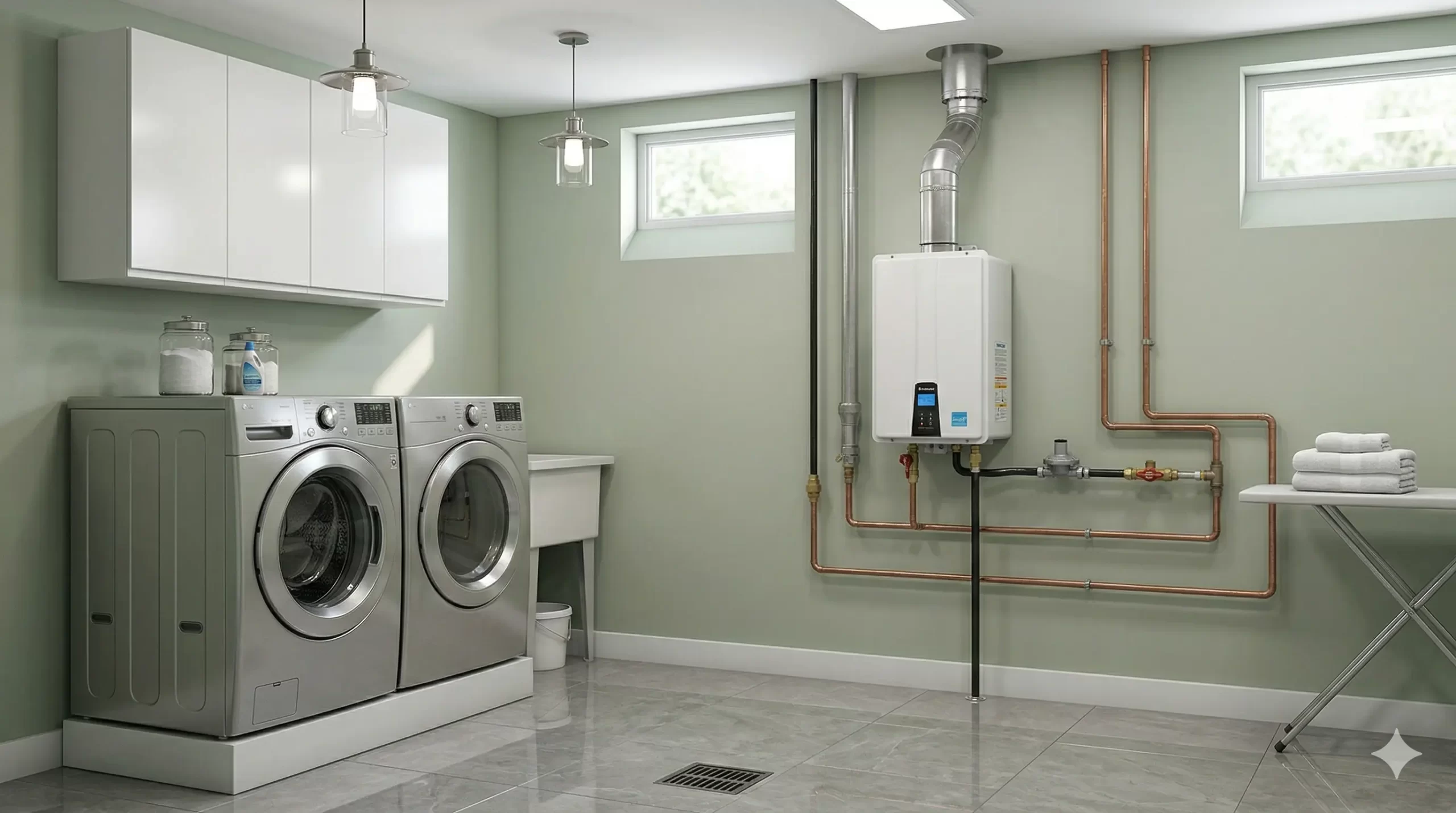
This is a life-threatening situation. The ‘hot air’ you feel is not merely heat; it is unvented flue gas containing high concentrations of carbon monoxide (CO). CO is an invisible, odorless gas that can cause incapacitation and death within minutes. Do not assume your hallway CO detector will provide adequate warning, as lethal levels can accumulate within the appliance room first. Immediately shut off the gas supply to the water heater, ventilate the entire house by opening all windows and doors, and evacuate the premises. Do not operate the appliance again until a qualified technician has certified the combustion air and venting systems are safe and code-compliant.
️ Repair Profile
Required Diagnostics Tools
Digital manometer, Combustible gas detector, CO detector, Smoke pen, Mirror, Drill, Jigsaw or Reciprocating saw, Screwdriver, Measuring tape, Safety glasses
Financial Breakdown: Parts vs. Licensed Labor
The cost allocation is heavily skewed towards labor because the primary expense is the technician’s diagnostic expertise in identifying complex pressure imbalances within the home’s envelope. The physical part, a louvered vent, is inexpensive, but its correct sizing and placement to ensure code-compliant combustion air delivery requires specialized knowledge.
Deep Technical Diagnosis: The Physics of the Failure
Draft hood spillage is a critical symptom of atmospheric backdrafting, where the appliance’s venting system fails due to a powerful pressure differential. The fundamental issue is that the static pressure inside the mechanical room has fallen significantly below the atmospheric pressure outside. This negative pressure, often measured in Pascals (Pa) with a digital manometer, creates a suction force potent enough to overcome the natural buoyancy of the hot flue gases, known as the stack effect. Instead of rising up the flue, the exhaust products, including deadly carbon monoxide, are pulled back down through the draft hood and into the living space.
This condition is exacerbated in modern, tightly sealed homes where air exchange is limited. The operation of high-CFM (Cubic Feet per Minute) exhaust appliances like kitchen range hoods, bathroom fans, or clothes dryers creates a significant air deficit. For every cubic foot of air exhausted, a cubic foot must be replaced. When infiltration pathways are sealed, the home’s only recourse is to pull makeup air from the path of least resistance—often the water heater’s flue pipe. This creates a competition for air that the naturally drafted appliance cannot win. The process of achieving ideal fuel-to-air ratio, known as stoichiometric combustion, is compromised, leading to incomplete combustion and higher CO production. Even the home’s HVAC air handler can contribute by depressurizing certain zones. The low voltage millivolt system that controls the gas valve is incapable of detecting this external venting failure, allowing the burner to operate continuously while spilling its toxic byproducts.
- Insufficient Combustion Air Volume: The room housing the appliance lacks the required volume of air (per code, often 50 cubic feet per 1,000 BTU/hr) for proper combustion and dilution.
- Competition from High-CFM Appliances: Powerful kitchen vents, whole-house fans, or even a clothes dryer can generate hundreds of CFM of exhaust, creating a powerful negative pressure zone.
- Blocked or Improperly Sized Flue Venting: While the primary cause is negative pressure, a partially obstructed flue (e.g., from a bird’s nest or debris) can lower the draft’s tolerance, making it more susceptible to spillage.
- Building Envelope Tightness: Recent energy-efficiency upgrades like new windows, doors, or insulation can seal a home, eliminating the natural air infiltration that previously supplied makeup air.
- Depressurization from HVAC Systems: An unbalanced HVAC system, particularly one with a leaky return duct located in an unconditioned space, can draw air from the utility room and create a negative pressure environment.
US Building Codes & Plumbing Regulations
The National Fuel Gas Code, NFPA 54, directly addresses this hazardous condition in its sections on ‘Air for Combustion and Ventilation.’ The code is predicated on the principle that mechanically-vented and fuel-burning appliances must be provided with a sufficient, uninterrupted supply of air. When household depressurization causes draft hood spillage, it constitutes a direct violation of the code’s mandate to ensure the venting system ‘shall convey all flue and vent gases to the outdoors.’ The installation of exhaust fans with high CFM ratings without providing a corresponding, engineered makeup air system fails to meet the code’s requirements for maintaining a neutral or positive pressure environment for naturally-drafted equipment.
Similarly, the Uniform Plumbing Code (UPC) contains prescriptive tables and calculations for sizing combustion air openings. It explicitly details the required net free area for louvers and grilles based on the total BTU input of all appliances within the space. The code provides separate methodologies for sourcing this air from indoors versus outdoors, acknowledging the pressure dynamics involved. A situation involving flue gas spillage is de facto evidence that the installation does not comply with these UPC provisions for adequate ‘dilution, ventilation, and combustion air,’ as the negative pressure condition proves the existing air supply is insufficient to overcome appliance-induced depressurization, rendering the installation unsafe and non-compliant.
Professional Master Plumber Repair Sequence
- Immediate Safety Protocol: Shut off the gas supply using the valve on the gas line leading to the water heater. Immediately ventilate the entire building by opening all windows and doors to dissipate any accumulated carbon monoxide. Do not operate the appliance.
- Visual Flue Inspection: Once the area is safe, visually inspect the entire length of the flue pipe from the draft hood to the chimney termination point. Look for disconnections, corrosion, or blockages like animal nests or debris.
- Create Worst-Case Depressurization: To accurately diagnose the issue, close all exterior windows and doors. Turn on all exhaust appliances in the home simultaneously (kitchen hood, all bathroom fans, clothes dryer) to simulate the maximum possible negative pressure.
- Perform a Spillage Test: Turn the water heater’s gas valve back on and set the thermostat to call for heat. After the main burner ignites, wait 60 seconds, then hold a smoke pen or a smoldering incense stick at the edge of the draft hood opening. If the smoke is drawn back into the room instead of up into the hood, spillage is confirmed.
- Confirm Negative Pressure as the Cause: While the burner is still running and spilling, open a nearby window or door. Repeat the smoke test. If the smoke is now correctly drawn up the flue, you have definitively proven that negative air pressure (lack of makeup air) is the cause. Shut the appliance down again.
- Calculate Makeup Air Requirement: Determine the total BTU/hr rating of all gas appliances in the room. Per code standards (e.g., NFPA 54), calculate the required size of the fresh air intake. A common method requires one square inch of net free area per 1,000 BTU/hr if venting to the outdoors, often requiring two vents (one high, one low).
- Plan and Cut the Louver Opening: Choose a suitable location, typically the bottom of the utility room door or an exterior wall. Mark the precise dimensions for the louvered vent. Using a drill and jigsaw, carefully cut the opening.
- Install Fresh Air Intake Louver: Insert the louvered vent into the opening. Secure it firmly with the provided screws, ensuring a tight fit. If venting to the outdoors, ensure the exterior vent is properly screened and shielded from weather.
- Final Verification Under Load: Close the previously opened window/door. Recreate the ‘worst-case’ depressurization scenario by turning on all exhaust fans. Turn the water heater on and perform a final smoke test at the draft hood to confirm the new vent has permanently resolved the spillage.
- Carbon Monoxide Monitoring: Use a calibrated, handheld CO detector to test the air around the draft hood after the fix to ensure no residual spillage. Advise the homeowner to maintain a low-level CO alarm in the mechanical room.
Expert Verdict: Is It Worth Repairing?
In this specific scenario, replacement of the water heater is almost never the correct solution and provides zero return on investment. The fault lies not with the appliance, but with the atmospheric environment in which it operates. Installing a brand-new, identical atmospheric vent water heater will result in the exact same dangerous draft spillage, as the root cause—negative air pressure in the home—remains unaddressed. Therefore, the ‘repair,’ which involves installing a dedicated makeup air supply, is not just a repair to the heater but a critical safety upgrade to the home’s entire ventilation system.
The ROI on installing a makeup air vent is exceptionally high, as it’s a relatively low-cost solution (typically a few hundred dollars) that resolves a life-threatening safety hazard and makes the existing appliance operate as designed. The only instance where replacement should be considered is if the homeowner chooses to upgrade to a sealed combustion, direct-vent, or power-vent water heater. These models draw their combustion air directly from the outdoors and have a sealed exhaust, completely isolating them from the home’s indoor pressure environment. While this is a permanent solution to the negative pressure problem, it is a significant investment (often $2,000+) and should be weighed against the much lower cost of simply providing the necessary makeup air for the existing unit.
Frequently Asked Questions (FAQ)
Q: Why did this draft spillage problem suddenly start after years of no issues?
A: This issue often appears after home improvements that increase air-tightness. Installing new energy-efficient windows, sealing air leaks, or even adding weather-stripping can eliminate the small, natural air gaps the house previously used for makeup air. The final trigger is often the installation of a new, powerful kitchen range hood or bathroom fan, which creates a negative pressure that the newly sealed house cannot compensate for.
Q: Is it safe to just keep a window cracked open near the water heater all the time?
A: No. While cracking a window is an effective diagnostic step and a temporary emergency measure, it is not a safe, reliable, or code-compliant permanent solution. A window can be accidentally closed by a family member, defeating its purpose. Furthermore, it is extremely energy-inefficient and fails to meet building code requirements for a permanent, properly sized combustion air source.
Q: Will a standard carbon monoxide detector in my hallway be enough to protect my family?
A: Not reliably. Standard CO detectors are often placed far from the utility room and may not alarm until dangerous concentrations have already built up in the immediate vicinity of the appliance. For homes with fuel-burning appliances, it is critical to have a low-level CO monitor placed in the mechanical room itself to provide the earliest possible warning of a venting failure or spillage event.
Q: Can a dirty or blocked chimney flue cause the same draft hood spillage symptom?
A: Absolutely. A physical blockage in the venting system, such as a bird’s nest, collapsed liner, or soot buildup, can create resistance that prevents exhaust from escaping. This will cause flue gas to spill from the draft hood, mimicking the symptoms of negative pressure. A thorough professional diagnosis must always include a complete inspection of the flue system to rule out obstructions before concluding that negative pressure is the sole cause.