
What Are Some Proactive Maintenance Tips for Florida Septic Systems?
Alright, let’s talk turkey before we get into the nitty-gritty of rules and regulations. An ounce of prevention is worth a pound of… well, a very expensive septic system replacement. Think of your septic system like a classic car; you can’t just drive it ’til it dies without some regular TLC. Here in Florida, our unique environment throws a few curveballs you need to watch out for.
- Regular Pumping is Non-Negotiable: I tell my clients this ’til I’m blue in the face. For a typical family of four, you should get your tank pumped every 3 to 5 years. This isn’t just about emptying it; it’s about removing the solid sludge that builds up at the bottom. If that sludge level gets too high, it flows into your drain field, clogging it up like cholesterol in an artery. And trust me, drain field replacement is the septic equivalent of open-heart surgery.
- Your Toilet is Not a Trash Can: The only things that should go down your toilet are human waste and toilet paper. That’s it. No ‘flushable’ wipes (they’re liars!), no feminine hygiene products, no dental floss, no cat litter. Your septic tank has a delicate ecosystem of bacteria breaking things down, and these items are like throwing a plastic grenade into a garden party.
- Watch Out for Florida’s Rainy Season: Our sandy soil is great for drainage… until it’s not. During hurricane season or our summer downpours, the ground can become super-saturated. This can make it harder for your drain field to do its job. If you notice slow drains specifically during heavy rain, that’s your system telling you it’s struggling to breathe.
- Landscaping Smarts: That beautiful Royal Poinciana or big oak tree looks great, but its roots are like little heat-seeking missiles aimed right at the moisture in your septic lines and drain field. Plant large trees far away from your system. Stick with shallow-rooted plants like grass or small shrubs over the septic area.
- Pre-Hurricane Prep: Before a big storm is forecasted, it’s not a bad idea to get your tank pumped if you’re close to your due date. A full tank plus a flooded drain field from torrential rain is a recipe for a nasty backup into your house.

What Does It Cost to Fix a Septic System That’s Too Close to the House?
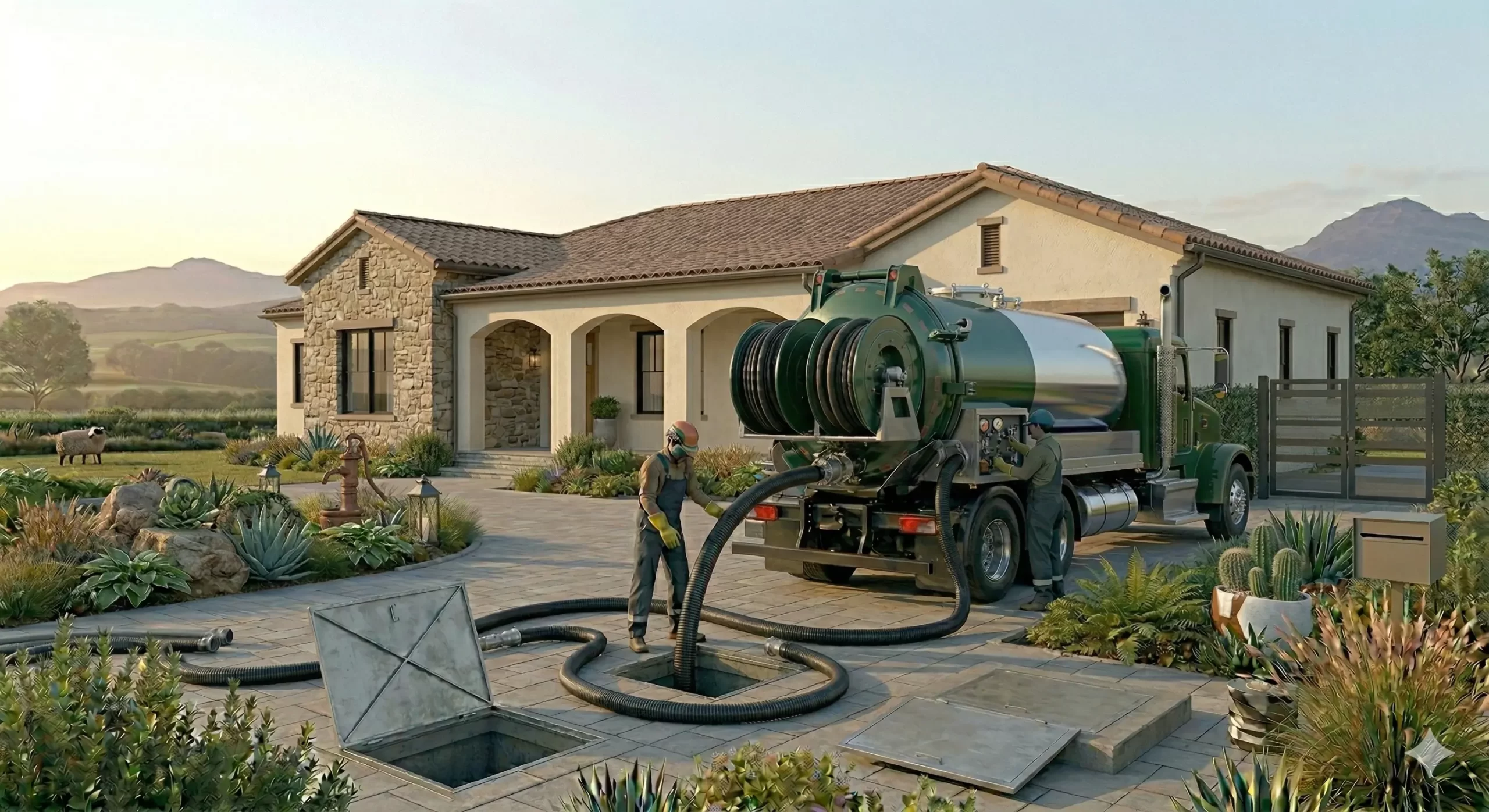
Okay, deep breaths. This is the part nobody likes to talk about, but we have to. If you’ve discovered your septic tank was installed improperly and is too close to your house, a property line, or a well, you can’t just ignore it. Relocating a septic system is a major project, and the costs reflect that. Here’s a ballpark breakdown of what you might be looking at in Florida:
- Permitting and Soil Testing: Before a single shovel hits the ground, you’ll need permits from your county’s health department. This involves site plans and soil percolation tests to ensure the new location is suitable. Expect to pay anywhere from $500 to $1,500 for this initial step.
- Decommissioning the Old Tank: You can’t just leave the old tank there. It must be properly pumped out one last time, and then either removed or crushed in place and filled with sand or gravel. This can run from $700 to $2,000 depending on the tank’s size and accessibility.
- A Brand New Tank: The cost of the tank itself varies. A standard 1,050-gallon concrete tank (common for a 3-bedroom home) might cost $1,500 to $3,000. Plastic or fiberglass tanks can sometimes cost a bit more.
- Excavation and Installation: This is the heavy lifting. Bringing in the backhoe, digging the new hole, setting the tank, and connecting the pipes is a significant labor cost. You’re likely looking at $2,000 to $4,000 for this part of the job.
- New Drain Field Installation: Often, if the tank has to move, the drain field does too. This is frequently the most expensive part of the whole operation. Depending on the size and type of system required by your soil conditions, a new drain field can range from $3,000 to $10,000+.
- Plumbing Rerouting: The main sewer line from your house has to be re-routed to the new tank location. The cost depends on the distance and complexity, but budget $500 to $2,500 for this plumbing work.
- Landscaping Repair: Your yard is going to look like a war zone. The cost to bring in topsoil, grade the area, and lay down new sod can add another $1,000 to $3,000.
Total Estimated Cost: Adding it all up, you’re realistically in the $8,000 to $20,000+ range to relocate a septic system in Florida. It’s a painful number, but the cost of foundation damage or a contaminated well is infinitely higher.
What Are the Official Setback Distances in Florida?
This is the heart of the matter. These aren’t suggestions or friendly guidelines; these are the rules written into the Florida Administrative Code (Chapter 64E-6, for those of you who enjoy light reading). The Florida Department of Health sets these minimum distances, or ‘setbacks’, to protect both your health and your property’s integrity. It’s all about keeping the ‘yuck’ away from the ‘yum’ (your drinking water) and from the place you sleep (your house).
Here’s a simple table that breaks down the most common setbacks you need to know as a homeowner. I’ve added a little ‘Plumber’s Explanation’ for why each rule is so darn important.
| Feature | Minimum Distance from Septic TANK | The Plumber’s Explanation (Why It Matters) |
|---|---|---|
| Your House Foundation | 5 feet | This is about structural integrity. A leak could saturate and erode the soil supporting your foundation, leading to cracks and shifting. It also makes future servicing possible without digging right next to your home. |
| Property Line | 5 feet | Be a good neighbor! This ensures your system doesn’t impact your neighbor’s property, and gives them room if they need to install a fence or do other work. |
| Private Potable Well | 75 feet | This is the big one. It’s the firewall between your wastewater and your drinking water. Florida’s high water table and sandy soil mean contaminants can travel, so this distance is critical to prevent serious illness. |
| Surface Water (Lake, Canal, River) | 75 feet | Protects Florida’s beautiful (and sensitive) ecosystems from nutrient pollution (like nitrogen and phosphorus) from septic effluent, which can cause algae blooms. |
| Swimming Pool | 15 feet | Keeps potential leaks away from the pool’s structure and prevents contamination. Also provides a buffer zone for any future digging or repairs on either the pool or the tank. |
Remember, the drain field often has even stricter setback requirements, especially from wells and surface water, because that’s the part of the system that actively discharges treated water into the soil.
Hear From Our Happy Customers
Sarah P. from Ocala, FL ⭐⭐⭐⭐⭐
“We bought an older home and had no idea where the septic tank was. After weeks of a funky smell near our patio, we called the experts. They located our tank, which was frighteningly close to the house and leaking. They walked us through the entire relocation process, handled the permits, and did a phenomenal job. It was a big project, but their professionalism made it painless.”
David R. from Fort Myers, FL ⭐⭐⭐⭐⭐
“Our toilets were gurgling and the yard was always soggy after the hurricane. Their technician used a camera to find a huge root intrusion and a crack in the line right by our foundation. They explained the setback codes and why our old system wasn’t just failing, but was a risk to our home. The new system they installed works flawlessly. Worth every penny for the peace of mind.” For homeowners nearby, we highly recommend calling our Fort Myers, FL wastewater professionals.
How Do I Know If My Septic System is Failing or Too Close?
Your septic system usually gives you hints before it throws a full-blown tantrum. The trick is learning to read the signs. Here’s a troubleshooting guide to help you figure out what’s going on. We’ll approach this like a detective. To get a customized pumping schedule, feel free to speak with our local representatives in Edgewood, FL.
Symptom #1: The Nose Knows (Foul Odors)
- IF you smell sewage or a ‘rotten egg’ odor inside your house, THEN your first check should be simple plumbing issues. It could be a dried-out P-trap in a guest bathroom or a failed wax ring under a toilet. These are easy fixes.
- IF the smell is outside, and it’s strongest right next to your home’s foundation, THEN you have a more serious problem. This strongly suggests a leak in the main sewer line leaving the house, or a crack in the septic tank itself if it’s located too close. The smell is sewer gas escaping from saturated soil.
Symptom #2: The Soggy Spot (Suspiciously Green or Wet Ground)
- IF you have a patch of grass that’s way greener and lusher than the rest of your yard, THEN you’re likely looking at the location of your drain field. A little extra green is okay, but if it’s a swampy, soggy mess, your drain field is failing and wastewater is surfacing.
- IF the soggy spot is located between your house and where you think the tank is, THEN you might have a break in the pipe connecting the two.
- IF the soggy patch is right up against your foundation, this is a code-red situation. It means wastewater is constantly saturating the soil that supports your home. In Florida’s sandy soil, this can lead to erosion and foundation failure surprisingly quickly.
- Diagnostic Tool: We use a tool called a soil probe—a long, thin metal rod. We can push it into the ground in and around the suspicious area. In a normal yard, it will meet resistance. In a saturated area, it will slide in way too easily, telling us the ground is basically liquid mud below the surface.
Symptom #3: The Gurgle and Glug (Plumbing Backups)
- IF only one sink or shower is draining slowly, THEN it’s probably a simple clog in that specific line. Break out the snake or call a plumber for a quick fix.
- IF *all* your drains are slow, your toilets gurgle when you run the washing machine, or you get backups in the lowest point of the house (like a ground-floor shower), THEN the problem is in the main line or the septic system. The system can’t accept any more water because it’s full or blocked.
- Diagnostic Tool: This is where the sewer camera is king. We can run a camera from your house all the way to the septic tank. It will show us *exactly* what and where the problem is—a crushed pipe, a belly in the line holding water, or a massive root ball. There’s no guesswork.
What’s the Timeline for a Failing System That’s Improperly Placed?
A septic system that’s too close to the house doesn’t just fail overnight. It’s a slow, creeping disaster. Here’s a progression of what that failure often looks like over time. Protect your property value by working with certified septic inspectors in Crowley, LA.
Year 1-2 (The Silent Problem): The system is newly installed (or you’ve just moved in) and everything seems perfect. Unseen, however, effluent from a small leak or an over-saturated system is slowly starting to change the soil composition near your foundation. There are no outward signs.
Year 3-5 (The First Clues): You might catch a faint sewer smell outside after a heavy Florida rainstorm. The grass right next to the house seems a little too healthy. Drains might seem to take an extra second or two to clear, but it’s easy to dismiss. This is the ‘check engine’ light coming on.
Year 5-8 (The Annoying Problem): The problem is now undeniable. The smell is persistent, especially on humid days. The ground near the foundation is often damp or squishy to the touch. You’re dealing with gurgling toilets and slow drains weekly, and you might have had your first major backup into the house.
Year 8+ (The Catastrophic Failure): The damage is now severe. The constant soil saturation has started to erode the ground supporting your foundation, potentially causing visible cracks in your blockwork or slab. The system is in a constant state of failure, with frequent, nasty backups. The area is a biohazard, and the home’s structural integrity is at risk. This is an emergency.
Can You Share a Real-Life Example from a Florida Homeowner?
Absolutely. Stories from the field are often the best teachers. Let’s talk about “The Case of the Sarasota Bungalow.”
A couple, the Jacksons, bought a charming 1960s bungalow. The home inspection noted it had a septic system, but didn’t perform a full septic inspection (a common and costly mistake). For the first year, everything was fine. Then, they started noticing the tile in their back lanai, which was part of a slab-on-grade addition, felt damp. A musty smell started to permeate the room. Whether it’s a minor repair or a major overhaul, our Sachse, TX plumbing and septic crew has you covered.
They called us, fearing a slab leak. When we arrived, the first thing I noticed was the ground right outside the lanai was far too soft for a typical dry spell in Florida. We used a probe rod and, to my surprise, hit the concrete lid of a septic tank just two feet off their foundation wall. Two feet!
We immediately deployed the sewer camera. The original clay pipe leaving the house had cracked right at the junction with the tank. For years, every flush was sending a small amount of wastewater directly into the sandy soil supporting their lanai. The soil had become a soupy, unstable mess.
The diagnosis was clear: the tank was in a critical code violation, and its failure was now threatening the structure of their home. Regular maintenance is crucial. Connect with our Clewiston, FL septic experts to schedule a check-up.
The solution was extensive. We had to work with Sarasota County to permit an entirely new system. The old tank had to be pumped, crushed, and filled. We then had to trench a new sewer line all the way around to the front yard—the only suitable location that met all setback requirements from the house, property line, and the neighbor’s well. We installed a new, modern tank and a new, efficient drain field. It was a big job, but it saved their home from potential foundation collapse.
The takeaway for the Jacksons, and for everyone, is that a septic inspection is one of the most important parts of due diligence when buying a property in Florida. What you can’t see can absolutely hurt you.
What Are Some Frequently Asked Questions About Florida Septic Setbacks?
What if my house was built before the current rules? Am I “grandfathered in”?
This is a great question and a common point of confusion. Yes, an existing system that was installed to code at the time is often ‘grandfathered in’ and you won’t be forced to move it. HOWEVER, this protection disappears the moment you need a major repair or replacement. If your tank fails or your drain field needs to be replaced, the health department will require the *entire new system* to meet all current codes and setback distances. You can’t just replace the old tank in the same illegal spot.
Can I get a variance or exception to the distance rules in Florida?
While technically possible, getting a variance from the Florida Department of Health is extremely difficult, expensive, and rare for standard systems. You have to prove that there is no other possible location on your property to install a system that meets code. Usually, a variance is only granted if you also install an advanced Aerobic Treatment Unit (ATU) or other performance-based system that treats wastewater to a much higher level before it’s discharged. It’s a complex engineering and legal process, not a simple form you fill out.
Does the drain field have the same distance requirements as the tank?
No, and this is a critical distinction. The drain field (or leach field) has its own, often stricter, set of setback requirements. For example, while the tank must be 75 feet from a private well, the drain field must *also* be at least 75 feet away. The drain field has additional requirements, such as being at least 10 feet from the house foundation and 10 feet from the property line in most cases. This is because the drain field is the component that is actively releasing treated effluent into the environment, so its location is paramount for health and safety.
How do I find my septic tank and measure the distance myself?
The best place to start is your county health department. They should have an ‘as-built’ diagram on file from when the system was first installed, showing its location relative to the house. If you want to find it yourself, locate the 4-inch sewer pipe where it exits your house foundation. The tank is usually in a straight line from there, anywhere from 5 to 20 feet away. You can use a thin metal probe rod to gently poke the ground every few inches until you feel the hard ‘thud’ of the concrete lid. Once you’ve located two corners, you can measure the distance to your foundation, property line, and wellhead. Be careful and gentle when probing to avoid damaging any pipes.
Technically Reviewed By:
BlixBase Master Plumber Team
20+ Years Septic Industry Experience | Certified System Inspectors