

Cost Breakdown: What You’ll Pay in NH (2026)

Let’s cut to the chase. You’re worried about money. I get it. A septic backup is the last thing you need. Here is the reality on the ground in New Hampshire. Prices are estimates for 2026. They will change based on your location, from the Seacoast to the White Mountains.
| Service | Estimated 2026 NH Cost Range | Key Factors |
|---|---|---|
| Standard Pumping (1000-1500 gal tank) | $450 – $750 | Tank size, accessibility. Is the lid buried under 2 feet of frozen ground? |
| Emergency / After-Hours Pumping | $700 – $1200+ | Immediate response fee. Weekend, holiday, or middle-of-the-night calls. |
| Effluent Filter Cleaning | $75 – $150 (if done with pumping) | A clogged filter is a common cause of backups. This is critical preventative care. |
| Riser Installation | $500 – $1500+ | Brings the lid to ground level. Eliminates digging fees in the future. Price depends on depth. |
| Basic Visual Inspection | $100 – $250 (often included with pumping) | Checking baffles, water level, and signs of drainfield distress. |
The Unseen Enemy: The Science of Septic Failure
Your tank is not just a holding container. It’s a living, breathing, underground stomach. It’s a biological wastewater treatment facility. When it fails, it’s because this delicate ecosystem has collapsed. Let’s break it down.
Anaerobic Digestion: The Bacterial Workforce
Inside your tank, an army of anaerobic bacteria (bacteria that thrive without oxygen) works 24/7. Their job is to break down organic solids that settle to the bottom, forming a layer called ‘sludge’. This is a multi-stage process:
- Hydrolysis: Bacterial enzymes break down complex organic polymers like proteins and carbohydrates into simpler molecules like sugars and amino acids.
- Acidogenesis: Acid-forming bacteria convert these simple molecules into volatile fatty acids, ammonia, and carbon dioxide.
- Acetogenesis: Acetogenic bacteria then convert these fatty acids into acetic acid, hydrogen, and more carbon dioxide.
- Methanogenesis: Finally, the heavy hitters, methanogenic archaea (like Methanosarcina), consume the acetic acid and hydrogen, producing methane gas and stabilizing the sludge.
This process digests up to 50% of the solids. But it’s slow, and it can’t keep up forever. That’s why pumping is non-negotiable.
Effluent, BOD, and the Leach Field
After the solids settle and the grease/scum floats, the liquid in the middle—the effluent—flows out to your leach field (also called a drainfield). But it’s not just water. It contains suspended solids and dissolved organic material. We measure this with Biological Oxygen Demand (BOD). BOD is the amount of dissolved oxygen needed by aerobic organisms to break down the organic matter in the water. A high BOD means highly polluted water. If you reside in the area, you can learn more about our septic services in Cape Coral, FL.
A healthy septic tank should reduce the raw sewage BOD by 40-60%. But if the tank is full of sludge, there’s no time for proper settling and digestion. Solids are churned up and washed out. The effluent leaving the tank has a dangerously high BOD. This high-BOD effluent is poison to your leach field.
New Hampshire Soil Physics: The Granite State Problem
Your leach field is where aerobic bacteria in the soil do the final cleaning. The effluent trickles through perforated pipes into gravel trenches and then into the native soil. The soil acts as a final, massive biological filter. But this only works if the soil can absorb the water. This is called soil percolation. Looking for a reliable local contractor? Explore our septic solutions for Sachse, TX.
Here in New Hampshire, we have a major problem: our soil is often ‘glacial till.’ It’s a compact, rocky mix left by glaciers, with low permeability. Add to that our famous granite bedrock. There’s often not enough good, absorbent soil to handle the effluent. A system designed for sandy soil will fail instantly in NH clay or rock. Furthermore, our harsh winters cause deep frost heave, which can shift pipes, compact soil, and drastically slow down percolation when the ground is frozen.
When high-BOD effluent hits this unforgiving soil, it feeds anaerobic bacteria at the soil interface. These bacteria create a thick, black, slimy layer called a biomat. This biomat clogs the pores in the soil, effectively waterproofing it. Once the soil can no longer absorb water, the system fails. Effluent either pools on your lawn or backs up into your house.
Troubleshooting: System Down! What Now?
Okay. Your toilet is gurgling. You smell something foul near the hedges. Don’t panic. Breathe. Let’s think like a first responder. Triage the situation. Whether it’s a minor repair or a major overhaul, our Odessa, TX plumbing and septic crew has you covered.
- Check Your Breakers. If you have a pump system (common for mound systems or homes where gravity isn’t on your side), the pump might have tripped a breaker. Check your electrical panel.
- Silence the Alarm. If an alarm is blaring, silence it. But don’t ignore it. It’s screaming for a reason. It means the water level in your pump tank is too high.
- Walk the Leach Field. Carefully. Do you see any wet, spongy, or unusually green patches of grass? Do you see standing water? Is there a sewage odor? If yes, your leach field is saturated. Failure is imminent or already happening.
- Reduce Water Use IMMEDIATELY. Stop doing laundry. No long showers. Minimize toilet flushing. Every drop you add to the system now is making the backup worse.
Progression of Failure: A Septic Danger Timeline
This doesn’t happen overnight. It’s a slow death. Here’s how it looks over time if you neglect pumping:
- Year 1-3 (Healthy): Your tank is functioning perfectly. Sludge and scum layers are minimal. Anaerobic bacteria are thriving. Effluent has a relatively low BOD. The leach field is easily absorbing all liquid.
- Year 3-5 (Getting Full): Sludge depth is approaching 30% of the tank’s volume. There’s less settling time. Some lighter solids might get pushed into the effluent. You won’t notice any symptoms yet, but the clock is ticking. This is the ideal time to pump.
- Year 5-7 (High Risk): The tank is overfull. Sludge and scum are restricting flow. Effluent leaving the tank is now thick with solids and has a very high BOD. The biomat in your leach field is rapidly growing, choking the soil. You might notice slow drains after heavy rain.
- Year 7+ (CRITICAL FAILURE): The biomat has completely sealed the soil pores. The leach field can no longer accept any water. Effluent now has nowhere to go but up onto your lawn or back into your pipes. At this point, pumping is just a temporary band-aid; the damage to the leach field may be permanent and irreversible. A new leach field in New Hampshire can cost $15,000 to $40,000+.
Pro Tools: What’s Really in My Truck? ️
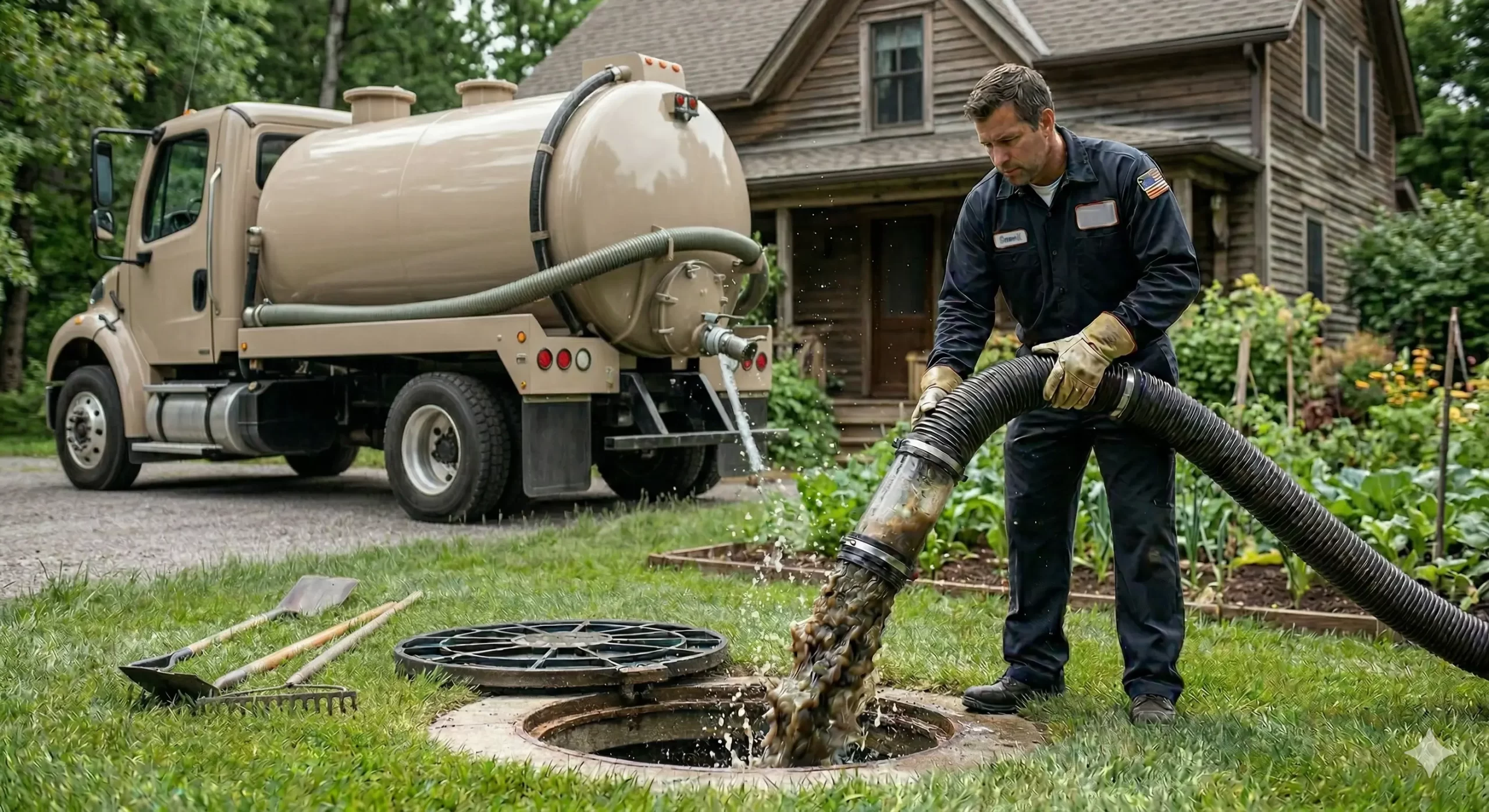
When I show up, I have more than just a big hose. Diagnosing a septic system, especially a failing one, requires specialized equipment. This isn’t your weekend toolbox.
- Sludge Judge: A clear, segmented polycarbonate tube with a check valve at the bottom. I lower it to the bottom of your tank and pull it up. It captures a core sample of the liquid, allowing me to measure the exact thickness of your sludge and scum layers in inches. No guesswork.
- Crust Buster / Agitator: Some tanks develop a hard, dense scum layer that the vacuum hose can’t break up. This is a high-powered mechanical mixer that I lower into the tank to churn the solids into a pumpable slurry. This ensures a truly empty, clean tank.
- Soil Core Sampler: If leach field failure is suspected, I use this tool to extract a vertical core of soil from the field. I can visually inspect it for the black biomat layer and send it to a lab to analyze its hydraulic conductivity, confirming if the soil is truly dead.
- High-Definition Sewer Camera: A fiber optic camera on a flexible push rod. I can run this from the house to the tank or from the distribution box into the leach field lines to find crushed pipes (from frost heave or vehicles), root intrusion, or blockages.
- Digital Hydrometer: This isn’t for your car battery. I can use this to measure the specific gravity of the effluent. A higher specific gravity can indicate a high level of dissolved solids, pointing to a problem with digestion inside the tank.
Real-Life Case Study: A Bedford, NH Homeowner’s Nightmare
The phone rang at 8 PM on a Saturday. It was the Miller family. They were hosting a 50th birthday party. Their house, built in the late 90s, had a 1,250-gallon tank. They had lived there for 10 years and had never had it pumped. “We just forgot,” they said.
The symptom was catastrophic: the downstairs toilet overflowed with raw sewage during the party. Their guests had to leave. The basement was flooding.
When I arrived, the problem was obvious. The ground over the leach field was a swamp. The tank was so full of solids that there was essentially no liquid left—it was just a solid mass. Every flush from the house was like pouring water into a full bucket. It had nowhere to go but back up the pipe.
We did an emergency pump that night to relieve the pressure and stop the backup. But the damage was done. A camera inspection and soil core sample confirmed their entire leach field, squeezed into a small patch of rocky New Hampshire soil, was completely sealed by a thick, impermeable biomat. The system was dead. For fast response times, get in touch with our septic professionals servicing Opelousas, LA.
The emergency pump cost them nearly $1,000. The basement cleanup was another $5,000. And the final bill? A complete new leach field design and installation, which, due to their difficult lot, cost them over $30,000. All of this could have been avoided with a $500 pump every 3-4 years.
What Our New Hampshire Neighbors Are Saying
⭐⭐⭐⭐⭐ – Fast, Honest, and a Lifesaver!
“Our septic alarm went off during that big March snowstorm. I was in a full-blown panic. I called and they were here within 2 hours. The technician quickly diagnosed a failed pump, explained everything clearly, and had it replaced from the stock on his truck. He saved our basement. Worth every single penny.” Navigating local soil conditions can be tricky. Consult our Portland, TX septic pumping guide.
– David P., Concord, NH
⭐⭐⭐⭐⭐ – The Only Company I’ll Ever Call
“I thought I just needed a routine pump. The technician took the time to show me on his ‘sludge judge’ tool that my baffles were starting to crumble. He explained how that would destroy my leach field. Instead of just pumping and leaving, he laid out a plan to fix it affordably. This is a level of professionalism you just don’t see anymore.”
– Susan B., North Conway, NH
FAQ: Your Questions Answered NOW ❓
How often should I *really* pump my tank in New Hampshire?
Stop looking for a magic number. It depends on three things: tank size, number of people in your home, and your habits. The standard advice is every 3-5 years. But for a family of five with a 1000-gallon tank and a garbage disposal, you might need it every 2 years. A retired couple on a 1500-gallon tank might go 5+ years. Given NH’s unforgiving soil, it’s better to be safe than sorry. I recommend every 3 years for most families.
Can I use septic tank additives to avoid pumping?
No. Think of it this way: your tank is already full of the best bacteria for the job. Adding more is like dropping a cup of water in the ocean. Worse, some powerful chemical or enzyme additives can aggressively break up the sludge layer at the bottom. This sounds good, but it actually churns the solids and suspends them in the water, forcing them out into your leach field and causing a rapid, catastrophic clog. Stick to pumping. The science is settled on this.
What does the ‘perc test’ mean that my installer mentioned?
A percolation (perc) test is a critical test to measure how quickly water drains through your soil. An engineer digs a hole, fills it with water, and times how long it takes for the level to drop. This rate determines if your soil is suitable for a leach field and how large that field needs to be. In New Hampshire, a failed perc test due to clay or rock is common and can mean a much more expensive, engineered system (like a mound system) is required by state law.
Why is my septic alarm going off in the middle of a New Hampshire winter?
This is an immediate emergency call. In winter, it could be several things. The most common is a failed effluent pump. But it could also be a frozen pipe between the tank and the leach field, or a blockage caused by ice. Sometimes, a rapid snowmelt can saturate the ground, raising the water table so high that the leach field can’t drain. Regardless of the cause, the pump tank is filling up and will soon back up into your home. Reduce all water use and call a professional immediately.
Technically Reviewed By:
BlixBase Master Plumber Team
20+ Years Septic Industry Experience | Certified System Inspectors