
Your A.O. Smith gas burner lights then dies? A dirty flame sensor is likely the culprit. This guide details the professional fix for this common lockout.
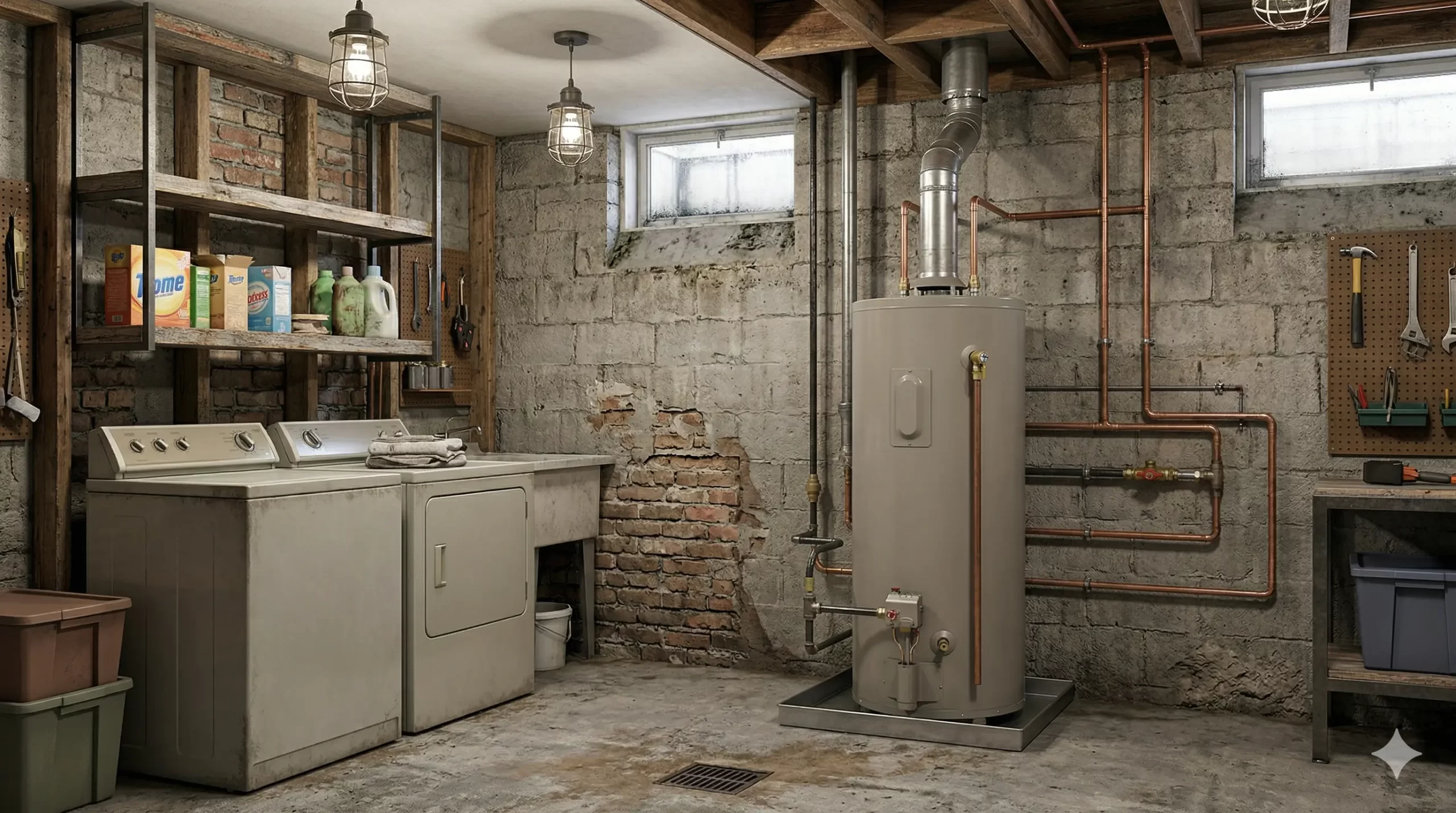
This specific fault, a repeated 5-second ignition attempt followed by shutdown, can lead to an accumulation of unburnt natural gas or propane within the sealed combustion chamber. While the control board’s safety logic is designed to prevent a major incident, a subsequent ignition attempt with residual fuel can result in a dangerous ‘hard light-off’ or rollout. This is not a standard pilot light issue; it involves the main burner valve. Do not cycle the power repeatedly. If you smell gas after several failed attempts, evacuate the area and contact your gas utility immediately.
️ Repair Profile
Required Diagnostics Tools
Nut driver set, Phillips screwdriver, Fine steel wool (#0000), Work gloves, Safety glasses, Flashlight
Financial Breakdown: Parts vs. Licensed Labor
The cost allocation is overwhelmingly weighted towards labor because this is a maintenance and diagnostic task, not a parts replacement job. The resolution hinges on the technician’s skill in safely accessing, meticulously cleaning, and correctly reassembling the burner components, with negligible material cost.
Deep Technical Diagnosis: The Physics of the Failure
The operational symptom of an A.O. Smith burner firing for precisely 5 seconds before lockout is a classic indicator of a failed flame rectification signal. The integrated furnace control (IFC) board initiates the ignition sequence by opening the main gas valve and energizing the igniter. Once combustion begins, the IFC sends a low AC voltage (typically 80-100 VAC) to the flame sensor rod, which is positioned to be engulfed by the flame. The plasma of the flame itself acts as a semiconductor, rectifying this AC current into a very small DC signal, usually between 1 and 10 microamps (µA). This DC current flows from the rod, through the flame, to the grounded burner assembly, and back to the IFC.
The IFC’s logic is programmed with a ‘trial for ignition’ window, often 4-7 seconds. If it does not detect the requisite DC microamp signal within this period, it correctly interprets the situation as ‘flame failure.’ It then executes a safety protocol, immediately closing the gas valve to prevent the release of uncombusted fuel. The root of the problem is typically an insulating layer of carbon or silica oxide that has built up on the flame rod. This deposit, a byproduct of combustion, has a high electrical resistance and prevents the DC signal from completing its circuit to ground. Even with a perfect flame envelope and correct stoichiometry, the IFC receives no feedback and performs a safety shutdown. A technician can confirm this by placing a multimeter set to DC microamps in series with the flame sensor wire during the trial for ignition; a reading below ~0.5 µA would confirm a rectification failure.
While a contaminated rod is the primary suspect, other conditions can produce the identical symptom:
- Poor Grounding: The burner assembly itself is the ground path. A corroded mounting screw or a loose ground wire to the chassis can interrupt the DC circuit, mimicking a dirty sensor.
- Cracked Ceramic Insulator: The ceramic base holding the flame rod can develop hairline fractures, allowing the electrical signal to short to ground before passing through the flame, thus preventing rectification.
- Incorrect Gas Pressure: Gas pressure outside the manufacturer’s specification (typically checked with a manometer) can cause a lazy, lifting, or unstable flame that doesn’t fully engulf the sensor rod, leading to an intermittent or weak signal.
- Failing IFC Board: In rare cases, the sensing circuit on the control board itself may fail, rendering it unable to process an otherwise valid DC microamp signal from the sensor.
US Building Codes & Plumbing Regulations
This specific failure mode directly engages safety protocols mandated by the National Fuel Gas Code, NFPA 54. Section 9.6.5.1 (or equivalent) requires that gas-fired appliances be equipped with a safety shutoff device. The flame sensor is a critical component of this system. Its function—to prove flame and shut down the gas valve in its absence—is a non-negotiable safety requirement. When the burner shuts off after 5 seconds due to a dirty sensor, the system is technically operating as designed by the code; it is failing safe. A service intervention to clean the sensor is not merely a repair but a restoration of the appliance’s primary safety interlock to its intended operational state, ensuring compliance with the code’s mandate to prevent the discharge of unburned gas.
Furthermore, the Uniform Plumbing Code (UPC), Chapter 5, addresses appliance access and serviceability. The code stipulates that appliances must be installed with sufficient clearance and access for inspection, service, and repair. The fact that the A.O. Smith burner assembly, including the flame sensor, can be removed for cleaning without demolition is a direct result of these code requirements. An inspector would verify that no permanent fixtures or construction obstructs the removal of the burner access panels. This ensures that a qualified technician can perform this critical safety maintenance, thereby upholding the operational integrity of the safety shutoff system as required by both NFPA 54 and the UPC.
Professional Master Plumber Repair Sequence
- Execute Safety Shutdown Protocol: Turn the thermostat on the water heater to the ‘OFF’ position. Locate the manual gas shutoff valve on the supply line to the unit and turn the handle perpendicular to the pipe to close it. If the unit has an electrical connection for a power venter, unplug it or switch off the corresponding circuit breaker.
- Open Combustion Chamber: Remove the outer metal burner access door. Behind it, you will find an inner door, often sealed with a gasket. Carefully remove the screws securing this inner door and set it aside, taking care not to damage the gasket.
- Document and Disconnect Wiring: Before disconnecting anything, take a clear photo of the wiring connections to the gas valve, igniter, and flame sensor. Carefully pull the single wire connector off the spade terminal at the base of the flame sensor. Disconnect the igniter wire, which is typically thicker and may have a ceramic boot.
- Detach Gas Manifold Tube: Using an appropriate wrench, carefully loosen and disconnect the main gas supply tube fitting that connects to the burner assembly. Be prepared for a minuscule amount of residual gas to escape.
- Extract the Burner Assembly: Identify and remove the screws (usually 2 to 4) that mount the entire burner tray to the water heater’s combustion chamber floor. The entire assembly should now slide straight out of the unit.
- Isolate and Polish the Flame Sensor: Locate the flame sensor, a thin metal rod mounted in a ceramic insulator, positioned to be in the path of the flame. Using a pad of fine #0000 steel wool or the abrasive surface of a crisp dollar bill, gently but thoroughly polish the entire surface of the metal rod until it is bright and free of any white or black residue. Wipe clean with a dry cloth. Do not use sandpaper or emery cloth.
- Inspect and Reinstall Assembly: While the assembly is out, inspect the burner ports for any rust flakes or debris and gently clean them. Carefully slide the burner assembly back into place, ensuring the gasket on the mounting flange creates a perfect seal. Reinstall the mounting screws and tighten them securely.
- Reconnect and Leak-Test: Reconnect the gas manifold tube, tightening the fitting to be snug but not overtightened. Reconnect the flame sensor and igniter wires to their correct terminals. Turn the manual gas valve back on. Mix a 50/50 solution of dish soap and water and apply it to the gas tube fitting you just tightened. Look for any bubbling, which indicates a gas leak that must be corrected before proceeding.
- Restore Power and Test: Once no leaks are detected, replace the inner and outer access doors. Restore power to the unit and turn the thermostat to a setting that calls for heat. Observe the unit through the sight glass. It should ignite, and the burner should now remain lit for a full heating cycle.
Expert Verdict: Is It Worth Repairing?
Evaluating the repair-versus-replace decision for an A.O. Smith water heater exhibiting a 5-second burner lockout is exceptionally straightforward. The repair, involving cleaning the flame sensor, carries a typical professional cost of $175-$350. This is almost entirely labor, as no parts are typically required. In contrast, the installed cost of a new, comparable A.O. Smith gas tank water heater ranges from $1,200 to $2,500+. The return on investment (ROI) for this specific repair is therefore one of the highest in home appliance maintenance. Spending a few hundred dollars effectively resolves a critical operational failure and restores the unit to full function, potentially for several more years. Opting for a full replacement due to a dirty flame sensor would be an extreme and financially inefficient decision, akin to replacing a car because of a dirty spark plug. This repair should always be the first course of action unless the heater is already past its expected service life and exhibiting other major failures, such as a leaking tank.
Frequently Asked Questions (FAQ)
Q: Can I use sandpaper to clean the A.O. Smith flame sensor?
A: Absolutely not. Sandpaper and emery cloth contain silicon carbide or aluminum oxide. These abrasive particles can embed in the metal rod and, when heated, form a glassy, electrically insulating layer that will make the problem significantly worse and potentially permanent.
Q: Why does my burner run for exactly 5 seconds before shutting off?
A: This specific duration is the ‘trial for ignition’ period programmed into the unit’s electronic control board. The board opens the gas valve and expects to receive a valid flame signal (a DC microamp current) within that 5-second window. If the signal doesn’t arrive due to the dirty sensor, the board executes a pre-programmed safety lockout to prevent gas buildup.
Q: Is a dirty flame sensor a sign of a bigger problem with my water heater?
A: It can be. While often a simple maintenance issue from normal combustion byproducts, chronically and rapidly fouling flame sensors can indicate deeper issues. These include incorrect gas pressure, a restricted air intake, or a partially blocked flue vent, all of which lead to incomplete combustion and excessive soot production that requires a comprehensive professional diagnosis.
Q: What does the flame sensor signal actually do?
A: The sensor facilitates a process called ‘flame rectification.’ The control board sends an AC voltage to the sensor rod. The ionized particles within the gas flame act as a diode, allowing current to flow more easily in one direction, effectively converting the AC signal into a tiny, measurable DC microamp signal. The control board is designed to only recognize this DC signal as definitive proof of a stable flame.