
Diagnosis: If your A.Y. McDonald 22000 well pump hums but fails to pump water, you have a classic locked rotor condition, typically caused by sand or silt physically binding the impellers. This is a critical fault that draws excessive amperage; immediately turn off the breaker to prevent motor burnout. The repair requires a professional service to pull the pump, disassemble the hydraulic assembly, and perform a chemical cleaning.
In this Guide:
What Causes the A.Y. McDonald Motor Humming but No Water Issue?
The primary engineering cause of a locked rotor in an A.Y. McDonald 22000 series pump is hydraulic seizure due to particulate contamination. This occurs when the well’s yield characteristics change, or the well screen degrades, allowing excessive sand, silt, or fine gravel to enter the pump. These abrasive particles are drawn into the pump’s hydraulic assembly, known as the ‘wet end’, where they become lodged in the extremely tight tolerances between the Noryl or stainless steel impellers and their corresponding diffuser bowls. As more sediment accumulates, it creates a powerful mechanical bond, effectively concreting the rotating assembly in place. The motor’s starting torque is insufficient to overcome this immense static friction, resulting in a stall condition where the motor hums as it attempts, and fails, to turn the shaft.
Electrically, this mechanical lock creates a catastrophic scenario for the submersible motor. A motor that cannot turn is essentially a large inductor, and upon energization, it will draw Locked Rotor Amperage (LRA), which can be five to seven times its normal Full Load Amperage (FLA) rating. This massive, instantaneous current surge generates extreme heat within the motor’s copper windings due to I²R losses (Joule heating). The motor’s thermal overload protector is designed to trip under these conditions, but repeated attempts to start the pump or a faulty protector can allow winding temperatures to rapidly exceed the insulation’s thermal class rating (e.g., Class F, 155°C). This can melt the enamel insulation, causing a turn-to-turn short circuit, a short to ground, and permanent motor failure.
Beyond the windings, the locked rotor condition inflicts severe mechanical stress throughout the pump and motor assembly. The violent starting torque against an immovable shaft can damage the spline on the motor shaft or the coupling connecting it to the pump. The motor’s thrust bearing, designed to handle thousands of pounds of downthrust during normal operation, is subjected to intense shock loads. Furthermore, the internal mechanical seals, typically carbon-ceramic or silicon carbide, which prevent well water from entering the oil-filled motor housing, can be damaged by the vibration and heat. Even a momentary breach of this seal can lead to water intrusion, compromising the motor’s dielectric oil and leading to eventual failure even if the pump is successfully unbound.
DIY Troubleshooting Steps
- Step 1: Immediate and Total Power Disconnect. Your first and most critical action is to locate the dedicated double-pole circuit breaker for the well pump in your electrical panel. Switch it firmly to the ‘OFF’ position. Do not attempt to reset it. Leaving power on to a humming, locked motor for even a few minutes can cause irreparable heat damage to the windings.
- Step 2: Inspect the Pump Control Box. Locate the pump’s control box, usually mounted near your pressure tank. Look for any visible signs of overheating, such as melted plastic, scorch marks, or a strong electrical burning odor. Check if there is a manual ‘reset’ button for the thermal overload. If so, you may attempt ONE reset ONLY after the pump has been off for at least one hour to cool down. If it immediately hums and trips again, do not repeat the process.
- Step 3: Verify Voltage (Qualified Personnel Only). If you are qualified and equipped with a multimeter, you can verify that proper voltage (typically 230-240V AC) is present across the L1 and L2 terminals at the control box or pressure switch when the breaker is on. This helps rule out a ‘single-phasing’ issue where the motor receives partial power, which can also cause a hum without starting.
- Step 4: Check Amperage Draw (Professional or Highly Skilled DIY). This is a definitive diagnostic step. Using a clamp-on ammeter around one of the motor’s power legs, briefly energize the circuit for no more than 2-3 seconds. A reading that spikes to the Locked Rotor Amps (LRA) — often over 50 amps for a residential motor, far exceeding the nameplate’s FLA — confirms a mechanical bind. Immediately shut off the power.
- Step 5: Monitor the Cycle Timer (If Equipped). Some systems have a cycle stop valve or a pump protection device. Ensure these external controls are not preventing the pump from running properly. A malfunctioning timer or valve could contribute to stress on the system but is not the root cause of a seized pump.
- Step 6: Assess Recent Well History. Consider any recent events. Has there been nearby blasting or drilling? Have you recently had the well serviced or experienced cloudy water? A sudden influx of sediment is often the trigger for this type of failure. This information is vital for the servicing professional.
When to Call a Professional Well Service
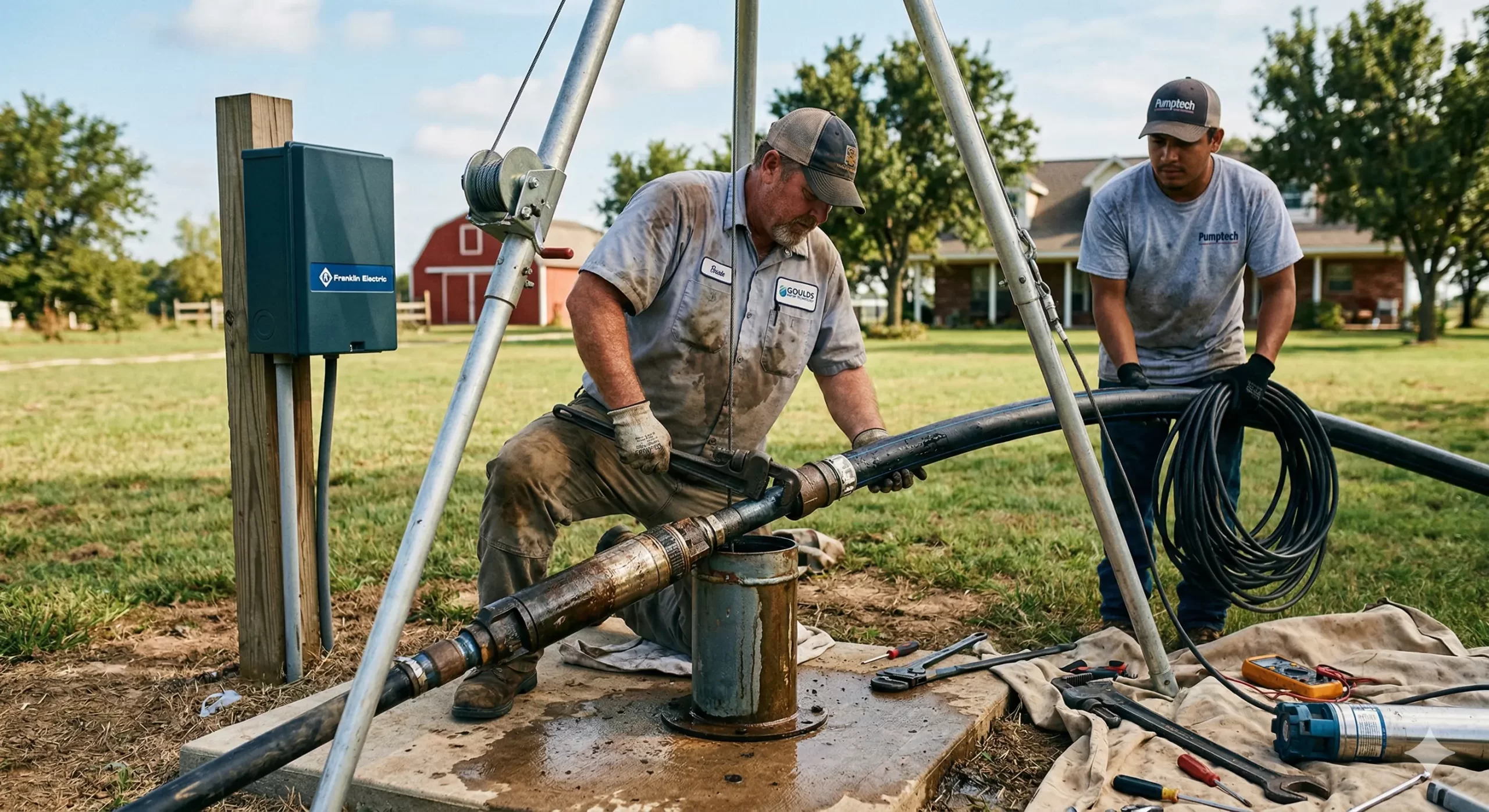
A professional technician’s first step upon arrival is to perform a definitive electrical diagnosis from the surface. Using a megohmmeter (often called a ‘megger’), they will test the insulation resistance between the motor windings and ground. A healthy motor will show very high resistance (hundreds of megaohms), while a failed motor will show a low reading, indicating a short. This test determines if the expensive submersible motor is salvageable before committing to the labor-intensive process of pulling the pump. With the diagnosis confirmed as a mechanical lock, the technician will deploy a specialized hydraulic pump hoist or a tripod pulling rig directly over the well casing. This equipment is non-negotiable for safety and control, as a typical 4-inch submersible pump set at 300 feet can have a total dead weight exceeding 500 pounds. They will then use a T-handle pitless adapter key to disengage the pump assembly from the pitless adapter located inside the well casing, allowing it to be lifted straight out.
The extraction process is methodical. The technician hoists the pump, drop pipe, submersible wire, and safety rope simultaneously, laying it out carefully on the ground. Once at the surface, the hydraulic pump end (the ‘wet end’) is unbolted and separated from the submersible motor. The technician will then attempt to turn the pump shaft by hand; its inability to move confirms the sand-bound diagnosis. The wet end is then systematically disassembled on a clean work surface. This involves removing the intake screen, cable guard, and then carefully separating each stage, which consists of an impeller and a diffuser. This process will invariably reveal that the internal passages are packed solid with a gritty paste of sand and silt, physically locking the impellers against the diffusers.
The core of the repair involves a controlled chemical cleaning. The seized components are submerged in an acid bath, typically using a sulfamic or inhibited muriatic acid solution, which is effective at dissolving the iron bacteria, manganese, and calcium carbonate that act as binding agents for the sand particles.
Safety Protocol: This procedure is hazardous and demands strict adherence to safety standards. The technician must wear full Personal Protective Equipment (PPE), including acid-resistant gauntlet gloves, chemical splash goggles, and a vapor respirator to protect against corrosive liquids and toxic fumes. After the chemical action has broken down the impaction, each component is removed, neutralized with a base solution, and pressure washed. Following a thorough inspection for abrasive wear on bearings and seals, the pump is meticulously reassembled. It is then coupled back to the motor, and new waterproof heat-shrink splices are installed on the power cable before the entire assembly is lowered back into the well and pressure tested.
Repair Cost & Time Assessment
For a complete professional repair of a sand-bound A.Y. McDonald 22000 series pump, a homeowner in the United States should budget for a cost ranging from $1,500 to $2,800. The final price is heavily dependent on the pump’s depth, the severity of the impaction, and local labor rates. The majority of this cost is comprised of skilled labor for two technicians, typically billed for 5 to 8 hours. This time covers initial diagnosis, mobilization and setup of the heavy-duty pump pulling rig, the extraction process, complete pump disassembly and acid bath, reassembly, reinstallation, and system testing.
A significant portion of the invoice accounts for specialized equipment usage fees, particularly for the pump hoist or crane, which is an essential piece of safety equipment. Material costs are also a factor, including the chemical agents for the acid wash and neutralization, a new high-quality heat-shrink splice kit for the submersible cable, and often a new check valve installed as a best practice during reinstallation. If the initial megohmmeter test reveals that the motor windings were compromised due to prolonged locked rotor conditions, the cost will increase substantially. A replacement submersible motor can add an additional $900 to $1,600 to the total bill, depending on its horsepower and whether it is a standard or high-efficiency model.
The on-site repair timeline for a successful cleaning and reinstallation is typically a full working day, ranging from 5 to 8 hours from arrival to completion. If the motor is diagnosed as failed and a specific replacement is not stocked on the service vehicle, a return trip will be necessary. This can extend the total system downtime to 2-3 business days while the correct motor is sourced and delivered.
Fast Local Service & Diagnostics
Calls are routed to a licensed local well professional.