
Diagnosis: A solid red ‘Low Water Limit’ light on an Amtrol Guardian CP indicates system pressure has dropped below the 10 PSI safety cutoff. This is typically caused by a catastrophic failure, such as a ruptured well pipe or a seized pump motor, preventing the system from building pressure. While initial electrical checks are possible, repair almost always requires professional intervention to pull the pump from the well.
In this Guide:
What Causes the Amtrol Красный диод горит постоянно Issue?
The Amtrol Guardian CP’s ‘Low Water Limit’ (solid red LED) is not a warning; it is a definitive lockout condition triggered when the system pressure falls below a non-recoverable threshold, typically 10 PSI. The controller’s logic dictates that if the pump is running but cannot build pressure past this point, a catastrophic mechanical failure has occurred. This safety protocol is engineered to prevent the submersible motor from dry-running, which would cause immediate and irreversible damage. The physics are simple: the volume of water being lost from a major breach in the system equals or exceeds the pump’s Gallons Per Minute (GPM) output. The controller, by monitoring the pressure transducer, correctly identifies this as a futile cycle and shuts down the pump motor to protect the asset.
The most common cause for this fault is a catastrophic failure of downhole components. This usually manifests in one of two ways: a ruptured drop pipe or a seized pump. A split in the polyethylene drop pipe, often occurring at a torque-arrestor clamp point or a fitting, allows the pump’s entire output to discharge back into the well casing instead of up to the pressure tank. A seized pump is an equally abrupt failure. This happens when sediment, sand, or mineral deposits cause the stainless steel impellers to grind against the Noryl diffuser stack, binding them solid. Alternatively, failure of the lower thrust bearing can cause the entire rotating assembly to drop and seize. In either scenario, the motor is instantly stalled, unable to turn, and therefore incapable of producing any pressure whatsoever.
From an electrical engineering perspective, a seized pump motor creates a ‘locked-rotor’ condition. The moment the controller energizes the motor, it attempts to spin but cannot, causing an instantaneous current surge up to 600% of its normal Full Load Amperage (FLA). This extreme amperage superheats the motor’s copper windings within seconds, melting their enamel insulation and creating a direct short circuit to the motor’s steel housing (a ground fault). This event is often violent enough to destroy the start capacitor and/or potential relay in the surface control box. Simultaneously, the mechanical stress of the seizure destroys the pump’s internal seals, allowing water to flood the oil-filled motor housing, further guaranteeing electrical failure and contaminating the well. The Guardian CP, or the main circuit breaker, will trip almost instantly under this load, but the damage to the motor is already done.
DIY Troubleshooting Steps
- Circuit Breaker and Power Verification: Before assuming the worst, check the dedicated double-pole circuit breaker for the well pump in your main electrical panel. If it is tripped, reset it firmly ONCE only. If it trips again immediately, you have a severe electrical fault (likely a shorted pump motor) and must not attempt to reset it again. Do not proceed with further electrical checks unless you are qualified.
- Visual Leak Inspection: Thoroughly inspect all visible plumbing from the well head to the pressure tank. Look for signs of major water leaks, such as pooling water, sodden ground around the underground service line, or audible spraying sounds inside the home. This fault indicates a massive leak, not a simple drip.
- Pressure Gauge Confirmation: Locate the pressure gauge on the plumbing near your pressure tank. Confirm that it reads at or near zero PSI. This validates the signal that the Amtrol Guardian CP is receiving from its transducer and confirms a true low-pressure state.
- Amperage Draw Test (Advanced Users Only): If you are proficient with electrical test equipment, use a clamp-on ammeter on one of the hot legs (L1 or L2) at the pump control box or pressure switch. Have a helper turn on a faucet to call for water. A reading of 0 amps indicates an open circuit (broken wire, failed controller, or blown motor windings). An extremely high amp reading that immediately trips the breaker confirms a locked-rotor/seized pump.
- Control Box Inspection: With the power OFF at the breaker, open the pump’s surface control box (if separate from the Guardian). Look for signs of overheating, such as melted plastic, a bulging or leaking start capacitor, or the acrid smell of burnt electronics. Check for a manual thermal overload reset button and press it if present.
- Listen at the Wellhead: With a helper ready, stand near the wellhead outside. Have them briefly call for water. You should hear the distinct hum of the motor starting and the sound of water rushing up the pipe. If you hear a single ‘thump’ followed by silence or the breaker tripping, the pump is seized. If you hear the pump running but also the sound of water falling back down, the drop pipe is ruptured.
When to Call a Professional Well Service
A professional technician’s first action is not to pull the pump, but to perform a definitive electrical diagnosis from the surface. Using a high-voltage insulation resistance tester, commonly known as a Megohmmeter or ‘megger’, the technician will disconnect the pump wiring at the control box and test the integrity of the motor windings. This test applies 500-1000 volts to measure the resistance between the motor’s electrical conductors and its steel casing (ground). A reading of millions of ohms (megohms) indicates a healthy motor. A reading near zero confirms the winding insulation has failed and shorted to ground. This test, combined with a standard multimeter check for continuity between the start, run, and common windings, provides a conclusive diagnosis of a dead motor in under 15 minutes, justifying the significant cost of pulling the pump.
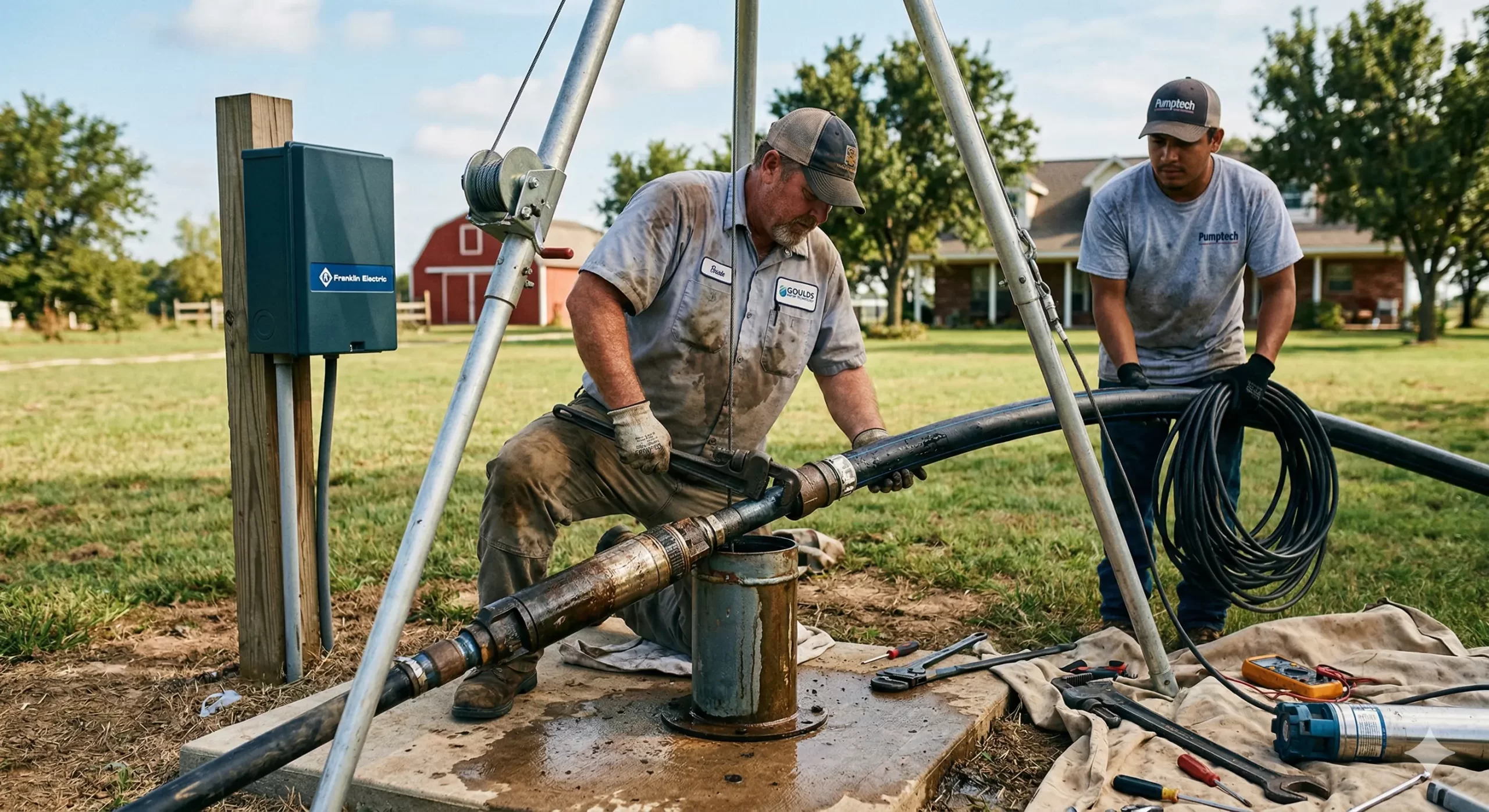
Once the pump is condemned, the retrieval process begins. This is a hazardous operation that demands specialized equipment. A hydraulic pump hoist or derrick rig is positioned over the wellhead. This equipment is non-negotiable, as a typical 4-inch submersible pump, motor, and hundreds of feet of water-filled pipe can weigh between 300 and 800 pounds. After de-energizing and applying a Lockout/Tagout (LOTO) device to the circuit breaker, the technician will unseal the well cap. A special T-handle pitless key is lowered into the casing to engage and unlock the pitless adapter, which is the fitting that allows the pipe to pass through the casing wall below the frost line. The hoist is then used to carefully and safely lift the entire assembly—pump, motor, drop pipe, submersible cable, and safety rope—out of the well and lay it out for inspection.
With the assembly on the surface, a full failure analysis is performed. The technician will confirm the point of failure—a split in the pipe, abraded or broken wire, or the seized pump itself. A new, correctly sized pump and motor are selected based on the well’s depth, static water level, and the home’s demand (well yield). The replacement process involves installing the new pump, new schedule 120 polyethylene pipe, a new stainless steel safety rope, and often new 10/3 or 12/3 submersible pump wire. All downhole electrical connections are made with industrial-grade, waterproof heat-shrink splice kits to ensure a permanent, reliable seal. Before reinstalling, the entire drop pipe assembly is often subjected to a pressure test to guarantee integrity. The new system is then carefully lowered, re-engaged with the pitless adapter, and sanitized with a chlorine solution before being put back into service. Safety Protocol: All work is performed under strict LOTO procedures to prevent accidental energization of the 240V circuit. The use of a mechanical hoist is mandatory to prevent worker injury or the catastrophic loss of the pump assembly down the well, which could cause irreparable damage to the well casing.
Repair Cost & Time Assessment
The cost for a full submersible well pump replacement is significant and typically ranges from $1,800 to $4,500 in the United States. This price reflects a combination of high-value components, specialized equipment, and skilled labor. A detailed breakdown includes: Labor, which usually involves a two-person crew for 4 to 6 hours at a rate of $125-$200 per hour per technician; an Equipment Fee for the use of the pump hoist truck or rig, typically $300-$500 per job; and Parts, which is the most variable component. A quality 10 GPM 1/2 HP stainless steel pump/motor combination can cost $500-$900, while higher horsepower or specialty pumps (e.g., constant pressure) can exceed $2,000. This doesn’t include the cost of new drop pipe ($1.50-$3.00 per foot) and submersible wire ($2.00-$4.00 per foot).
Several factors directly influence where a job will fall within this cost range. The single greatest factor is the depth of the well. A pump set at 400 feet requires significantly more labor, pipe, and wire than one set at 100 feet. The required pump horsepower and brand (e.g., premium brands like Grundfos or Franklin Electric vs. standard-grade options) also heavily impact the material cost. Finally, site accessibility can affect labor time; a wellhead that is difficult to reach with the pump hoist truck may require additional setup time and effort, adding to the final invoice. Emergency service calls outside of normal business hours will also incur a substantial premium.
Fast Local Service & Diagnostics
Calls are routed to a licensed local well professional.