
Diagnose a Bradford White 3-blink error code. This guide covers the draft proving switch failure, blower diagnostics, and vent inspection for power vent models.
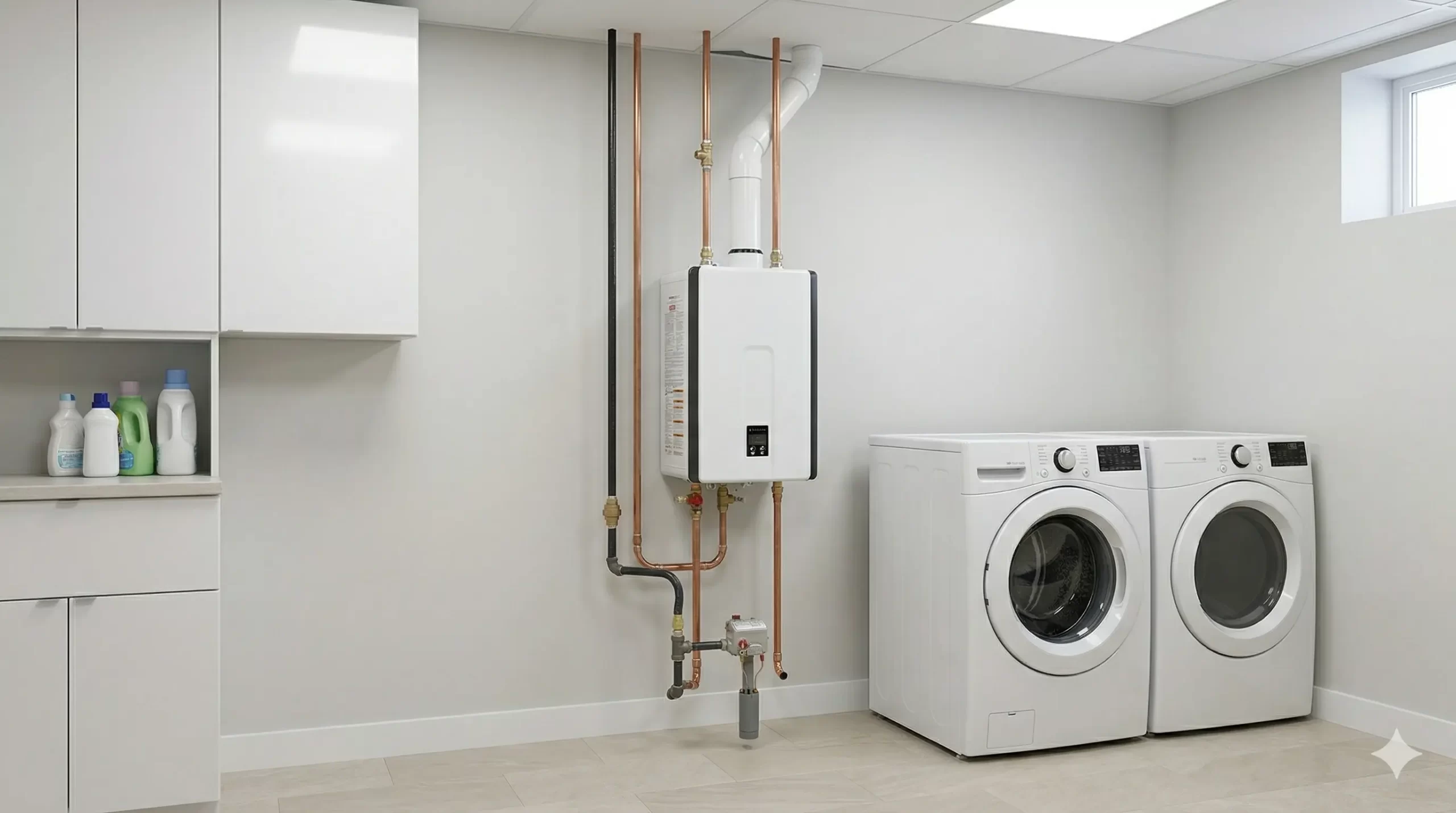
A 3-blink fault code on a Bradford White ICON control system is a critical safety lockout. It signifies the unit’s primary mechanism for verifying safe exhaust venting has failed. The control board has actively prevented ignition to stop the production of flue gases, including lethal, odorless carbon monoxide (CO), which cannot be safely evacuated. Attempting to bypass or ‘jumper’ the draft proving switch is a direct override of a life-safety device and can rapidly lead to flue gas spillage into the living space, creating an immediately dangerous to life and health (IDLH) atmosphere. All diagnostics must be performed on a de-energized and gas-isolated appliance by a qualified professional.
️ Repair Profile
Required Diagnostics Tools
Digital Multimeter (with continuity and VAC), Manometer (inches W.C.), Nut Driver Set (1/4″, 5/16″), Insulated Screwdrivers, Wire Strippers, Jumper Wires (for testing only), Inspection Mirror, Flashlight
Financial Breakdown: Parts vs. Licensed Labor
The significant cost allocation to parts reflects the potential need for a complete power vent blower assembly, a high-value component. Labor costs are primarily for precise diagnostic procedures, including manometer testing, rather than extensive installation time.
Deep Technical Diagnosis: The Physics of the Failure
The Bradford White ICON electronic gas control valve has initiated a hard lockout, indicated by three flashes, because the draft proving (pressure) switch has failed to close its internal contacts within the pre-purge sequence. This switch is a normally-open, single-pole, single-throw (SPST) safety interlock. Upon a call for heat, the control module energizes the power vent blower motor with 120 VAC. The centrifugal blower must generate a specific negative static pressure, measured in inches of water column (W.C.), to actuate a diaphragm inside the pressure switch, thereby closing the low-voltage circuit back to the control board. A 3-blink fault confirms the board did not receive this closed-circuit signal, aborting the ignition sequence to prevent incomplete, unsafe combustion.
The root cause analysis extends beyond a simple failed switch. The failure to achieve the required pressure differential (typically between -0.40″ and -0.70″ W.C.) is the core issue. This can stem from either mechanical deficiencies in the blower or pneumatic restrictions in the venting system. A technician must use a manometer teed into the vacuum sensing tube to quantitatively measure the actual draft being produced. If the measured W.C. is below the switch’s setpoint, the problem lies with the air-moving system. If the W.C. is sufficient yet the switch fails to close (verified with a multimeter check for continuity), the switch itself is defective.
- Seized Blower Motor: Failure of motor bearings due to age or corrosion prevents the impeller from reaching the required RPM to generate sufficient negative pressure.
- Compromised Venting System: Obstructions such as bird nests, ice accumulation at the termination point, or debris within the PVC/ABS vent piping increase static pressure beyond the blower’s operational range.
- Excessive Equivalent Vent Length: Each fitting (e.g., 90° elbow, 45° elbow) adds ‘equivalent feet’ to the total vent run. If the installer exceeded the manufacturer’s specified maximum, the blower cannot overcome the inherent frictional losses in the pipe.
- Degraded Vacuum Tubing: The silicone or rubber tube connecting the blower housing to the pressure switch can become cracked, kinked, or clogged with debris or condensation, preventing the negative pressure signal from reaching the switch diaphragm.
- Failed Pressure Switch: The internal diaphragm may have ruptured, or the electrical contacts may be pitted or corroded, preventing circuit closure even when adequate vacuum is present. This is a point of mechanical failure.
- Insufficient Line Voltage: A voltage drop to the appliance can cause the blower motor to operate at a reduced speed, failing to generate the necessary draft for switch actuation.
US Building Codes & Plumbing Regulations
This 3-blink fault code is a direct enforcement of principles within NFPA 54, the National Fuel Gas Code. Specifically, sections governing the venting of mechanically drafted appliances mandate that burner operation be interlocked with a proven venting system. The draft proving switch and the ICON controller’s logic that generates this specific error code are engineered safety features designed to meet this code requirement. A failure to prove draft means the system cannot guarantee the safe removal of combustion byproducts, including CO, from the structure. As per NFPA 54, any condition that impairs the venting system, such as a blocked termination or an improperly sized vent run, renders the appliance’s operation non-compliant and hazardous, necessitating the automatic lockout that this 3-blink code represents.
Furthermore, while the symptom is an exhaust issue, the root cause can sometimes be traced back to violations of the Uniform Plumbing Code (UPC) Section 506 or equivalent local codes concerning the provision of adequate combustion and ventilation air. Insufficient makeup air can lead to a negative pressure environment within the mechanical room, creating a condition where the power vent blower struggles against this pressure differential. This ‘starvation’ of air can lead to sooting, eventual vent blockage, and the subsequent activation of the 3-blink draft proving fault. Therefore, a proper diagnosis must include verifying that the installation complies with all code requirements for combustion air openings based on the appliance’s BTU input and the confinement of its space.
Professional Master Plumber Repair Sequence
- Safety Lockout/Tagout (LOTO): De-energize the water heater’s electrical circuit at the breaker panel. Shut off the gas supply at the manual shutoff valve located on the gas line to the appliance. Verify zero voltage at the unit’s junction box with a multimeter.
- Initial Visual System Survey: Inspect the entire length of the PVC/ABS vent pipe for disconnected joints, sags that could hold water, or physical damage. Examine the exterior vent termination for blockages like leaves, nests, or ice. Check the blower’s air intake screen for lint or debris.
- Inspect Vacuum Tube Integrity: Carefully disconnect the small rubber/silicone tube from the pressure switch and the blower housing port. Visually inspect its entire length for cracks, brittleness, or kinks. Gently blow through it to ensure it is not obstructed.
- Test Blower Motor Function: Reconnect the vacuum tube. Temporarily restore power. Initiate a call for heat by turning up the thermostat. Listen for the blower motor to start. A humming noise with no rotation indicates a seized motor. Grinding or squealing indicates failing bearings. If it runs, proceed to the next step. Power down the unit again.
- Static Test of Pressure Switch: With power off, disconnect the two electrical leads from the pressure switch terminals. Set your multimeter to the continuity setting (audible beep or Ω). Place probes on the two terminals. The meter should indicate an open circuit (no continuity, OL). If continuity is present, the switch is stuck closed and must be replaced.
- Dynamic Draft and Switch Actuation Test: Connect a manometer in-line with the vacuum tube using a ‘T’ fitting. Reconnect electrical leads to the switch. Power on the unit and call for heat. As the blower runs, watch the manometer. The reading should be a steady negative pressure that exceeds the rating printed on the switch (e.g., -0.60″ W.C.). If the vacuum is sufficient, your multimeter (set to VAC) should read ~24V across the two switch terminals before it closes, and near 0V after it closes. If vacuum is good but the switch does not close, the switch is faulty.
- Blower Motor Voltage Verification: If the blower motor does not run at all, disconnect its wiring harness from the control module. Power on the unit, call for heat, and carefully test the terminals on the harness coming *from the controller* for 120 VAC. If 120V is present, the control board is sending power, and the motor itself is definitively bad. If no voltage is detected, the control board is the likely point of failure.
- Component Replacement: After confirming the faulty component (blower motor or pressure switch), replace it with an identical OEM part. Ensure any new gaskets are properly seated to prevent leaks. Reconnect all wiring and tubing exactly as it was.
- Operational Verification: Reassemble all covers. Restore gas and electrical power. Initiate a call for heat and closely observe the full ignition sequence. Confirm the status light transitions from blinking to a solid ‘on’ or ‘slow-flash’ state, indicating normal operation and a successful repair.
Expert Verdict: Is It Worth Repairing?
When faced with a 3-blink draft switch error on a Bradford White power vent unit, a repair is overwhelmingly the most cost-effective option for units under 10-12 years of age. The total cost of replacing a blower motor assembly or a pressure switch, including professional labor, typically falls between $250 and $650. In contrast, the full replacement and installation of a comparable new power vent water heater ranges from $2,500 to $4,000. The return on investment for the repair is immediate and substantial. This fault code points to a failure in a specific, replaceable sub-system (the venting components), not a systemic failure of the tank or gas control valve. Unless the water heater’s tank is actively leaking or it is well beyond its expected service life, investing in a new blower motor or switch restores the unit to its original factory safety and performance specifications for a fraction of the replacement cost.
Frequently Asked Questions (FAQ)
Q: Can a strong wind outside cause a 3-blink error on my Bradford White water heater?
A: Yes, it is possible. Extreme wind conditions can create unusual pressure dynamics at the exterior vent termination. This can sometimes interfere with the blower’s ability to establish a stable, negative pressure, causing the draft proving switch to ‘flutter’ or fail to close, which will trigger the 3-blink diagnostic code as a safety precaution.
Q: Is a 3-blink error code dangerous?
A: The error code itself is not dangerous; it is a signal that a critical safety system is working correctly by locking out the appliance. However, the underlying cause—a failure of the mechanical draft system—is a potentially hazardous condition. It means the unit cannot guarantee safe removal of flue gases, including carbon monoxide, so it should be addressed as an emergency.
Q: Can I just bypass the pressure switch to get hot water temporarily?
A: Absolutely not. Bypassing or ‘jumpering’ the pressure switch is exceptionally dangerous. This switch is the only component that confirms the exhaust vent is clear. Overriding it means the water heater could fire with a blocked vent, filling your home with deadly carbon monoxide. This modification creates a life-threatening situation and should never be attempted.
Q: Why did my power vent blower motor fail on a relatively new water heater?
A: Premature blower motor failure can be caused by several factors. The most common are moisture intrusion from an improperly sloped or terminated vent pipe causing corrosion, excessive vibration from an unbalanced impeller, or voltage irregularities from the home’s electrical supply. In some cases, a manufacturing defect in the motor bearings can also be the cause.