
A continuous red light on a Bradford White gas heater signals total ICON control valve failure. This is an emergency requiring immediate gas shutoff and replacement.
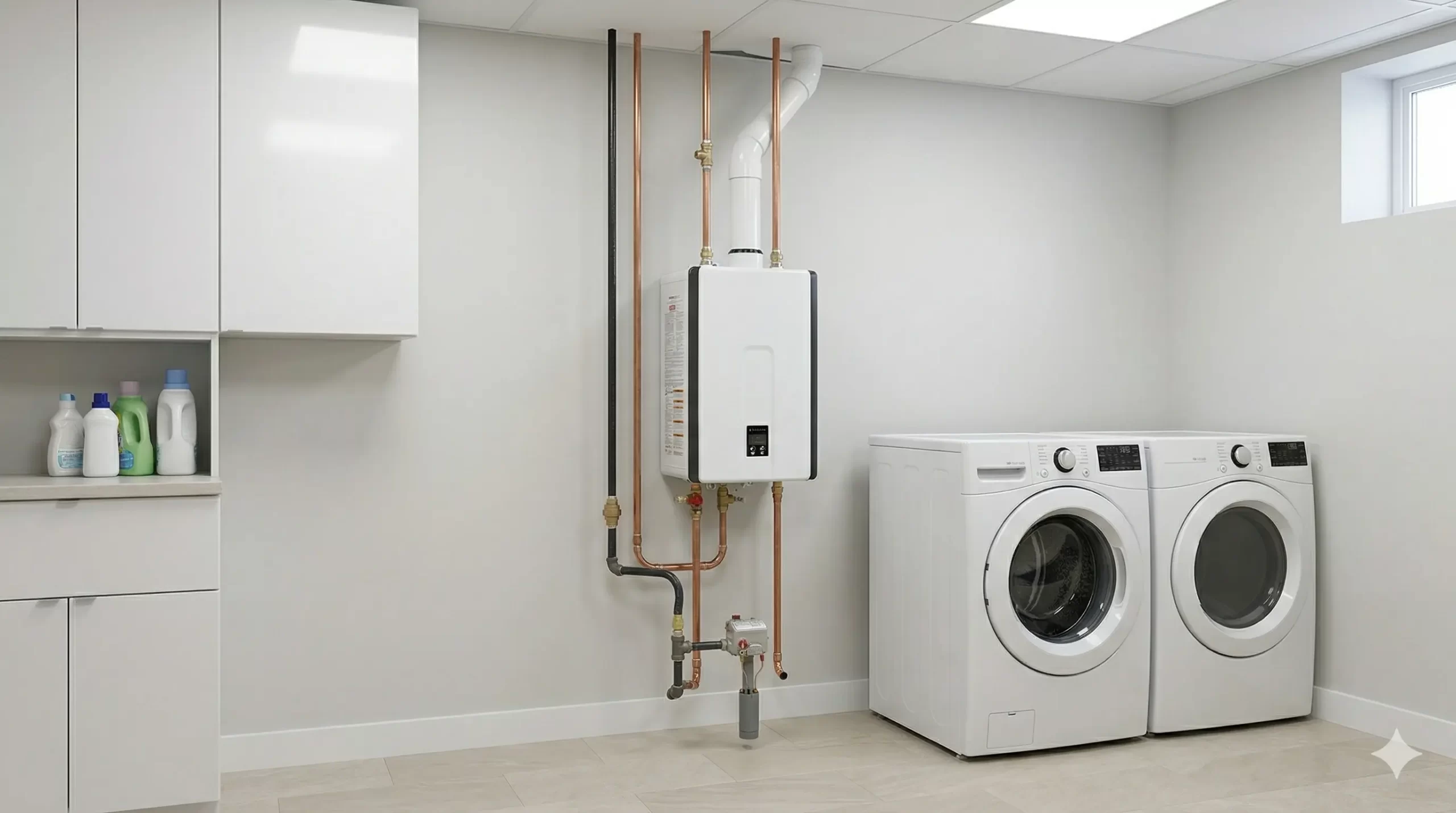
EMERGENCY ALERT: IMMEDIATE ACTION REQUIRED. A continuous red light signifies a critical failure of the ICON control valve’s internal microprocessor. The unit is in a ‘hard lockout’ because it can no longer trust its own ability to safely regulate gas flow. This is not a simple pilot outage. The risk is an unpredictable failure of the solenoid valve, potentially leading to an unmanaged gas release into the combustion chamber or your home. DO NOT attempt to relight the pilot or cycle power. Your only action should be to immediately locate the gas supply valve to the water heater and turn it to the ‘off’ position (handle perpendicular to the pipe) until a certified technician can replace the entire control unit.
️ Repair Profile
Required Diagnostics Tools
Pipe Wrenches (2), Gas-Rated Pipe Thread Sealant, Electronic Gas Leak Detector, Socket Set, Wire Brush, Rags
Financial Breakdown: Parts vs. Licensed Labor
The Bradford White ICON valve is a proprietary electronic assembly, making the component itself the primary driver of the total repair cost. Labor, while requiring certified gas expertise, constitutes a smaller portion as the physical replacement is a well-defined procedure.
Deep Technical Diagnosis: The Physics of the Failure
The continuous, non-blinking red status light on a Bradford White ICON System gas control valve is an explicit and terminal diagnostic code indicating a catastrophic failure of the main control board’s hardware. This is not a sensor error or a pilot light issue; it is a hard lockout initiated by the unit’s own startup self-diagnostics. When powered by the initial millivoltage from the thermopile, the internal microcontroller runs a checksum and a series of hardware integrity tests. A solid red light means this boot sequence has failed, and the controller deems itself unfit to safely manage combustion.
The root cause is a permanent fault within the printed circuit board (PCB) assembly. The logic that governs gas flow, temperature sensing, and safety shutdowns is compromised. The microcontroller cannot verify the state of the solenoid actuator or accurately interpret data from the thermistor. This failure prevents the valve from performing its fundamental safety function: ensuring a precise stoichiometric fuel-air mixture and confirming pilot flame presence before allowing main burner ignition. Attempting to bypass or reset this state is impossible and hazardous, as the device has essentially declared itself neurologically dead.
Multiple factors can lead to this irreparable state:
- Microcontroller Unit (MCU) Failure: The central processing chip on the board has experienced a critical fault, often due to thermal stress from thousands of heating cycles, rendering it incapable of executing its firmware.
- Internal Power Regulation Circuit Damage: The circuitry responsible for converting the thermopile’s fluctuating millivolt signal into stable DC power for the board’s logic components has failed, leaving the MCU unpowered or supplied with erratic voltage.
- Solenoid Driver Short Circuit: The transistors and associated components that send the electrical pulse to open and close the main gas valve solenoid have shorted or opened, making gas flow control impossible.
- PCB Trace Corrosion: Microscopic cracks or corrosion on the copper traces of the circuit board, often caused by ambient humidity or condensation, have severed critical electrical pathways.
- Firmware Corruption: In rare cases, the embedded software on the control chip can become corrupted, preventing a successful boot-up and causing the system to default to this safe-failure mode.
Diagnosis with a manometer or multimeter would be futile in this case, as the problem lies upstream of any pressure or voltage readings the valve is supposed to be managing. The control is fundamentally unresponsive and must be replaced as a complete, sealed unit.
US Building Codes & Plumbing Regulations
According to NFPA 54 (National Fuel Gas Code), any safety control device, which explicitly includes the ICON integrated gas control valve, must be replaced with a component that is listed and approved for that specific appliance model. The continuous red light indicates the original certified safety device has failed. Installing a non-OEM or attempting an internal board repair would void the appliance’s ANSI Z21.10.1 certification. The code mandates that the integrity of the original design’s safety systems be maintained, thus requiring a like-for-like replacement of the entire valve assembly to restore the water heater to its compliant operational state.
Furthermore, the Uniform Plumbing Code (UPC) Section 1211.1 requires that any work on gas piping systems be performed by a qualified installer. The replacement of the ICON valve necessitates breaking and remaking sealed gas connections. The UPC requires that upon completion, all affected joints must be meticulously tested for leaks using an approved method, such as a calibrated manometer to check for pressure drops or a non-corrosive leak detection fluid. Bypassing this post-repair verification is a serious code violation, as it fails to ensure the containment of fugitive gas emissions at the point of repair, directly contravening the code’s primary public safety mission.
Professional Master Plumber Repair Sequence
- Initiate Emergency Gas Shutoff: Locate the dedicated gas shutoff valve on the supply line leading to the water heater. Turn the handle 90 degrees so it is perpendicular to the pipe. This immediately isolates the faulty appliance.
- Confirm Fault Code: Visually verify the diagnostic light is solid red and not a blinking sequence. This confirms the specific ‘Control Failure’ diagnosis and the necessity of replacement.
- Disconnect Control Wiring: Carefully unplug all wire harnesses from the ICON valve. This typically includes the thermopile, the spark igniter wire, and any additional sensor leads. Take a photo beforehand for reference.
- De-pressurize and Disconnect Gas Lines: Using two pipe wrenches in opposition (one to hold the valve steady, one to turn the fitting), disconnect the main gas supply flex line from the top of the valve. Subsequently, use an appropriate wrench to disconnect the smaller pilot tube and main burner feed tube from the bottom of the valve.
- Remove the Faulty Control Valve: Locate and remove the mounting screws that secure the entire ICON valve assembly to the water heater’s housing. Carefully maneuver the valve, with the attached burner assembly, out of the combustion chamber access panel.
- Prepare and Install New Valve: Apply a moderate amount of gas-rated pipe thread sealant to the male threads of the main gas supply line fitting. Secure the new ICON control valve to the heater housing, then carefully thread and tighten the burner tube and pilot tube into the base of the new valve.
- Reconnect Main Gas Supply: Using the two-wrench method to prevent stress, securely tighten the main gas supply line to the new valve’s inlet port. Ensure a snug, leak-proof connection without overtightening.
- Reconnect Electrical Components: Firmly re-attach the thermopile, igniter, and sensor wire harnesses to the corresponding terminals on the new ICON control valve.
- Perform Critical Leak Test: Slowly reopen the gas shutoff valve. With the system now pressurized, meticulously apply an electronic gas detector or a soapy water solution to every joint that was disconnected (main inlet, pilot, and burner connections). Watch for any bubbles or audible alerts, which indicate a gas leak that must be corrected immediately.
- Follow Lighting Procedure & Verify Operation: Adhere strictly to the lighting instructions printed on the Bradford White heater. Once the pilot is established and the main burner ignites, observe the new control’s status light. It should now display a normal operational code (typically a slow, steady blink), confirming the repair was successful.
Expert Verdict: Is It Worth Repairing?
When faced with a failed ICON control valve on a Bradford White water heater, the repair-versus-replace decision hinges almost entirely on the age of the unit. For a water heater that is under 7 years old, a repair offers a strong Return on Investment (ROI). The replacement cost, while significant, is typically less than one-third the price of a full, professionally installed new unit. Given that the tank and anode rod have substantial remaining service life, investing in a new control valve is the most financially sound choice to maximize the value of your original purchase.
However, if the water heater is approaching or has exceeded 10 years of service, the ROI for this specific repair diminishes drastically. The likelihood of a tank failure due to corrosion increases exponentially after a decade. Spending several hundred dollars to fix the control valve on a tank that may begin leaking within the next 12-24 months is a poor allocation of funds. In this scenario, the wiser financial path is to decline the repair and apply that capital directly toward a complete water heater replacement, which comes with a new tank, new components, and a full manufacturer’s warranty.
Frequently Asked Questions (FAQ)
Q: Can I just reset the Bradford White control to fix the solid red light?
A: No. A solid, non-blinking red light is a terminal error code indicating a non-recoverable internal hardware failure. It is a ‘hard lockout’ that cannot be cleared by power cycling or pressing a reset button. The control’s self-diagnostics have determined it is unsafe to operate, and replacement is the only solution.
Q: Is a continuous red light on the ICON valve an immediate danger?
A: Yes, it constitutes an emergency. The unresponsive control board means the primary safety device for managing gas flow is compromised. There is a risk of the valve failing in an open or partially open state. You must shut off the gas supply to the water heater immediately and contact a professional.
Q: Why is the replacement Bradford White ICON control valve so expensive?
A: The ICON is a proprietary, intelligent gas control system that integrates a microprocessor, thermistor sensors, a solenoid, and valve body into a single certified assembly. The research, development, complex electronics, and rigorous safety testing required for such a device contribute to a much higher cost than older, simpler mechanical gas valves.
Q: Could a bad thermopile cause a solid red light instead of a blinking one?
A: A failing thermopile, which generates the unit’s operating voltage, will almost always produce a specific blinking error code (often one flash every few seconds). The solid red light is uniquely reserved for the control board’s failure to pass its own internal startup tests, a fundamentally different fault from simply receiving a weak millivolt signal from the thermopile.