
Diagnosis: Danfoss VLT Alarm 29 indicates the drive’s heatsink temperature has exceeded its safety limit, typically due to poor ventilation or a clogged cooling fan. This protective shutdown prevents catastrophic failure of the drive’s internal power electronics. The immediate fix involves cleaning the VFD heatsink and improving pump house ventilation to ensure ambient temperatures remain below 104°F (40°C).
In this Guide:
What Causes the Danfoss Alarm 29 Issue?
The Danfoss VLT Alarm 29 is a protective shutdown triggered when the internal temperature of the drive’s heatsink surpasses its engineered thermal limit, often set around 90-95°C. The root cause is a breakdown in the drive’s ability to dissipate heat. Inside the VFD, Insulated-Gate Bipolar Transistors (IGBTs) switch thousands of times per second to create the variable frequency AC waveform that controls the motor’s speed. This high-frequency switching is inherently inefficient and generates significant thermal energy as a byproduct. The aluminum heatsink, coupled with a forced-convection cooling fan, is designed to transfer this heat away from the sensitive electronics into the ambient air. When the cooling fan becomes clogged with dust or the ambient temperature in the pump house exceeds the drive’s maximum rating (typically 104°F or 40°C), this thermal transfer process fails, causing heat to build up rapidly and trigger the alarm.
While the VFD is protecting itself, this overheating event is often a symptom of a larger systemic issue that can cause cascading damage to the downstream equipment. A VFD operating at its thermal limit can produce a less stable, ‘dirtier’ AC sine wave with increased voltage harmonics. This ‘dirty’ power forces the submersible motor downhole to work harder, generating excess heat within its own windings. This thermal stress accelerates the degradation of the motor’s Class F winding insulation. Over time, the insulation becomes brittle and can develop microscopic cracks, leading to turn-to-turn shorts or a phase-to-ground fault, ultimately culminating in a complete motor burnout. Therefore, a VFD overheating alarm should be seen as a critical early warning sign of potential, and far more expensive, motor failure.
The thermal stress extends beyond the motor windings to the mechanical components of the pump assembly. Heat generated by the overworked motor travels conductively through the stainless-steel motor shaft directly to the pump’s thrust bearing assembly and mechanical seals. These components rely on the surrounding well water for both lubrication and cooling. When excessive heat is introduced, the thin film of water at the bearing and seal faces can flash to steam, momentarily eliminating lubrication and causing galling and scoring of the bearing surfaces. For the mechanical seal, this thermal shock can cause the precision-lapped carbon-ceramic or silicon carbide faces to warp or crack, compromising the seal and allowing well water to intrude into the motor housing, leading to a catastrophic and unrecoverable electrical failure.
DIY Troubleshooting Steps
- Perform a Safe Electrical Shutdown: Before any physical inspection, execute a full lockout/tagout (LOTO) procedure. Switch off the dedicated circuit breaker feeding the VFD. Using a calibrated multimeter, verify zero voltage is present at the drive’s main input terminals (L1, L2, L3) to ensure the system is completely de-energized.
- Inspect Heatsink and Fan for Obstructions: Visually examine the VFD’s cooling fan. Is it seized or obstructed by dust, debris, or insects? Check the aluminum heatsink fins, typically located on the rear of the drive. Ensure they are completely clear, as even a thin layer of dust can act as an insulator, drastically reducing cooling efficiency.
- Measure Ambient Air Temperature: Place a reliable thermometer inside the pump house or control enclosure, near the VFD’s air intake. Allow it to acclimate for 15-20 minutes. If the temperature reads at or above 104°F (40°C) during peak daytime hours, you have identified an environmental cause. The drive cannot cool itself effectively if the air it’s using for cooling is already too hot.
- Execute a Thorough Cleaning: With the power locked out, use a can of electronics-grade compressed air and a soft, non-metallic brush to meticulously clean the fan blades, motor, and heatsink fins. Blow air through the VFD’s ventilation channels to dislodge any internal dust buildup. Do not use water or chemical solvents.
- Verify Clearances and Enclosure Ventilation: Ensure the VFD has a minimum of 6 inches of unobstructed airspace on all sides, especially above and below, to promote natural convection. Check that any ventilation screens or louvers on the pump house or control panel are not blocked by storage, vegetation, or debris.
- Monitor Key Parameters on Restart: After re-engaging power, access the VFD’s Local Control Panel (LCP) and monitor the live heatsink temperature reading during a pump cycle. Also, observe the running amperage. Compare this value to the motor’s nameplate Full Load Amps (FLA). If the measured amps are consistently higher than the FLA rating, it indicates the pump is being overloaded, which in turn overworks the VFD and generates excess heat.
When to Call a Professional Well Service
A professional technician’s approach begins where DIY checks end, employing specialized diagnostic tools to differentiate between a simple environmental issue and a more severe electrical problem. After confirming basic cooling integrity, the technician will use a thermal imaging camera to scan the VFD, circuit breaker, and all power connections. This identifies any abnormal hot spots caused by loose terminal block connections or failing components that create high-resistance heat points. They will then connect a power quality analyzer to assess the incoming voltage for phase imbalance or sags, which can force the VFD to work harder. The drive’s internal fault log will be reviewed to look for a history of overcurrent or undervoltage alarms that might correlate with the overheating events, painting a more complete picture of the system’s health.
If environmental and power quality issues are ruled out, the investigation focuses on the pump and motor downhole. The primary tool for this is a megohmmeter, often referred to by the brand name ‘Megger’. The technician will disconnect the motor leads from the VFD’s output terminals (U, V, W) and connect the megohmmeter to perform an insulation resistance test. By applying a high DC voltage (typically 500V or 1000V) to the motor windings, this test measures the integrity of the insulation between the windings and the motor’s casing (ground). A reading of many hundreds or thousands of megohms indicates a healthy motor. A reading below 2 megohms is a sign of critical insulation breakdown, meaning the motor is drawing excessive current and is on the verge of failure, which is the true source of the VFD’s thermal overload.
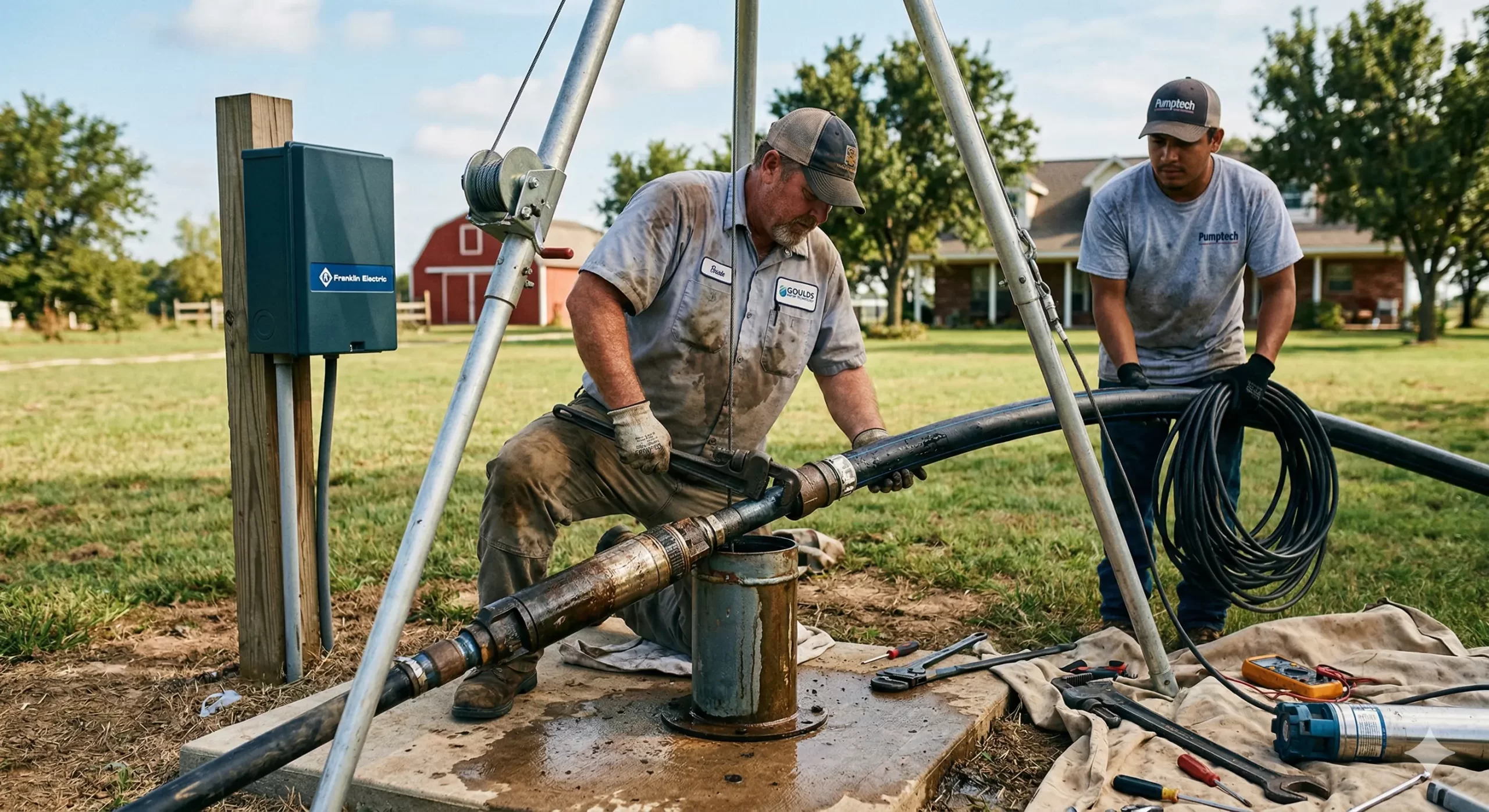
Safety Protocol: If the megohmmeter test confirms a failing motor, the pump must be pulled from the well—a task that is unequivocally not for amateurs. A licensed technician will perform a full electrical LOTO. A specialized pump hoist or pulling rig is mandatory; a typical 4-inch submersible pump and motor assembly with 200 feet of pipe and water can weigh over 500 pounds. Attempting to lift this manually is extremely dangerous and can damage the equipment. The technician will use a pitless adapter T-handle key to safely disconnect the pump from the underground piping inside the well casing. This specialized equipment and procedure ensures the pump is pulled vertically and without damage to the well, drop pipe, or critical power cable, mitigating the significant risks associated with high voltage and heavy suspended loads.
Repair Cost & Time Assessment
For a diagnosis limited to a simple cooling problem—a clogged fan or poor pump house ventilation—the cost is relatively low. This scenario typically involves a standard service call fee plus one to two hours of labor for diagnostics, thorough cleaning of the VFD and enclosure, and verification of proper operation. In most US markets, you can expect a cost in the range of $250 to $450. This fee covers the technician’s expertise, travel, and the use of basic diagnostic tools to confirm no other underlying issues exist.
Conversely, if the investigation determines the VFD is overheating because a failing submersible motor is drawing excessive current, the repair becomes a major project with significantly higher costs. The process involves pulling the pump, replacing the pump and/or motor, and reinstalling the entire assembly. The cost for this service typically ranges from $1,800 to $5,000+, depending on the pump’s depth, size, and local labor rates. This price reflects the use of a specialized pump pulling rig (often billed per hour), the labor of a two-person crew for several hours, the cost of the new pump/motor unit, and replacement materials like a waterproof heat-shrink splice kit, new safety rope, and potentially new wiring.
Fast Local Service & Diagnostics
Calls are routed to a licensed local well professional.