
Diagnosis: A Flint & Walling Commander VFD showing an F4 ‘Dry Run’ error indicates the submersible pump is no longer submerged in water, typically because the aquifer level has dropped. This condition can catastrophically damage the motor and pump end. The definitive repair requires a professional technician to lower the pump assembly deeper into the well casing.
In this Guide:
What Causes the Flint & Walling Code F4 Issue?
The F4 ‘Dry Run’ fault on a Flint & Walling Commander VFD is a critical protective shutdown triggered by an underload condition. Submersible pumps are engineered to operate fully submerged, relying on the surrounding water for two essential functions: hydrodynamic lubrication of bearings and convective cooling of the motor. When the water level drops below the pump’s intake screen, it begins to pump air. Since air has a density roughly 800 times less than water, the hydraulic load on the motor vanishes. The VFD detects this as a significant drop in amperage draw relative to the operational frequency (Hz), correctly interpreting it as a dry run scenario and initiating the F4 fault to prevent immediate, catastrophic failure.
The engineering consequences of a sustained dry run are severe and multi-faceted. First, without the lubricating film of water, the pump’s internal sleeve bearings and thrust bearings experience direct metal-on-metal friction, generating intense localized heat that leads to galling, seizing, and ultimate destruction of the pump’s rotating assembly. Second, the motor windings, which are designed to dissipate heat into the water flowing past the motor’s steel shell, begin to rapidly overheat. This thermal stress degrades the enamel insulation on the copper windings, causing turn-to-turn shorts and eventual ground faults, rendering the motor useless. Third, the mechanical seals that prevent water from entering the oil-filled motor cavity will overheat and fail, compromising the motor’s integrity permanently.
The root cause of this condition is almost always a drop in the well’s static water level, a phenomenon driven by external environmental factors. This can be a seasonal variation, a prolonged period of drought depleting the aquifer, or a significant increase in water demand from new high-capacity wells in the vicinity (known as well interference). The well’s ‘yield’—its ability to replenish water as it is pumped out—has diminished to a point where the pump-out rate exceeds the inflow rate, causing the water level to be drawn down below the pump setting. The F4 fault is therefore not a sign of a faulty VFD, but a correct diagnosis of a serious hydrogeological issue with the well itself.
DIY Troubleshooting Steps
- System Power Cycle & Observation: De-energize the pump circuit at the main breaker for at least 30 minutes to allow the motor to cool. Re-energize the system and call for water. Observe the VFD display. If it ramps up to speed, draws very low amperage, and faults on F4 again within a minute, it strongly confirms a no-load (dry run) condition.
- Monitor VFD Parameters: During a startup attempt, carefully watch the Amps and Hz readings on the Commander drive. A classic dry run signature is the frequency (Hz) ramping to its target (e.g., 60 Hz) while the amperage (Amps) stays abnormally low or drops sharply before the fault. A fully loaded pump will show a stable and significant amperage draw proportional to its horsepower.
- Inspect All Electrical Overloads: Verify that the dedicated two-pole breaker for the pump is fully engaged and has not tripped. In some installations with an external contactor, check for a tripped thermal overload unit and press its reset button. While the VFD provides primary protection, secondary devices must be ruled out.
- Auditory Check at the Wellhead: With a helper, stand near the wellhead while the system attempts to start. You may hear the faint hum of the motor running, but you will not hear the characteristic sound of a column of water rushing up the drop pipe. This absence of flow noise is a key indicator.
- Review Original Well Documentation: Locate the well driller’s log report. This document contains the two most critical pieces of data: the total depth of the drilled well and the original pump setting depth. The difference between these two numbers tells you exactly how much room you have to lower the pump. If the pump is already near the bottom, a deeper well may be required.
- Measure Static Water Level: For advanced users, an electronic water level meter (e-tape) can be lowered into the well (with power OFF) to find the precise depth of the water. Comparing this measurement to the known pump setting depth from the well log will definitively confirm if the water level is below the pump intake.
When to Call a Professional Well Service
Upon arrival, a qualified technician will perform a series of definitive diagnostic tests before any mechanical work begins. The first step is to confirm the underload condition using a clamp-on ammeter on the output lines of the VFD. The next, and most critical, test involves using a Megohmmeter (often called a ‘megger’) to measure the insulation resistance between the motor windings and ground. This test sends a high voltage (500-1000V) through the wiring to detect any breakdown in insulation that may have occurred from overheating during the dry run events. A low megohm reading indicates a compromised motor that must be replaced, as simply lowering it would result in an immediate short to ground.
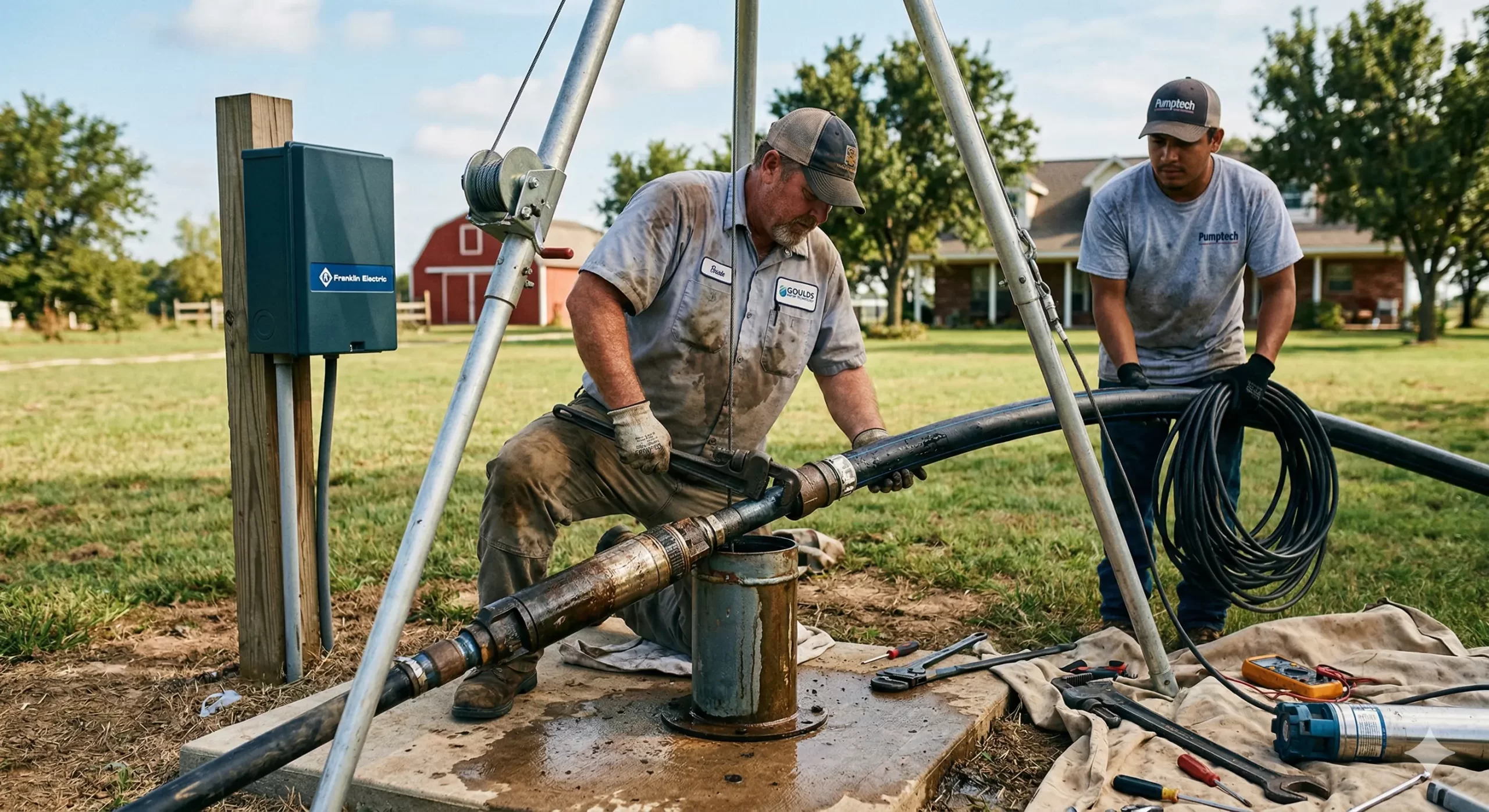
Once the motor’s electrical integrity is confirmed, the mechanical procedure of pulling the pump begins. This is a high-risk operation requiring specialized equipment. A hydraulic Pump Hoist (pulling rig) is positioned directly over the well casing. This rig provides the controlled power needed to safely lift a pump and pipe assembly that can weigh from 200 to over 1,000 pounds. After removing the sanitary well cap, the technician will use a large T-handle ‘Pitless Key’ to latch onto the pitless adapter inside the casing and disengage it. The entire assembly—pump, motor, drop pipe, safety rope, and power cable—is then carefully hoisted from the well, with the crew managing the pipe sections as they emerge.
With the pump assembly out of the well, the technician will add one or two 20-foot sections of drop pipe to achieve the new, deeper setting. The power cable is extended using a UL-listed submersible heat-shrink splice kit, a critical component that creates a permanent, waterproof seal. Standard electrical tape will fail underwater. A new, appropriately rated polypropylene safety rope is also attached. The entire assembly is then chlorinated for sanitation and carefully lowered back into the well, ensuring the pump does not get stuck (bridged) against the casing wall. The pitless adapter is re-seated, the well is capped, and the system is restarted. The technician will then monitor the VFD for stable amperage, measure the pumping water level, and calculate the well’s yield to ensure the problem is truly solved.
Safety Protocol
This repair must not be attempted by homeowners. The combination of high voltage (240V or higher), extreme weight suspended over a deep hole, and the risk of permanently damaging the well makes this a job exclusively for licensed professionals with proper insurance and equipment. Attempting to pull a deep-set pump by hand or with an inadequate vehicle can lead to loss of control, causing the entire assembly to fall down the well, potentially destroying the casing and requiring a new well to be drilled at a cost of tens of thousands of dollars.
Repair Cost & Time Assessment
The cost for a professional service call to address an F4 fault by lowering a submersible pump typically ranges from $1,200 to $2,500 in the United States. This price reflects a complex service involving significant liability and specialized equipment. The cost breakdown generally includes a service call fee, a mobilization fee for the pump hoist rig ($300-$500), and hourly labor for a two-person crew for 4 to 6 hours at a rate of $125-$175 per hour per technician.
Material costs are also a factor and will include new sections of schedule 120 PVC or galvanized steel drop pipe, a new submersible splice kit, additional footage of 10/3 or 12/3 submersible pump wire, and a new length of safety rope. The final price can be influenced by the pump’s depth, accessibility of the wellhead, and local labor rates. If the diagnostic megohmmeter test reveals that the motor is failed due to the dry run, the cost will increase substantially as it now involves the price of a new pump and motor assembly, which can add another $1,000 to $3,000+ to the total invoice.
Fast Local Service & Diagnostics
Calls are routed to a licensed local well professional.