
Diagnosis: A Franklin Electric Fhoton Solar Drive E1 error code indicates the DC bus voltage from the solar array has exceeded the drive’s maximum limit. This is often caused by a voltage surge during high solar irradiance events or an incorrectly configured PV array. Troubleshooting involves inspecting array wiring, verifying the open-circuit voltage (Voc), and performing a power cycle reset.
In this Guide:
What Causes the Franklin Electric Display E1 Issue?
The E1 fault code on a Franklin Electric Fhoton drive is a critical protective shutdown, signifying that the DC voltage supplied by the solar array has surpassed the engineered maximum threshold for the drive’s internal components. The physics behind this event is typically tied to solar irradiance and temperature. Photovoltaic panels produce a voltage (Voc – Open Circuit Voltage) that is inversely proportional to their temperature; on a cold, bright, sunny day, the Voc can be significantly higher than its rated value at standard test conditions. The most common trigger is an ‘edge-of-cloud’ effect, where a passing cloud suddenly clears, causing an instantaneous, massive spike in solar irradiance. This surge floods the drive’s DC bus capacitors with voltage faster than the motor can draw it down, forcing the controller to trip on an E1 fault to protect the sensitive inverter stage (IGBTs) from catastrophic failure due to over-voltage.
Repeated exposure to these high voltage spikes has a severe degrading effect on the entire electromechanical system. Within the Fhoton drive itself, the electrolytic capacitors on the DC bus are the first line of defense. Each overvoltage event stresses their dielectric material, leading to gradual breakdown, increased internal resistance, and eventual failure, often manifesting as swelling or leaking. For the submersible motor, the drive’s shutdown is protective, but the rapid voltage fluctuations stress the insulation of the motor windings. Over time, this can cause micro-fractures in the winding enamel, creating a pathway for a high-voltage short circuit to the motor casing (ground), especially if any moisture is present. This degradation is insidious and cumulative, leading to a premature motor failure that appears sudden but was developing over hundreds of fault cycles.
While the primary damage is electrical, the secondary mechanical stresses are also significant. Every E1 fault triggers an abrupt, non-controlled shutdown of the motor. This sudden stop causes the water column in the drop pipe to slam down against the pump’s check valve, inducing a powerful water hammer effect. This hydraulic shockwave reverberates through the entire system, stressing the drop pipe joints, pitless adapter, and most critically, the pump’s thrust bearing assembly. The bearings are designed for smooth starts and stops, not for the violent shock of an emergency shutdown. Likewise, internal seals and impellers experience sudden mechanical stress. Over time, these repeated shocks accelerate wear, reduce bearing lifespan, and can even lead to cracked impellers or a failed pump stack, turning a nuisance electrical fault into a major mechanical failure requiring a full pump replacement.
DIY Troubleshooting Steps
- SAFETY SHUTDOWN AND OBSERVATION: Before any physical inspection, execute a full Lockout/Tagout (LOTO) procedure on the solar array DC disconnect. Wear appropriate PPE, including insulated gloves and safety glasses. Document the exact conditions when the E1 fault occurs: time of day, cloud cover (e.g., clear sky, intermittent clouds), and ambient air temperature. This data is invaluable for diagnosing irradiance-related voltage spikes.
- INSPECT ARRAY WIRING AND TERMINATIONS: Conduct a thorough visual inspection of all wiring from the solar panel combiner box to the Fhoton drive’s DC input terminals. Check for loose connections, signs of corrosion on terminals, or evidence of arcing (black scorch marks). Ensure all terminations are tight and that polarity is correct (+ to + and – to -) throughout the entire DC circuit. A loose neutral or ground can cause floating voltages.
- MEASURE OPEN-CIRCUIT VOLTAGE (Voc): With the array disconnected from the drive, use a quality multimeter rated for at least 1000V DC to measure the Open-Circuit Voltage (Voc) of the array. Take this measurement during peak sun conditions, ideally replicating the environment that caused the fault. Compare this real-world Voc reading to the Fhoton drive’s maximum allowable DC input voltage specified in the installation manual. If the measured Voc is close to or exceeds the limit, the array is improperly configured.
- VERIFY ARRAY STRING CONFIGURATION: Physically count the number of solar panels connected in series in each string feeding the drive. Cross-reference this count with the original system design specifications and the pump/drive manual. Too many panels in series is the most common design flaw leading to chronic E1 faults, as the cumulative Voc of the string exceeds the drive’s limits, especially in cold weather.
- PERFORM A FULL POWER CYCLE RESET: After verifying wiring and confirming Voc is within an acceptable range under normal conditions, perform a hard reset. With the DC disconnect off, wait a minimum of 5-10 minutes to allow the drive’s internal capacitors to fully and safely discharge. Re-engage the DC disconnect and observe the drive’s startup sequence. Note if the E1 error clears.
- MONITOR DC BUS VOLTAGE POST-RESET: If the drive successfully restarts, use the drive’s built-in display to monitor the DC Bus Voltage in real-time. Watch this value closely as solar irradiance increases toward midday. If the voltage consistently climbs near the drive’s maximum limit, it confirms the array is producing excessive voltage and will require professional reconfiguration to prevent future faults.
When to Call a Professional Well Service
Upon arrival, a professional technician’s first step is advanced diagnostics using specialized equipment that goes far beyond a standard multimeter. The primary tool is a Megohmmeter, commonly referred to as a ‘Megger’. This instrument performs an insulation resistance test by applying a high DC voltage (typically 500V or 1000V) to the motor leads and drop cable. This test reveals any subtle breakdown or weakness in the insulation between conductors and ground, a condition often exacerbated by voltage surges. A low megohm reading indicates an impending motor failure or a compromised splice that requires pulling the pump. Additionally, a solar I-V curve tracer may be used to analyze the performance of each solar array string, identifying any mismatched panels, degradation, or internal faults that could contribute to voltage instability under load.
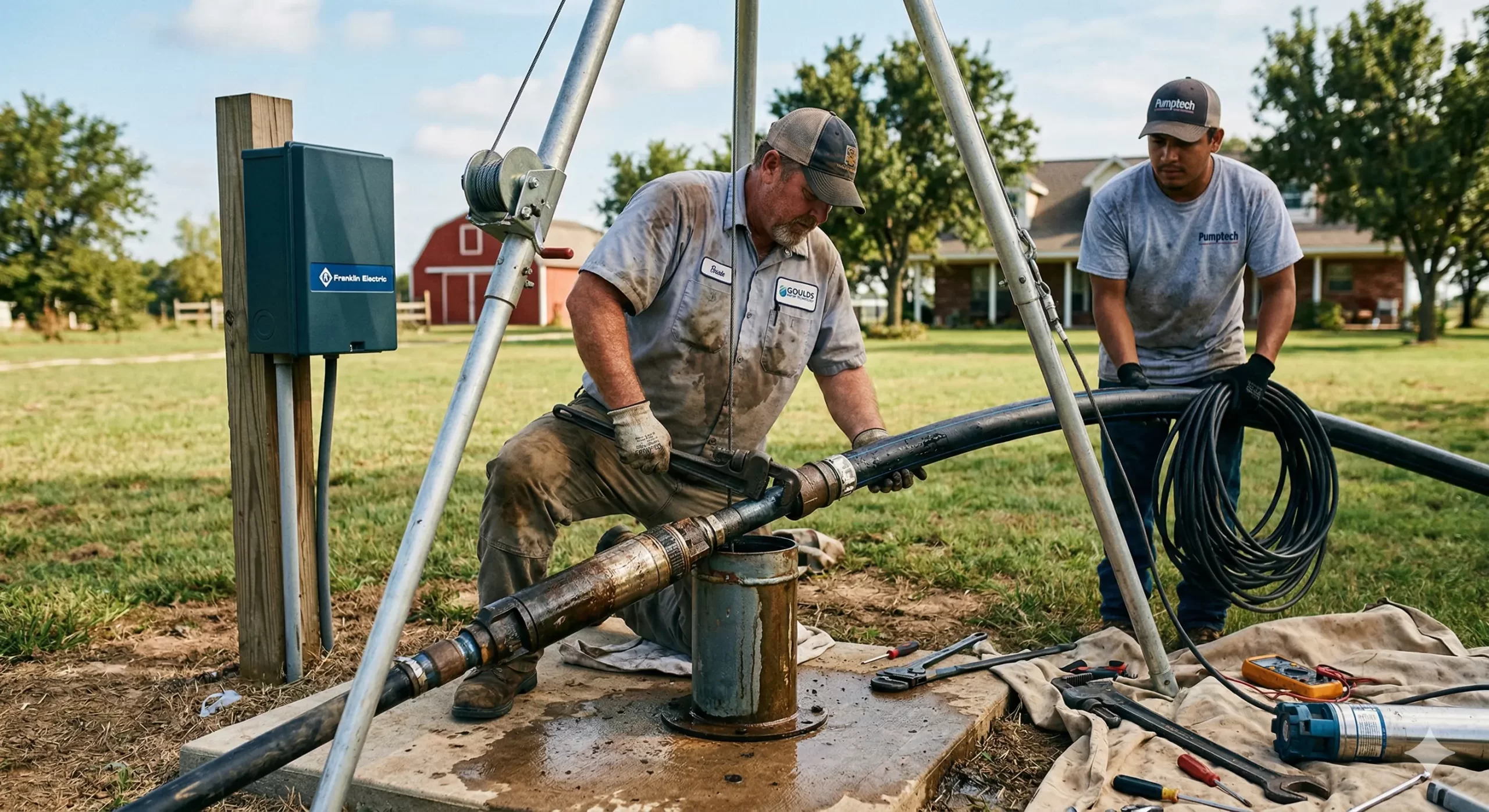
If the Megger test indicates a fault downhole, pump retrieval is necessary. This is an inherently dangerous operation requiring specialized heavy equipment and strict safety protocols. A technician will utilize a purpose-built Pump Hoist or a service truck with a hydraulic crane. The process begins by setting up the rig, securing the wellhead, and using a T-handle Pitless Key to engage and unlock the pitless adapter deep inside the well casing. This allows the entire assembly—pump, motor, drop pipe, and cable, often weighing over 500 pounds—to be lifted vertically and safely out of the well. Attempting this without a proper pulling rig is a recipe for catastrophic failure, potentially dropping the entire assembly down the well or causing severe personal injury.
Once the pump is at the surface, a full inspection and repair are conducted. A failed motor is replaced, and the drop cable is meticulously inspected for abrasions. Any splices are redone using premium, submersible-rated heat-shrink splice kits to ensure a permanent, watertight seal. If the downhole equipment tests clear, the technician will address the root cause: the solar array’s voltage. This often involves reconfiguring the array by changing the stringing from a high-voltage series configuration to a series-parallel layout. This adjustment lowers the total Voc to a safe level within the Fhoton drive’s operating window while maintaining the necessary wattage to power the pump effectively. After reinstallation and a successful pressure test of the system, all final operating parameters, including amperage draw and running DC voltage, are documented to validate the repair.
Safety Protocol
All work must comply with NFPA 70E standards for electrical safety. High-voltage DC from a solar array is exceptionally dangerous and cannot be simply switched off at a breaker. Technicians must use proper LOTO procedures at the array disconnect, wear arc-flash rated PPE as required, and use insulated tools. During pump pulling operations, a secure perimeter is established, and all personnel must wear hard hats, safety glasses, and steel-toed boots. The lifting equipment’s capacity and rigging must be verified before every lift.
Repair Cost & Time Assessment
The cost for resolving an E1 fault varies widely based on the underlying cause. For a simple diagnostic service call where the issue is a loose wire or requires a system reset and verification, a customer can expect to pay between $300 and $600. This typically covers 2-3 hours of a licensed technician’s time, travel expenses, and the use of standard diagnostic tools. The low difficulty of the suspected cause (wiring inspection) places the expected cost in this range if the problem is resolved at the surface without pulling the pump.
However, if diagnostics determine the pump must be pulled for motor testing or the solar array needs to be physically reconfigured, the cost escalates substantially. A full service involving a pump hoist or crane rig starts at approximately $1,800 and can easily exceed $4,500. This comprehensive price includes the mobilization of a pump rig ($500-$1,000 fee), a two-person crew for a full day (8-10 labor hours), and the cost of premium replacement parts like a new submersible motor ($900-$2,500+ depending on horsepower), new drop cable, or new stainless steel check valves. The customer is paying not just for parts and labor, but for the technician’s extensive experience, liability insurance, specialized equipment, and the warranty that accompanies a professional repair.
Fast Local Service & Diagnostics
Calls are routed to a licensed local well professional.