
Diagnosis: The Franklin Fhoton E2 error indicates Low DC Bus Voltage, caused by insufficient solar power from cloud cover, shade, or soiled panels. This is a protective shutdown. First, ensure panels are clean and unobstructed, then inspect wiring before calling a technician for advanced diagnostics.
In this Guide:
What Causes the Franklin Electric Display E2 Issue?
The ‘E2 – Low DC Bus Voltage’ fault on a Franklin Electric Fhoton Solar Drive is a protective mechanism designed to prevent damage to the motor and drive. In solar pumping, the variable frequency drive (VFD) requires a minimum DC voltage from the photovoltaic (PV) array to properly rectify and invert power for the 3-phase submersible motor. This voltage is directly proportional to solar irradiance. The error is triggered when this input voltage drops below a preset operational threshold, a condition most often caused by environmental factors such as heavy cloud cover, early morning or late evening sun angle, or physical obstructions like dust, snow, or new shading from tree growth. Less common but more critical causes include a compromised wire, a failed bypass diode in a panel, or a high-resistance connection, all of which create a voltage drop before the power reaches the drive.
From an engineering perspective, attempting to run a motor under low-voltage conditions is highly detrimental. According to the power formula (Power = Voltage × Current), to maintain the necessary wattage to start the pump and lift water, a drop in voltage must be compensated by an increase in current (amperage). This excess current generates significant heat (I²R losses) in the motor windings. While the Fhoton drive is designed to prevent a full-on stalled start, repeated attempts under low-light conditions can still cause thermal stress, gradually degrading the winding’s enamel insulation. Over time, this thermal cycling can lead to micro-fractures in the insulation, creating a pathway for a turn-to-turn short or a phase-to-ground fault, ultimately causing catastrophic motor failure.
The hydraulic pump end is also subjected to damaging forces during low-power operation. Submersible pumps are designed to operate at a specific speed (RPM) to achieve their Best Efficiency Point (BEP). When the drive provides insufficient power due to an E2 condition, the motor turns the pump at a much lower, unstable RPM. This off-BEP operation creates hydraulic instability, leading to significant radial and axial thrust on the impeller stack and shaft. The increased vibration and unbalanced loads accelerate wear on the pump’s bearings and thrust washers. Furthermore, the internal mechanical seals, which rely on proper rotation and pressure to function correctly, can be compromised, leading to internal recirculation, loss of efficiency, and eventual seizure of the pump assembly.
DIY Troubleshooting Steps
- Perform a Thorough Visual Inspection of the Solar Array: Carefully examine every solar panel. Look for accumulated dirt, dust, bird droppings, leaves, or snow, as these will significantly reduce output. Note any new sources of shading, such as tree growth or new construction, that may be blocking the sun during key hours of the day. Even partial shading on a single panel can drastically reduce the voltage of the entire series string.
- Correlate Faults with Weather and Time of Day: Access the drive’s fault log. If the E2 error occurs exclusively during heavily overcast days, or in the first and last hours of sunlight, the cause is almost certainly environmental and not an equipment failure. This is normal behavior as the system waits for sufficient power.
- Conduct a System Shutdown and Wiring Check: Following proper safety protocol, de-energize the system at the main AC/DC disconnects. Open the solar combiner box and the drive’s wiring compartment. Check every terminal for tightness. Look for any signs of corrosion, discoloration from overheating, or water intrusion. A loose connection acts as a resistor, causing a voltage drop.
- Verify PV Disconnect and Breaker Integrity: Manually operate the main DC disconnect switch several times to ensure it engages firmly. A worn or corroded internal contact in a disconnect or circuit breaker can introduce high resistance and is a common, often overlooked, point of failure.
- Monitor Live DC Bus Voltage in Full Sun: On a clear, sunny day near solar noon, access the Fhoton drive’s display menu to monitor the ‘DC Bus Voltage’. Compare this real-time reading to the expected voltage for your array’s configuration (sum of Voc ratings for panels in series). If the voltage is significantly lower than expected in ideal conditions, it points toward a hardware problem rather than a lack of sun.
- Inspect Array Grounding and Conduits: Visually trace the equipment grounding conductor from the array racking back to the ground rod. Check that conduits are properly sealed and that no wires are exposed or physically damaged by weather or animals, which could cause a partial short to ground.
When to Call a Professional Well Service
Upon arrival, a professional technician will immediately move beyond visual checks and employ specialized diagnostic equipment. The first step is to isolate the PV array and use a CAT III/IV rated multimeter and a solar clamp meter to measure the Open Circuit Voltage (Voc) and Short Circuit Current (Isc) of each individual string. These measurements are compared against the panel manufacturer’s specifications, adjusted for the current ambient temperature and solar irradiance (measured with a solar irradiance meter). This test definitively determines if the array is producing the correct amount of power. A string showing low Voc suggests a failed panel or a wiring issue within that string, while low Isc might indicate severe soiling or a high-resistance connection.
If the array’s output is low, the next diagnostic tool is a Megohmmeter, commonly known as a ‘Megger’. This instrument applies a high DC voltage (typically 500V-1000V for solar applications) to the conductors to test their insulation resistance. The technician will test the resistance between the positive and negative conductors, and between each conductor and ground. A low megohm reading indicates an insulation breakdown or a ground fault somewhere in the wiring between the array and the drive. This is a critical failure point that can cause not only low voltage but also a significant fire and safety hazard. The Megger can pinpoint faults that are invisible to a standard multimeter.
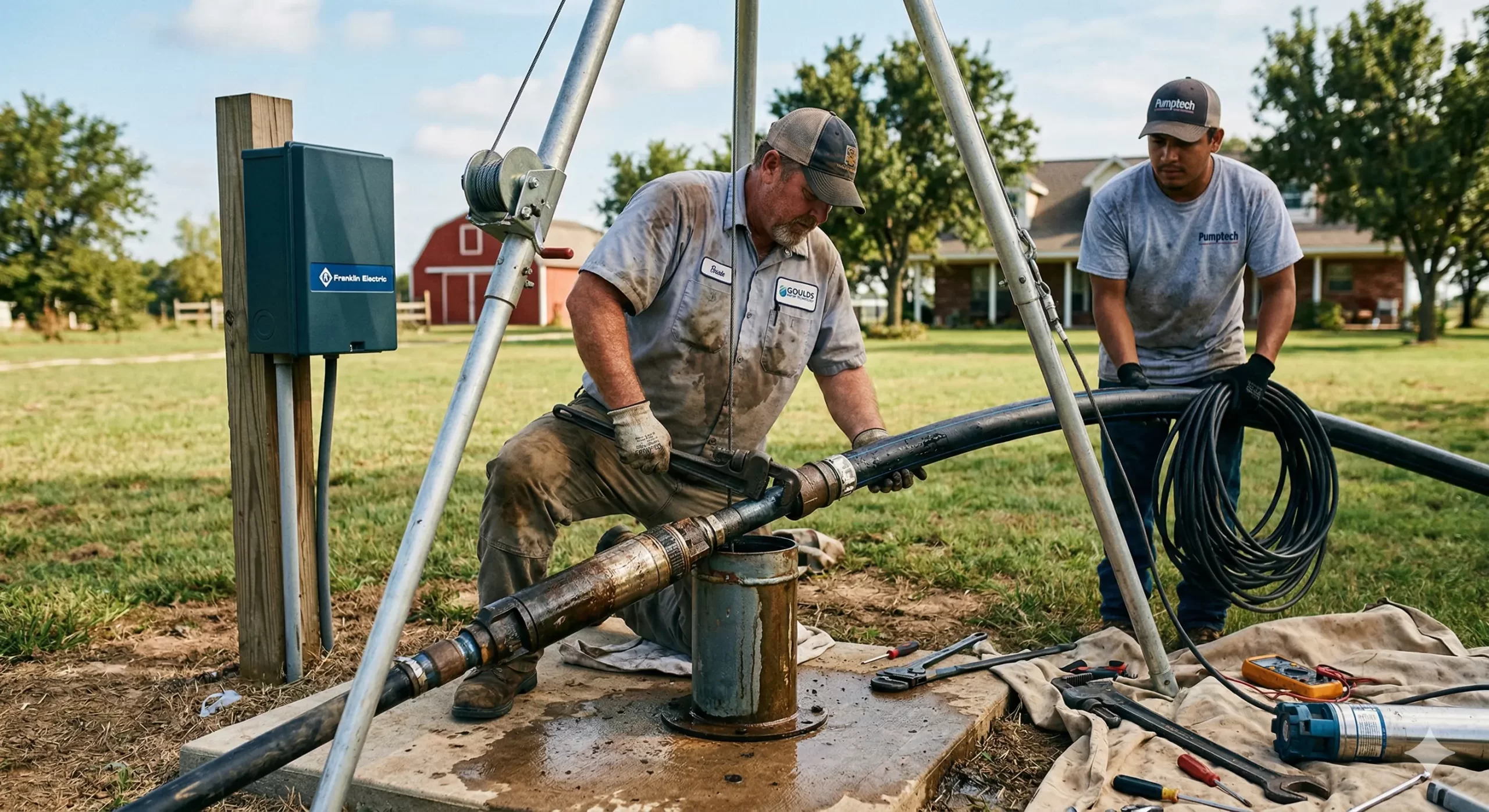
Safety Protocol: In the event the array and surface wiring test perfectly, the fault may lie with the downhole motor or drop cable. This requires pulling the pump. Any professional operation will involve a dedicated pump hoist or pulling rig. A submersible pump, along with hundreds of feet of water-filled pipe and cable, can weigh from 300 to over 1000 pounds. Attempting a manual pull is reckless and risks injury, equipment damage, or dropping the entire assembly down the well. The technician will follow strict lockout/tagout (LOTO) procedures, don arc-flash rated personal protective equipment (PPE), and use a specialized Pitless Key to safely disconnect the assembly from the wellhead before beginning the hoisting operation.
Repair Cost & Time Assessment
The cost for resolving an E2 fault varies widely based on the root cause. For a basic service call where the issue is environmental (dirty panels) or a simple fix like tightening a loose terminal in a combiner box, a customer can expect to pay between $300 and $600. This fee typically covers a trip charge and 1-2 hours of a licensed technician’s diagnostic time, including the use of standard multimeters and hand tools.
If the diagnosis reveals a more severe hardware failure, costs escalate. Replacing a single damaged solar panel can cost $500 to $900, including the panel itself and labor. If a Megohmmeter test identifies a ground fault in the underground wiring from the array to the wellhead, locating and repairing that wire could involve trenching and run into the thousands. Should the fault be traced to the submersible motor itself, the cost for a pump pulling rig service alone is often $1,000 to $2,500, depending on well depth and site access. This is before the cost of the replacement motor, splices, and the several hours of labor required for the replacement, which can bring the total repair cost to well over $4,000.
Fast Local Service & Diagnostics
Calls are routed to a licensed local well professional.