
Diagnosis: A Franklin Electric SubDrive or MonoDrive flashing 4 times indicates an overheated controller, not the motor. This is often caused by direct sun exposure, poor ventilation, or a blocked heat sink. Immediate fixes include providing shade and cleaning the unit, but it can also signal a deeper issue like a failing pump motor that is overloading the drive.
In this Guide:
What Causes the Franklin Electric Flashes 4 times (Мигает 4 раза) Issue?
The 4-flash fault code on a Franklin Electric SubDrive or MonoDrive is a specific thermal protection trigger for the controller itself, not the downhole motor. These controllers are sophisticated Variable Frequency Drives (VFDs) that utilize power electronics, primarily Insulated-Gate Bipolar Transistors (IGBTs), to convert incoming single-phase AC power into three-phase DC, and then synthesize a variable-frequency AC waveform to precisely control motor speed. This conversion process is inherently inefficient and generates significant heat. The controller’s large, finned aluminum heat sink is engineered to passively dissipate this thermal load into the ambient air. When the controller is installed in direct sunlight, especially on a south- or west-facing wall in hot climates, the solar gain can elevate the unit’s core temperature beyond its design limits (often 160-185°F / 70-85°C). The internal thermistor detects this critical temperature and triggers a protective shutdown to prevent the permanent failure of the sensitive IGBTs and electrolytic capacitors, which are highly susceptible to heat damage.
While environmental factors are the primary cause, the controller can also overheat due to excessive electrical load. A failing submersible motor down in the well, suffering from worn bearings, sand abrasion, or the initial stages of a winding insulation failure, will draw significantly more amperage to perform the same amount of work. This increased current demand forces the VFD’s power components to work much harder, which quadratically increases their heat generation (Power Loss ≈ I²R). The heat sink, potentially already compromised by high ambient temperatures, becomes completely overwhelmed by this combined internal and external thermal load. In this scenario, the 4-flash code is a critical symptom of a severe downhole problem. The controller is effectively sacrificing its operational uptime to protect the motor from a catastrophic burnout, alerting the owner to a mechanical or electrical issue that requires immediate professional attention.
Finally, poor installation practices and lack of maintenance are common culprits. Mounting the controller within a small, unventilated enclosure or pump house creates a convection oven effect, where the unit’s own waste heat cannot escape, leading to a rapid temperature rise. Similarly, the heat sink fins can become clogged with dust, cobwebs, leaves, or insect nests. This debris acts as an insulating blanket, severely restricting airflow and preventing proper heat dissipation. Over years of service, the thermal interface material (thermal paste) between the electronic components and the heat sink can dry out and degrade, reducing its conductivity and creating thermal bottlenecks. Any of these factors can reduce the system’s thermal resilience, causing a 4-flash fault even on moderately warm days under normal operating loads.
DIY Troubleshooting Steps
- Assess the Immediate Thermal Environment: Check if the controller is mounted in direct sunlight or on a surface that gets extremely hot. As a temporary measure, create shade for the unit with a piece of plywood or a tarp (ensure it doesn’t block airflow) and see if the fault clears after a 30-60 minute cool-down period. Never spray water on a hot electronic device.
- Perform a Power-Off Visual Inspection and Cleaning: Turn off the dedicated two-pole breaker supplying power to the system. Carefully inspect the aluminum heat sink fins on the back and sides of the controller. Use a soft-bristled brush and compressed air to meticulously clean out any accumulated dust, dirt, cobwebs, or insect nests that are impeding airflow.
- Verify Proper Clearances and Ventilation: Confirm that the controller is installed with the manufacturer-recommended clearances (typically 6-12 inches on all sides) to allow for natural convection cooling. If it’s inside a pump house or enclosure, ensure that ventilation ports are open, unobstructed, and sufficiently large.
- Execute a Full Power Cycle Reset: After the unit has completely cooled, perform a hard reset. With the breaker still off, wait a full 5 minutes to allow the internal capacitors to safely discharge. Then, restore power and observe the controller’s status lights. Note if the fault returns immediately (indicating a persistent hardware issue) or only after the pump has been running for some time (indicating a heat build-up problem).
- Monitor System for Short-Cycling: Pay close attention to the pump’s run cycles. If the pump is turning on and off every minute or two, this is known as short-cycling. It is often caused by a failed or water-logged pressure tank and places immense thermal stress on the controller’s electronics from repeated high-current motor starts, which can lead to overheating.
- Listen at the Wellhead: During the brief moments the pump runs before faulting, listen at the wellhead for any abnormal sounds. Grinding, rattling, or heavy rumbling can indicate failing pump bearings or a motor that is struggling against an obstruction, both of which cause an over-current condition that will overheat the controller.
When to Call a Professional Well Service
Upon arrival, a certified pump technician will begin with a comprehensive electrical diagnosis to differentiate between an environmental issue and a more severe downhole failure. Using a true-RMS clamp-on ammeter, they will measure the amperage draw on each of the three motor leads (T1, T2, T3) at the controller’s output terminals. An amperage reading that is excessively high, unbalanced between phases, or immediately pegs the meter upon startup is a strong indicator of a failing motor. The definitive diagnostic test involves using a Megohmmeter, or ‘Megger’. The technician will disconnect the motor leads from the controller and perform an insulation resistance test, applying 500 or 1000 volts to check for electrical leakage between the motor windings and ground. A healthy motor and drop cable will read hundreds or thousands of megohms; a reading below 2 megohms signifies a critical insulation failure requiring the pump to be pulled.
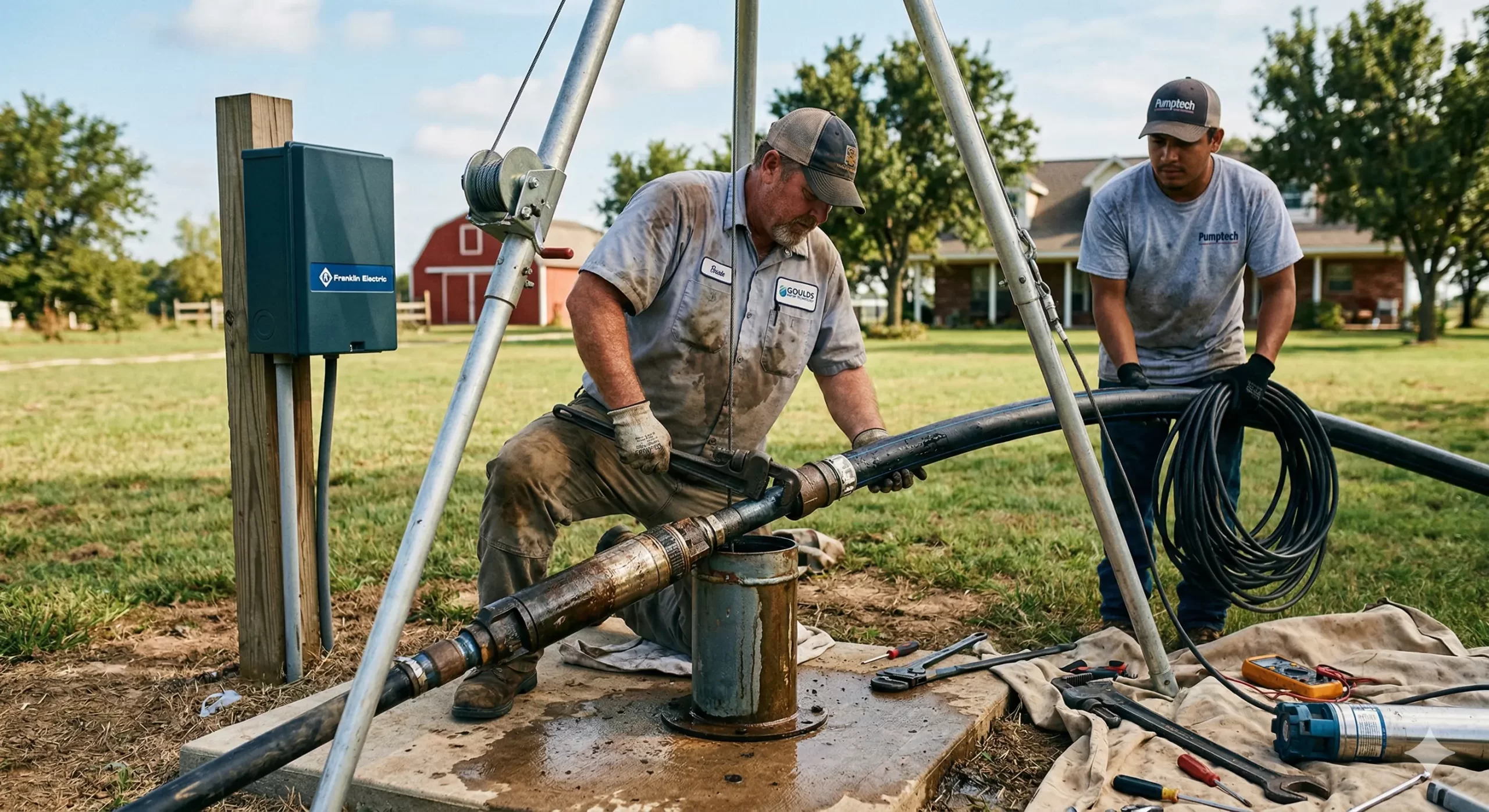
If diagnostics confirm a downhole fault, the pump assembly must be pulled from the well—a task that is both physically demanding and electrically hazardous. A professional crew will use a dedicated pump hoist or pulling rig. This specialized hydraulic or electric crane is essential for safety and to prevent damage, as a deep-set pump assembly can weigh hundreds of pounds and cannot be safely lifted by hand. The technician will employ a pitless adapter key, a long T-handle tool, to disengage the pump from the home’s water line deep inside the well casing without any excavation. This entire procedure is performed under strict Lockout/Tagout (LOTO) safety protocols, ensuring the 240V circuit is de-energized and cannot be accidentally switched on while technicians are handling the equipment.
Once the pump is on the surface, the failure can be physically confirmed—seized impellers, a burnt motor winding smell, or visible damage. The standard professional repair is a full replacement of the submersible motor and often the pump end (‘wet end’) as well. The electrical connection between the new motor and the existing drop cable is made with a high-quality, submersible heat-shrink splice kit to create a durable, waterproof seal critical for long-term reliability. After carefully lowering the new pump back into the well, the technician will repeat the Megohmmeter and amperage tests to verify that all electrical readings are within the manufacturer’s specifications. Finally, they will address the original cause of the controller fault by recommending a permanent solution, such as relocating the controller to a shaded, north-facing wall or installing it inside a properly ventilated, weatherproof enclosure to prevent future thermal shutdowns.
Repair Cost & Time Assessment
The financial outlay to resolve a 4-flash ‘Overheated Controller’ fault code varies widely depending on the underlying cause. For a simple environmental issue, the cost will be limited to a standard service call. This typically ranges from $175 to $400 in the US, covering 1-2 hours of a qualified technician’s time to diagnose the problem, thoroughly clean the controller’s heat sink, and potentially install a simple sun shield. If the controller itself has failed due to repeated thermal stress, replacing the SubDrive/MonoDrive unit alone can cost between $900 and $2,000 for parts and labor.
In the more common scenario where the controller’s overheating is a symptom of a failed submersible motor, the project becomes a major repair with significantly higher costs. A complete pump and motor replacement for a typical residential well can range from $2,000 to $5,000+. This comprehensive price includes the initial diagnostic fee, a charge for mobilizing and using the pump pulling rig ($350 – $650), the cost of the new pump and motor (which varies by horsepower and brand, from $600 to $2,500), and several hours of intensive labor for a two-person crew ($1,000 – $2,000). The total time for such a job is typically 4 to 8 hours, contingent on the well’s depth, accessibility, and any complications encountered during the pulling process.
Fast Local Service & Diagnostics
Calls are routed to a licensed local well professional.