
Diagnosis: A Franklin Electric SubDrive ‘2 Flashes’ error code signifies a critical output fault due to a short circuit. This is most often caused by a failed waterproof cable splice or abrasion of the submersible cable against the well casing, leading to a phase-to-phase or phase-to-ground short. A professional repair involves pulling the pump and performing a megohmmeter test to locate and repair the compromised wiring.
In this Guide:
What Causes the Franklin Electric Flashes 2 times (Мигает 2 раза) Issue?
The ‘2 Flashes’ fault code on a Franklin Electric SubDrive is the controller’s self-preservation mechanism against a high-amperage short circuit event. From an engineering perspective, the Variable Frequency Drive (VFD) is designed to constantly monitor the current flowing through its Insulated Gate Bipolar Transistors (IGBTs) to the three-phase submersible motor. When insulation on the motor’s power cable is breached—either between phases or from a phase to ground—it creates a low-resistance path. Per Ohm’s Law (I = V/R), as resistance (R) approaches zero, the current (I) spikes to a potentially destructive level. The drive’s logic detects this near-instantaneous surge and trips the output in microseconds to prevent the IGBTs from exploding.
The two most common physical causes for this electrical failure occur downhole. The first is a breakdown of a waterproof splice. A submersible pump installation requires at least one splice between the motor’s short leads and the main drop cable. If this splice was installed with any contamination (dirt, skin oils) or insufficient heat during the heat-shrink process, mineralized well water can eventually ingress. This water creates a conductive path, leading to a short. The second common cause is cable abrasion. Over years of operation, the torque from the motor starting and stopping can cause the power cable to rub against the rough steel well casing. This constant friction wears through the cable’s outer jacket and inner insulation, eventually exposing the copper conductors and causing a direct short against the grounded casing.
While the VFD is designed to protect itself, the underlying fault can still damage the motor. Each short circuit event sends a high-voltage, high-current transient down the line. This can stress the motor’s internal winding insulation, which is a thin enamel coating on the copper wires. Repeated faults can lead to a ‘pinhole’ breakdown in this enamel, causing an internal, non-repairable motor short. Furthermore, a powerful arc from a dead short can superheat the surrounding water, creating a steam pocket and a concussive force. While rare, this pressure wave can stress the motor’s mechanical seals or thrust bearing assembly, although the primary failure is almost always the electrical path itself long before mechanical damage is evident.
DIY Troubleshooting Steps
- Perform a Full Power Cycle: Shut off the dedicated double-pole breaker for the pump system in your main electrical panel. Leave it off for at least 15 minutes. This allows the drive’s internal capacitors to fully discharge and its microprocessor to reset, clearing any transient software glitches.
- Visual Inspection at Wellhead: Carefully inspect the wiring entering the well cap. Look for any signs of physical damage, rodent chewing on conduits, corrosion on terminals, or evidence of moisture inside the well cap’s junction area. A burnt smell is a definitive sign of a problem.
- Isolate the Motor from the Drive: Turn the power OFF at the breaker. At the SubDrive controller, use an insulated screwdriver to disconnect the three motor output leads (labeled U, V, W) and the ground wire. Ensure the disconnected wires are separated and not touching each other or any metal part of the controller chassis.
- Test the Drive Independently: With the motor leads still disconnected, turn the breaker back ON. If the ‘2 Flashes’ fault code disappears and is replaced by a different code (e.g., ‘Open Circuit’, ‘No Load’, or ‘Dry Well’), you have successfully confirmed the fault exists downstream in the wiring or the motor itself. If the ‘2 Flashes’ fault persists with nothing connected, the drive itself has a failed output stage and requires replacement.
- Basic Multimeter Resistance Check (Power OFF): Ensure power is off. Set your multimeter to the lowest Ohms (Ω) setting. Measure the resistance between the disconnected motor leads: U to V, V to W, and U to W. The readings should be very low (typically 0.5-5 ohms) and, most importantly, nearly identical to each other. A reading of zero indicates a dead short between phases.
- Basic Insulation Check to Ground (Power OFF): Set your multimeter to the highest Ohms (MΩ) setting. Measure the resistance from each motor lead (U, V, and W) to the ground wire. A healthy motor and cable will read ‘O.L.’ or infinite resistance. Any reading, even in the thousands or millions of ohms, suggests an insulation leak and is a likely cause of the fault.
When to Call a Professional Well Service
Upon arrival, a qualified pump technician will first verify the fault code and perform a definitive diagnostic test that goes beyond the capabilities of a standard multimeter. Using a megohmmeter (often called a ‘Megger’), they will perform an insulation resistance test. This instrument applies a high DC voltage (typically 500V or 1,000V) to the motor circuit to test the integrity of the cable and motor winding insulation under load. The technician will test from each phase to ground and between each phase. An industry-standard ‘pass’ is a reading of several hundred, if not thousands, of megohms. A reading below 2 megohms confirms a serious insulation failure and necessitates pulling the pump from the well for physical inspection and repair.
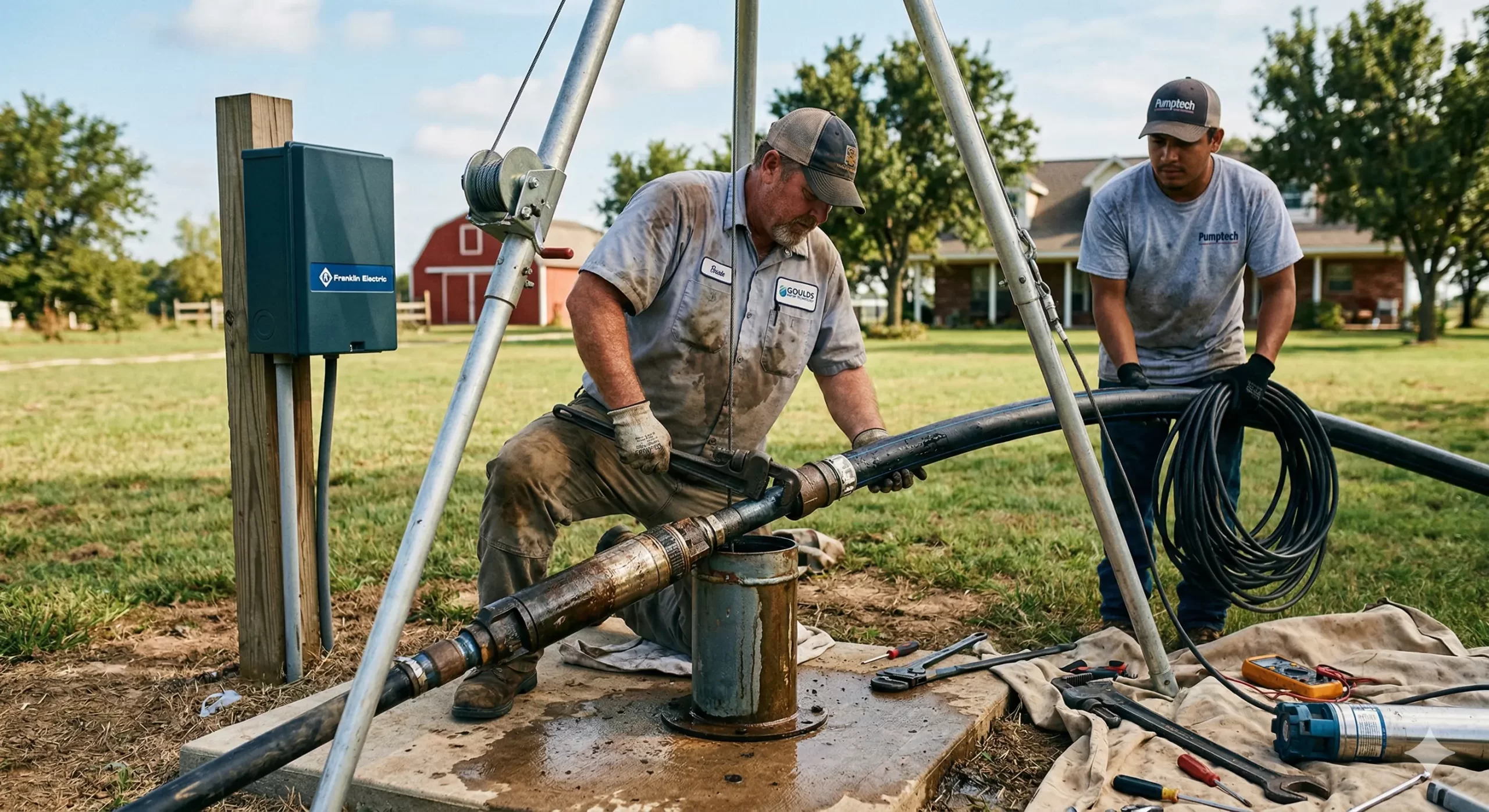
The pump pulling process is a specialized and hazardous operation. A submersible pump, motor, and hundreds of feet of water-filled pipe can weigh over 500 pounds, making it impossible and unsafe to pull by hand. The technician will position a dedicated pump hoist or crane truck over the wellhead. After removing the well cap, they will use a T-handle pitless adapter key to engage and unlock the pump assembly from the pitless adapter located inside the casing below the frost line. The entire assembly is then carefully hoisted from the well, with a second technician guiding the pipe and cable to lay them out straight on the ground, preventing kinks or additional damage.
Safety Protocol
This work involves a high-voltage 240V system and extremely heavy equipment. Technicians will always perform a lock-out/tag-out (LOTO) procedure on the circuit breaker to ensure power cannot be accidentally restored. They will wear appropriate Personal Protective Equipment (PPE), including steel-toed boots and heavy-duty gloves. The hoist equipment must be properly rated for the load and positioned on stable ground to prevent tipping. Handling the pipe and pump requires training to avoid pinch points and crushing injuries.
Once the pump is on the surface, the technician will meticulously inspect the entire length of the drop cable, paying close attention to any splices. The failure point is often visually obvious—a burnt, swollen, or abraded section of cable. The damaged section is professionally excised. A new, high-quality waterproof heat-shrink splice kit is then installed. This is a critical procedure involving precise stripping, cleaning of conductors, and systematic application of sealant-lined heat-shrink tubes to create a multi-layered, permanent, and fully submersible seal. After the splice is complete, a final Megger test is performed to confirm the integrity of the repair before the pump is carefully lowered back into the well and re-engaged with the pitless adapter.
Repair Cost & Time Assessment
The cost for a professional service call to diagnose and repair a short circuit fault typically ranges from $850 to $2,200 in the United States. This price reflects the specialized nature of the work. The primary cost drivers are labor and equipment mobilization. This is often a two-person job requiring 3 to 5 hours on-site, and the fee includes the dispatch of a service truck equipped with a hydraulic pump hoist or crane, which is a significant operational expense.
The final invoice is influenced by several variables. The well depth is the most significant factor; a 500-foot well requires far more time and labor to pull and reinstall than a 100-foot well. The cost of materials, such as a premium-grade heat-shrink splice kit from a manufacturer like 3M or Franklin Electric, also contributes. If the initial megohmmeter test reveals that the motor windings are internally shorted (a non-repairable condition), the job will escalate from a wire repair to a full pump and motor replacement, which would substantially increase the cost beyond this initial estimate. Emergency or after-hours service will also command a premium rate.
Fast Local Service & Diagnostics
Calls are routed to a licensed local well professional.