
Diagnosis: Franklin Electric Cerus X-Drive Fault 4 indicates an Underload or ‘Dry Well’ condition, where the motor is not working hard enough because it is no longer pumping water. This is typically caused by the static water level in the well dropping below the pump’s intake, requiring a professional to lower the pump deeper into the aquifer.
In this Guide:
What Causes the Franklin Electric Fault 4 Issue?
The primary engineering cause for a Fault 4 (Underload) on a Cerus X-Drive is a significant drop in the static water level within the aquifer, causing the pump intake to be exposed to air. A Variable Frequency Drive (VFD) like the X-Drive continuously monitors the motor’s power consumption (amperage). When a submersible pump is fully submerged and moving water, the motor operates under a specific, predictable load. If the water level drops and the pump begins to cavitate or ‘run dry,’ the impellers are no longer pushing against the dense column of water. This drastically reduces the required torque, causing the motor’s amperage draw to plummet. The X-Drive’s sophisticated protection algorithms detect this drop below a pre-set threshold and trip on Fault 4 to prevent catastrophic equipment failure.
When a submersible pump runs without water, two critical failure cascades begin simultaneously. First, the motor windings, which rely on the surrounding well water as their primary heat sink, begin to overheat almost immediately. The enamel insulation on the copper windings can rapidly degrade, leading to turn-to-turn shorts. If left unchecked, this thermal runaway will cause a complete burnout of the motor, resulting in a ground fault and a total loss of the unit. The VFD’s underload protection is specifically designed to preempt this thermal destruction, serving as the last line of defense against a multi-thousand-dollar motor replacement.
Second, the pump end itself suffers severe mechanical damage. Submersible pumps use the water they are pumping as lubrication for the shaft bearings and as a medium to cool the impeller wear rings and seals. Without water, these precision-machined components experience extreme frictional heating and galling. The stainless steel shaft can seize within the bearings, and the thermoplastic or stainless steel impellers can warp or disintegrate. The internal mechanical seals, designed for a wet environment, will overheat, lose their integrity, and fail. This sequence of mechanical self-destruction happens within minutes of running dry and often renders the entire pump end irreparable.
DIY Troubleshooting Steps
- Confirm the Fault and Parameters on the Drive: Do not immediately reset the drive. Go to the Cerus X-Drive’s display panel. Verify that the active fault is indeed ‘F4’ or ‘Underload’. Navigate to the monitoring menu to view the real-time amperage draw. A reading that is significantly below the motor’s nameplate Full Load Amps (FLA) confirms the underload condition.
- Perform a Single, Cautious Reset After a Cool-Down Period: Power down the entire system at the circuit breaker for at least 30-60 minutes. This allows the motor to cool and, more importantly, allows the well’s static water level time to potentially recover. Power the system back on and attempt ONE restart. If it immediately faults again, do not continue to cycle the pump; this will cause permanent damage.
- Listen at the Wellhead: During a brief restart attempt, listen carefully at the wellhead. A healthy pump has a smooth, consistent hum. A pump running dry may produce gurgling sounds, the sound of cascading water falling back down the well, or a high-pitched whirring noise as it spins freely without load.
- Inspect Pressure Tank and Switch Operation: Check your pressure tank’s air charge using a tire gauge; it should be 2 PSI below the cut-in pressure of your pressure switch. A waterlogged tank can cause rapid cycling, which can exacerbate drawdown issues in a low-yield well. Ensure the pressure switch contacts are clean and functioning correctly.
- Check Breakers and Thermal Overloads: While not a direct cause of Underload, ensure the main circuit breaker is fully engaged and any external thermal overload protection (if installed) has not tripped and is properly calibrated.
- Review VFD Underload Settings: For advanced users only. Enter the X-Drive’s programming menu to view the underload trip point (Amps) and trip delay (seconds). Do not change these unless you are a qualified technician, but note the values. If they are set unusually high, it could indicate a previous misconfiguration, though this is unlikely to be the cause of a new, sudden issue.
When to Call a Professional Well Service
Upon arrival, a certified technician’s first step is to confirm the diagnosis using specialized instrumentation. They will use a true-RMS clamp-on ammeter at the control panel to independently verify the low current draw that triggered the VFD’s Fault 4. The next crucial diagnostic is an insulation resistance test. Using a Megohmmeter (often called a ‘megger’), the technician will test the integrity of the motor windings and drop cable from the surface. By applying a high voltage (500-1000V) and measuring the resistance in megaohms, they can determine if the motor has already suffered heat damage before committing to the labor-intensive process of pulling it. This test definitively differentiates between a true dry well condition and a failing motor that is coincidentally drawing low current.
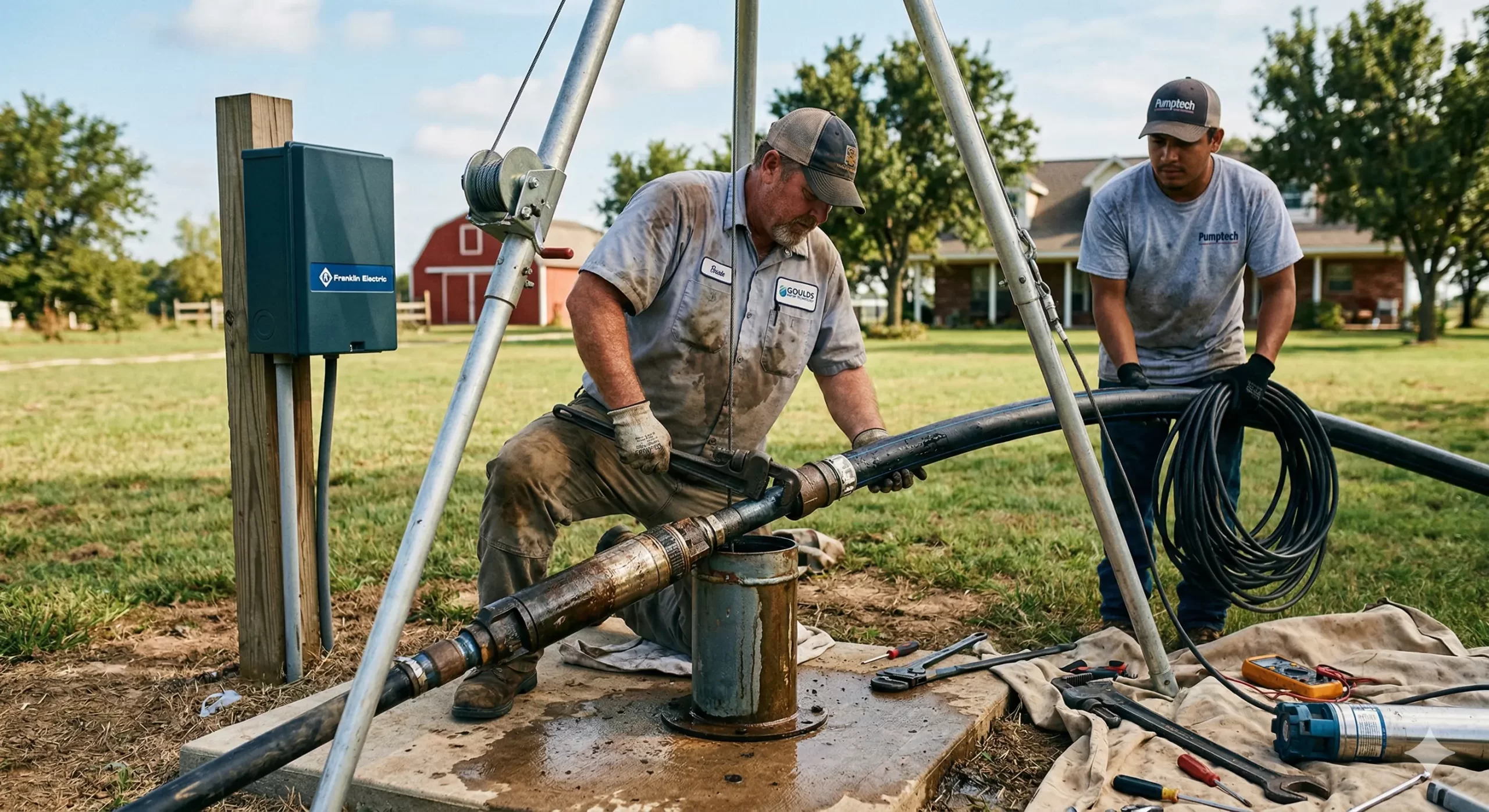
Once a low water level is confirmed as the cause, the pump must be pulled from the well. This is a hazardous operation requiring specialized equipment and strict safety protocols. A heavy-duty pump hoist or a dedicated pulling rig is mandatory. A typical 4-inch submersible pump assembly with hundreds of feet of water-filled drop pipe and power cable can weigh over 500 pounds. The technician will utilize a pitless adapter key, a long T-handle tool, to safely disengage the pump assembly from its connection point inside the well casing below the frost line. This avoids excavating the yard and allows the entire assembly to be lifted vertically through the casing.
Safety Protocol
This procedure is non-negotiable. The technician will perform a full lockout/tagout (LOTO) on the 240V circuit breaker, ensuring the system is de-energized and cannot be accidentally switched on. The wellhead area will be secured, and all personnel will wear appropriate PPE, including hard hats, steel-toed boots, and gloves. The pulling rig must be properly stabilized to handle the immense static and dynamic loads during the lift. Attempting this without the proper rig and safety knowledge can lead to a dropped pump (a catastrophic and often unrecoverable event), severe personal injury, or electrocution.
With the pump safely on the surface, the technician will measure its current setting depth. By referencing the original well driller’s report, they can determine the well’s total depth and the original static water level. The solution is to add one or more sections of drop pipe (typically 20-foot lengths of heavy-wall PVC or galvanized steel) to lower the pump deeper into the well, well below the new, lower static water level. This requires extending the power cable with a professional-grade, submersible heat-shrink splice kit to create a permanent, waterproof connection. After re-installation, the system is started, and the VFD’s settings are fine-tuned to match the new, deeper operating conditions, ensuring the underload protection is recalibrated for reliable performance.
Repair Cost & Time Assessment
The cost for a professional repair of a Fault 4 (Dry Well) condition typically ranges from $1,500 to $4,500 in the United States. This price reflects a complex and labor-intensive job that requires specialized equipment and at least two certified technicians for safety and efficiency. The service call can take anywhere from 4 to 8 hours to complete, depending on the depth of the well and any complications encountered.
The customer is paying for several key components. Labor constitutes a significant portion, covering the time of two highly skilled technicians. A crucial line item is the ‘Pump Hoist Surcharge’ or ‘Rig Fee,’ which covers the transportation and use of the heavy-duty pulling equipment essential for the job’s safety and success. Material costs include new sections of high-quality drop pipe (e.g., Schedule 120 PVC or galvanized steel), new stainless steel safety cable, and critically, professional-grade submersible heat-shrink splice kits for the power cable extension. These are not commodity items and are vital for long-term reliability.
It is important to note that this cost estimate assumes the existing pump and motor are undamaged. If the dry-running condition was severe enough to burn out the motor or destroy the pump end, the cost will increase substantially to include the price of a new Franklin Electric pump and motor, which can add an additional $1,200 to $3,000+ to the final invoice.
Fast Local Service & Diagnostics
Calls are routed to a licensed local well professional.